
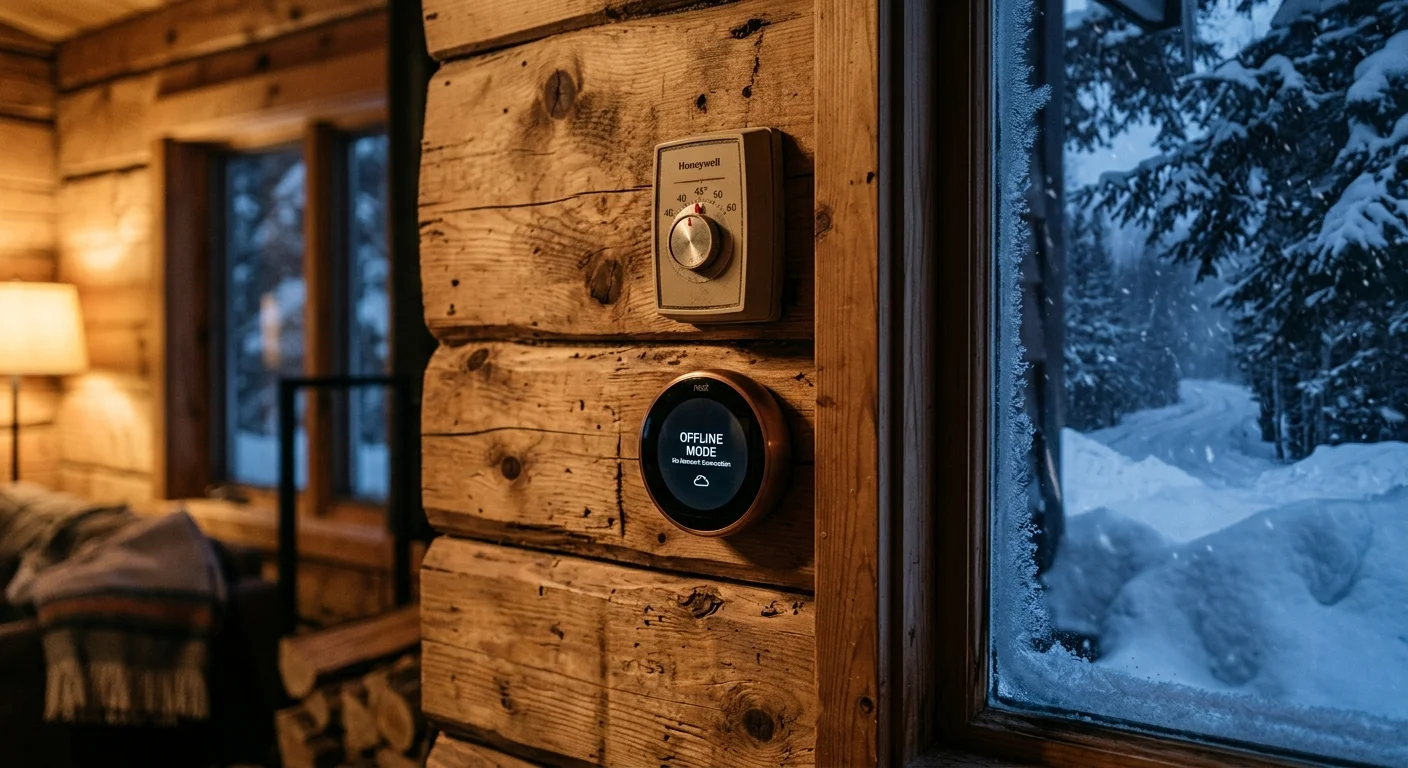
Sub-zero mountain blizzards regularly sever rural broadband connections right when temperatures hit their most dangerous lows. If your freeze defense relies on cloud-based routines, your plumbing sits completely defenseless against catastrophic pipe bursts.
Understanding which smart thermostat features actually save money allows you to keep winter heating efficient without risking plumbing damage.
Real pipe protection does not depend on cloud pings; it requires hardwired local baselines and parallel analog triggers that force auxiliary heat on even during total internet dropouts.
By pairing local firmware routines with an inexpensive mechanical thermostat wired directly across your heating terminals, you create an offline fail-safe that stops freeze damage before it starts.
The Real Risk: Cloud Dependency and Frozen Cabin Pipes
Remote cabins endure extreme weather patterns that easily knock down regional fiber lines and cellular towers. When internet connectivity drops, cloud-dependent automations immediately stop functioning.
Knowing how to troubleshoot common smart thermostat issues beforehand ensures your system will not unexpectedly falter during deep freezes.
Severe winter storms also frequently disrupt electrical grids, making a comprehensive smart home power outage survival plan vital for maintaining auxiliary cabin heat.
Most commercial smart home routines rely on remote cloud servers to process automation logic. If your freeze alerts depend on a cloud server pinging your phone, a severed line leaves you blind.
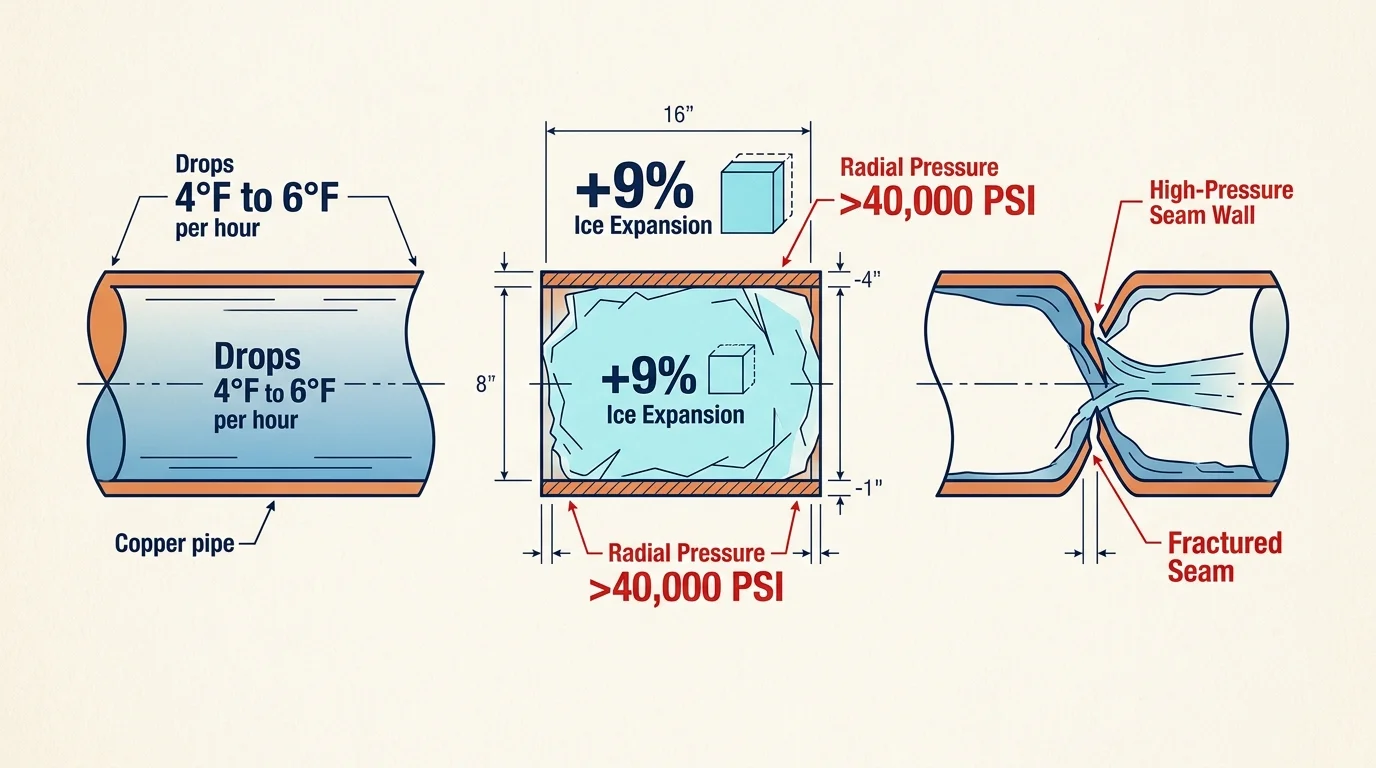
Unheated mountain properties lose thermal energy rapidly during sub-zero polar vortex events. Under-insulated crawlspaces and unheated basements can drop by 4°F to 6°F per hour once heating equipment stops running.
At those cooling rates, interior plumbing can freeze in fewer than eight hours. Water expands by roughly 9% when it transitions into ice, generating radial pressures exceeding 40,000 PSI inside copper and PEX lines.
That immense force ruptures pipe walls and splits brass fittings cleanly in half. When temperatures eventually rebound, pressurized water flows unrestricted into the structure until someone physically turns off the municipal curb stop or well pump.
To successfully prevent frozen pipes vacation home heating designs must rely on physical, on-site hardware logic rather than external internet connections.
Insurance Thresholds and the 55-Degree Rule
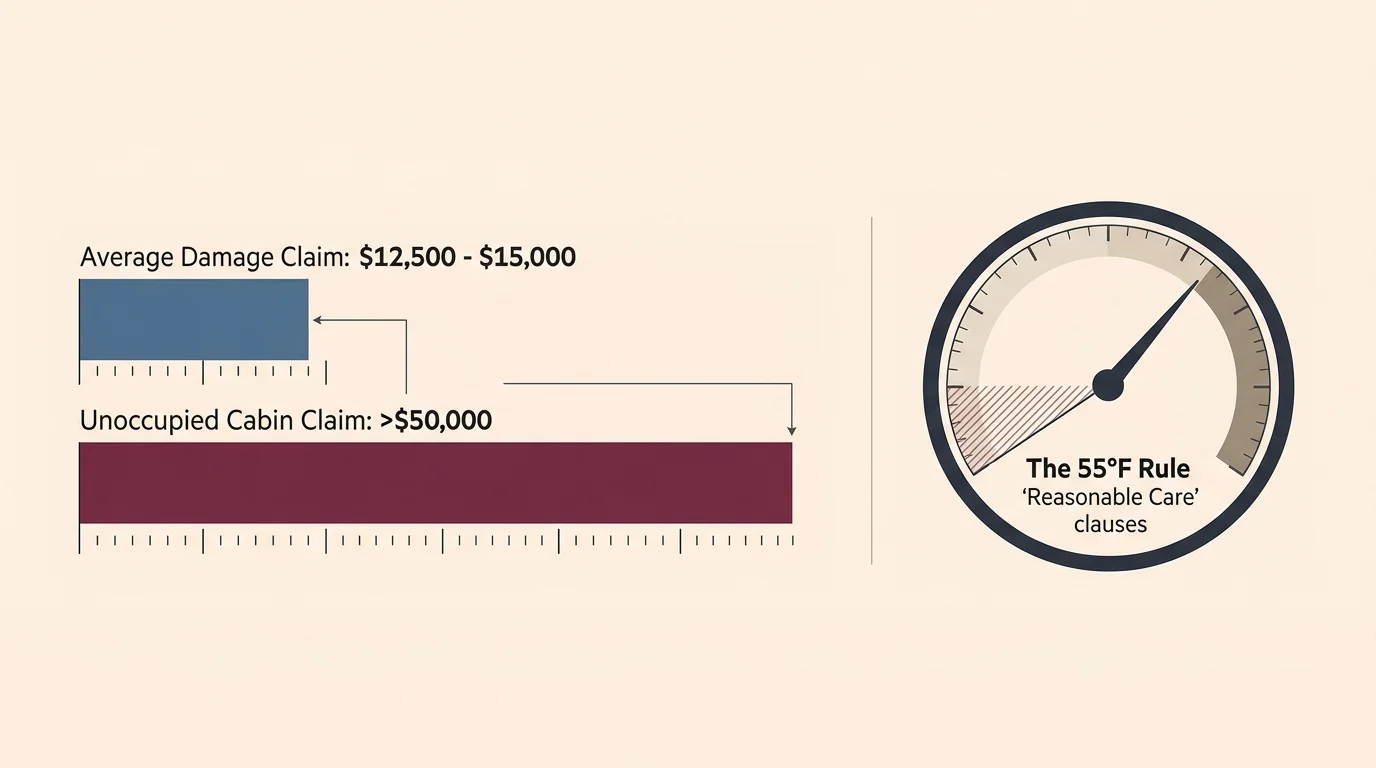
According to data from the Insurance Information Institute, the average property damage claim for freezing and water damage ranges between $12,500 and $15,000. In unoccupied mountain properties, however, delayed discovery frequently pushes total remediation bills past $50,000.
In larger vacation properties, installing smart thermostats for homes with multiple zones helps prevent isolated lower levels and remote rooms from plunging below the safe baseline.
Cabin owners preparing their smart thermostats for seasonal changes must balance heating efficiency against structural protection before winter arrives.
Most standard homeowners policies contain explicit “reasonable care” clauses regarding unoccupied structures. Under these contractual terms, your insurer can deny water damage claims entirely if you fail to maintain adequate building heat.
Major property insurers, municipal building codes, and the American Red Cross designate 55°F (13°C) as the absolute minimum safe baseline for unoccupied properties during winter months.
Many property owners mistakenly set their vacation thermostats to 42°F or 45°F to conserve costly propane or heating oil. This narrow margin leaves zero room for error during severe cold snaps.
While the central hallway where your thermostat hangs might read 45°F, enclosed exterior wall cavities and cantilevered floor joists often sit 15°F colder. That thermal gradient allows localized pipe runs to freeze solid while your primary living area appears safe.
Maintaining a dedicated 55°F target ensures that convective heat transfers through cabinet faces, floorboards, and wall voids, protecting vulnerable supply lines.
Configuring Native Offline Thermostat Safety Routines
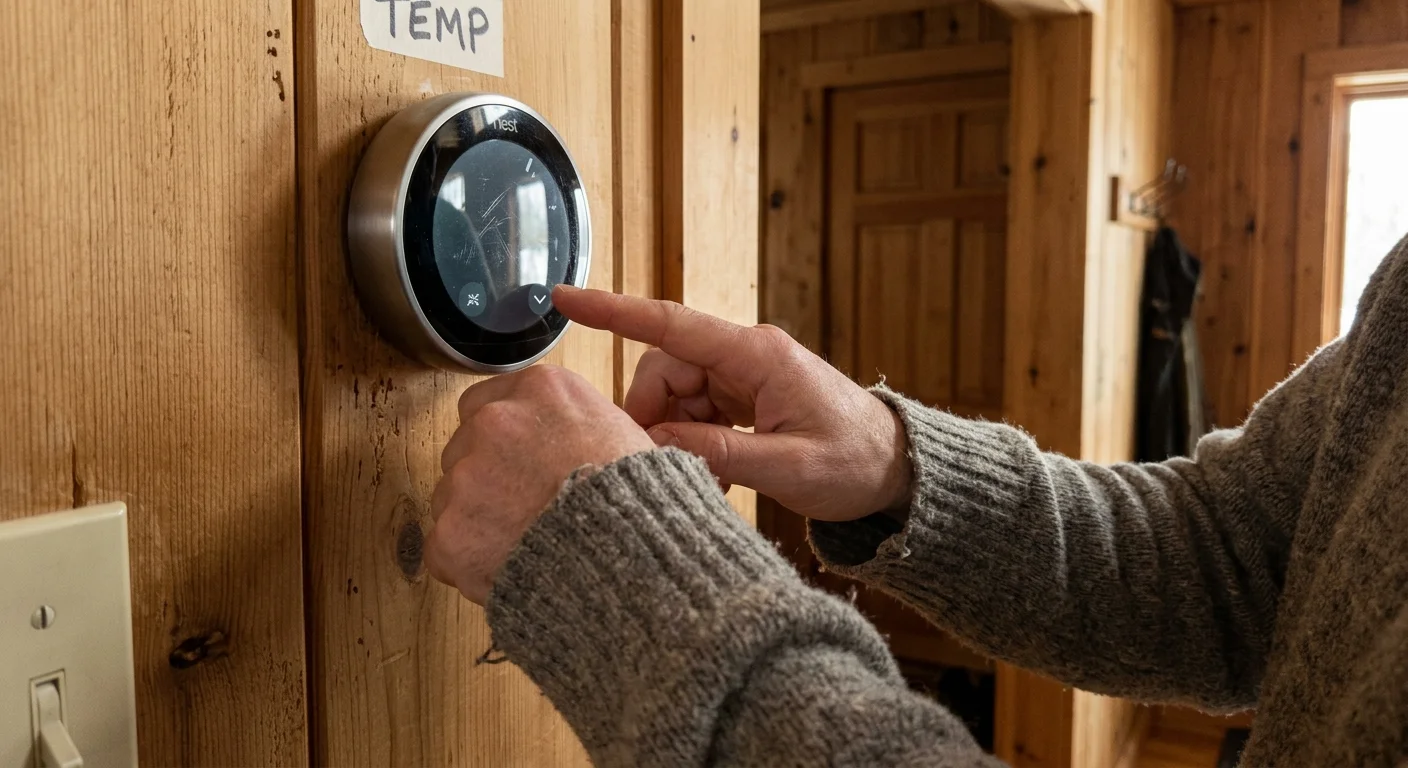
Leading manufacturers program local fail-safe instructions directly into their thermostat hardware firmware. These local safeguards execute without an active Wi-Fi connection, ensuring baseline operation during internet outages.
When integrating your smart thermostat with other devices, always verify whether automations execute locally or depend on an active internet connection.
When selecting hardware, verify compliance through certified programs like Energy Star Smart Thermostats, which demand rigorous reliability profiles from connected devices.
Google Nest devices feature an internal protocol designated as Safety Temperatures. By default, Nest thermostats maintain a 40°F (4.5°C) heating threshold locally on the unit.
Even if your Nest drops offline from your network, or if someone accidentally sets the mode to “Off,” the internal chip automatically fires the heating relay if ambient air drops below this setting.
For a mountain property, a 40°F baseline is dangerously low. You must manually raise this local safety threshold to 50°F or 55°F directly on the physical thermostat ring or within the equipment settings menu.
All ecobee smart thermostats feature a hardcoded hardware safeguard called Freeze Protection. If the internal base sensor detects temperatures dipping to 41°F (5°C), the thermostat immediately forces a local heating call.
Crucially, ecobee models disengage remote satellite sensors during this emergency event; they rely entirely on the primary wall unit’s thermistor to ensure continuous furnace operation.
Honeywell Home T-Series smart thermostats retain scheduled setpoints directly on their local printed circuit boards. If the network disconnects, the internal clock and local thermal sensor continue executing your scheduled 55°F floor indefinitely.
Configuring these device-level thresholds directly on the hardware ensures your smart thermostat freeze protection cabin strategy functions even when cloud servers go dark.
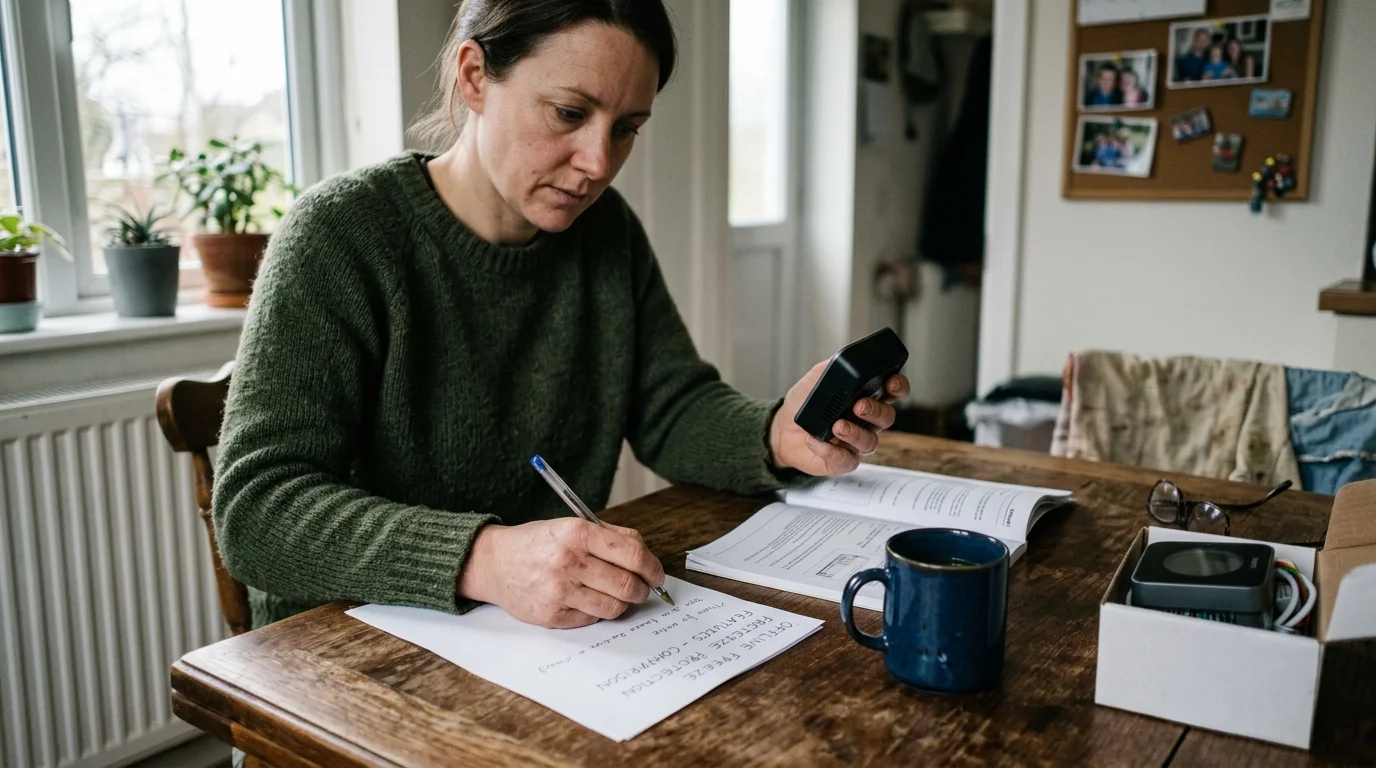
Hardware Comparison: Smart Thermostat Offline Freeze Features
Evaluating hardware before installation ensures your secondary property has adequate local safeguards. The table below outlines specific offline thresholds and equipment behaviors across primary smart thermostat platforms.
If your cabin features older two-wire furnace wiring, reviewing smart thermostats that work without a C-wire can help you select compatible hardware before winter.
| Thermostat Model | Default Local Safety Threshold | Maximum Offline Safety Setting | Aux/Emergency Heat Engagement Without Wi-Fi | Local Relay Retention During Power Cycle |
|---|---|---|---|---|
| ecobee Smart Thermostat Premium | 41°F (5°C) fixed hardware limit | 55°F (13°C) via local comfort profile | Yes; stages auxiliary heat based on local timer algorithm | Yes; non-volatile flash memory restores state in under 60 seconds |
| Google Nest Learning Thermostat (4th Gen) | 40°F (4.5°C) adjustable | 70°F (21°C) adjustable limit | Yes; commands local terminal relays without internet connectivity | Yes; stores Safety Temperature configurations locally on internal storage |
| Honeywell Home T9 Smart Thermostat | Disabled by default (manual program dependent) | 60°F (15.5°C) permanent local hold | Yes; operates dual-fuel and electric strips via equipment interface | Yes; EEPROM memory preserves setpoints indefinitely without backup batteries |
| Emerson Sensi Touch 2 Smart Thermostat | 45°F (7°C) manual setpoint floor | 55°F (13°C) local setpoint hold | Yes; local mechanical toggles execute auxiliary heat staging | Yes; hardware relays remain active through brownouts |
While these smart units handle software-level disconnection well, they share a single critical vulnerability: they depend entirely on 24VAC electrical current to power their internal processors.
Hardware failures, blown low-voltage fuses, or voltage surges can incapacitate a digital thermostat. That reality requires an analog backup system running alongside your smart installation.
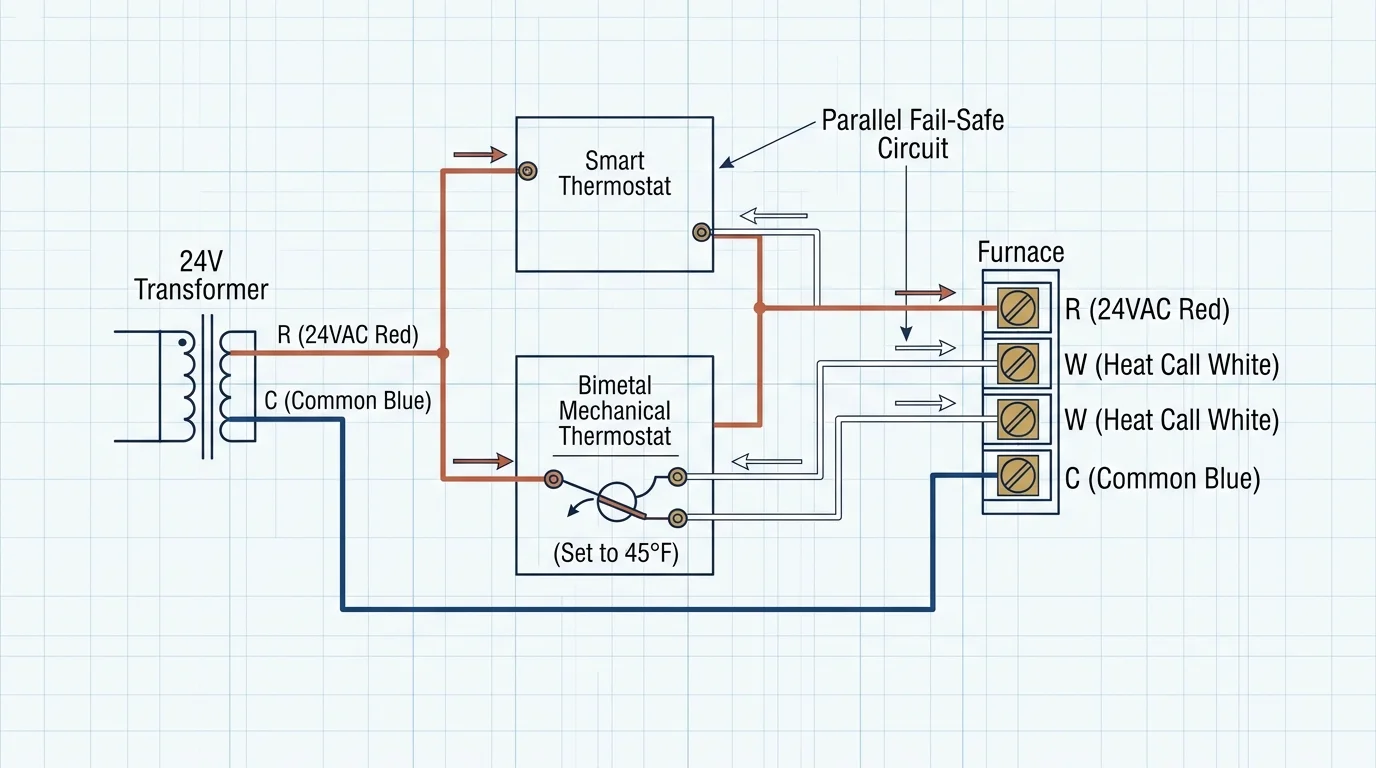
The Dual-Stat Fail-Safe: Wiring a Mechanical Bimetal Backup
The most resilient defense for unattended winter cabins is a dual-thermostat parallel wiring configuration. This setup connects a simple, non-powered mechanical bimetallic thermostat to the same control board terminals as your primary smart thermostat.
For cabins equipped with electric baseboard heaters instead of central heating, replacing high-voltage 240V dial thermostats with line-voltage smart controllers requires dedicated high-voltage hardware rather than 24VAC relays.
A standard 24VAC heating circuit operates like an open electrical gate. When ambient air drops below the setpoint, the thermostat closes the contact between the R terminal (24VAC power) and the W terminal (heat call), igniting the furnace.
By wiring an inexpensive mechanical thermostat in parallel across those exact same R and W terminals, you create an alternative physical path for electricity to flow.
If your smart thermostat locks up, suffers component failure, or gets disconnected by a software glitch, the mechanical thermostat acts as an automated bridge. As indoor temperatures fall to the mechanical dial’s setpoint, its physical bimetallic strip bends, closes the circuit, and turns on the heat.
Follow these step-by-step instructions to install a secondary mechanical fail-safe:
- Disconnect main electrical power to your heating appliance at your home’s central service breaker panel, verifying with a non-contact voltage tester that zero voltage reaches the control board.
- Select a reliable, mercury-free mechanical thermostat featuring a rugged internal bimetallic coil, such as the Honeywell Home T87K or T822K.
- Mount the mechanical unit directly to the wall adjacent to your central heating appliance, or fish low-voltage wire up into your living area next to your primary smart thermostat.
- Strip approximately 1/2 inch of insulation from two lengths of 18-gauge solid copper thermostat wire (18/2 gauge).
- Connect one copper lead to the R (or Rh) terminal on the mechanical thermostat, and fasten the other copper lead to the W (heating call) terminal.
- Route the opposite ends of this two-wire cable directly to your furnace control board terminals, landing the mechanical R wire alongside the smart thermostat’s existing R wire, and the mechanical W wire alongside the existing W wire.
- Set the mechanical thermostat’s physical dial precisely to 48°F (9°C) or 50°F (10°C).
- Restore breaker power, set your primary smart thermostat to “Off,” and lower your indoor space temperature or use cold air to verify that the mechanical thermostat independently commands furnace ignition.
Independent assessments from trade reviews like Consumer Reports Smart Home emphasize that simple mechanical backups routinely eliminate the single points of failure found in fully digitized households.
If your furnace utilizes staged electric auxiliary heat strips alongside a heat pump, splice the mechanical thermostat’s W wire into the furnace’s W2 or Aux terminal instead. This directs the mechanical fail-safe to trigger high-output auxiliary emergency heat if your primary system fails.
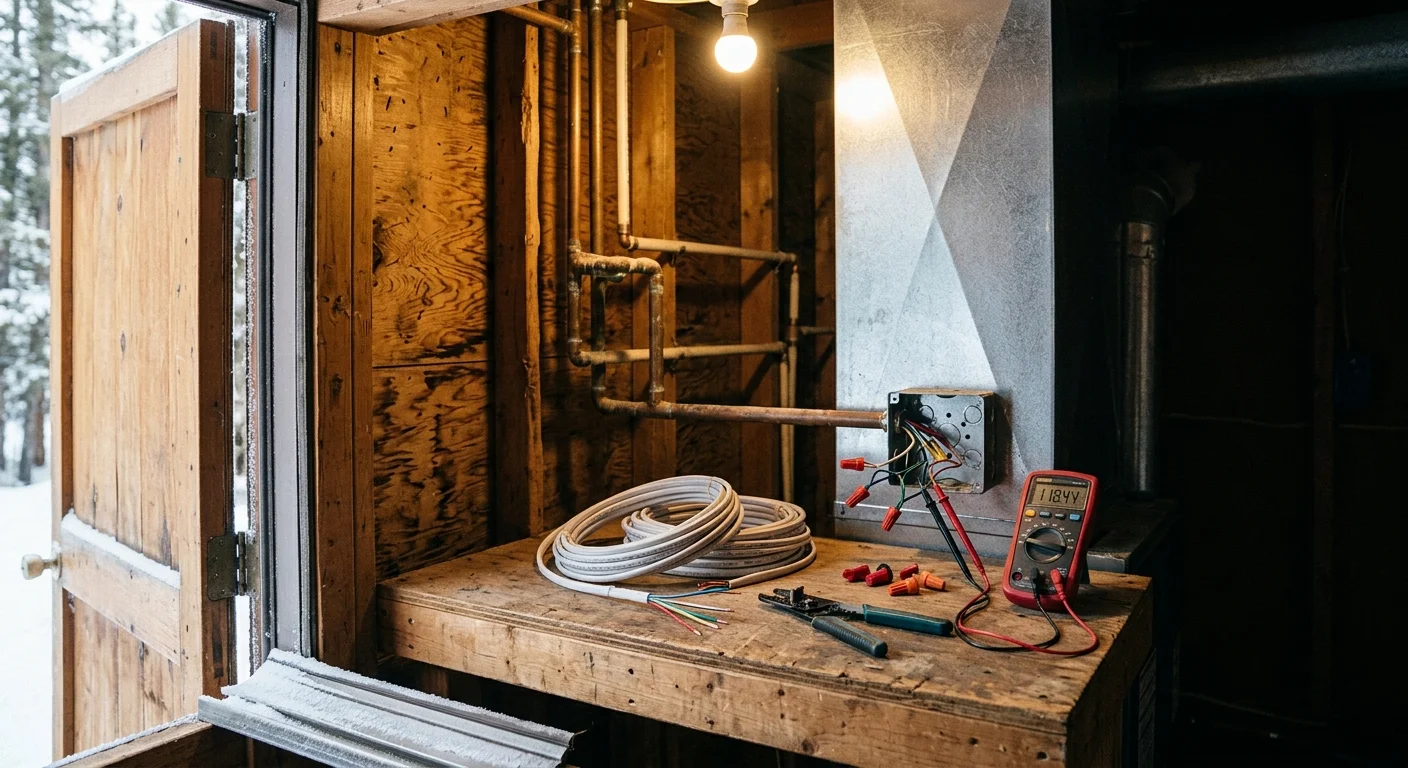
Worked Example: A Colorado Cabin Sub-Zero Emergency Retrofit
To examine this setup in practice, consider a 1,950-square-foot timber-frame cabin situated at 9,200 feet near Breckenridge, Colorado. The property uses a two-stage forced-air propane furnace with auxiliary electric plenum heaters.
During December 2025, the owner scheduled a four-week vacancy while regional temperatures were projected to plunge to -22°F. The primary smart unit was an ecobee Smart Thermostat Premium set to maintain a baseline of 55°F.
The owner retrofitted the property with an analog fail-safe system using precise hardware components and professional labor allocations:
- Honeywell Home T87K round mechanical bimetal thermostat: $38.50
- 75-foot spool of Southwire 18/2 solid thermostat wire: $24.95
- Dual-port low-voltage wire tap lever connectors: $8.20
- Licensed HVAC technician installation fee (1.25 hours labor): $162.50
- Total installed project investment: $234.15
The technician wired the T87K in parallel across the R and W2 (auxiliary emergency heat) terminals on the furnace motherboard, setting the mechanical dial to exactly 47°F.
On December 19, heavy riming collapsed an overhead tree limb across regional fiber-optic cables, taking down the cabin’s satellite broadband gateway for 92 consecutive hours. Concurrently, a minor electrical surge scrambled the ecobee’s low-voltage digital display, locking the smart unit in an unconfigured setup state.
Without an active Wi-Fi link, no push notifications were transmitted to the owner’s smartphone. The home’s interior temperature plummeted from 55°F down through the 40s over an 11-hour span as outside winds gusted to 45 mph.
At precisely 4:15 AM on December 20, interior ambient temperatures at the mechanical thermostat reached 47°F. The physical bimetal coil contracted, snapping the mechanical contact shut and delivering 24VAC straight to the W2 terminal.
The furnace engaged auxiliary emergency heat cycles continuously, sustaining a safe 48°F to 51°F indoor air temperature for three full days until utility technicians repaired regional lines.
When the owner arrived on January 3, all copper supply lines and porcelain fixtures remained completely intact. The mechanical fail-safe prevented a catastrophic burst that would have caused an estimated $46,000 in structural and water-remediation damages.
Power Outage Mitigation: C-Wires and Battery Resilience
A smart thermostat requires uninterrupted electrical current to keep its internal sensors and microcontrollers operating. Connecting your smart thermostat with a dedicated Common wire (C-wire) is mandatory for severe winter climates.
Older two-wire or four-wire heating circuits lack a dedicated C-wire. Many property owners install thermostats that rely on “power stealing” or internal rechargeable lithium-ion cells to circumvent running a fifth wire.
Power stealing systems trickle tiny amounts of electricity from the heating circuit when the furnace rests. When temperatures drop below zero and your furnace fires nearly continuously, the thermostat cannot pull power, depleting its internal battery.
Cold cabin air also degrades internal lithium-ion battery capacity by up to 40%. Once the battery dies, the screen turns black, the relays open, and your heating equipment shuts off completely.
Installing an uninterrupted 24VAC path via a genuine C-wire or an external 24V plug-in transformer ensures your primary thermostat retains processing power regardless of heating duty cycles.
To survive electrical grid blackouts, connect your heating appliance’s 120VAC electrical supply circuit to an automatic standby generator or an uninterruptible power supply (UPS) system.
Modern high-efficiency furnaces draw under 600 watts of electrical power to run control boards, inducer draft blowers, and circulating fan motors. A 1,500VA commercial pure sine wave UPS battery backup can run furnace cycles for four to six hours during brief winter outages.
For multi-day grid collapses, pair an automated propane-fired standby generator with a smart transfer switch. The generator immediately restores 120V line power to your furnace and 24VAC control power to your thermostat network.
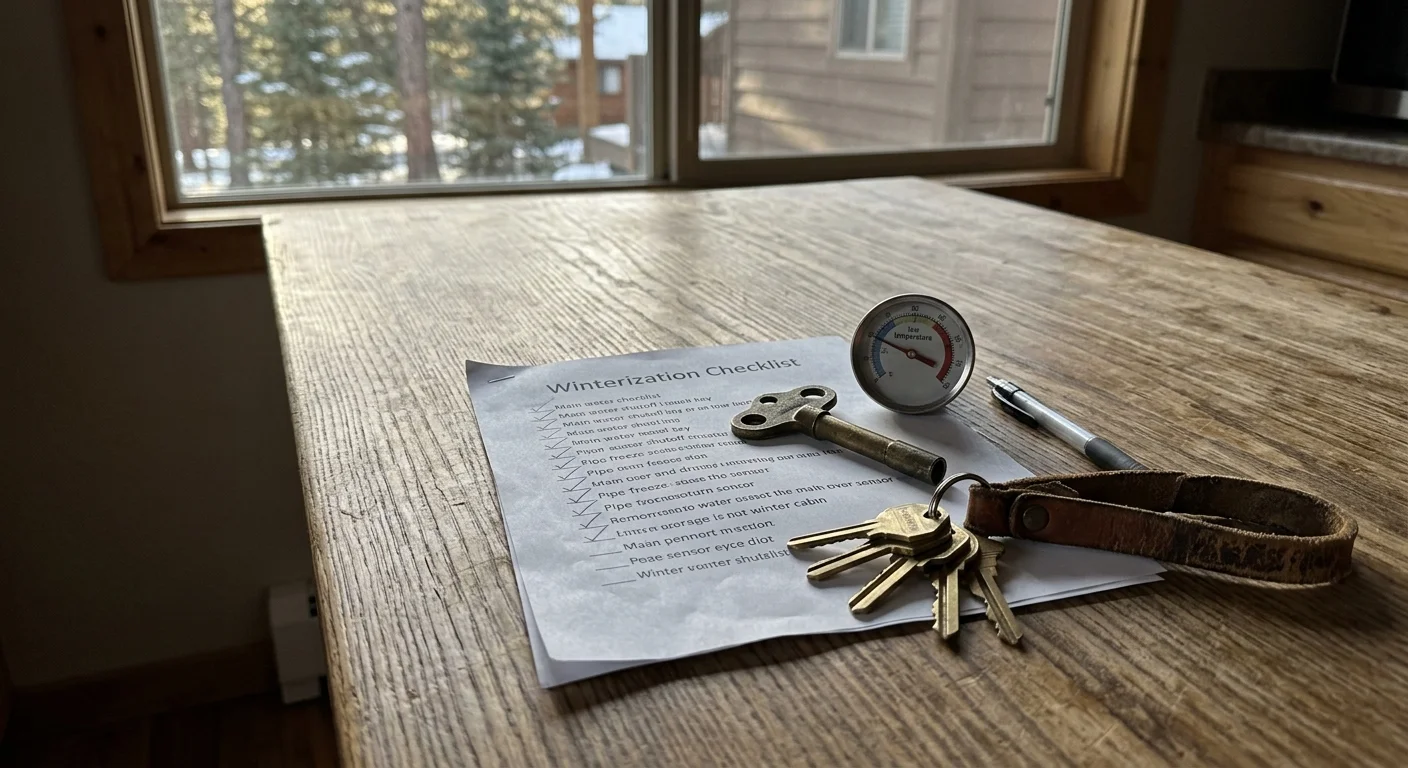
Offline Pipe Protection Checklist for Vacation Homes
Before closing your mountain retreat for the winter season, execute an offline freeze alert smart thermostat audit to guarantee total structural defense.
- Set local smart thermostat safety thresholds directly on the hardware screen to a minimum baseline of 55°F (13°C).
- Disable aggressive green energy eco-modes or geofencing away-modes that lower setpoints below safe winter thresholds.
- Install a non-powered mechanical bimetallic thermostat wired in parallel across the primary R and W terminals, calibrated to 48°F.
- Verify solid 24VAC electrical current across the C-terminal using a digital multimeter to prevent system battery depletion.
- Mount insulated pipe wraps around exposed copper, PEX, and brass valves inside unheated sub-areas and exterior rim joists.
- Open interior vanity cabinet doors beneath kitchen sinks, bathroom vanities, and utility basins to allow warm ambient air to circulate against wall plumbing.
- Shut down the property’s primary incoming water shutoff gate valve, open all faucets to bleed line pressure, and drain holding tanks.
- Install an emergency mechanical freeze drain valve on the main supply riser that mechanically unseats to dump line water if ambient temperatures hit 35°F.
Frequently Asked Questions
Will my smart thermostat heat my cabin if my internet router disconnects?
Yes, all major smart thermostats retain their scheduled heating setpoints and baseline hardware safety temperatures on internal solid-state memory. The thermostat commands your heating equipment locally via direct low-voltage relays without needing an active internet connection.
Why is setting my vacation home thermostat to 45°F considered dangerous?
While water freezes at 32°F, heating distribution throughout an unoccupied cabin is rarely uniform. When central rooms read 45°F, concealed wall cavities, crawlspaces, and basement corners often plunge 15°F colder, causing structural pipes to freeze and burst.
Can wiring a mechanical thermostat in parallel damage my primary smart thermostat?
No, provided both units operate on the same 24VAC Class 2 control circuit supplied by the identical furnace transformer. When the mechanical thermostat closes its switch, it simply bridges the R and W terminals, an action your smart thermostat also performs internally.
Do battery-powered smart thermostats work reliably in sub-zero winter temperatures?
Thermostats relying strictly on alkaline or internal rechargeable lithium batteries face high failure rates in extreme cold. Sub-zero temperatures degrade battery chemistry and voltage output, making a dedicated, hardwired C-wire connection essential for vacation properties.
Disclaimer: This article is for informational purposes only. Smart home devices involve electrical connections and data privacy. Always follow manufacturer instructions for installation. For complex wiring or HVAC work, consult a licensed professional.

1 Comment