
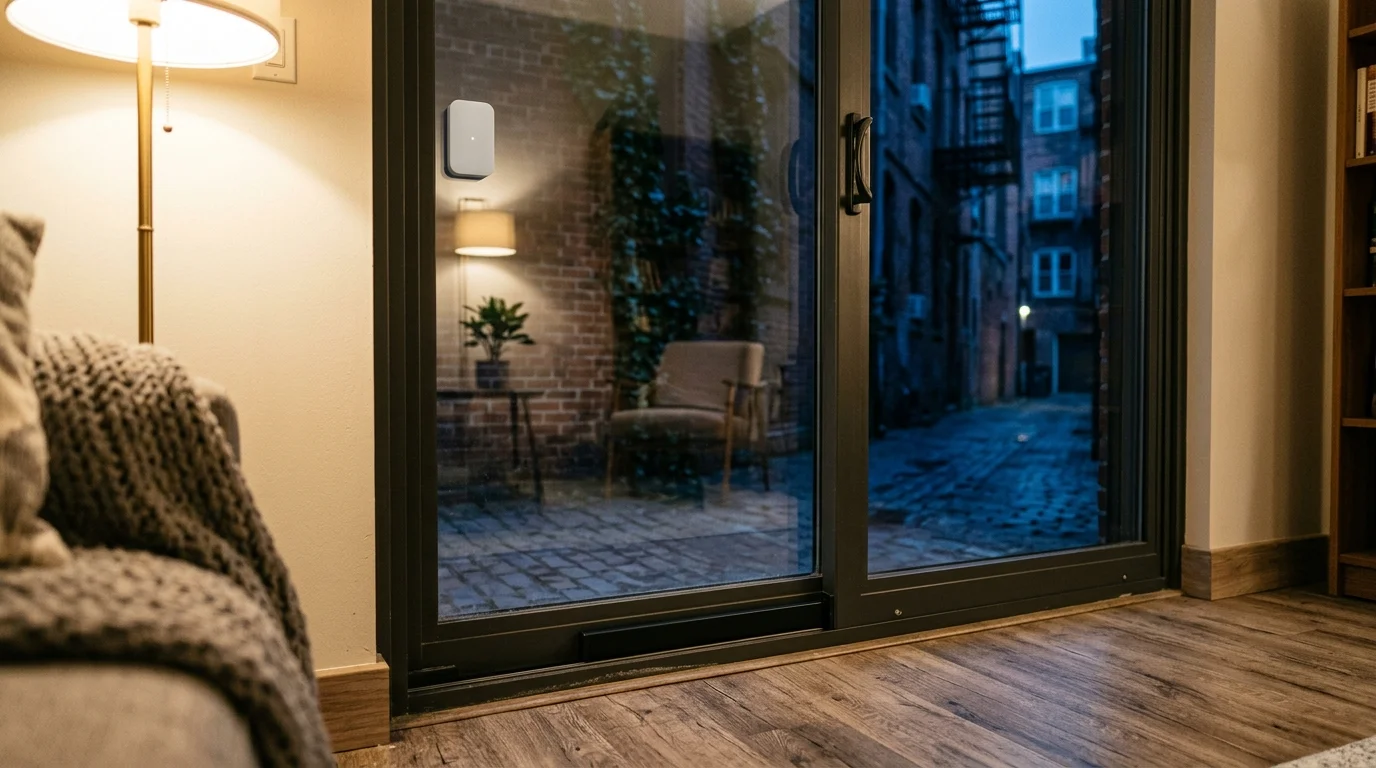
Living on the ground floor with a patio door facing a shared urban alley leaves your home vulnerable to quiet intrusion. Standard factory latches fail under less than 200 pounds of lateral force, yet heavy foot traffic constantly threatens false alarms.
You do not need invasive structural drilling to eliminate this vulnerability. By isolating high-frequency kinetic shock from low-frequency alley rumblings, a properly calibrated smart vibration sensor and physical track blocker stop breaches before glass shatters.
This guide details the precise sensitivity thresholds, renter-safe hardware configurations, and track reinforcement methods required to secure your ground-floor sliding patio door.

Urban Ground-Floor Sliding Door Vulnerabilities
Ground-floor sliding glass doors present an attractive entry point for intruders seeking quick access. Law enforcement data reveals that sliding patio doors account for approximately 22% of residential burglary entry points.
For broader exterior coverage, tuning outdoor smart floodlight PIR sensors ensures perimeter illumination only triggers for human intruders rather than passing neighborhood animals.
In addition to physical barrier upgrades, understanding how to automate your porch lights for safety provides a strong visual deterrent along dark alleyways.
Most factory-installed patio latches rely on a simple mortise hook mechanism. These cast-metal components routinely snap or slip when an intruder applies minimal force with a standard pry bar.
The American Society for Testing and Materials established the ASTM F842 standard to measure forced entry resistance in sliding door assemblies. The test protocol evaluates how well a door resists jacking, lateral prying, and vertical lifting off its lower track.
Budget-grade doors installed in typical rental units rarely exceed baseline ASTM Grade 10 ratings. An intruder can lift the operable panel upward into the head track pocket, clearing the bottom rollers entirely.
Safety glazing regulations introduce another physical variable you must account for during your security planning. International Residential Code (IRC) Section R308.4.1 mandates tempered or laminated safety glass in all sliding patio panels.
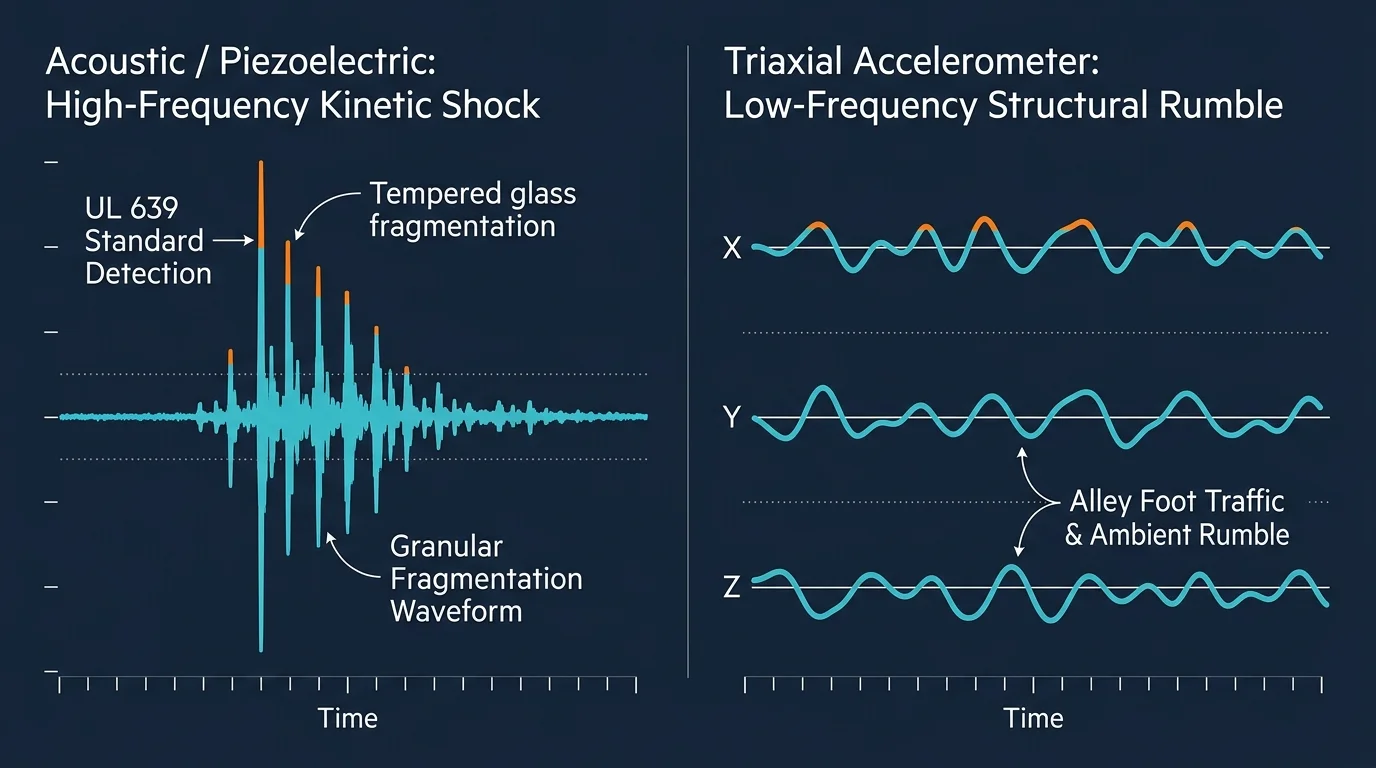
Tempered glass features high surface compression balanced by internal tensile stress. When compromised by blunt force, the entire sheet disintegrates into granular dice rather than jagged shards.
This explosive fragmentation produces an unmistakable kinetic and acoustic signature. Your detection hardware must differentiate that specific high-frequency collapse from external alleyway disturbances.
- Factory latch failure under less than 200 pounds of lateral force
- Vertical lift clearance allowing panel disengagement from the lower rail
- Direct pedestrian exposure creating continuous ambient kinetic vibrations
- Tempered glass fragmentation patterns requiring specialized shock detection thresholds
Piezoelectric vs. Triaxial Accelerometer Mechanics
Securing sliding glass requires understanding how different sensor architectures capture physical disturbance. Standard acoustic glass break detectors evaluate airborne sound waves using internal microphone diaphragms.
Just as overcoming road rumble requires isolating acoustic devices from background vibrations, door sensors must successfully filter out heavy structural rumblings caused by passing alley traffic.
Underwriters Laboratories standard UL 639 outlines performance criteria for intrusion-detection units, including acoustic and shock devices. While acoustic sensors excel in quiet rooms, urban alleys render them prone to false triggers.
Delivery trucks, metal dumpster lids, and loud pedestrian conversations frequently mimic acoustic glass-break profiles. In contrast, surface-mounted shock sensors measure direct structural displacement through the glass substrate itself.
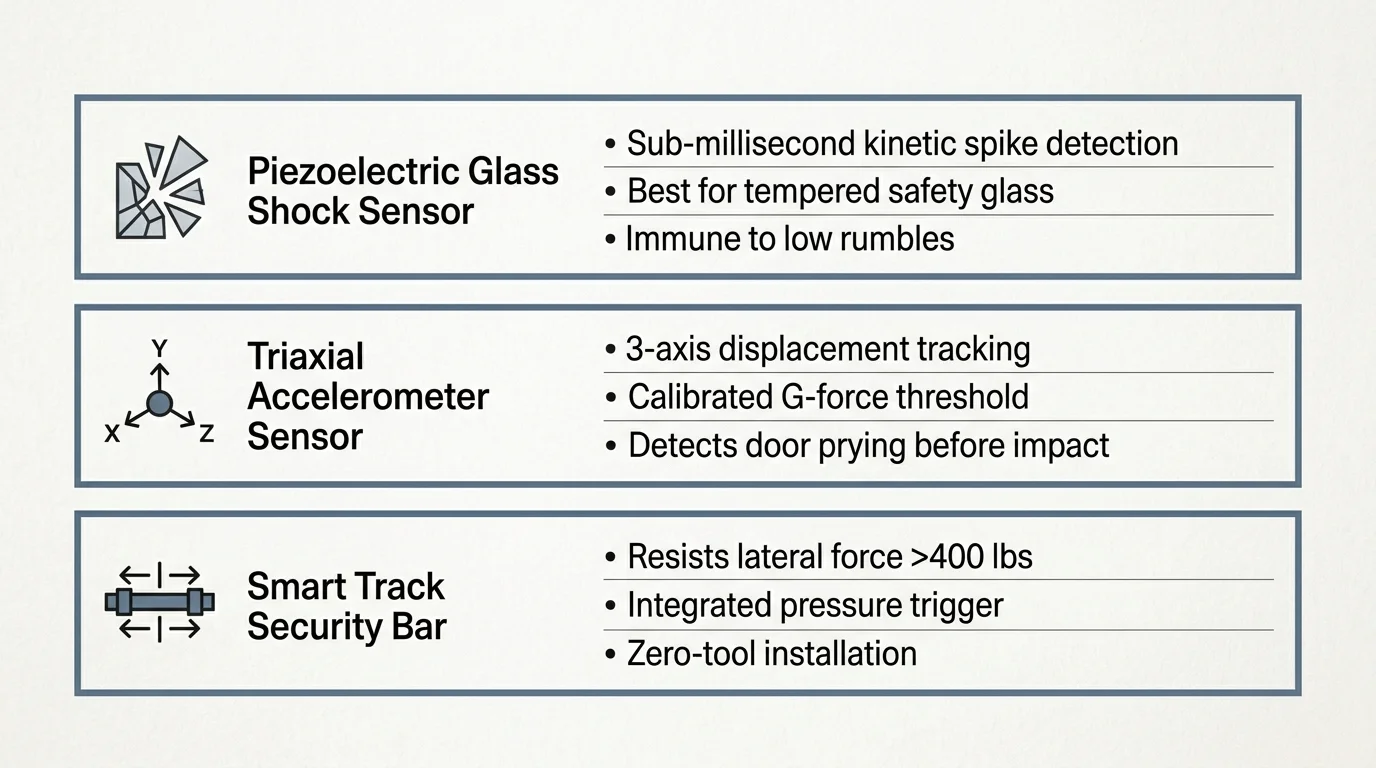
Modern smart home setups rely primarily on two internal sensor technologies: piezoelectric elements and digital micro-electromechanical systems (MEMS) triaxial accelerometers. Each mechanism handles structural vibrations differently.
Piezoelectric sensors utilize ceramic crystal elements that generate an electrical charge when mechanically stressed. They react instantly to high-frequency impacts, such as carbide wheel scoring or hammer blows.
Triaxial MEMS accelerometers measure movement across three physical planes: X, Y, and Z. According to evaluations on PCMag Smart Home, smart sensors containing multi-axis accelerometers deliver superior nuance because they identify both sudden shock and sustained angular tilt.
Pedestrian footsteps and traffic rumblings travel through your apartment building foundation as low-frequency, continuous seismic waves. These ambient waves produce long wavelengths that move through the door frame evenly.
A forced breach produces an abrupt, high-amplitude spike with an ultra-short rise time. To achieve reliable renter ground floor patio security, your hardware must filter out baseline structural sway while capturing rapid kinetic spikes.
- Piezoelectric sensors excel at detecting the sharp resonance of surface scoring and shattering.
- Triaxial accelerometers capture spatial displacement, such as panel lifting and prying attempts.
- Acoustic sensors struggle in urban alleys due to ambient street reflections and heavy curtains.
- Dual-criteria logic combines tilt and shock verification to virtually eliminate false dispatch events.
Step-by-Step Sensor Sensitivity Calibration Guide
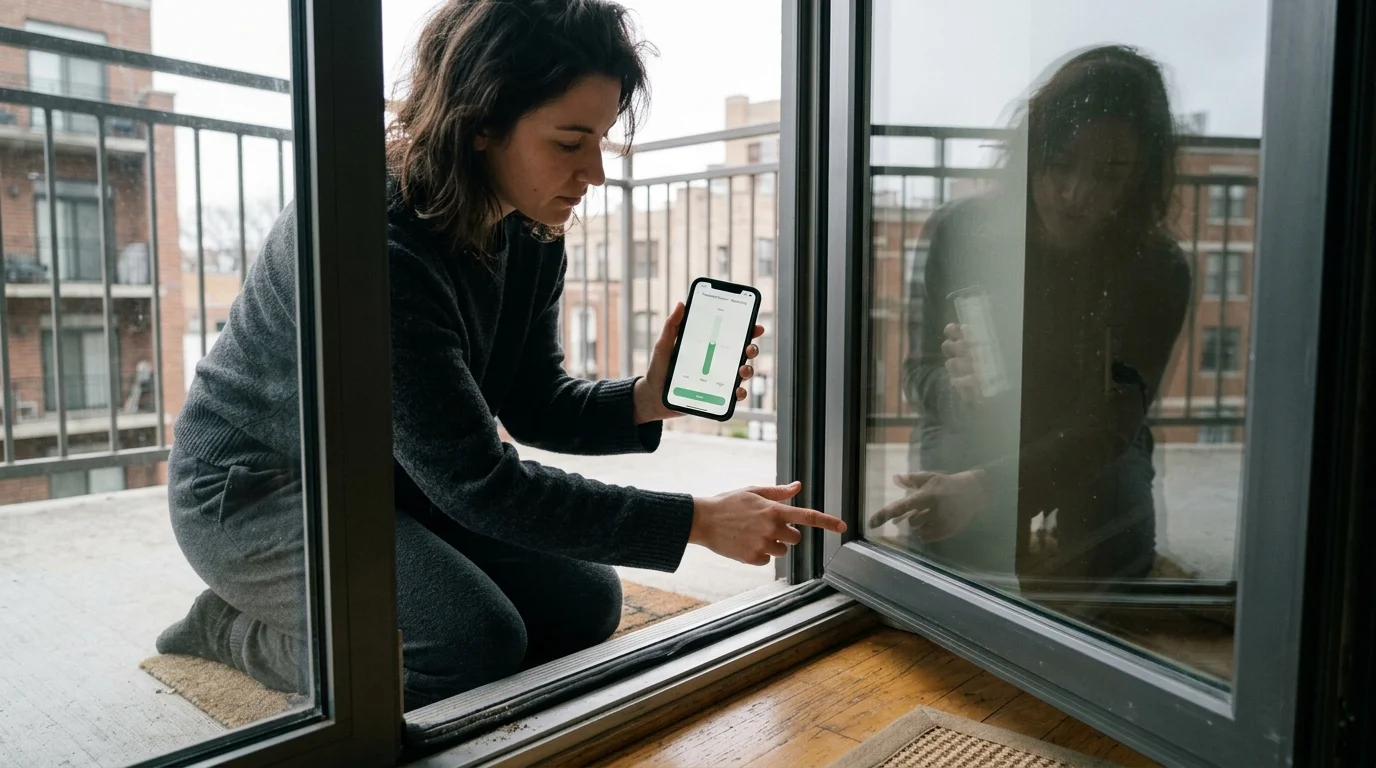
Calibrating your sliding door smart sensor demands precision to prevent 2:00 AM sirens caused by passing delivery vans. The objective is tuning out low-frequency alley rumbles while registering genuine tampering.
When routing your vibration triggers to indoor sirens, configuring smart speaker alarm frequencies ensures emergency alerts easily penetrate ambient urban street noise.
Calibrating these thresholds is essential before connecting entry triggers to a smart home emergency alert system to prevent disruptive false alarms.
For this calibration protocol, you will use an Aqara Vibration Sensor T1 or an equivalent Zigbee-based triaxial sensor. These compact devices retail between $15 and $25 and feature renter-friendly adhesive backings.
Mount the sensor on the upper interior corner of the operable sliding panel. Position the casing roughly two inches from the vertical frame stile and two inches below the upper rail.
Placing the unit in the upper corner preserves your field of view while maximizing detection of frame-prying leverage. It also captures the shock waves transmitted across the entire pane of tempered safety glass.
- Clean the glass mounting zone using 70% isopropyl alcohol to eliminate dust and oily residues.
- Affix the sensor firmly using the supplied non-damaging adhesive pad, pressing continuously for 30 seconds.
- Pair the device with your local Zigbee hub, such as Home Assistant via ZHA or Zigbee2MQTT.
- Access the device configuration clusters to locate the sensitivity attribute, which typically ranges from Low (value 21) to High (value 1).
- Set the base sensitivity to Medium (threshold value 11) to establish an operational baseline.
- Perform an ambient baseline test by having a partner stomp past the door in the alley while you monitor the state logs.
- If the sensor trips from footfalls, decrease the sensitivity setting incrementally until five consecutive heavy steps cause zero state changes.
- Test breach detection by firmly tapping the lower frame using a rubber mallet wrapped in a towel, confirming an immediate trigger.
Log each test event in your smart home interface to confirm your debounce duration. A debounce window of 150 to 300 milliseconds prevents a single impact from generating multiple redundant event triggers.
Fine-tuning your glass break vibration sensitivity ensures the accelerometer registers high-amplitude impacts while remaining blind to external alleyway movement. Document your final numerical threshold values in your automation platform notes.
Non-Invasive Smart Track Reinforcement Methods
Sensory detection alerts you to an intrusion, but physical resistance stops the intruder from stepping inside. Standard patio doors require secondary reinforcement that does not violate apartment lease agreements.
Homeowners with extended outdoor pathways can supplement track blockers by deploying long-range beam sensors to detect approaching movement well before an intruder touches the glass.
Drilling into modern aluminum or vinyl sliding door frames can void manufacturer warranties and forfeit your security deposit. Non-invasive track reinforcement delivers commercial-grade physical resistance using simple pressure dynamics.
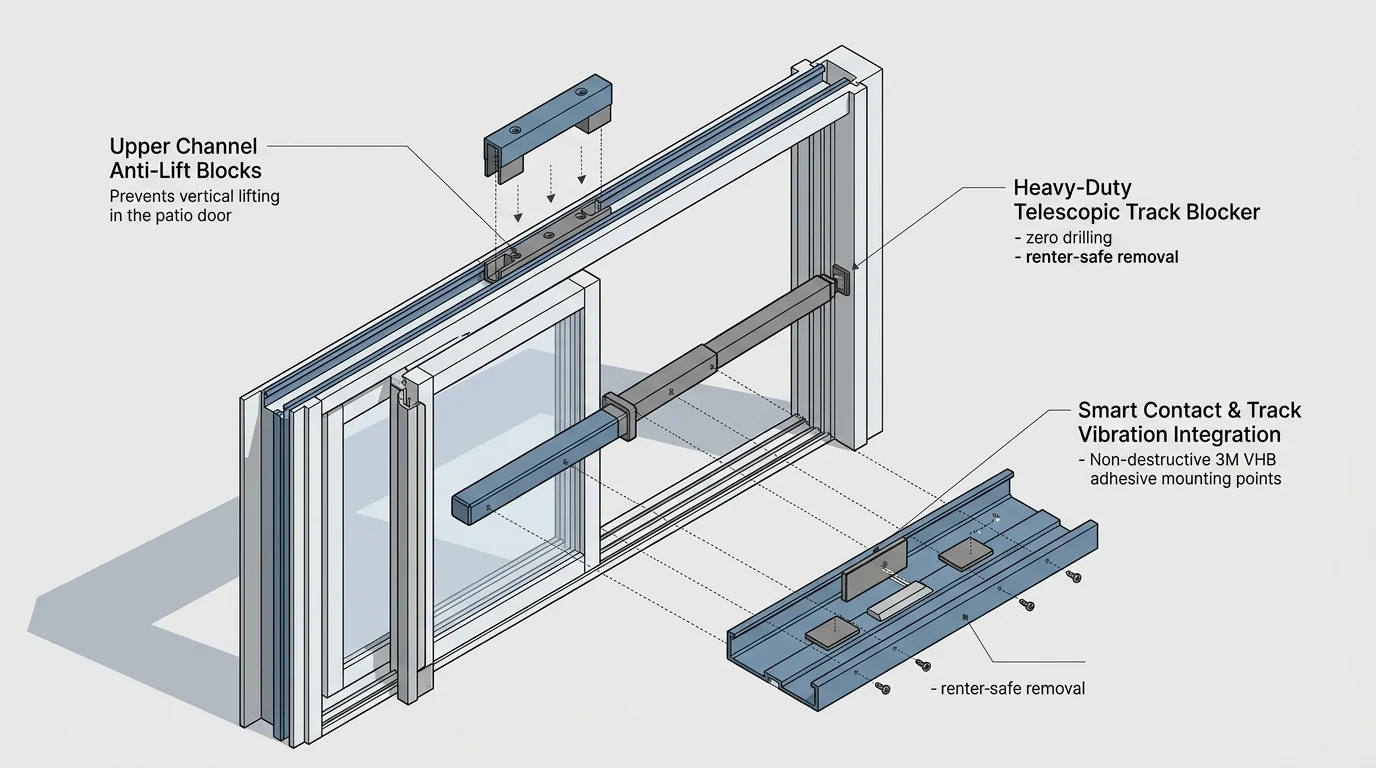
A telescoping steel security bar rests directly inside the lower or middle slider track. Testing compiled by Wirecutter Smart Home demonstrates that heavy-duty telescoping steel bars can withstand 300 to 350+ pounds of mechanical shear force.
This physical barrier prevents the operable leaf from sliding backward even if an intruder disables the primary mortise lock. You can modernize this mechanical solution by integrating smart contact monitoring.
Attach a miniature magnetic contact sensor directly to the hinge point or saddle bracket of your track security bar. When you lift the bar to step out, the contact circuit opens, automatically toggling your security status.
For automated access control, you can integrate a motorized smart track blocker. Motorized deadbolt actuators mounted adjacent to the jamb drop a hardened steel pin behind the moving panel upon arming.
- Telescoping steel bars distribute forced lateral pressure across the structural door frame.
- Saddle-mounted Charley bars fold flat against the frame when not in active use.
- Non-marring rubber end-caps prevent scratch damage to powder-coated rental track finishes.
- Anti-lift track shims inserted into the upper rail prevent vertical lifting attacks.

Worked Implementation Scenario: The Alleyway Patio Door
Consider a practical implementation for a ground-floor tenant living in a dense metropolitan alleyway. The residence features a standard 72-inch by 80-inch vinyl patio slider with an active 36-inch sliding leaf.
If you also monitor the exterior passage with surveillance, eliminating motion camera false alarms with polygonal masking ensures passing commuters do not flood your phone with alerts.
Homeowners who require immediate perimeter awareness can also link secondary track switches to zero-latency door open chimes for instant audible alerts.
The concrete alley handles continuous traffic, including pedestrian commuters, garbage bin movements, and delivery carts. The security objective is zero false alarms over a 30-day window combined with complete forced-entry resistance.
The total investment for this implementation remains well under $100 while using fully removable hardware. The table below lists the components, retail costs, and installation time required.
| Hardware Component | Specific Model | Hardware Cost | Installation Time |
|---|---|---|---|
| Triaxial Vibration Sensor | Aqara T1 (Zigbee 3.0) | $19.99 | 5 minutes |
| Telescoping Security Bar | Securityman Heavy-Duty Steel Bar | $26.99 | 10 minutes |
| Miniature Contact Sensor | ThirdReality Smart Contact Sensor | $12.99 | 5 minutes |
| Anti-Lift Track Blockers | Sliding Window/Door Wedges (2-Pack) | $8.50 | 10 minutes |
| Adhesive Track Damping Shims | High-Density Neoprene Foam Strips | $6.50 | 12 minutes |
The tenant mounts two anti-lift wedges inside the upper head pocket above the sliding panel. Leaving a precise 1/16-inch clearance allows smooth gliding while preventing intruders from lifting the panel off the bottom track.
Next, the tenant applies neoprene damping shims along the lower interior rail contact points. These shims absorb the structural chassis vibration generated by heavy alley delivery carts.
The Aqara T1 sensor is adhered to the glass pane two inches from the top corner. In the Zigbee configuration dashboard, the sensitivity threshold is set to value 12, balancing impact sensitivity against chassis rumble.
The Securityman steel bar is adjusted to 35.5 inches, locking the moving door panel securely against the primary jamb. A miniature contact sensor monitors the bar position, disarming the perimeter chime whenever the bar is lifted.
During physical verification testing, three simulated shoulder strikes against the exterior frame fail to budge the reinforced door. The vibration sensor ignores external pedestrian stomping while reliably tripping within 180 milliseconds of direct frame prying.
Hardware Comparison: Sensors and Track Reinforcements
Choosing compatible security hardware requires evaluating load ratings, communication protocols, and lease compliance. Not every smart device fits the spatial constraints of a sliding patio frame.
Low-voltage connected devices must maintain reliable communication through metal door extrusions and low-emissivity glass. Wireless protocols like Zigbee and the Matter Smart Home Standard ensure local processing without vendor lock-in.
The following comparison analyzes market hardware options across measurable structural criteria, power sources, and rental viability.
| Product & Model | Operating Mechanism | Holding / Shear Rating | Protocol & Ecosystem | Renter Compliance |
|---|---|---|---|---|
| Aqara Vibration Sensor T1 | Triaxial MEMS Accelerometer | Impact Detection Only | Zigbee 3.0 / Matter via Hub | 100% (No-drill adhesive) |
| Securityman 2-in-1 Patio Bar | Telescoping 20-Gauge Steel | 350 lbs Lateral Force | Mechanical (Smart via contact) | 100% (Pressure mounted) |
| Ideal Security BK110W Bar | Pivoting Square Steel Bar | 300 lbs Lateral Force | Mechanical Only | Requires 2 screw holes |
| Minut Smart Home Sensor | Acoustic & Environmental Barometer | Sound & Pressure Only | Wi-Fi / Cloud API | 100% (Wall adhesive) |
| Tuya Zigbee Shock Detector | Piezoelectric Ceramic Resonator | Impact Detection Only | Zigbee 3.0 / Tuya Smart | 100% (No-drill adhesive) |
Notice the structural difference between purely acoustic units like Minut and surface accelerometers like the Aqara T1. Acoustic units monitor ambient room pressure, whereas contact units track actual frame displacement.
For rental properties, the combination of a pressure-mounted steel bar and an adhesive triaxial sensor provides optimum defense. This pairing exceeds baseline ASTM F842 intrusion requirements without damaging structural frames.
Smart Automation Recipes for Ground-Floor Security
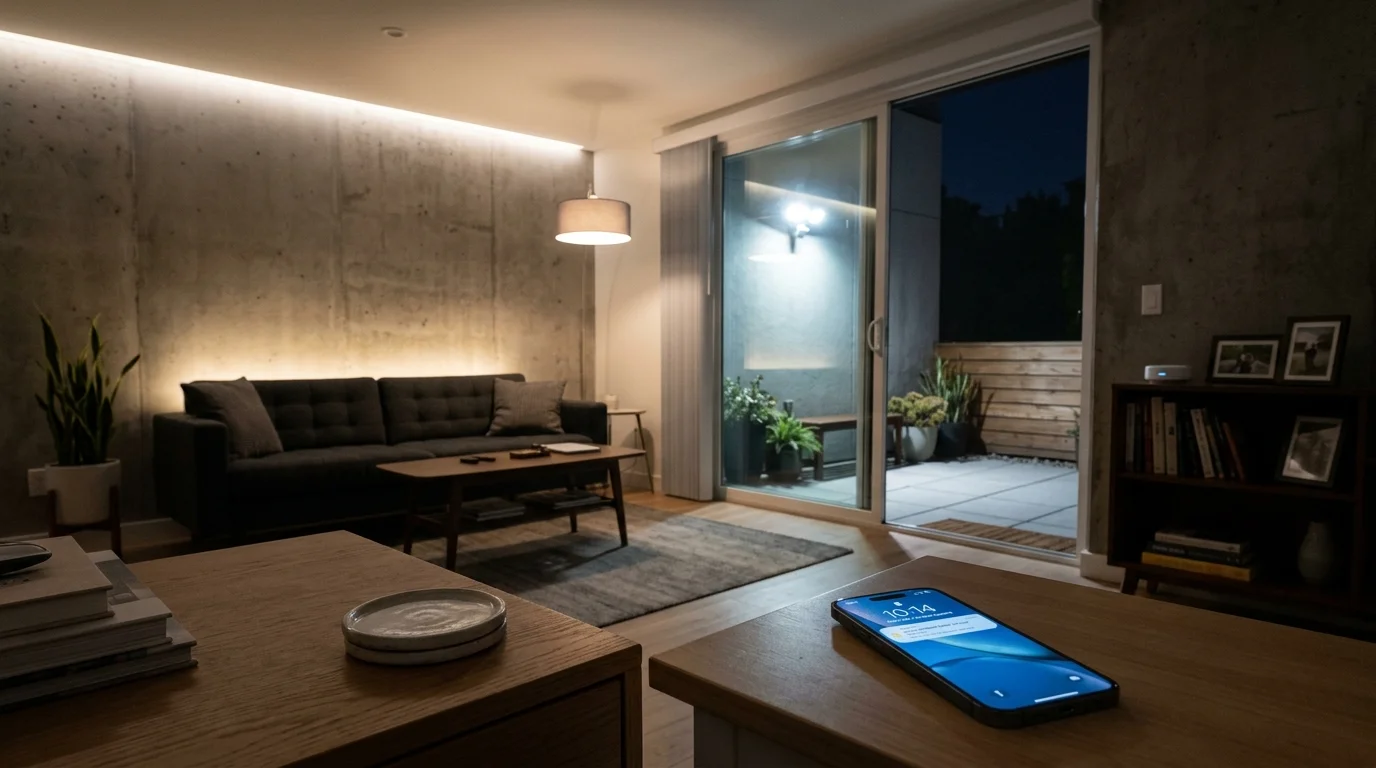
Hardware calibration reaches its full potential when integrated into automated smart home responses. Passive alarms rarely startle modern intruders; an active, visible environmental shift proves far more deterrent.
Your automation logic should employ multi-stage deterrence based on the intensity of the received sensor payload. A minor structural vibration can trigger outdoor illumination, while a confirmed shock trip sounds a perimeter siren.
Configure these routines within a local automation controller like Home Assistant, Apple HomeKit, or SmartThings. Local processing ensures your security responses execute even if an intruder disrupts exterior internet cabling.
- Define an alleyway warning routine: If the vibration sensor detects acceleration above threshold 12 between 11:00 PM and 6:00 AM, turn your patio floodlight to 100% cool white instantly.
- Broadcast an interior audible chime through smart speakers to alert occupants of perimeter activity.
- Establish a breach response: If the vibration sensor registers a severe tilt or high-impact shock (threshold 5 or lower), trigger a 105-decibel siren immediately.
- Push a critical alert notification with an attached camera snapshot to your smartphone, bypassing your device silent switch.
- Illuminate indoor hallway lights in red to provide defensive visibility while disorienting an intruder peering through the glass.
- Reset the automated lighting sequence automatically after four minutes of confirmed inactivity along the track.
Pairing these automated routines with mechanical track barriers ensures your apartment remains secure against physical breach attempts. You convert a vulnerable glass panel into an actively defended, smart perimeter zone.
Frequently Asked Questions
Will delivery trucks in the alley set off my calibrated vibration sensor?
Proper calibration filters out passing trucks by isolating low-frequency chassis rumble from sharp kinetic shocks. Setting your triaxial sensor to medium sensitivity allows the accelerometer to disregard gradual ground displacement while remaining responsive to direct impact.
Can I install a sliding patio security bar without losing my rental deposit?
Pressure-mounted telescoping security bars use non-marring rubber feet that seat tightly into the sliding track without screws. These bars hold over 300 pounds of lateral force and lift out cleanly without leaving marks or screw holes behind.
What is the difference between an acoustic glass break sensor and a vibration sensor?
Acoustic sensors use internal microphones to detect the sound frequency of breaking glass traveling through the air. Surface vibration sensors mount directly to the pane, measuring physical kinetic displacement and frame shock before the glass breaks.
Where is the best spot on the sliding door to stick a smart vibration sensor?
Mount the sensor on the interior glass surface in an upper corner of the operable sliding leaf, roughly two inches from the frame. This placement protects the sensor from daily hand contact while capturing both frame prying leverage and glass shock waves.
Disclaimer: This article is for informational purposes only. Smart home devices involve electrical connections and data privacy. Always follow manufacturer instructions for installation. For complex wiring or HVAC work, consult a licensed professional.



1 Comment