
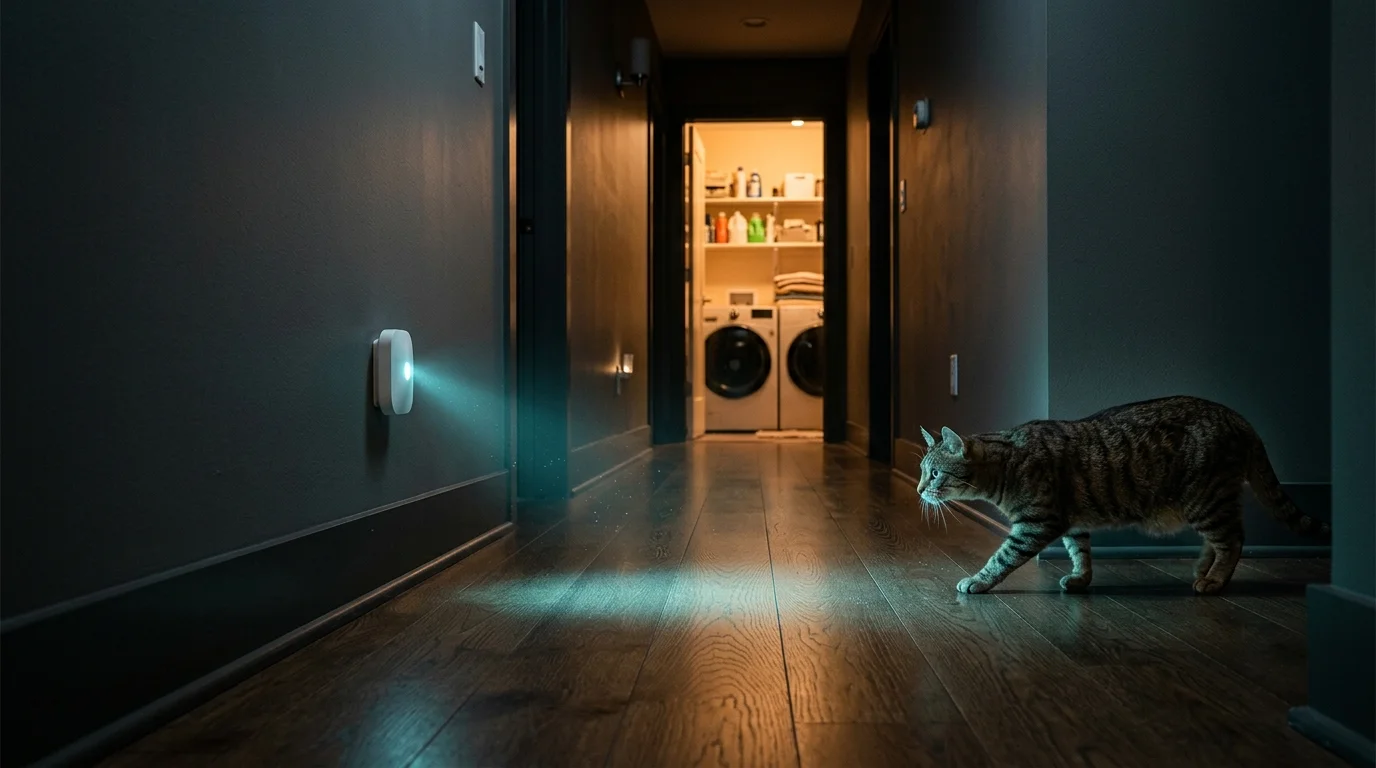
If your dominant cat traps your timid cat inside a secluded litter area, traditional behavioral advice tells you to move boxes. That advice fails when architectural layouts force litter pans into utility alcoves or dead-end hallways.
Incorporating specialized smart routines for pet owners allows connected hardware to ease social strain between animals without constant human intervention.
Directional 60 GHz mmWave radar solves this bottleneck by tracking spatial approach vectors in real time. Dividing corridors into micro-zones lets you trigger subtle acoustic and ambient light interruptions before a stalking cat seals off the exit.
This automated intervention de-escalates territorial ambushes autonomously, keeping vulnerable cats safe without constant human supervision.
The Biomechanics and Psychology of Litter Box Ambushes
Elimination places a cat in an inherently vulnerable posture. While squatting, a cat cannot maintain 360-degree visual vigilance or deploy quick defensive maneuvers.
Similar territorial guarding frequently emerges around shared meal stations, leading many owners to deploy smart pet feeders to isolate critical daily resources.
Dominant felines exploit this sensory deficit by staking out critical approach vectors. They turn natural transit paths into high-tension territorial checkpoints.
The American Association of Feline Practitioners notes that social stress and territorial guarding around resources represent primary catalysts for feline house-soiling and inter-cat aggression.
According to veterinary environmental guidelines published by the American Association of Feline Practitioners (AAFP) and the International Society of Feline Medicine (ISFM), multi-cat homes require an N+1 box distribution. You must provide one box per cat plus one additional unit in distinct physical locations.
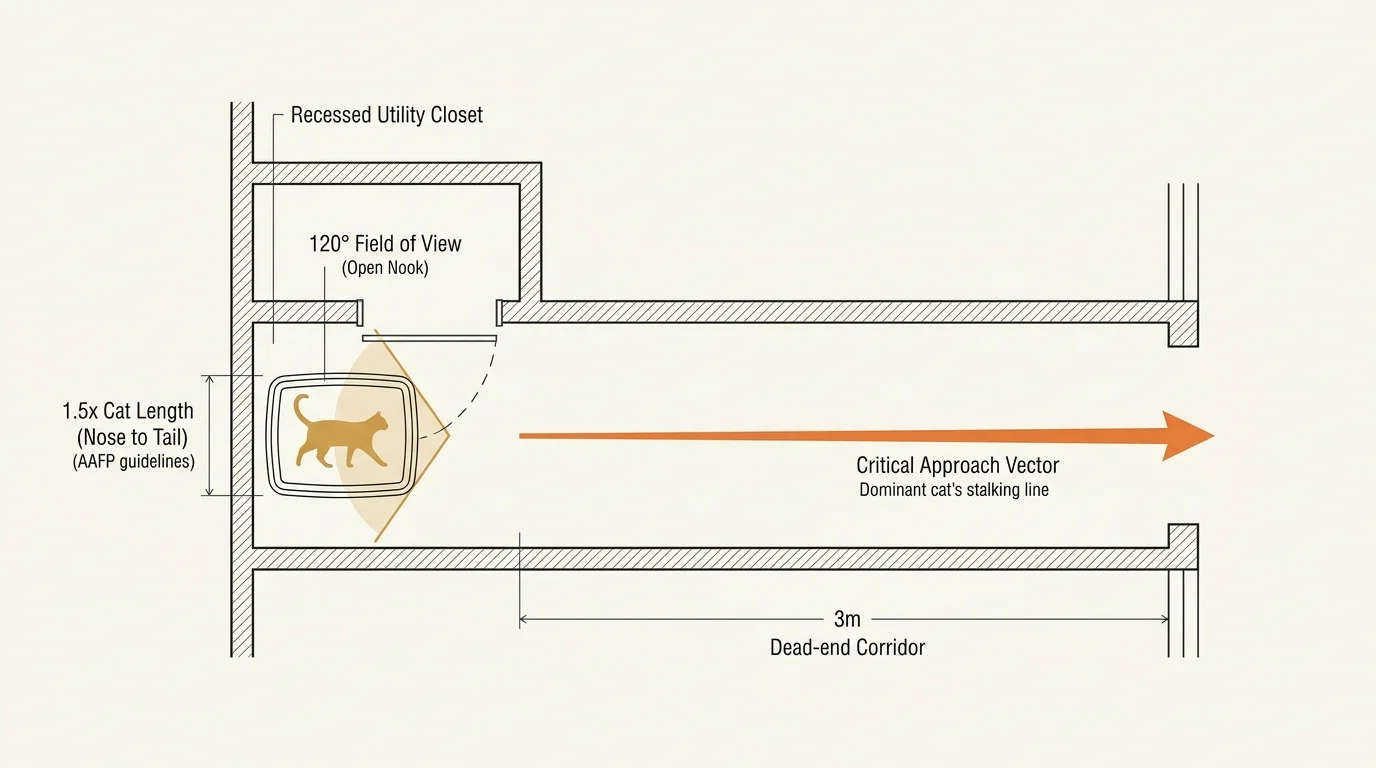
Unfortunately, standard architectural layouts often force multiple pans into single laundry rooms, basements, or recessed hallways. When space constraints compress your layout, physical separation collapses.
AAFP sizing standards dictate that a functional litter box must measure at least 1.5 times the length of the cat from nose to base of tail. Cramped boxes exacerbate spatial claustrophobia when another cat patrols outside.
When an aggressive cat corners a submissive animal inside a blind corridor, traumatic associations form rapidly. The victim cat quickly associates the litter box with entrapment.
The victim cat then seeks alternative, open elimination sites with unobstructed escape routes, such as living room rugs or guest beds. Stopping this behavioral cascade requires intervening before physical contact occurs.

Why Traditional PIR Motion Sensors Fail Multi-Cat Spaces
Standard smart home security sensors rely on passive infrared (PIR) technology to detect moving heat signatures. While inexpensive, PIR sensors cannot manage multi-cat territorial dynamics.
While homeowners often succeed in tuning outdoor PIR sensors to overlook wildlife, indoor feline stalking involves static postures that defeat standard thermal detection entirely.
While proper pet-immune sensor placement can prevent false triggers in standard household walkways, it still cannot track subtle stalking postures.
PIR hardware measures broad thermal variations across wide optical facets. It cannot determine whether an animal moves forward, retreats, or remains stationary.
When a stalking cat prepares an ambush, it drops into a low, motionless crouch near a corridor corner. Traditional PIR sensors register zero motion during this static freeze phase.
Because the PIR sensor believes the corridor is empty, your automation controller clears all active states. The trapped cat emerges directly into an unmonitored ambush.
PIR sensors also lack directional resolution. A PIR sensor cannot differentiate between a cat exiting the litter tray and a cat approaching the threshold.
Without directional tracking, your smart routines fire indiscriminately. Playing warning chimes while the victim tries to eliminate creates severe litter pan aversion.
Hardware Architecture: Directional mmWave Radar and Micro-Zoning
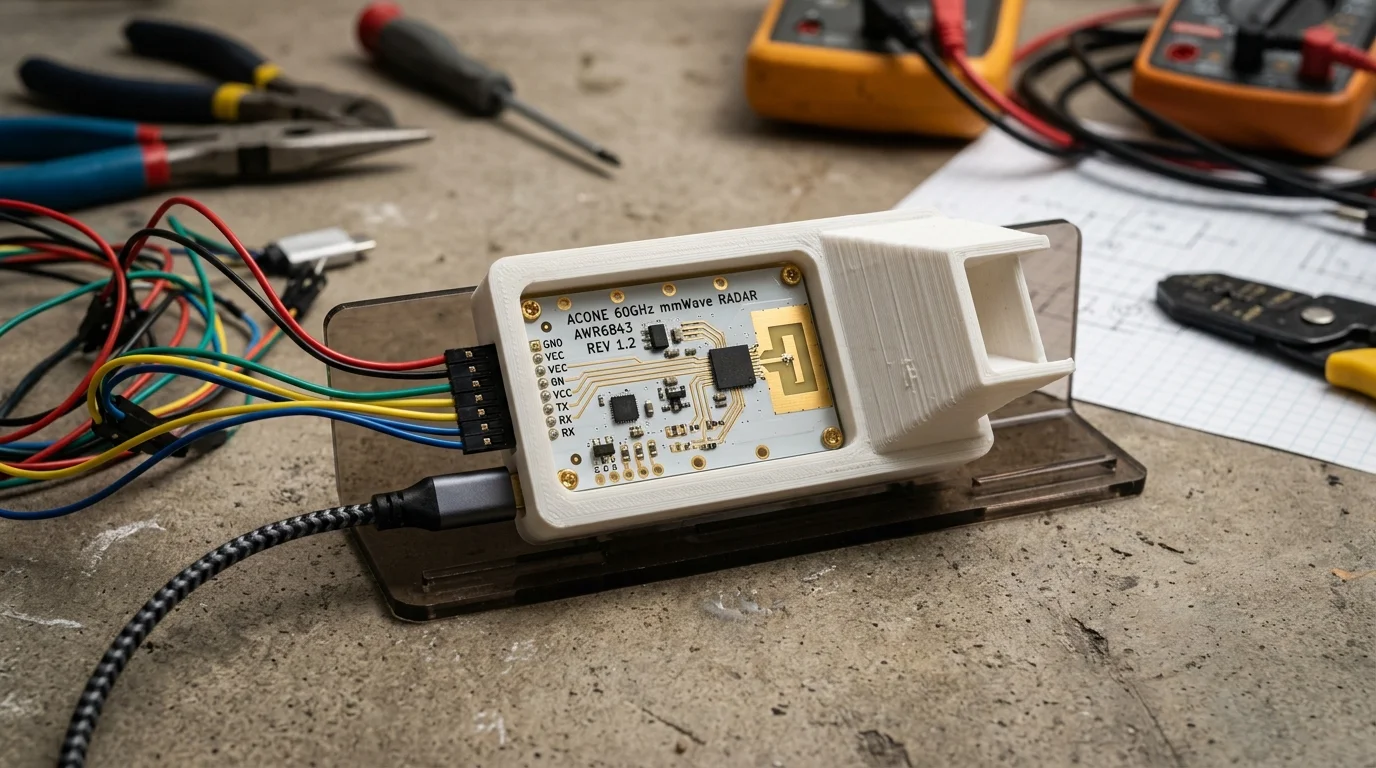
Millimeter-wave (mmWave) radar operates across high-frequency bands between 24 GHz and 60 GHz. Instead of sensing radiant body heat, mmWave sensors emit continuous electromagnetic radio waves.
Pairing progressive lighting with audio frequency step-downs creates gradual sensory transitions that break predatory fixation without triggering panic.
Minimizing local processing delays mirrors the approach used in zero-latency door chimes, where split-second reaction times are vital.
These radar pulses reflect off physical surfaces and living tissue, returning to receiving antennas. Advanced onboard processors calculate target distance, angle, and instantaneous velocity.
The Aqara Presence Sensor FP2, retailing at an MSRP of $82.99, utilizes 60 GHz mmWave radar to track up to five targets simultaneously across a 430-square-foot coverage area. You can divide that single spatial footprint into 30 distinct software micro-zones.
Unlike infrared sensors, 60 GHz radar tracks micro-Doppler phase shifts produced by subtle chest wall expansions during respiration. A cat cannot become invisible to mmWave radar simply by freezing in place.
Connecting your radar sensor via local integration protocols prevents cloud processing lag. Fast local execution ensures immediate automated responses before a stalking cat advances.
Standardizing your local hub on modern standards like the Matter smart home standard keeps automation response times under 200 milliseconds. Rapid sensor-to-switch communication is critical for real-time behavioral redirection.
Step-by-Step Spatial Mapping in a Dead-End Corridor
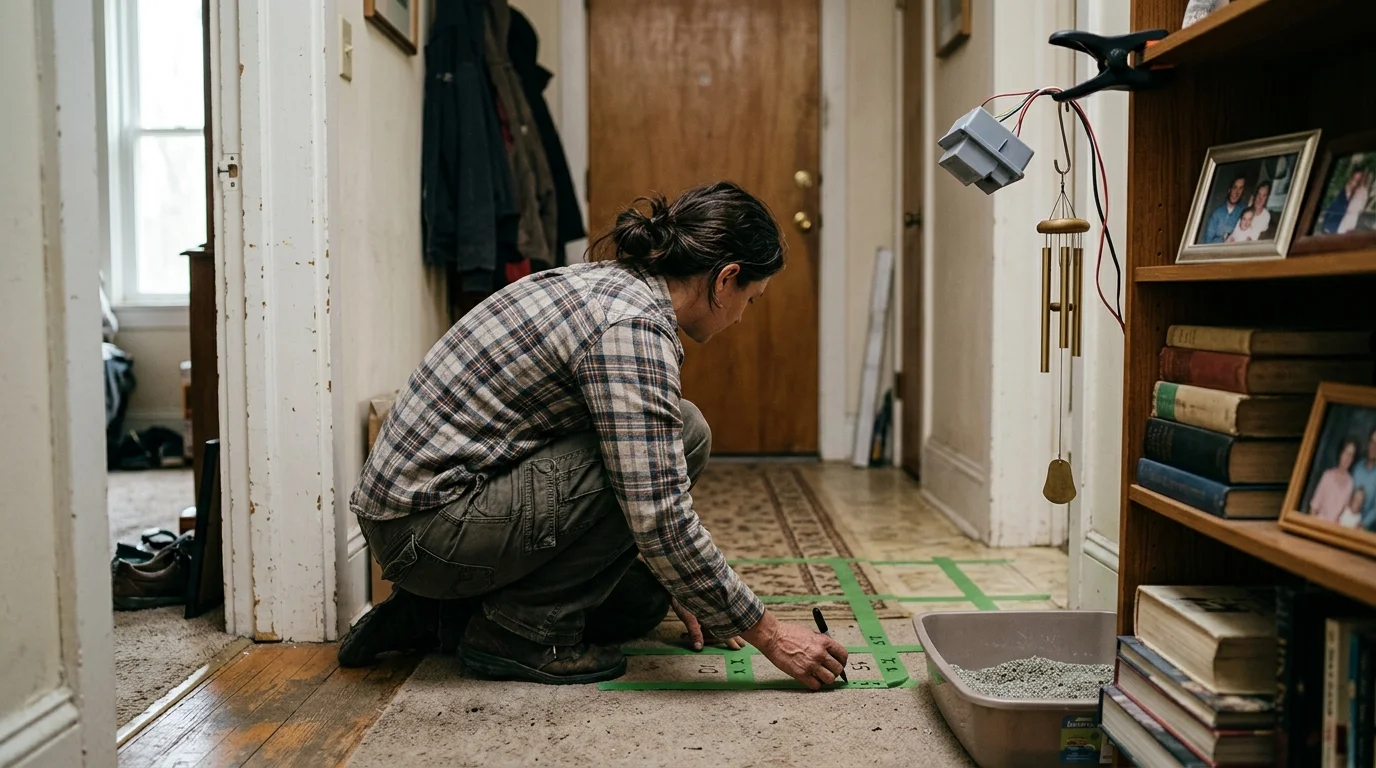
Configuring micro-zones requires establishing a coordinate map that mirrors your corridor’s physical choke points. Precise spatial boundaries prevent false triggers from inside the litter box.
Much like fine-tuning thresholds during vibration sensor calibration, filtering out physical flooring rattles ensures only legitimate pet movement registers.
Mount the radar sensor on a stable vertical surface at feline shoulder height, roughly 12 to 16 inches from the floor. Point the radar antenna array directly down the central corridor axis.
- Mount the sensor facing the litter box approach path using non-marking adhesive or mechanical screws.
- Open your sensor configuration app and define your global detection boundary to exclude ceiling fixtures and adjacent living rooms.
- Create “Zone A: Refuge” encompassing the litter box and a 12-inch perimeter surrounding the tray opening.
- Create “Zone B: Choke Point” spanning the two-foot blind corner where the stalking cat conceals itself.
- Create “Zone C: Approach Corridor” covering the transit runway leading from main living areas toward the corner.
- Configure non-detection zones over oscillating objects like HVAC registers or heavy floor-length curtains.
- Walk your hands or a toy through the mapped zones at floor level to verify coordinate accuracy on your grid.
Keep Zone A and Zone B separated by a neutral buffer of at least 18 inches. Physical separation prevents coordinate overlap when a cat stands near the border.
Test the grid by monitoring the live device map as your cats walk naturally through the hallway. Adjust detection sensitivity from high to medium if ambient floor vibrations trigger ghost targets.
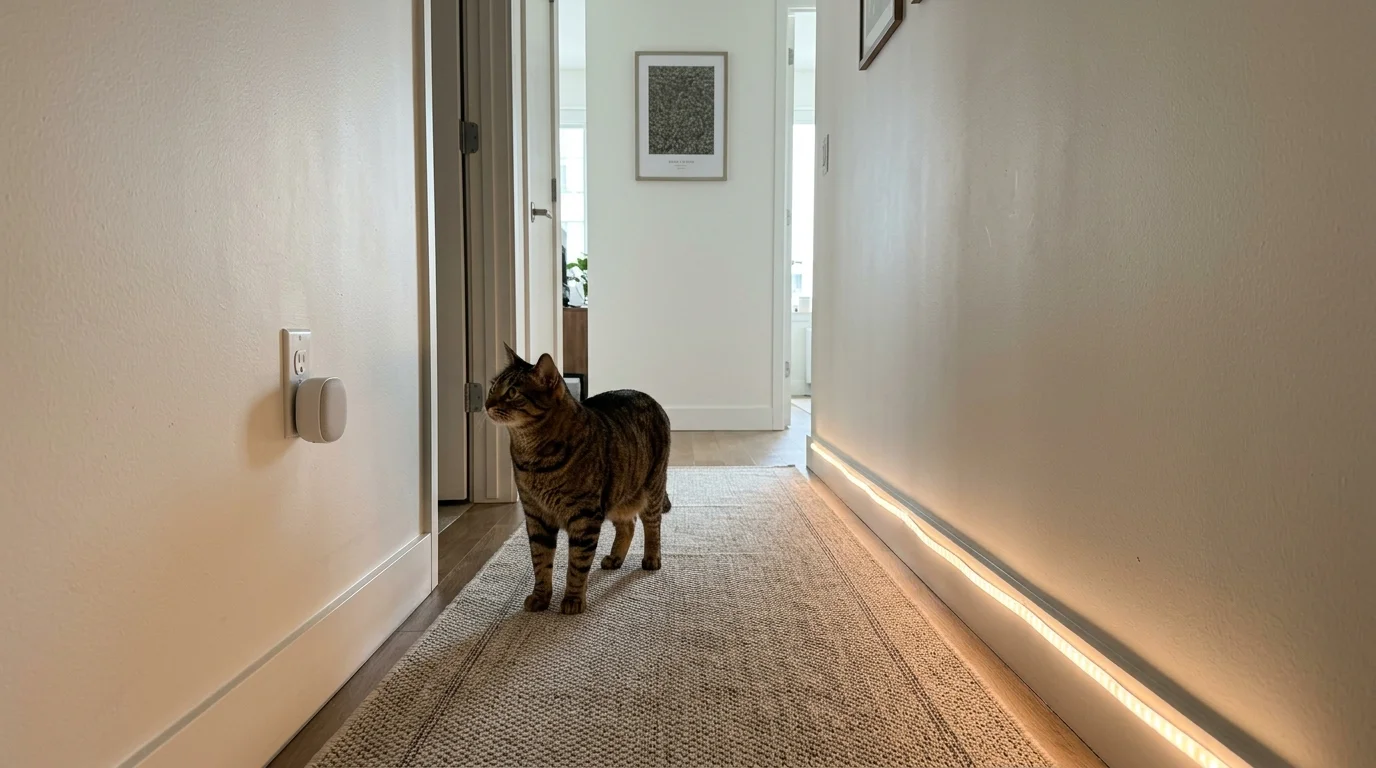
Audio and Visual Deterrent Protocols: Choosing the Right Stimuli
Feline auditory systems detect frequencies from 48 Hz up to 85 kHz, far exceeding the human hearing threshold of 20 kHz. Because cats hear high frequencies intensely, aggressive deterrents can cause psychological harm.
Just as configuring smart speaker alarm frequencies ensures sounds cut through background interference, choosing the right pitch range here prevents ambient home hum from masking gentle chimes.
Applying principles of acoustic null zones and spatial offsets ensures sound carries down the hallway rather than reverberating directly into the litter pan.
Enclosing your corridor light strip in diffused under-rail channels prevents reflective hot spots that could startle an already nervous pet.
Much like managing stressed pets with calming routines for dogs, acoustic interventions must be tuned carefully to avoid inducing fear.
Ultrasonic alarm devices or loud air horns produce extreme panic responses. Traumatizing a stalking cat elevates generalized territorial stress, worsening aggressive resource guarding throughout your home.
The goal is cognitive disruption rather than punishment. A soft, unfamiliar stimulus breaks predatory fixation and redirects the stalking cat’s focus away from the corner.
- Deploy two-tone marimba chimes played between 1 kHz and 4 kHz at a moderate 45 to 50 decibels.
- Install addressable RGBW LED light strips set to warm white (2700K) at 10% baseline floor illumination.
- Shift light strip illumination to an ambient amber glow (590 nm) at 40% brightness when tracking approach vectors.
- Avoid sudden high-frequency tones, strobe lighting, or harsh mechanical buzzers.
- Mount small auxiliary smart speakers six to eight feet down the hallway, directed away from the litter box.
Directing audio cues down the hallway encourages the stalking cat to turn its head toward the sound source. Turning around instantly breaks the physical stalking vector.
Independent smart home evaluations from PCMag smart home guides confirm that local smart speakers reliably execute low-latency media cues without audible clipping. Reliable execution prevents missed redirection windows.

Automation Logic: Advanced Conditional Routines and State Engines
Simple motion triggers cannot evaluate feline behavioral intent. You must build a state machine using multi-condition conditional logic inside Home Assistant or your preferred hub.
Implementing failsafe debounce logic prevents rapid state fluttering whenever a cat lingers directly along the boundary between two micro-zones.
Your automation must track sequential zone transitions. The system must verify that a cat occupies the box before triggering warnings for corridor movements.
Begin by creating an input boolean helper named “Litter Box Occupied.” This virtual switch tracks whether your vulnerable cat currently uses the elimination station.
- Create an automation that turns “Litter Box Occupied” ON when mmWave Zone A detects continuous presence for three seconds.
- Create an automation that turns “Litter Box Occupied” OFF when mmWave Zone A remains clear for five seconds.
- Build the intercept automation using “Zone C enters Occupied state” as the primary trigger.
- Add a logic condition requiring “Litter Box Occupied” to equal ON before proceeding.
- Add a directional condition verifying that target velocity tracks toward Zone B rather than away from it.
- Set the action sequence to play a 48 dB acoustic chime on the hallway speaker for two seconds.
- Simultaneously ramp the hallway accent lights to 40% amber over a 1.5-second transition.
If target tracking indicates an animal exits from Zone A toward Zone C, the automation aborts. An exiting cat must never trigger acoustic chimes or light shifts.
Add a 30-second cooldown timer to the primary intercept routine. Cooldown limits prevent rapid chime loops if an animal paces back and forth along the boundary.
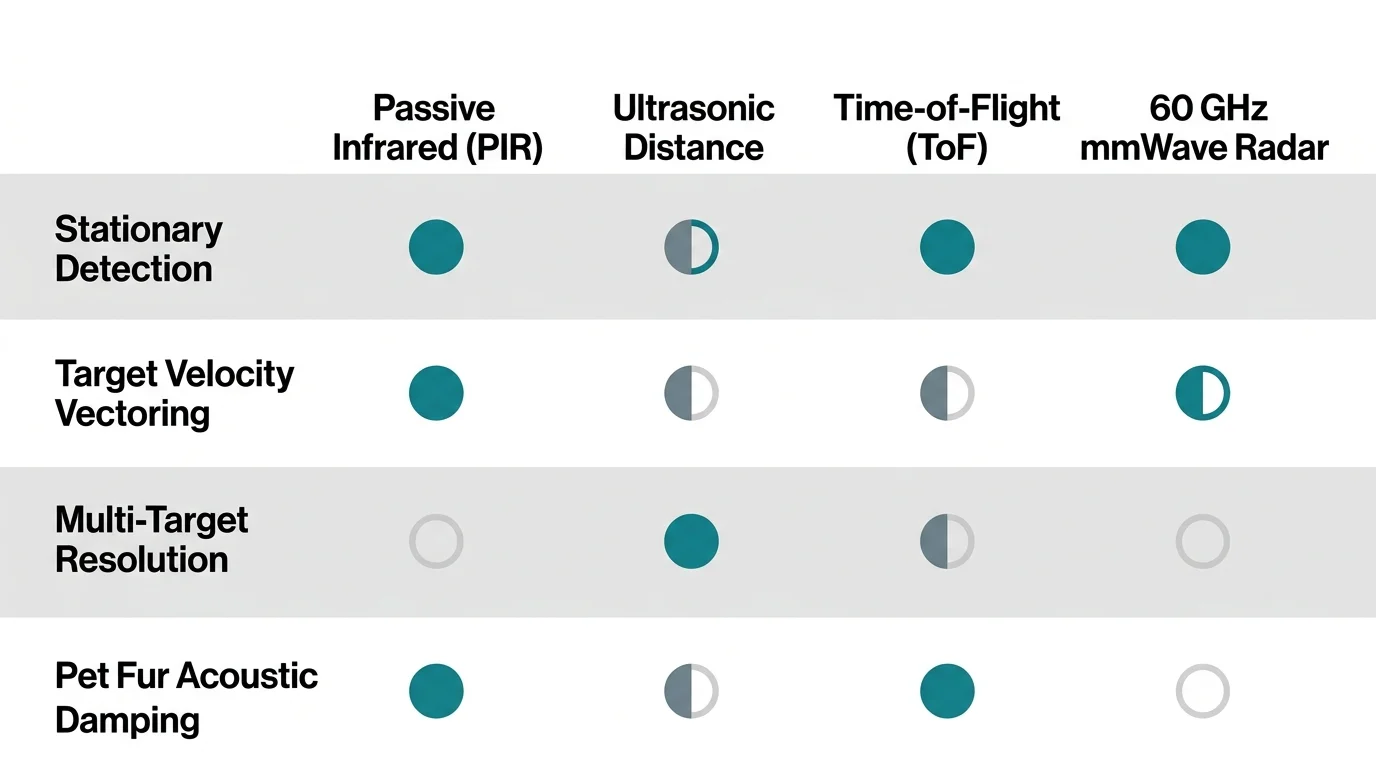
Sensor Comparison for Pet Micro-Zone Tracking
Selecting the right tracking technology determines whether your de-escalation system succeeds or causes erratic triggers. Pet-specific tracking requires high spatial precision and continuous static target detection.
| Technology Type | Micro-Zoning Precision | Static Target Detection | False Trigger Risk | Hardware Cost Range |
|---|---|---|---|---|
| 60 GHz mmWave Radar | Sub-meter (Grid cells) | Yes (Respiration tracking) | Low (Software masked) | $70 – $90 |
| Passive Infrared (PIR) | None (Broad cone) | No (Blind to stationary pets) | Medium (Thermal drafts) | $15 – $35 |
| Optical AI Vision (Cameras) | High (Pixel bounding boxes) | Yes (Visual recognition) | Medium (Shadow variations) | $60 – $150 |
| Active Infrared Breakbeam | Point-specific (Tripwire) | No (Triggered only on break) | High (Tail swings/pets) | $25 – $50 |
While optical camera systems identify individual animal markings, video processing introduces latency. Video feeds also introduce severe data privacy concerns inside private household areas.
Breakbeam sensors provide instant triggers but only monitor a narrow physical line. Cats easily leap over optical beams or slip beneath low-mounted sensors.
High-frequency mmWave radar provides the optimal balance of spatial granularity, static target monitoring, and immediate local data delivery. Radar data preserves privacy while capturing critical positional metrics.
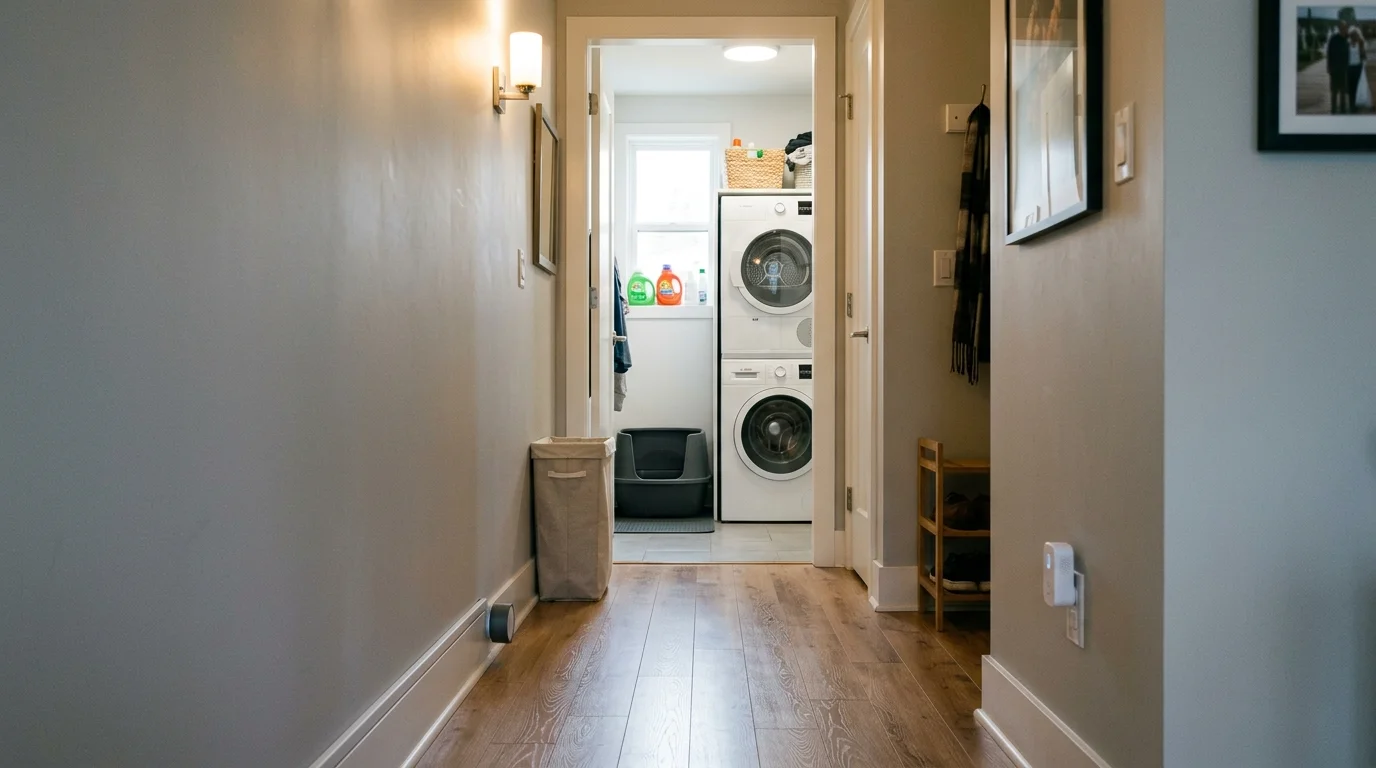
Real-World Implementation: A Worked Corridor Example
Consider a 12-foot by 3.5-foot residential corridor leading to a recessed laundry alcove. In this scenario, “Leo” (a 13-pound dominant male) regularly traps “Milo” (a 9-pound timid male) inside the litter area.
The system utilizes one Aqara Presence Sensor FP2 ($82.99), an existing smart speaker ($39.99), and a Zigbee-controlled RGBW LED light strip ($24.99). Total project equipment expenditure equals $147.97.
The corridor is divided into an 8×3 grid in the sensor app, allocating cells across three functional sectors. Zone A covers cells 1–2 (the pan), Zone B covers cells 3–4 (the corner), and Zone C spans cells 5–8 (the runway).
At 8:14 AM, Milo enters the laundry alcove and steps into Zone A. The mmWave sensor confirms occupancy within 180 milliseconds, switching the “Litter Box Occupied” boolean to ON.
At 8:15 AM, while Milo is eliminating, Leo rounds the living room threshold and enters Zone C at 0.5 meters per second. The radar detects incoming trajectory toward Zone B.
Because the boolean state is ON, the smart hub triggers immediately. The hallway light strip transitions from off to 35% amber, and the speaker sounds a 46 dB marimba chime.
Hearing the chime behind him, Leo halts his forward stride and turns his head toward the speaker. This brief two-second pause breaks his hunting fixation, causing him to sit down in Zone C.
Milo completes elimination unmolested and walks down the corridor past Leo without being trapped against the wall. The entire sequence executes autonomously without human presence.

Troubleshooting False Triggers and Habituation
Feline habituation represents a primary operational challenge in automated deterrent systems. If an intelligent cat hears the exact same acoustic chime daily, the cue loses its redirection value.
Prevent habituation by creating a media playlist containing five distinct, non-threatening acoustic tracks. Program your automation engine to cycle through these sound files sequentially on each trigger.
Use short marimba runs, muted kalimba arpeggios, gentle acoustic guitar plucks, and ambient water droplet chimes. Keep all tracks within the 1 kHz to 4 kHz range at identical peak volumes.
False triggers can occur if your radar detects moving air currents from heating vents or robotic vacuums. Inspect your real-time spatial map during HVAC runtime to identify ghost interference.
Add small rectangular exclusion masks over moving heating registers within the sensor management app. Setting tracking sensitivity to medium eliminates ghosting while reliably tracking targets weighing over five pounds.
Periodically review system logs to cross-reference trigger timestamps against litter box cleanliness. Documenting these routines verifies that your timid cat eliminates comfortably without defensive hesitation.
Frequently Asked Questions
Will deterrent chimes scare the cat currently using the litter box?
Position directional smart speakers at least six to eight feet outside the litter box zone, angled down the approach corridor. Low-volume chimes between 45 and 50 decibels distract the approaching cat without penetrating the box area.
Can an mmWave sensor distinguish between two cats of similar size?
Consumer mmWave radar tracks moving targets by coordinate position and velocity rather than biometric weight. The automation relies on spatial occupancy sequences—which zone was entered first—rather than individual feline recognition.
Why not use an ultrasonic deterrent to stop feline ambushes?
Ultrasonic devices cause acute acoustic distress and generalized panic across all pets in your home. Gentle audible chimes between 1 and 4 kilohertz merely interrupt predatory hyper-focus without causing anxiety or box aversion.
How does mmWave radar track a cat that freezes in place?
High-frequency 60 GHz radar detects microscopic chest wall displacements caused by respiration. Even when a stalking cat freezes into an ambush posture, the sensor maintains an active target lock.
Disclaimer: This article is for informational purposes only. Smart home devices involve electrical connections and data privacy. Always follow manufacturer instructions for installation. For complex wiring or HVAC work, consult a licensed professional.



1 Comment