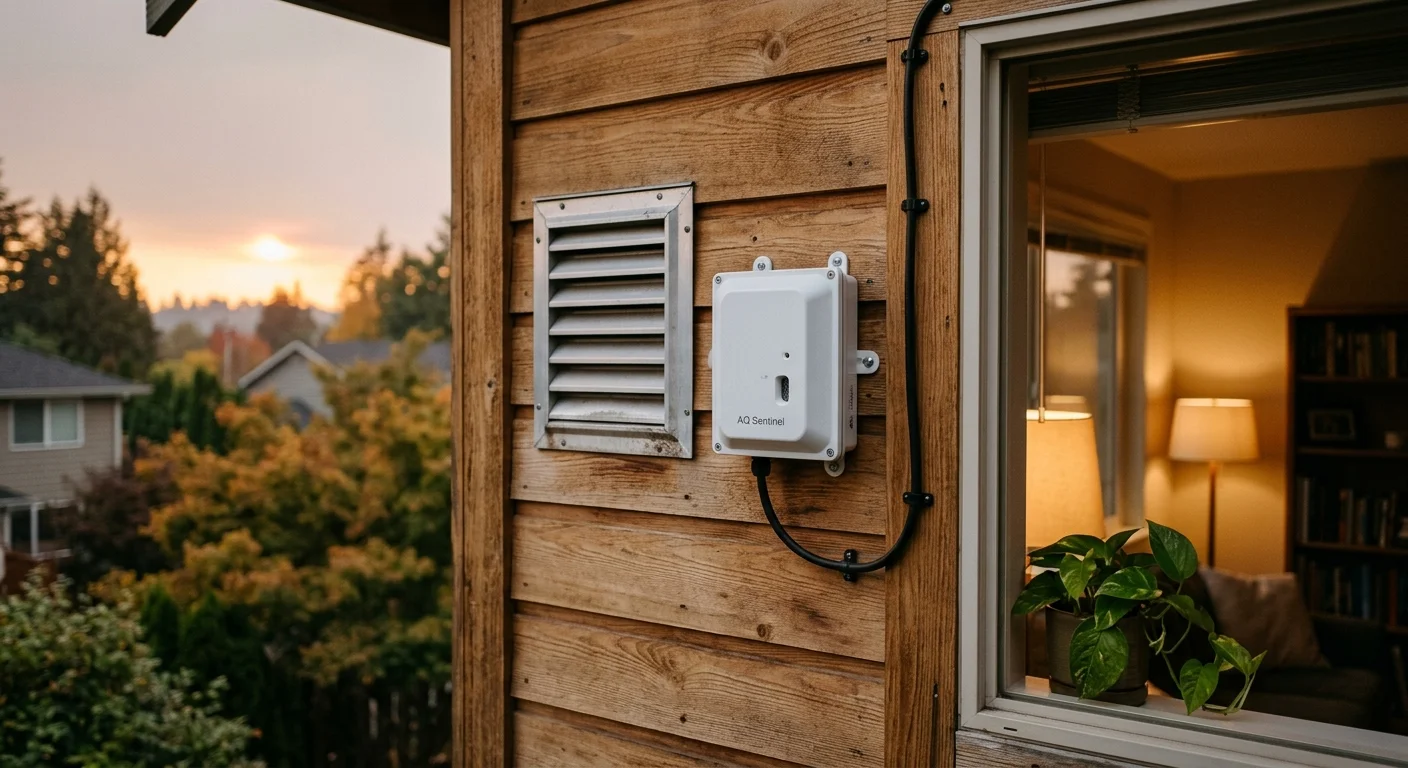
If severe asthma leaves you vulnerable to seasonal pollen plumes or wildfire smoke, your home ventilation system is actively working against you. Most fresh air intakes pull outdoor air inside on a rigid timer, regardless of pollution levels.
Integrating your dampers into a broader smart home emergency alert system also ensures your household is instantly notified the moment outdoor air turns hazardous.
You can eliminate this hazard by pairing an outdoor laser particle sensor directly with a motorized intake damper and staging indoor filtration. This setup seals your home in seconds when outdoor particulates spike, creating an automated respiratory safe haven.
Standard smart thermostats lack native particle-based ventilation logic, but a local dry-contact relay closes that gap cleanly without cloud delays.

Why Standard Fresh Air Ventilation Threatens Sensitive Lungs
Modern building standards mandate continuous or intermittent outdoor air exchange to dilute indoor carbon dioxide and volatile organic compounds. Standard ASHRAE 62.2 governs residential ventilation rates, requiring dedicated mechanical intakes that draw outside air directly into your central ductwork.
Just as coastal properties utilize barometric pressure automations for storm prep to seal vulnerable openings, automated ventilation control seals your ductwork before particulate surges enter living spaces.
While many homeowners create weather-based smart home automations to adjust climate controls to local forecasts, managing particulate surges demands automated, localized sensor triggers.
These intake ducts rely on motorized or barometric dampers wired directly to furnace control boards. Most systems cycle on an unmanaged schedule, pulling outside air into your return plenum every twenty minutes.
This design assumes outdoor air is always cleaner than indoor air. For someone managing allergic asthma downwind from agricultural burnings or spring tree pollen blooms, this mechanical assumption triggers acute respiratory distress.
Intact tree, grass, and weed pollen grains typically range from 10 to 100 micrometers in aerodynamic diameter. Standard media filters catch intact grains with moderate efficiency when seated firmly inside the filter rack.
However, thunderstorm downdrafts and high relative humidity break these pollen grains into sub-micrometer fragments through osmotic shock. These respirable fragments measure well under 2.5 micrometers, matching the size profile of wildfire smoke particles.
Microscopic particles bypass your upper airway defenses entirely, penetrating deep into the pulmonary alveoli. When wildfire smoke rolls through, the threat escalates rapidly from annoying mucosal irritation to severe systemic inflammation.
On May 6, 2024, the United States Environmental Protection Agency tightened the annual PM2.5 National Ambient Air Quality Standard to 9.0 micrograms per cubic meter. This update lowered the breakpoint for the Moderate Air Quality Index band.
Federal agencies urge vulnerable populations to set central HVAC systems to full recirculation during smoke events. Waiting for local news alerts or regional Air Quality Index reports introduces hours of dangerous exposure lag.
By the time a municipal monitoring station twenty miles away logs a Code Orange event, your intake duct has already pumped millions of particles into your bedroom. Direct sensor-to-damper automation eliminates that latency entirely.
Hardware Architecture: Optical Monitors, Relays, and Dampers
Building a robust defense system requires three core components: an optical outdoor particulate counter, a low-voltage dry-contact relay, and a motorized duct damper. Each device must communicate reliably across your local network without reliance on third-party cloud servers.
This design philosophy mirrors setting up offline smart thermostat fail-safes, where local device rules guarantee system reliability even during total network outages.
While outdoor laser counters guard against airborne pollution, maintaining interconnected smart smoke and CO detectors ensures your home remains protected against indoor combustion hazards as well.
Your outdoor air monitor must use dual laser optical scattering sensors to report accurate PM2.5 mass concentrations in real time. Units like the PurpleAir PA-II or AirGradient Open Air shine laser diodes through an internal detection chamber.
As airborne particles cross the laser beam, light scatters onto an onboard photodiode detector. Internal microprocessors translate those electrical pulses into microgram-per-cubic-meter mass values across microsecond intervals.
For actuation, you need a smart relay capable of switching isolated low-voltage alternating current circuits. The Shelly Plus 1 operates via local Wi-Fi or Bluetooth, providing dry contacts that handle 24-volt HVAC signals without passing line voltage.
Z-Wave enthusiasts can deploy the Zooz ZEN17 MultiRelay, which provides dual isolated relays powered by 12-to-24-volt direct or alternating current. Both devices execute commands within 200 milliseconds of sensor state changes.
The final physical boundary is the motorized damper installed inside your fresh air intake duct. Damper actuators run on 24VAC power supplied by your central air handler or a dedicated plug-in transformer.
You can verify cross-platform communication capabilities by checking device compatibility on the Matter Smart Home Standard registry. Local protocols keep your automated defenses fully functional during neighborhood internet outages.
| Device Model | Hardware Category | Electrical Requirements | Communication Protocol | Key Performance Specification | Approximate Retail Price |
|---|---|---|---|---|---|
| AprilAire 6506 | Motorized Round Damper | 24VAC, 10VA (Spring Return) | Hardwired 2-wire control | Normally Closed; 90-degree sweep in 12 seconds | $165 |
| Honeywell Home EARD6 | Motorized Round Damper | 24VAC, 8VA (Power Close) | Hardwired 2-wire control | Normally Open; spring-return power closure | $115 |
| Shelly Plus 1 | Dry-Contact Smart Relay | 110–240VAC or 12–24VDC | Wi-Fi (802.11 b/g/n), Bluetooth | 16A dry contact; sub-200ms local execution | $19 |
| Zooz ZEN17 MultiRelay | Isolated Low-Voltage Relay | 12–24V AC/DC or USB-C | Z-Wave Plus (800 Series) | Dual dry-contact relays, 10A resistive rating | $38 |
| AirGradient Open Air | Outdoor PM2.5/PM10 Monitor | 5VDC via USB-C (2.0A) | Wi-Fi, Native ESPHome / Local API | Dual Plantower PMS5003 laser counters | $168 |
| PurpleAir PA-II | Outdoor Particle Monitor | 5VDC via Outdoor USB Adapter | Wi-Fi, Direct Local JSON API | Dual laser sensors with cross-channel averaging | $279 |
Selecting between Normally Open and Normally Closed dampers determines your mechanical failure state. A Normally Open damper requires active power to hold shut during smoke events.
A Normally Closed damper remains sealed by mechanical spring tension until your automation actively applies 24VAC power to vent fresh air. For asthma defense, Normally Closed provides superior fail-safe protection during sudden electrical outages.
Independent hardware reviews on Wirecutter Smart Home emphasize using dedicated local hardware rather than proprietary closed hubs. Local execution prevents cloud downtime from leaving your ventilation damper locked open during a sudden pollution surge.
Low-Voltage Wiring: Installing an Inline 24VAC Relay
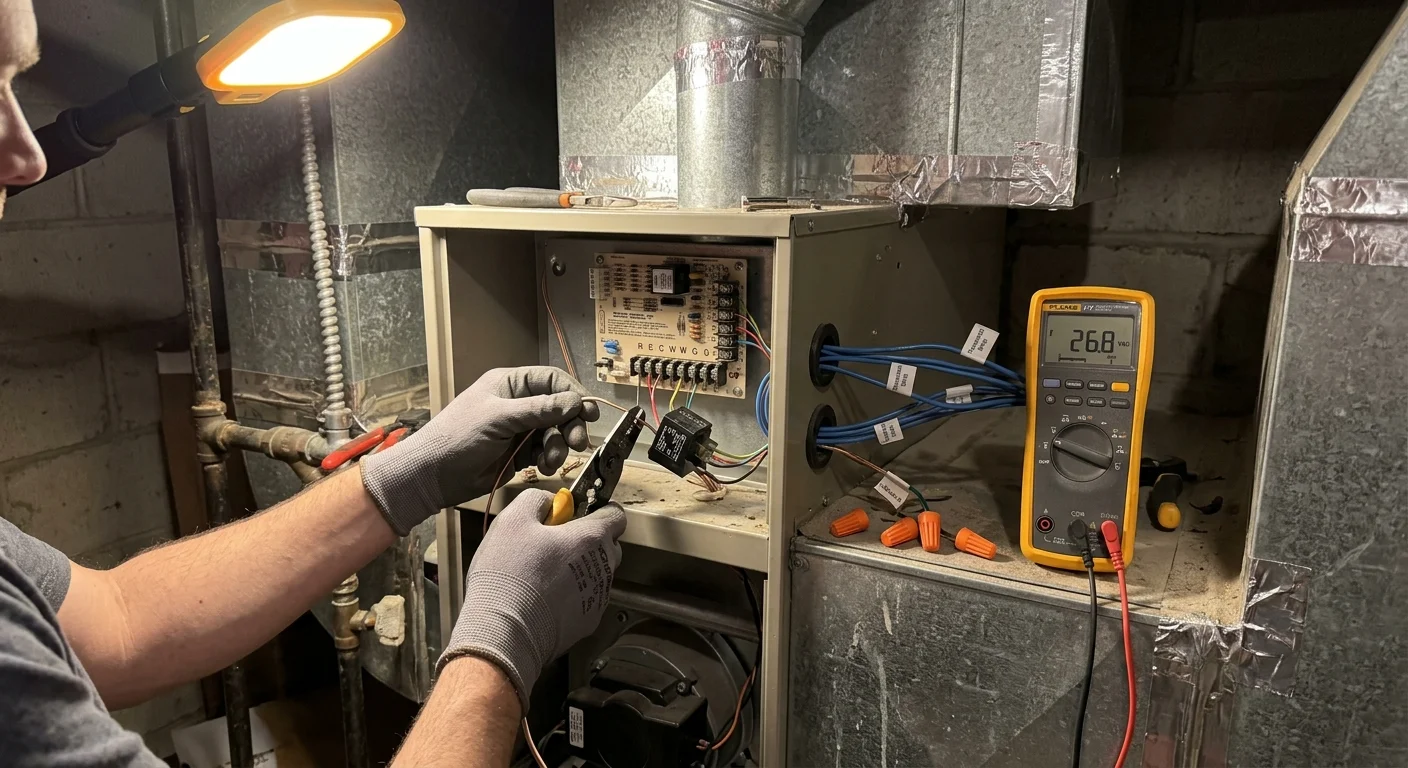
Wiring an inline relay requires basic familiarity with low-voltage HVAC circuits. Your HVAC system powers thermostats and zone accessories using an internal transformer that converts 120VAC household current into 24VAC.
Unlike replacing high-voltage line-voltage thermostats that handle dangerous 240V loads, 24VAC damper circuits operate safely within standard Class 2 low-voltage limits.
If you plan to house your relay in a dedicated electrical enclosure near the furnace, consult our guide on installing smart relays in metal boxes to manage box fill and heat dissipation safely.
Working with low voltage minimizes severe shock hazards, but shorting 24VAC lines directly to common grounds will blow the low-voltage fuse on your furnace motherboard. Always switch off power at the main HVAC service disconnect before touching wiring.
- Disconnect household electrical power from your HVAC air handler and external ventilation transformers.
- Locate the 2-wire low-voltage control cable running from the ventilation timer or furnace control board to the intake damper actuator.
- Identify the 24VAC hot wire and the 24VAC common return wire using a digital multimeter set to continuity mode.
- Cut and strip the 24VAC hot wire that powers the damper motor, exposing three-eighths of an inch of bare copper.
- Insert the supply side of the stripped 24VAC hot wire into the Input terminal of your dry-contact smart relay.
- Insert the load side running to the damper actuator motor into the Output terminal of your relay.
- Connect dedicated 24VAC power and common wires to the smart relay operating terminals to power the relay board continuously.
- Restore circuit breaker power, verify indicator lights, and manually toggle the relay via your hub interface to verify physical damper movement.
If you use an AprilAire 8140 series fresh air intake system, the motorized damper sits inside an insulated powered housing. You can wire the dry-contact relay across the system external override terminals rather than slicing into structural motor leads.
Always route low-voltage lines through plastic grommets when entering metal ductwork or junction boxes. Sharp duct edges wear through copper insulation over time, causing intermittent short circuits.
“The best smart home is the one you don’t have to manage.”
Once wired, set the relay default power-on state in your smart hub configuration software. Ensure the relay returns to its safe isolation state if a transient voltage spike interrupts local power.
Worked Engineering Scenario: Component Sizing, Response Times, and Costs
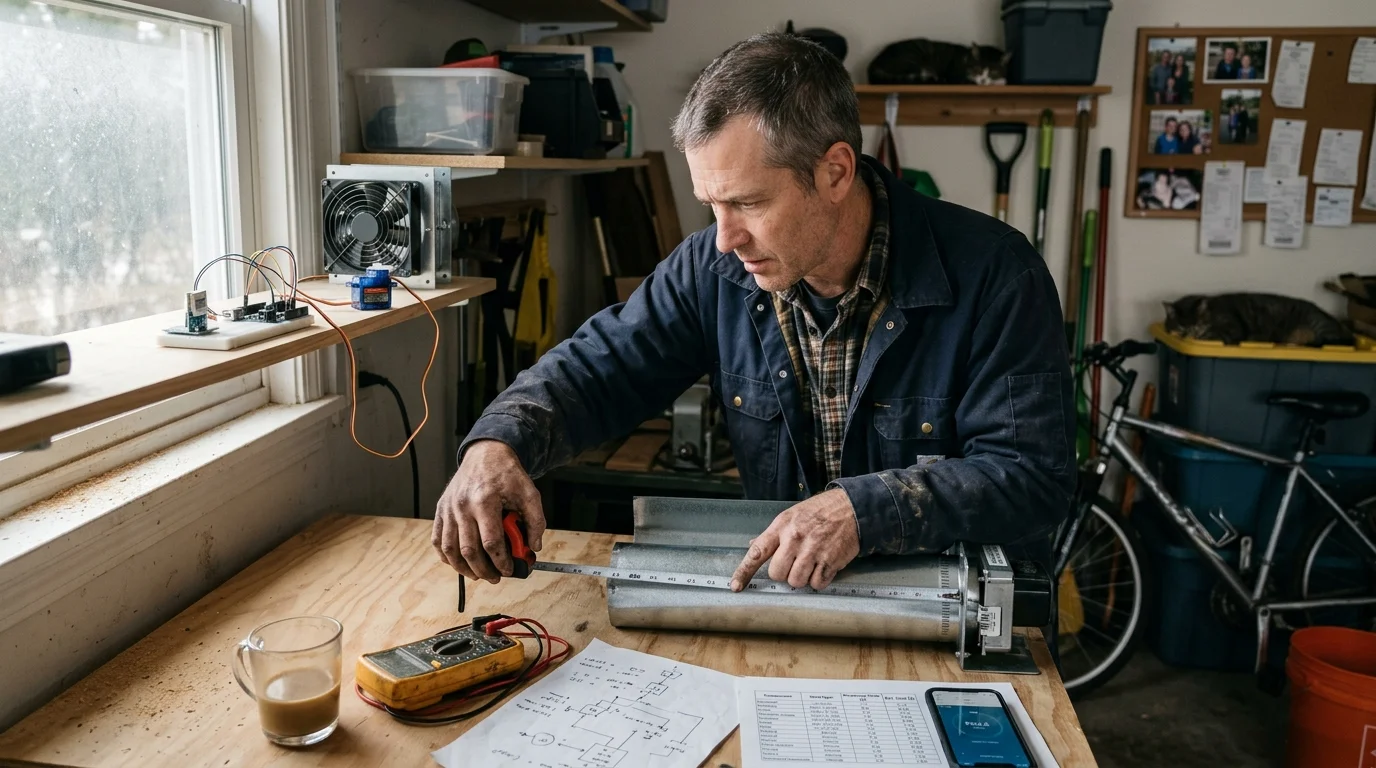
Consider a 2,400-square-foot ranch home located two miles downwind from agricultural fields and foothills in Yakima County, Washington. The resident lives with severe allergic asthma and requires continuous particulate protection during harvesting and late-summer smoke plumes.
This mechanical cutoff functions similarly to smart recirculation valve control in freeze prevention systems, using localized sensor triggers to isolate critical household infrastructure.
Implementing failsafe debounce logic in your automation rules prevents the motorized damper from rapidly cycling open and closed when readings fluctuate near threshold boundaries.
The house features an 8-inch round fresh air intake duct routed directly into the central HVAC return air plenum. Under normal conditions, an intermittent ventilation control board opens the damper for twenty minutes every hour, introducing 140 cubic feet per minute of outside air.
The hardware investment includes an AprilAire 6506 8-inch Normally Closed motorized damper costing $165. A Shelly Plus 1 dry-contact relay adds $19, and an AirGradient Open Air monitor mounted on the north eaves adds $168.
Auxiliary supplies include fifty feet of 18/2 solid thermostat wire, an inline 3-amp blade fuse, and an external 24VAC 40VA step-down transformer. These components cost $36, bringing the total hardware expenditure to $388.
On August 14, an active wildfire plume descends across the valley, raising ambient outdoor particulate concentrations rapidly. The AirGradient monitor measures an outdoor PM2.5 spike from 7.4 micrograms per cubic meter to 18.2 micrograms per cubic meter at 2:14:00 PM.
The local monitoring integration polls sensor readings every ten seconds via a local HTTP REST call. At 2:14:10 PM, your automation controller registers the threshold violation and executes a local cutoff sequence.
The controller sends a local Wi-Fi payload commanding the Shelly Plus 1 relay contacts to open, interrupting the 24VAC circuit at 2:14:11 PM. De-energizing the circuit allows the internal heavy-duty spring mechanism to pull the damper blade shut.
The AprilAire 6506 actuator completes its 90-degree mechanical sweep in exactly 12 seconds, sealing the gasketed metal blade against the duct housing at 2:14:23 PM. From initial particle spike to complete duct closure, exactly 23 seconds elapse.
This rapid isolation halts the entry of 140 cubic feet of unfiltered, smoke-laden air every minute. The resident’s indoor air quality remains at 2.1 micrograms per cubic meter throughout the afternoon firestorm.
Building the PM2.5 Automated Damper Logic
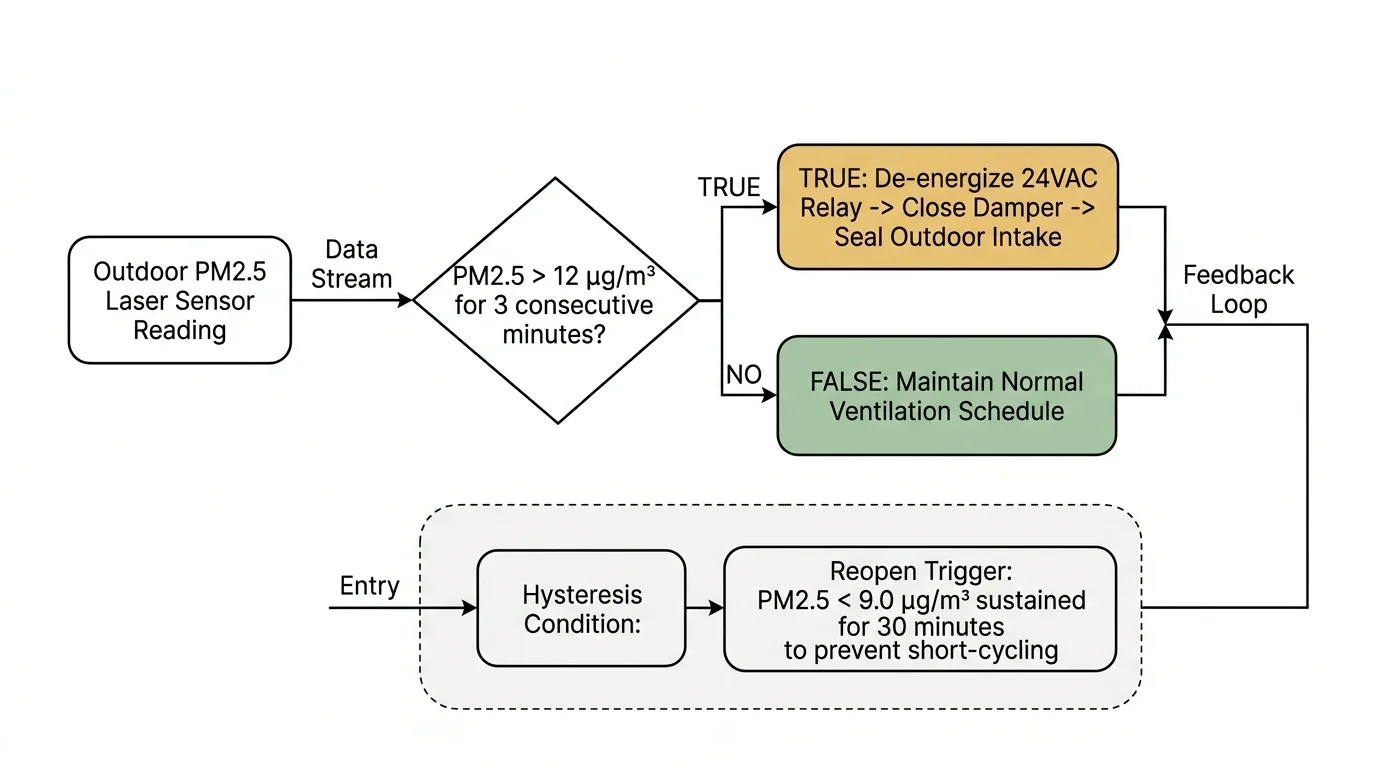
A smart routine for respiratory defense requires strict thresholds, validation timers, and hysteresis buffers. Triggering closures directly on single raw data points introduces mechanical relay chattering caused by transient dust puffs.
To ensure complete awareness when outdoor pollution escalates, you can link your damper logic into a broader smart home emergency alert system to notify your family immediately.
Your primary trigger must monitor the 2-minute rolling average of outdoor PM2.5 mass concentration. While EPA regulations consider 35.5 micrograms per cubic meter as Code Orange, an asthma defense baseline requires a lower setpoint.
Configure your automation trigger to fire whenever outdoor PM2.5 exceeds 15.0 micrograms per cubic meter for more than 120 seconds. This captures early-stage smoke intrusion and thunderstorm pollen rupture before irritants penetrate your living areas.
- Automation Name: PM2.5 Automated Damper Isolation Sequence
- Trigger: Outdoor PM2.5 entity value climbs above 15.0 µg/m³ for two continuous minutes.
- Condition: Intake damper relay state equals “ON” (circuit energized, duct open).
- Immediate Action 1: Send command to switch dry-contact relay state to “OFF” (cut 24VAC power to spring-return damper).
- Immediate Action 2: Set central thermostat fan control mode from “Auto” to “Continuous On” or “Recirculate.”
- Immediate Action 3: Send a priority alert notification to your mobile phone detailing the outdoor particulate reading.
- Verification Delay: Wait 30 seconds, then confirm the relay switch status matches the closed command.
Equally critical is the reopening automation that restores standard ASHRAE ventilation when outdoor air clears. Premature reopening exposes your home to lingering localized smoke pockets.
Build an independent restoration automation requiring outdoor PM2.5 to fall below 8.0 micrograms per cubic meter for at least 45 continuous minutes. This substantial deadband prevents the motorized actuator from cycling on and off repeatedly during shifting wind directions.
If your smart home platform supports Home Assistant, manage this logic via native YAML scripts or graphical automations using local template sensors. Hubitat users can execute identical state monitoring using Rule Machine with isolated local variables.
Staging the Smart Home Air Quality Allergy Routine
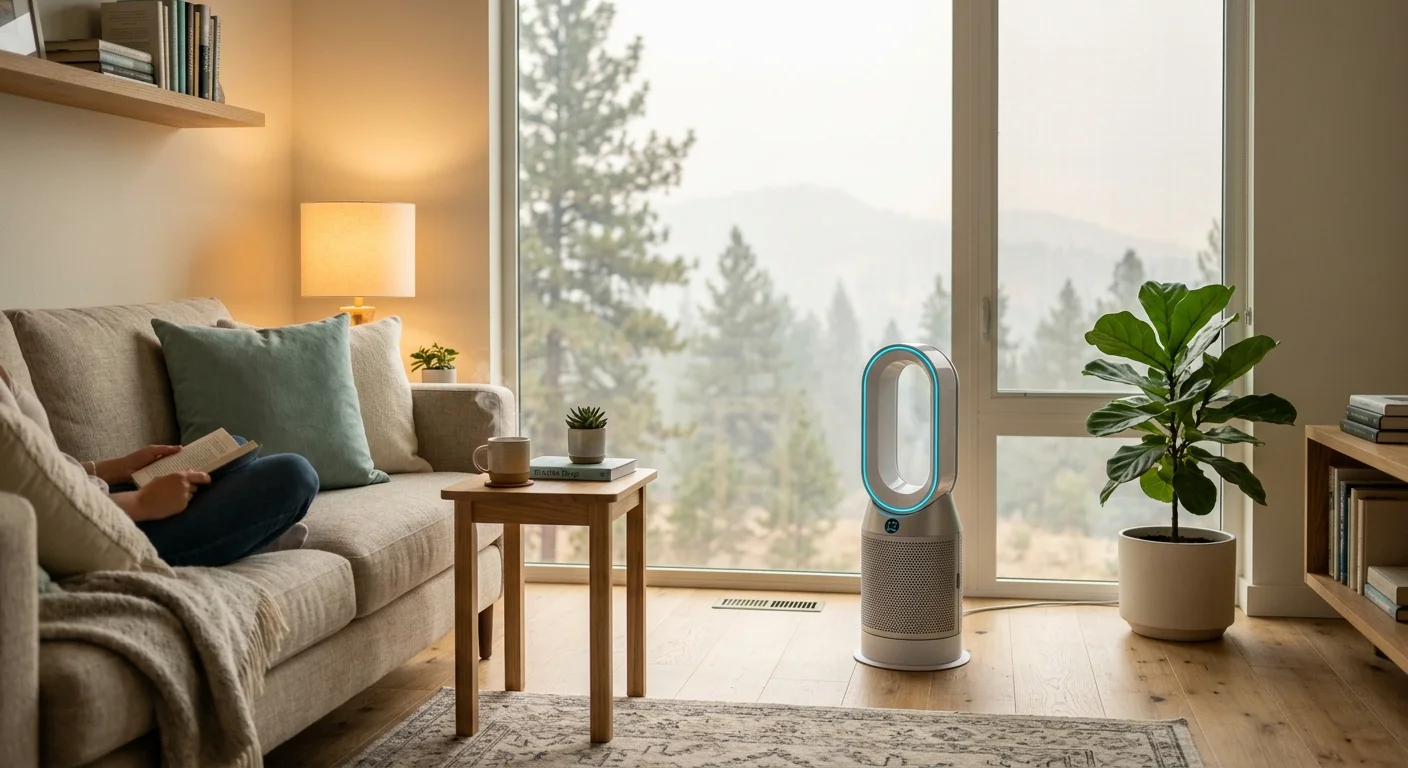
Closing your intake damper stops external pollution from entering, but it does not remove the particulates already suspended in indoor air. An effective wildfire smoke smart routine coordinates your central blower and standalone room air cleaners in progressive stages.
Stage One executes simultaneously with damper closure. Your smart hub commands your connected thermostat to switch the central blower from intermittent cycling to continuous circulation.
Consulting guidelines from Energy Star Smart Thermostats reveals that continuous fan operation improves air quality dramatically when paired with high-efficiency filters. Your HVAC media cabinet must house a genuine MERV 13 or MERV 14 filter rack to trap microscopic smoke.
MERV 13 media captures more than 50 percent of sub-micrometer particulates between 0.3 and 1.0 micrometers, and over 85 percent of particles up to 3.0 micrometers. Continuous circulation pulls indoor air through this filter matrix four to six times per hour.
Stage Two coordinates smart HEPA purifiers placed throughout your home. While central systems handle whole-home baseline circulation, portable HEPA purifiers provide focused Clean Air Delivery Rate capacity in primary living areas.
- Stage 1 (Outdoor PM2.5 > 15 µg/m³): Fresh air damper closes; central HVAC fan switches to continuous recirculation mode.
- Stage 2 (Indoor PM2.5 > 5 µg/m³): Bedroom and office HEPA air purifiers ramp up from whisper-quiet sleep mode to 50 percent fan speed.
- Stage 3 (Indoor PM2.5 > 12 µg/m³): All portable HEPA units ramp to maximum turbo velocity; secondary electrostatic filters activate.
- Stage 4 (Indoor PM2.5 > 25 µg/m³): Hub issues audible verbal announcements and disables all bathroom and kitchen exhaust fans to prevent house depressurization.
This staged response creates a dynamic smart home air quality allergy routine that conserves energy during mild days but delivers massive CADR during emergencies. You achieve hospital-grade air cleaning without manually touching a single control dial.
Depressurization defense is an essential component of this staged sequence. Running high-volume kitchen range hoods while your fresh air intake is sealed creates negative pressure inside your building envelope.
Negative pressure draws unconditioned, smoke-laden outdoor air through door weatherstripping, window gaps, and electrical outlet cutouts. Automating an exhaust-fan interlock protects your home pressure balance until outdoor air quality returns to baseline levels.
Preventing Short-Cycling and Humidity False Positives
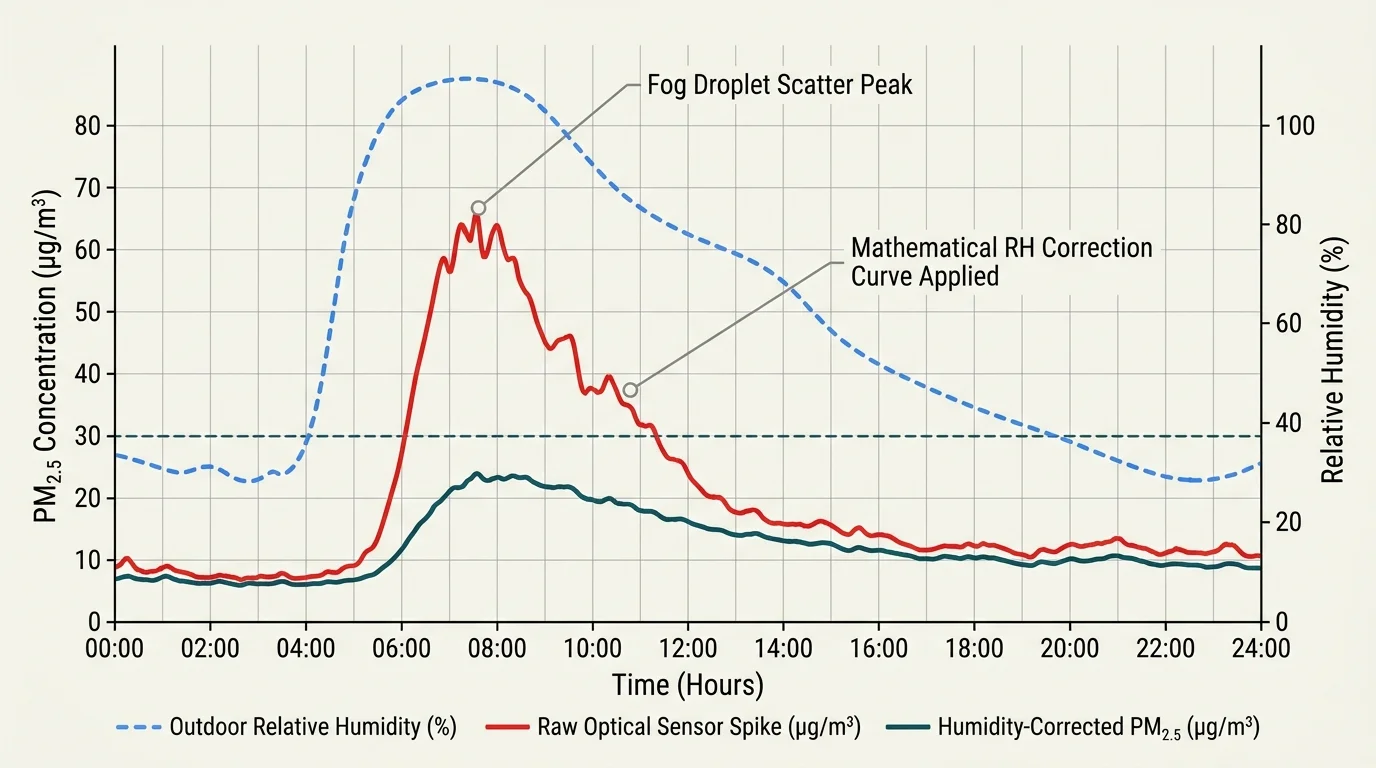
Laser optical particle counters face physical limitations during fog, heavy mist, and rapid relative humidity shifts. Because optical sensors gauge particle size by measuring scattered light, microscopic water droplets mimic the reflective signature of solid PM2.5 particles.
When early-morning relative humidity exceeds 85 percent, standard optical sensors report artificially elevated PM2.5 spikes. Without filtering logic, your automation will seal your fresh air intake during clean, damp mornings.
To prevent these humidity false positives, apply a hygroscopic correction algorithm inside your home automation hub. Many open-source platforms offer mathematical correction curves, such as the EPA-calibrated relative humidity formula developed for Plantower sensors.
Alternatively, install a multi-sensor outdoor unit that includes onboard temperature and humidity metering. Program a logical condition that ignores PM2.5 spikes above 15 micrograms per cubic meter if relative humidity simultaneously exceeds 90 percent and local particulate trends remain flat.
Hardware short-cycling poses another major threat to equipment longevity. Standard 24VAC spring-return damper motors use internal gear trains that overheat if subjected to rapid on-off power cycling.
Ensure your smart relay configuration includes an enforced minimum off-time parameter. Setting an enforced ten-minute delay prevents the actuator motor from toggling repeatedly when outdoor smoke plumes hover near your threshold boundary.
Monitor the operating temperature of your 24VAC step-down transformer after installation. Holding a Normally Open damper continuously energized in the closed position draws continuous holding current, generating sustained low-level heat inside the junction box.
Verify that your low-voltage transformer carries a minimum 40VA power rating to manage prolonged holding periods without voltage drop. Checking wiring terminals biannually ensures your physical smoke barrier responds flawlessly when wildfire season returns.
Frequently Asked Questions
Why trigger fresh air damper closure at 15 µg/m³ instead of the official AQI 101 threshold?
Official AQI 101 alerts represent regional averages calibrated for the general population. Severe asthmatics and allergy patients experience bronchial reactivity and airway inflammation at much lower particulate concentrations. Setting your cutoff threshold at 15 µg/m³ isolates your indoor environment long before municipal agencies publish delayed warnings.
Should I select a normally-open or normally-closed motorized damper for smoke defense?
A normally-closed damper provides the safest fail-safe protection for homes in wildfire and high-pollen corridors. If a storm cuts electrical power, the internal mechanical spring snaps the damper blade shut immediately. A normally-open damper requires continuous electrical power to stay closed, leaving your ductwork wide open if power drops during a fire.
Will closing the fresh air damper cause dangerous indoor carbon dioxide buildup?
Sealing your fresh air damper for twelve to thirty-six hours during a smoke crisis will not create dangerous CO2 levels in typical residential homes. Standard residential building envelopes experience natural envelope leakage between 3 and 5 Air Changes per Hour at 50 Pascals. Particulate smoke presents an immediate health risk, whereas transient CO2 accumulation remains mild.
Can smart thermostats control motorized fresh air dampers directly based on outdoor air quality?
Most commercial smart thermostats include auxiliary terminals capable of controlling ventilation dampers on fixed hourly timers. However, virtually no consumer thermostats allow you to bind those auxiliary dry contacts directly to live outdoor PM2.5 sensor metrics. An independent smart relay connected to Home Assistant or Hubitat bridges that critical gap seamlessly.
Disclaimer: This article is for informational purposes only. Smart home devices involve electrical connections and data privacy. Always follow manufacturer instructions for installation. For complex wiring or HVAC work, consult a licensed professional.