

Replacing your variable-speed HVAC wall controller with a popular smart thermostat quietly strips away your system’s efficiency. You trade advanced variable-capacity performance for standard app controls while paying significantly more on monthly utility bills.
Standard retail devices rely on legacy 24-volt relays that dumb down modulating compressors into crude two-stage machines. This mismatch erases up to 35% of your seasonal efficiency and voids certified SEER2 ratings.
Before removing your proprietary communicating display, you must understand how digital serial communication dictates the real-world performance of modern inverter heat pumps.
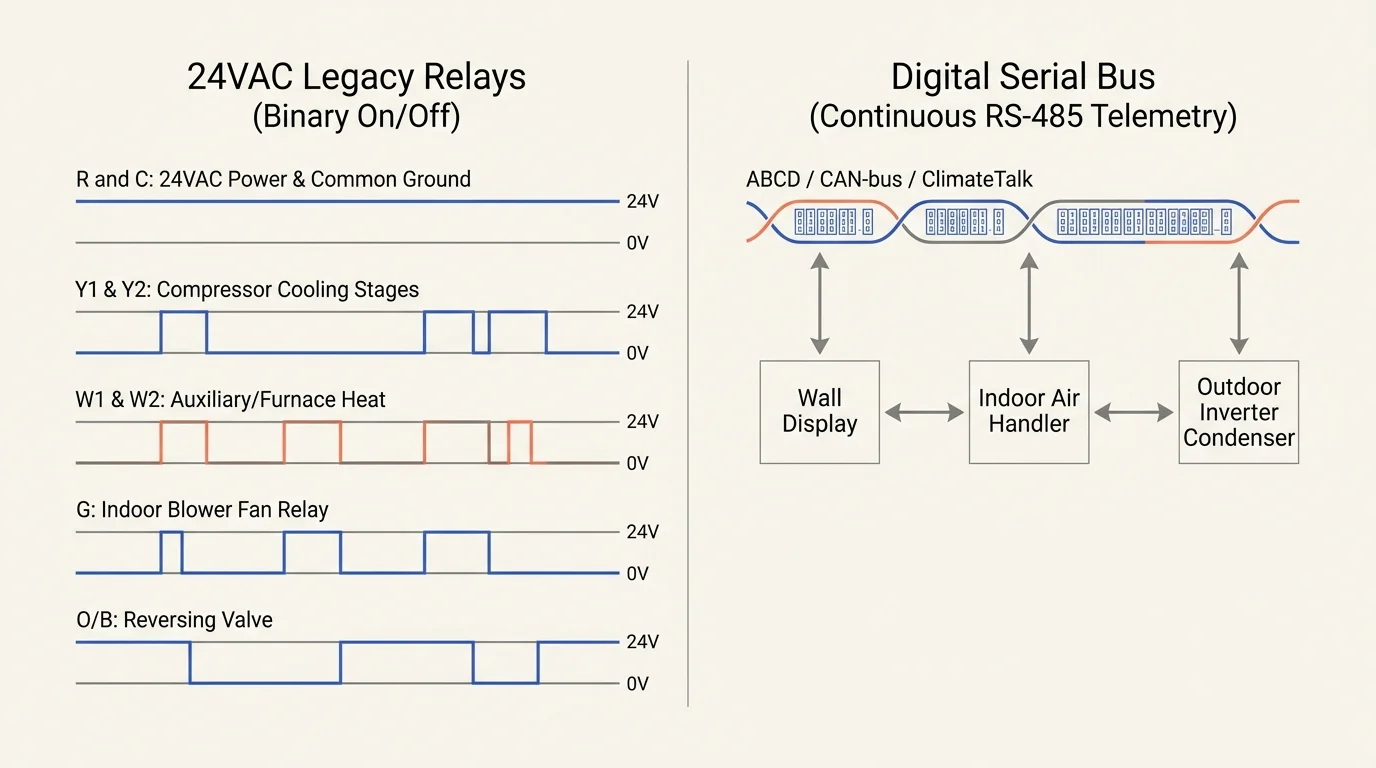
The Communication Gap: Serial Data vs. 24VAC Legacy Relays
Traditional thermostats rely on simple 24-volt alternating current (24VAC) switching circuits. When your home warms up, the thermostat closes an internal relay to send voltage down a dedicated wire.
Each terminal connection corresponds to a single mechanical command. Voltage applied to a wire merely instructs a component to turn completely on or completely off.
- R and C: 24VAC power supply and continuous common ground return.
- Y1 and Y2: First-stage and second-stage compressor cooling activation.
- W1 and W2: First-stage and second-stage auxiliary or furnace heat calls.
- G: Indoor blower fan relay activation at a predetermined single speed.
- O/B: Reversing valve actuation to toggle heat pumps between heating and cooling.
In contrast, a variable-speed inverter system functions like a distributed computer network. Instead of binary on-off relay signals, components exchange continuous data packets over a digital serial bus.
Most premium inverter systems utilize an RS-485 serial communication backbone. This physical bus architecture transmits real-time telemetry between the wall display, indoor air handler, and outdoor condenser.
- Carrier and Bryant: Four-wire proprietary ABCD serial communication bus.
- Daikin and Amana: Daikin One+ two-wire non-polarized digital communication bus.
- Trane and American Standard: ComfortLink II four-wire CAN-bus architecture.
- Lennox: S40 Smart Thermostat four-wire digital ClimateTalk protocol.
When evaluating a communicating thermostat vs smart thermostat, the core difference lies in their operational language. Standard smart thermostats deliver binary on-off switching; communicating controllers exchange continuous, data-rich operating metrics.
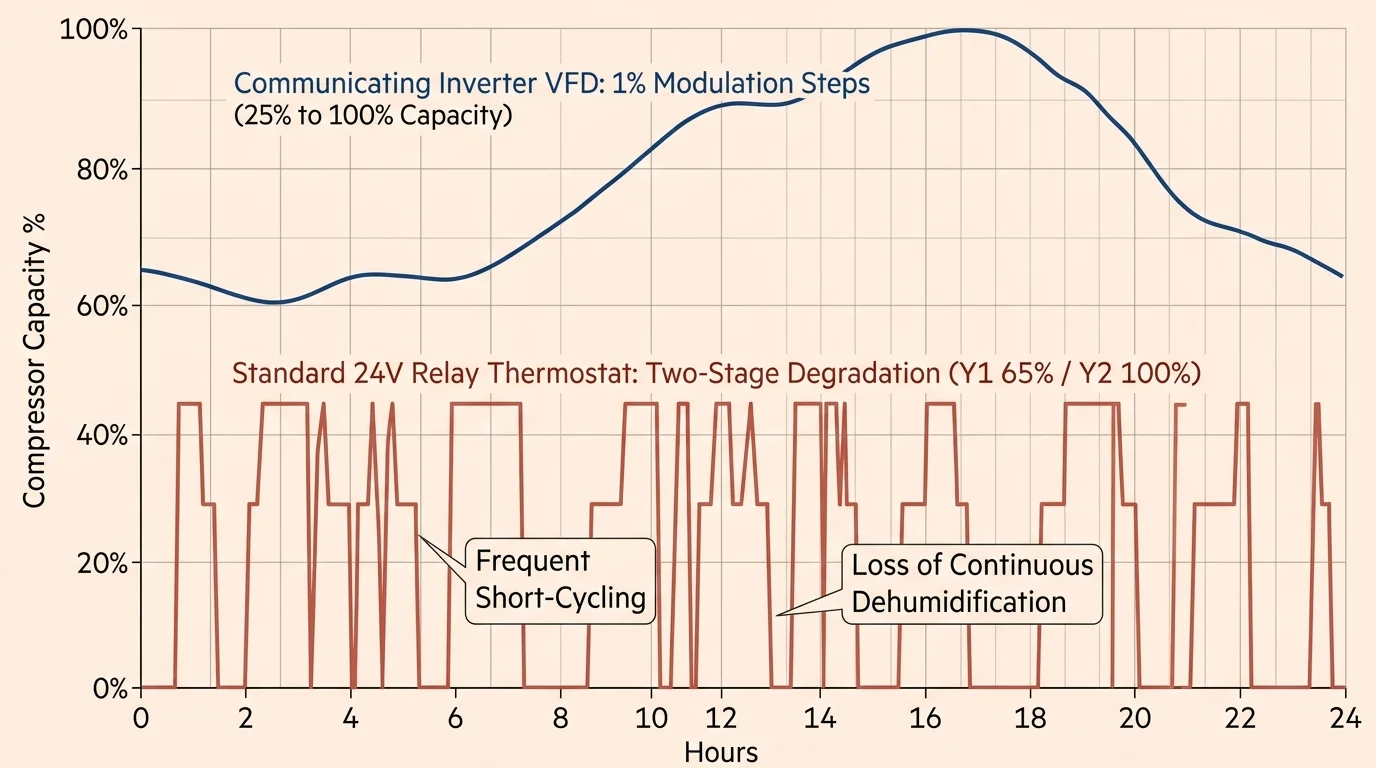
How Standard Smart Tech Degrades Variable-Speed Inverters
Modern inverter compressors utilize variable-frequency drive (VFD) technology. Rather than running at full blast, they continuously modulate compressor motor speed in precise 1% increments from 25% to 100% capacity.
Unlike traditional HVAC setups where aggressive smart thermostat scheduling lowers power usage, variable-capacity units achieve maximum efficiency by holding constant setpoints over long, low-frequency cycles.
Unlike standard thermostats that rely on configuring overcool to dehumidify routines that chill your space to pull out moisture, communicating inverters maintain dry air while matching sensible loads precisely.
This dynamic operation matches your structure’s instantaneous heat gain. The compressor hums continuously at low electrical frequencies, maintaining stable indoor temperatures and pulling moisture out of the air.
Installing a Nest on variable capacity HVAC breaks this precise feedback architecture. Standard retail thermostats lack the digital communication transceivers required to command variable-frequency motor drives.
To connect a standard thermostat, an installer must install a 24V relay interface or rewire the control board. This conversion locks the modulating compressor into basic single-stage or two-stage operation.
Under 24VAC relay control, the compressor defaults to fixed stage gates—typically 65% capacity on low stage and 100% on high stage. You completely lose the 25% to 64% capacity range where inverters achieve peak efficiency.
- Short-cycling penalties: Delivering 65% capacity under small cooling loads causes rapid cycling, causing mechanical wear and continuous startup power spikes.
- Humidity control loss: Inverters dehumidify by running continuous long cycles at low airflow; fixed-stage operation terminates cycles before indoor moisture drops.
- Blower static pressure mismatch: Binary fan relays cannot coordinate airflow with refrigerant expansion, creating duct pressure spikes.
- Loss of diagnostic monitoring: The system stops reporting motor RPM, liquid line temperatures, subcooling metrics, and inverter inverter heat-sink temperatures.
The Department of Energy (DOE) implemented the Appendix M1 testing standard on January 1, 2023. This rule increased external static pressure testing parameters from 0.1–0.2 to 0.5 inches of water column.
Under this rigorous standard, systems that cycle repeatedly against high duct friction suffer severe efficiency degradation. Losing inverter modulation under 0.5 in. w.c. duct resistance directly destroys seasonal performance.
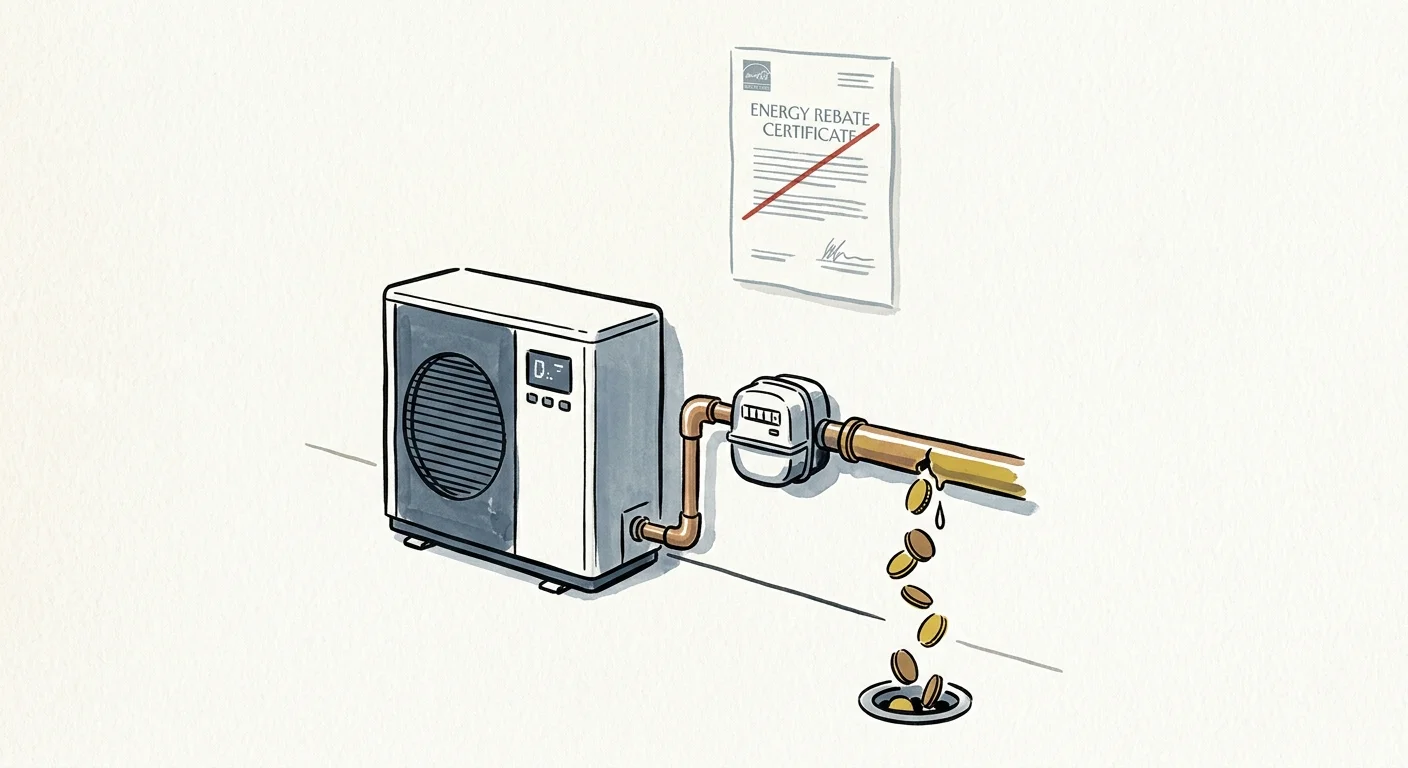
Financial Reality: The Hidden Cost of 24V Adapters and Lost Rebates
Homeowners often swap communicating controllers for off-the-shelf devices to avoid high replacement costs. Retail models cost between $150 and $280, whereas proprietary communicating controllers retail between $600 and $1,200.
When adapter boards glitch or miscommunicate with the condenser, troubleshooting common smart thermostat issues becomes far more difficult without native onboard diagnostics.
However, connecting retail equipment requires an OEM conversion interface, such as the Mitsubishi PAC-US444CN-1 or Daikin 24V interface. These adapter boards cost between $200 and $350 before factoring in professional installation labor.
According to guidance from Energy Star Smart Thermostats, seasonal efficiency ratings depend entirely on matched system configurations. Third-party relay interfaces invalidate these precise factory combinations.
The Air-Conditioning, Heating, and Refrigeration Institute (AHRI) certifies performance ratings exclusively for fully matched components. A certified certificate requires the manufacturer-specified communicating wall control.
When you strip away the digital controller in favor of a 24V interface, you invalidate your AHRI match certificate. This clerical and functional downgrade carries significant financial consequences.
- Loss of utility rebates: Electric utility companies require valid AHRI reference numbers verifying minimum SEER2 performance to disburse $500 to $1,500 efficiency rebates.
- Federal tax credit forfeiture: The Inflation Reduction Act (IRA) Section 25C provides up to $2,000 for qualifying heat pumps, but requires certified AHRI compliance.
- Compounded hardware expenses: Purchasing a $250 smart thermostat plus a $300 adapter board approaches the cost of a native communicating controller.
- Potential warranty disputes: Manufacturers can deny component failure claims if unapproved third-party relay boards cause compressor oil return problems.
Trading certified compliance for retail convenience turns an apparent hardware savings into a net financial loss before the equipment runs its first cooling cycle.
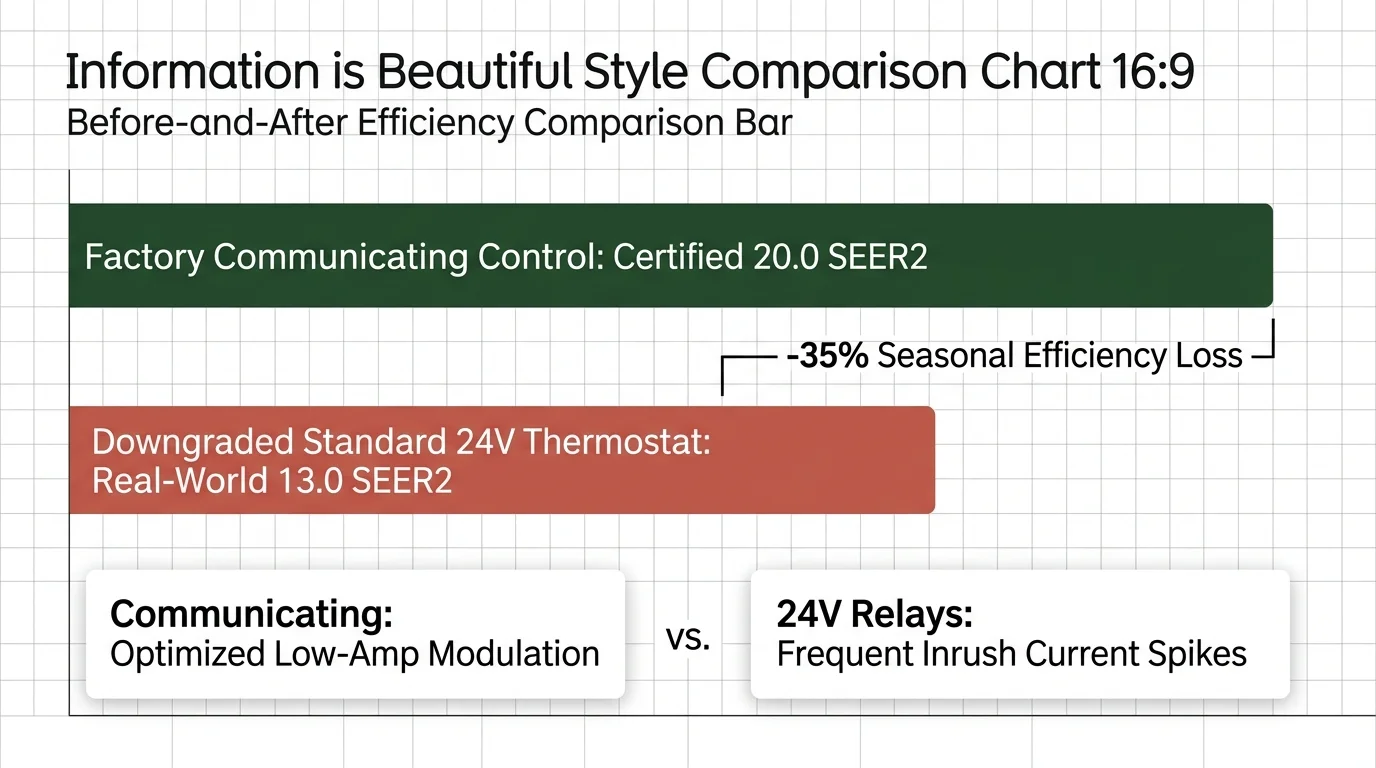
Worked Example: Calculating the Real-World SEER2 Efficiency Penalty
Consider a 3-ton (36,000 BTU/h) variable-capacity inverter heat pump installed in a 2,200-square-foot home in Dallas, Texas. The fully matched communicating system carries an AHRI-certified rating of 20.0 SEER2 and 10.0 HSPF2.
For dual-fuel installations, calculating the economic balance point on smart thermostats is crucial to ensure auxiliary fossil fuels only engage when heat pump COP drops below parity.
The local climate requires 2,100 cooling hours per year. The household pays an electricity rate of $0.16 per kilowatt-hour (kWh).
- Calculate baseline communicating cooling consumption: Operating across its native 25% to 100% modulation range, the 20.0 SEER2 system consumes power according to formula (36,000 BTU/h × 2,100 hours) / (20.0 × 1,000) = 3,780 kWh.
- Calculate baseline cooling expense: Multiplying 3,780 kWh by $0.16 per kWh yields an annual cooling operating cost of $604.80.
- Calculate operational degradation under 24V relay control: Constrained to 65% and 100% capacity stages, the system cycles frequently. Real-world operating efficiency falls roughly 26% down to 14.8 SEER2.
- Calculate degraded cooling energy consumption: The revised power draw equals (36,000 BTU/h × 2,100 hours) / (14.8 × 1,000) = 5,108 kWh per year.
- Calculate degraded cooling operating expense: Multiplying 5,108 kWh by $0.16 per kWh results in an annual cooling cost of $817.28.
- Calculate the annual cooling penalty: The homeowner spends an additional $212.48 every cooling season ($817.28 − $604.80) due to crippled compressor modulation.
- Account for winter heating degradation: During winter, heating efficiency drops from 10.0 HSPF2 to roughly 8.1 HSPF2. This drop adds approximately $142.00 in excess electricity costs.
The total annual operating penalty across cooling and heating cycles equals $354.48. Over a 10-year operating lifespan, this inefficient relay downgrade costs the homeowner $3,544.80 in wasted electricity.
That operating penalty completely dwarfs the minor initial savings achieved by purchasing a retail smart thermostat instead of an OEM communicating wall unit.
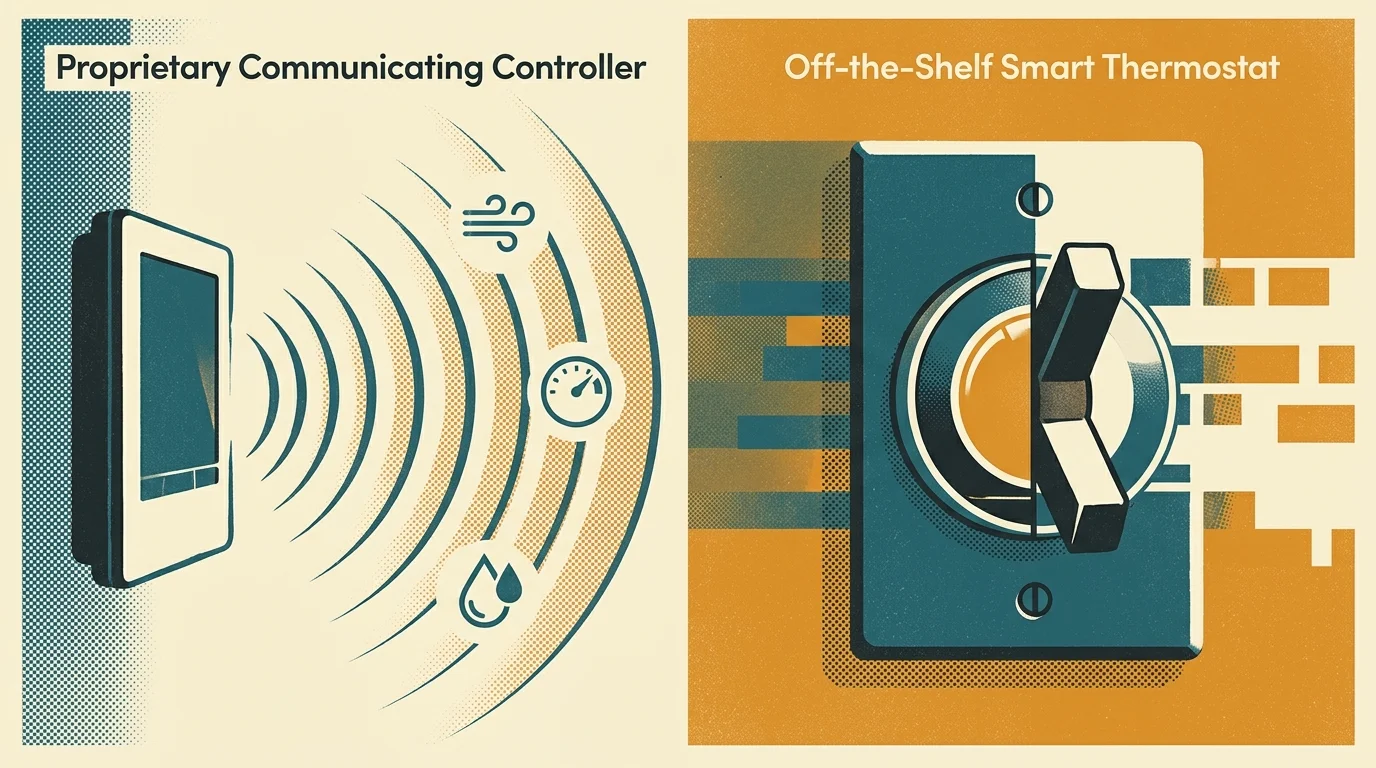
Comparing Communicating Controls Against Off-the-Shelf Smart Thermostats
Evaluating hardware alternatives requires analyzing control protocols, modulation granularity, and system compliance side by side.
Even implementing the top energy-saving smart thermostat settings cannot compensate for the efficiency lost when stripping away factory communicating protocols.
| Hardware Model | Control Architecture | Modulation Granularity | AHRI Match Valid | Dehumidification Precision |
|---|---|---|---|---|
| Carrier Infinity System Control (SYSTXCCITC01-C) | Proprietary ABCD Serial Bus | 1% increments (25%–100%) | Yes (Retains full SEER2) | Continuous low-CFM variable dehumidification |
| Daikin One+ Smart Thermostat (DTST-CWBSA-NI-A) | Two-Wire Digital Serial Bus | 1% increments (30%–100%) | Yes (Retains full SEER2) | Dedicated variable moisture removal algorithms |
| Google Nest Learning Thermostat (4th Gen) | Standard 24VAC Relay Terminals | 2-Stage Fixed (65% / 100%) | No (Invalidates rating) | Crude overcooling via relay engagement |
| Ecobee Smart Thermostat Premium | 24VAC Relay via OEM Adapter | 2-Stage Fixed (65% / 100%) | No (Invalidates rating) | Crude overcooling via relay engagement |
Proprietary controllers read outdoor ambient sensors, return air humidity, and indoor coil temperatures simultaneously. They adjust electronic expansion valves and compressor drive frequencies to hold temperature without cycling.
Energy efficiency ratings published in the AHRI directory are valid only for fully matched system configurations tested under standardized conditions.
When you substitute retail relay controls, the inverter loses its digital link to indoor airflow calculations. The system runs blind to dynamic duct conditions, eliminating the advantages of high-efficiency equipment.

Smart Ecosystem Integration Without Sacrificing Inverter Modulation
Homeowners often want retail smart thermostats for simple automation features like geofencing, remote app control, and smart speaker compatibility. Fortunately, you can achieve broad ecosystem integration without removing your communicating thermostat.
Modern communicating wall units feature native Wi-Fi radios and modern mobile companion apps. Carrier Infinity, Trane ComfortLink, and Lennox S40 systems connect directly to home networks.
These platforms interface cleanly with Amazon Alexa and Google Assistant through official cloud skills. You can adjust temperature setpoints and run schedule routines using voice commands without touching HVAC wiring.
Home automation platforms like Home Assistant provide robust integrations for communicating hardware. Community integrations interface with Carrier, Daikin, and Lennox cloud APIs to bridge your HVAC metrics into custom local automations.
Cross-platform protocols like the Matter Smart Home Standard are actively expanding interoperability boundaries for connected appliances. Matter bridges enable centralized home management while allowing proprietary controls to manage equipment modulation.
- Preserve physical serial connections: Keep your OEM communicating controller wired directly to the indoor board and outdoor inverter terminals.
- Connect to residential Wi-Fi: Pair your communicating controller to your 2.4 GHz home network using the manufacturer’s setup mobile app.
- Enable cloud ecosystem bridging: Link the OEM manufacturer account to Apple Home, Google Home, or Amazon Alexa inside your smart home settings.
- Build virtual logic automations: Set up occupancy routines that alter target temperatures based on smart lock state or door sensor triggers rather than relay hardware swaps.
This hybrid approach protects your investment in a variable speed inverter smart thermostat. You preserve your high SEER2 efficiency while gaining the connected automation features of a modern smart home.
Frequently Asked Questions
Can I install a Nest or Ecobee on a variable-capacity HVAC system?
You can install them only by using a 24VAC adapter board or legacy relay wiring. However, this restricts the variable compressor to basic two-stage operation, sacrificing efficiency and dehumidification performance.
Does replacing a communicating thermostat void my manufacturer equipment warranty?
It does not automatically void the entire warranty, but it can complicate claims. If improper relay cycling damages the inverter drive board or compressor lubrication, manufacturers may deny warranty coverage.
How can I identify if my current thermostat uses communicating wiring?
Turn off power and remove the thermostat faceplate from the wall. If the terminal connections are labeled with serial letters like A, B, C, D or Data 1/Data 2 rather than standard R, C, Y, W, G, your system is communicating.
Why do some HVAC contractors install standard smart thermostats on inverter systems?
Contractors often propose retail smart tech to lower upfront installation bids or accommodate customer requests for familiar app interfaces. Unfortunately, many fail to communicate the resulting SEER2 efficiency penalty to the homeowner.
Disclaimer: This article is for informational purposes only. Smart home devices involve electrical connections and data privacy. Always follow manufacturer instructions for installation. For complex wiring or HVAC work, consult a licensed professional.



2 Comments