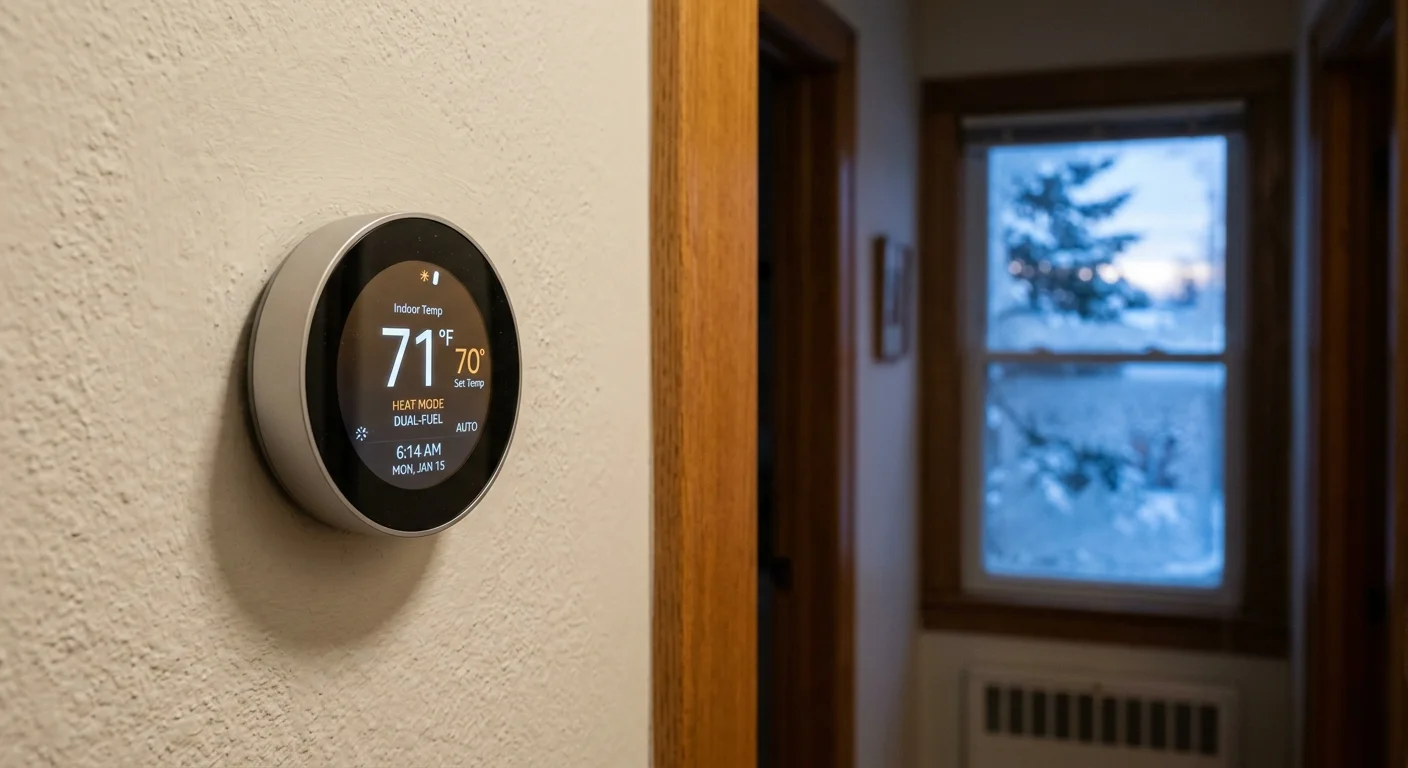
Setting your heat pump switchover to a generic 35°F factory default wastes money every winter. You can cut heating bills immediately by calculating your system’s precise economic balance point using your local propane and electric rates.
Fine-tuning these crossover thresholds works hand-in-hand with implementing the top energy-saving smart thermostat settings across your HVAC setup.
While standard installation manuals rely on arbitrary temperature estimates, this guide demonstrates how to calculate the exact thermodynamic crossover where your heat pump efficiency drops below your propane furnace operating cost.
By aligning real-time utility tariffs with manufacturer performance curves, you will program accurate lockout thresholds into your smart thermostat to stop overpaying for auxiliary propane heat.
Understanding Thermal vs. Economic Balance Points
Dual-fuel heating systems pair an electric heat pump with a backup combustion furnace; in rural installations, this auxiliary unit almost always burns propane. Operating this equipment efficiently requires balancing two distinct physical thresholds.
Preventing unnecessary recovery spikes from auxiliary heat when returning home is also easier when using geofencing to adjust your thermostat before arrival.
Recalibrating these operating limits is an essential task when preparing your smart thermostat for seasonal changes before cold weather arrives.
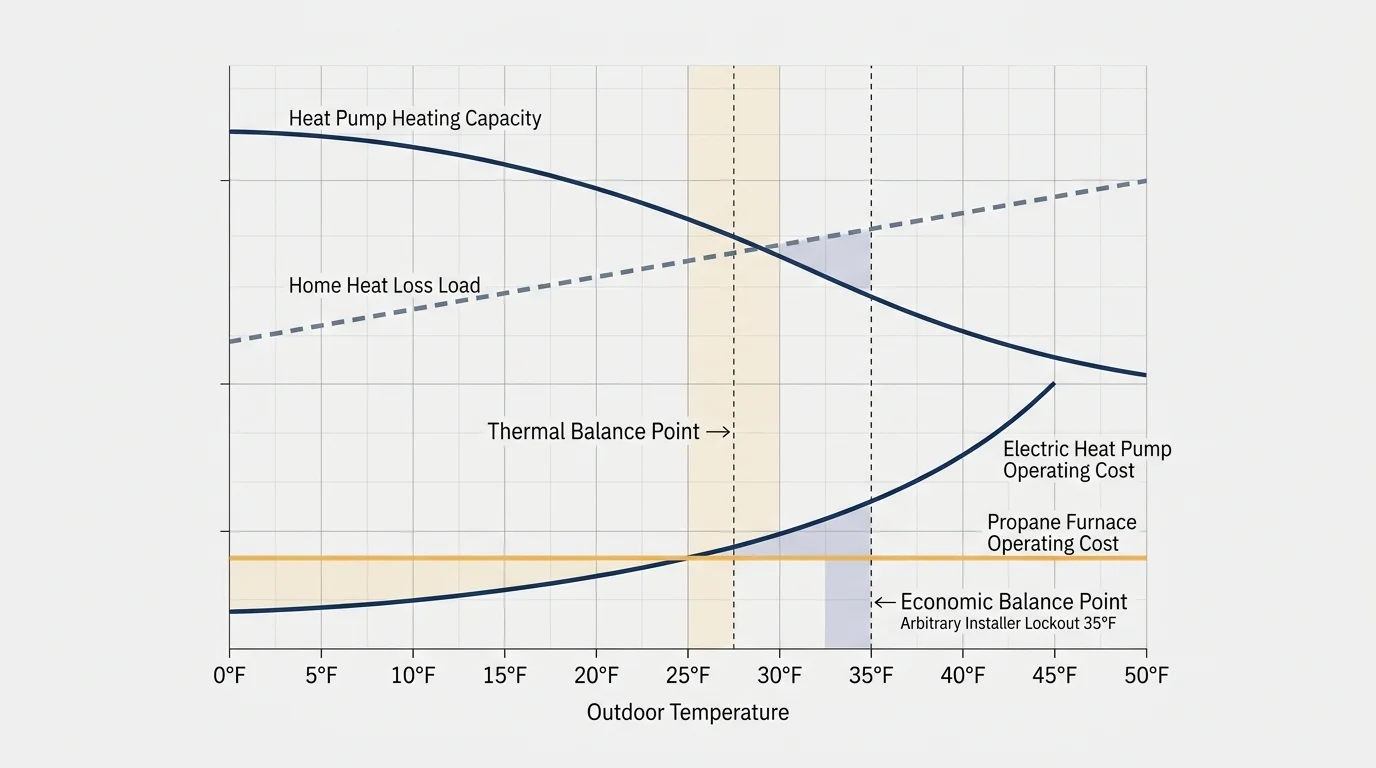
The thermal balance point is the outdoor temperature where your home’s heat loss exactly equals your heat pump’s heating capacity. Below this outdoor temperature, the heat pump can no longer maintain your indoor setpoint alone.
The economic balance point represents the outdoor temperature where delivering heat with your electric heat pump costs the exact same amount as generating heat with your propane furnace.
HVAC installers routinely set dual-fuel thermostat lockouts to 35°F or 40°F out of habit. This arbitrary setting forces the furnace to ignite prematurely, burning expensive delivered propane when the heat pump could still run more cheaply.
Your economic balance point moves constantly whenever fuel prices shift. Key factors separating thermal and economic balance points include:
- Building Thermal Envelope: Insulation levels and air leakage determine your home’s heat loss rate and set your thermal balance point.
- Refrigerant Dynamics: Compressor sizing dictates when heat output drops below home load.
- Fuel Volatility: Delivered propane prices fluctuate throughout winter, changing the economic threshold independently of weather.
- Utility Rate Structures: Tiered or time-of-use electricity pricing shifts your operating expenses without altering equipment capacity.
If propane costs soar while electricity rates remain stable, your economic balance point can plummet well below the thermal balance point. In that scenario, running the heat pump with supplemental electric resistance or staging remains cheaper than burning gas.
The Mathematical Formula for Fuel Crossover COP
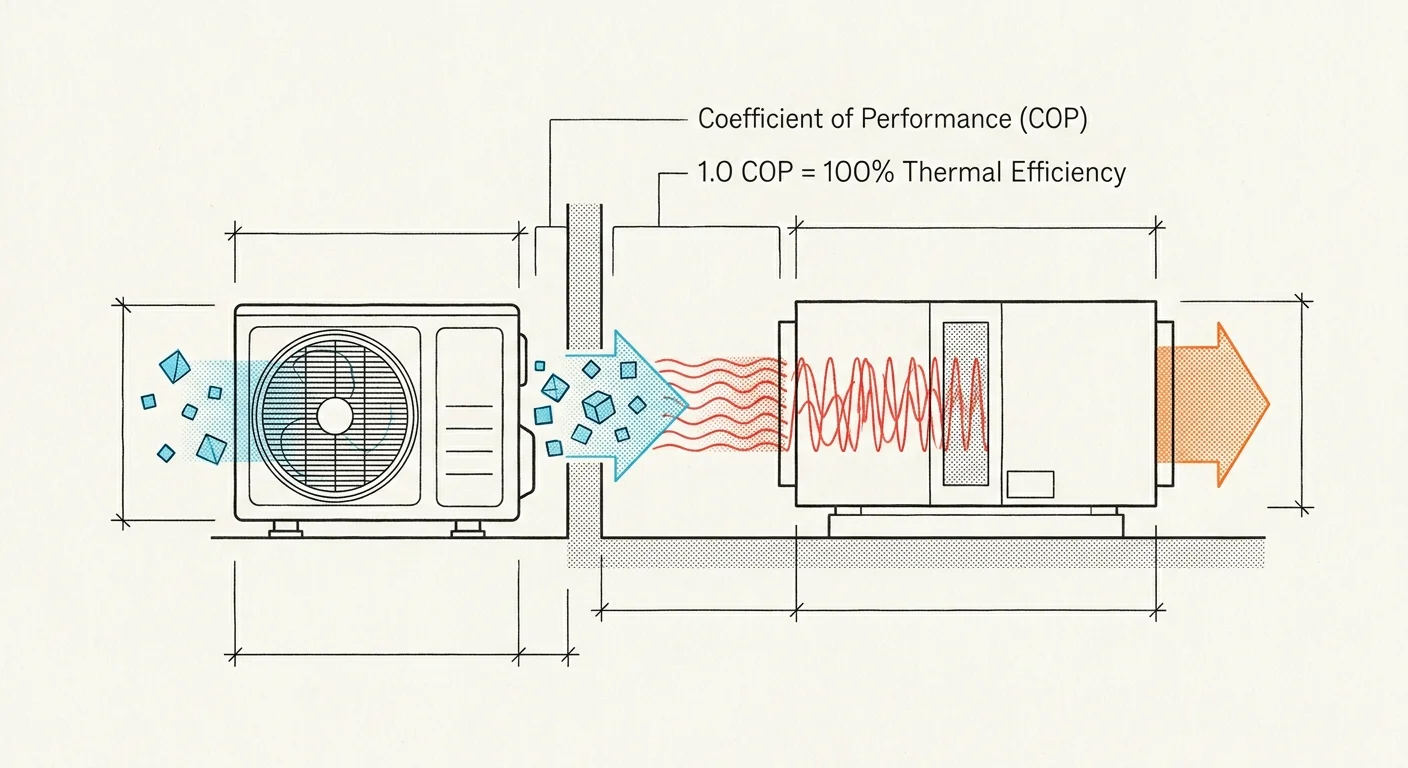
Heat pumps do not create heat; they extract thermal energy from outdoor air and transfer it indoors. Their operating efficiency is quantified as the Coefficient of Performance (COP).
Integrating these COP limits into your broader system is easier once you master smart thermostat scheduling basics for dual-fuel equipment.
A COP of 1.0 represents baseline electric resistance heating, where one unit of electricity yields one unit of heat. A modern heat pump operating at a COP of 3.0 delivers three times more heat energy than it consumes in electrical power.
Propane furnaces convert chemical energy directly into heat through combustion. Their efficiency is measured by the Annual Fuel Utilization Efficiency (AFUE) rating, typically ranging from 80% to 98%.
To establish where heating costs match, you must first convert both fuel sources into equivalent British Thermal Units (BTUs). The standard energy conversion constants are:
- Liquid Propane (HD-5): 91,500 BTUs per gallon of fuel.
- Electricity: 3,412 BTUs per kilowatt-hour (kWh).
- Furnace Usable Energy: 91,500 multiplied by your furnace’s rated AFUE decimal (e.g., 91,500 × 0.96 = 87,840 usable BTUs/gallon).
The break-even COP equation identifies the exact heat pump efficiency where the cost per delivered BTU of electric heat equals the cost per delivered BTU of propane heat:
Break-Even COP = (Electricity Rate in $/kWh / Propane Rate in $/gal) × ((91,500 × AFUE) / 3,412)
Whenever your heat pump operates at a COP higher than this calculated break-even threshold, running the heat pump saves money. When outdoor temperatures drop low enough that the heat pump’s COP falls below this number, switching to propane becomes cheaper.
Heat Pump COP Degradation Across Winter Temperatures
As outdoor ambient temperatures fall, outdoor air contains less sensible heat, and the refrigerant’s boiling pressure drops. This thermodynamic penalty forces the compressor to work harder, reducing heating capacity and lowering your operating COP.
For larger properties, implementing these thresholds across smart thermostats for multi-zone homes prevents different dampers from triggering auxiliary heat at conflicting times.
Under the standardized AHRI 210/240 testing conditions, manufacturers report heat pump performance at two benchmark temperatures: 47°F (high-temperature rating) and 17°F (low-temperature rating). Cold-climate models also report performance data at 5°F.
At 47°F, standard inverter-driven heat pumps operate at an exceptional COP between 3.2 and 4.2. At 17°F, that efficiency drops to between 1.8 and 2.4.
Below freezing, air-source heat pumps must periodically enter a defrost cycle to melt frost accumulation on outdoor coils. Defrost cycles reverse refrigerant flow or engage auxiliary heat, creating a temporary parasitic electrical draw that reduces overall operating efficiency.
To determine how your heat pump performs across specific outdoor temperatures, consult the manufacturer’s technical specifications. You can locate these exact efficiency curves through three sources:
- Manufacturer Expanded Heating Performance Tables: Found inside the engineering submittal sheets for your specific outdoor condenser model.
- The AHRI Certified Directory: Provides standardized COP ratings at 47°F and 17°F for your paired condenser and indoor evaporator coil combination.
- NEEP Cold Climate Air Source Heat Pump List: Lists verified COP curves down to 5°F and 0°F for variable-capacity systems.
Plotting your calculated break-even COP against these manufacturer tables reveals your exact switchover temperature. That temperature is the number you will program into your smart thermostat.

Step-by-Step Worked Example: Calculating Your Switchover Temperature
Consider a rural home heated by a 3-ton variable-speed heat pump paired with a high-efficiency 96% AFUE condensing propane furnace. Review the step-by-step process below to establish your operational parameters.
After applying these thresholds, review how to read and understand your thermostat’s energy reports to verify that your actual propane and electric runtime match your projections.
Pairing your math with real-time smart home energy monitoring helps verify your heat pump’s actual power draw as outdoor temperatures fall.
- Identify Current Fuel Costs: Examine your utility bills. The current delivered residential propane cost is $2.85 per gallon, and the total residential electric rate (combining supply and delivery charges) is $0.18 per kWh.
- Determine Furnace Effective Output: Multiply the propane energy constant by furnace efficiency: 91,500 BTUs × 0.96 AFUE = 87,840 effective BTUs per gallon.
- Calculate Fuel Energy Ratio: Divide effective propane BTUs by electric BTUs: 87,840 / 3,412 = 25.744.
- Calculate Fuel Price Ratio: Divide electric cost per kWh by propane cost per gallon: $0.18 / $2.85 = 0.06316.
- Solve for Break-Even COP: Multiply the price ratio by the energy ratio: 0.06316 × 25.744 = 1.626. Your break-even COP is 1.63.
- Cross-Reference Manufacturer COP Data: Check your heat pump’s expanded engineering tables to see what outdoor temperature produces a 1.63 COP.
Suppose the engineering submittal for your heat pump lists the following performance benchmarks:
- 47°F outdoor ambient: COP 3.72
- 35°F outdoor ambient: COP 2.85
- 25°F outdoor ambient: COP 2.20
- 17°F outdoor ambient: COP 1.74
- 14°F outdoor ambient: COP 1.62
- 5°F outdoor ambient: COP 1.35
Your break-even COP of 1.63 occurs at 14°F. Operating the heat pump at any temperature down to 14°F costs less than burning propane.
If your thermostat was left at the standard 35°F default, your system would switch to propane while the heat pump still operated at an efficient 2.85 COP. In that 21-degree window between 14°F and 35°F, burning propane unnecessarily inflates your heating costs.
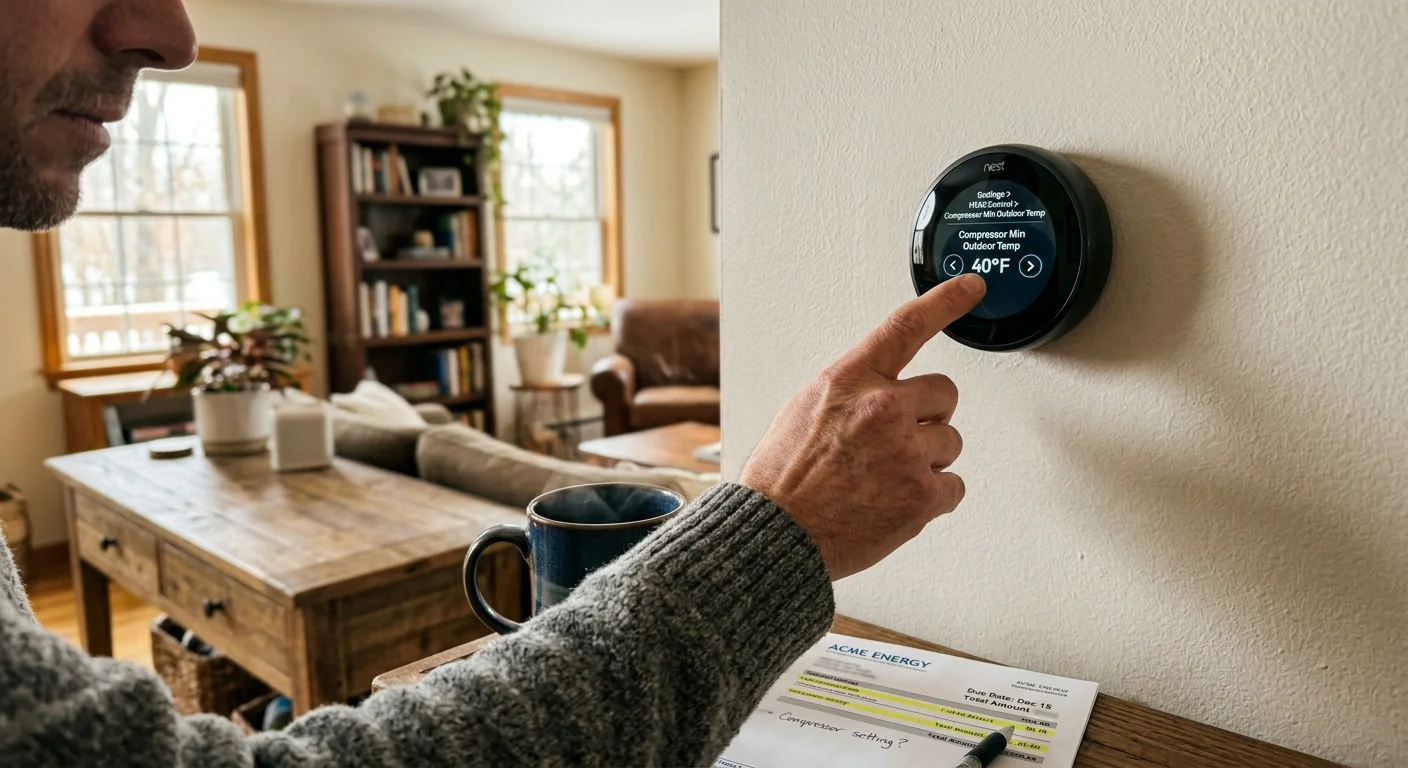
Configuring Thresholds on ecobee, Nest, and Honeywell Smart Thermostats
Once you calculate your economic balance point, you must program it into your smart thermostat’s installer settings. Many Energy Star certified smart thermostats support dual-fuel configurations, but their menus hide these critical thresholds under advanced staging submenus.
Before modifying settings, ensure your thermostat has a dedicated common wire (C-wire) connection. Dual-fuel staging relies on uninterrupted power to maintain continuous outdoor weather polling.
Follow these specific configuration steps for the three leading thermostat platforms:
ecobee Smart Thermostat Premium / Enhanced
ecobee provides granular control over compressor and auxiliary heat lockouts within its manual threshold menu.
You can also pair these staging limits with remote room sensors for better temperature control to avoid short-cycling auxiliary heat when individual rooms drift cool.
If you are setting up your unit for the first time, check out our ecobee smart thermostat installation walkthrough to confirm correct terminal wiring.
- Navigate to Main Menu > Settings > Installation Settings > Thresholds.
- Change Configure Staging from “Automatically” to “Manually”.
- Select Compressor Minimum Outdoor Temperature and set it to your calculated balance point (e.g., 14°F). The heat pump will run until outdoor temperatures drop below this point.
- Select Aux Heat Maximum Outdoor Temperature and set it to the same temperature (or up to 5°F higher if you want a narrow overlap window). The furnace cannot ignite above this temperature.
Google Nest Learning Thermostat
Google Nest uses an integrated “Dual Fuel” feature that switches between equipment using local Wi-Fi weather data.
- Access Settings > Equipment > Pro Setup on the thermostat display ring.
- Ensure the fuel source for your auxiliary heat is designated as “Propane” or “Gas” rather than “Electric”.
- Open the Dual Fuel Lockout menu.
- Set the Lockout Temperature slider directly to your calculated balance point. Nest will shut down the heat pump compressor and engage the furnace below this threshold.
Honeywell Home T9 / T10 Pro
Honeywell smart thermostats support balance point lockouts via cloud weather data or hardwired outdoor sensors (C7089R).
- Enter the Installer Setup (ISU) menu by holding down the center icon on the device.
- Locate ISU 3120 (Dual Fuel Heat Pump Control) and set to “Enabled”.
- Navigate to Compressor Lockout Temperature and adjust the value in 5°F increments to match your target.
- Navigate to Auxiliary Heat Lockout Temperature and mirror the setting to prevent simultaneous equipment operation.
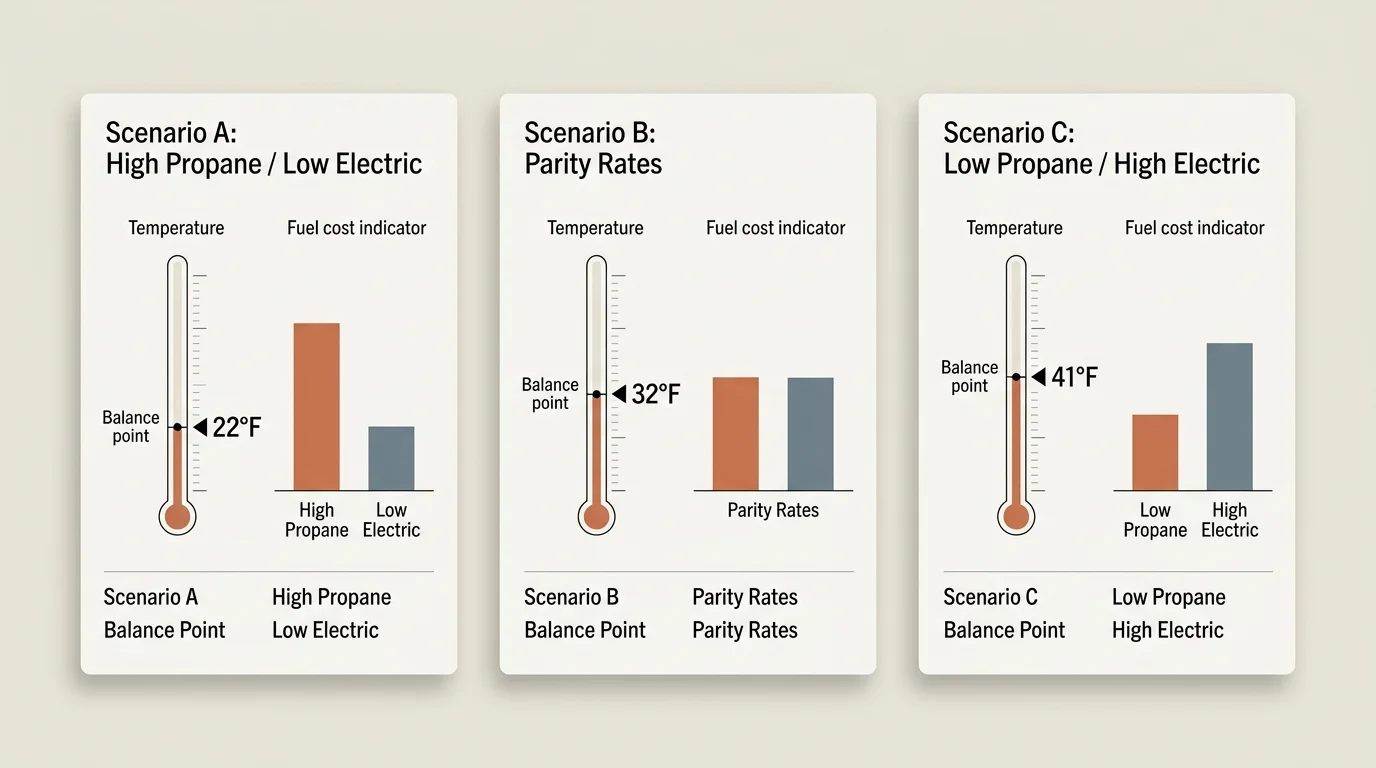
Comparing Balance Points Across Regional Fuel Price Scenarios
Because propane distribution costs and electric utility tariffs vary dramatically by region, your economic switchover temperature is unique to your local geography. The table below outlines five common regional operating scenarios using verified residential fuel pricing.
| Regional Scenario | Propane Cost ($/gal) | Electric Rate ($/kWh) | Furnace Efficiency | Break-Even COP | Thermostat Switchover |
|---|---|---|---|---|---|
| Northeast Rural | $3.65 | $0.27 | 96% AFUE | 1.90 | 20°F |
| Upper Midwest | $2.35 | $0.16 | 95% AFUE | 1.75 | 17°F |
| Mid-Atlantic Coastal | $3.40 | $0.18 | 80% AFUE | 1.14 | 5°F (Equip. Limit) |
| Pacific Northwest | $2.80 | $0.12 | 96% AFUE | 1.10 | 5°F (Equip. Limit) |
| Mountain West | $2.45 | $0.21 | 80% AFUE | 1.85 | 19°F |
Notice how furnace efficiency dramatically shifts your operational economics. Upgrading an aging 80% AFUE furnace to a 96% condensing unit raises the break-even COP, moving the ideal switchover to a higher outdoor temperature.
Conversely, areas with cheap hydroelectric power—such as the Pacific Northwest—yield a break-even COP well below 1.50. In those climates, running your heat pump down to its absolute mechanical operating limit saves money over propane.
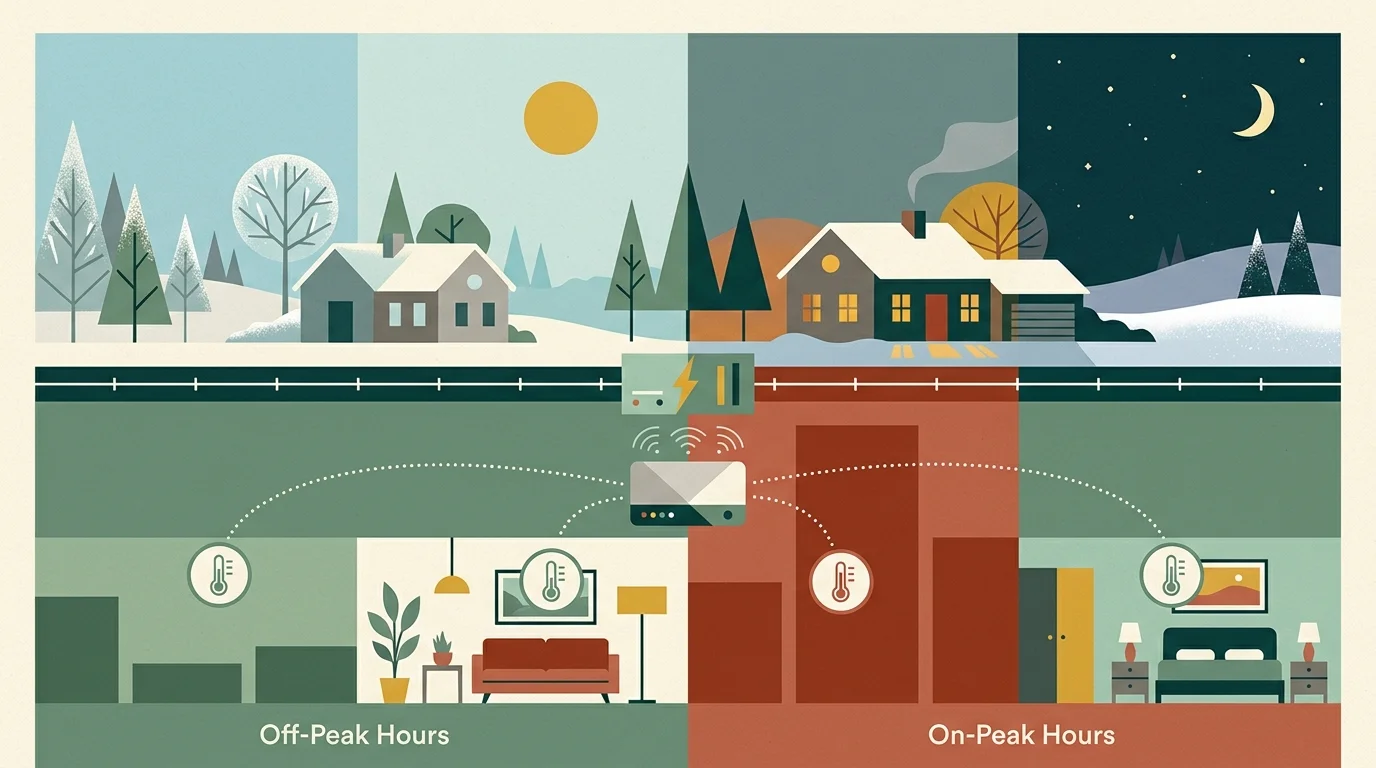
Advanced Thermostat Strategies: Time-of-Use Rates and Staging Delays
Static calculations assume constant utility pricing, but many modern power companies bill customers on Time-of-Use (TOU) rate schedules. Under TOU structures, electricity costs can double during peak late-afternoon and early-evening hours.
When peak electric rates kick in, your fuel price ratio shifts instantly, pushing your break-even COP significantly higher. You can manage this dynamic by programming your smart thermostat to switch fuels based on scheduled utility rate periods.
Another major cause of wasted fuel is “aux heat droop.” Thermostats frequently abandon the heat pump and fire the propane furnace whenever the indoor temperature sits 2°F or 3°F below the target setpoint for more than 20 minutes.
To stop premature auxiliary staging, adjust your thermostat’s advanced staging parameters:
- Compressor to Aux Runtime: Increase this delay to at least 45 or 60 minutes, giving the heat pump adequate time to recover indoor temperatures gradually.
- Aux Heat Temperature Droop: Widen this threshold to 4°F or 5°F so normal morning setbacks do not instantly trigger expensive propane heating.
- Remote Sensor Averaging: Position wireless room sensors in occupied spaces to ensure furnace staging responds to living areas rather than cold hallways. Independent evaluations from testing organizations like Wirecutter’s smart home reviews show remote sensors prevent erratic system staging.
- Compressor Stage 2 Delays: Allow variable-capacity heat pumps to ramp to 100% capacity before auxiliary heat calls can initiate.
Finally, monitor your outdoor condenser throughout sub-freezing weather. Keep the outdoor heat pump elevated at least 12 inches above expected snow lines and inspect the condensate drain regularly to prevent ice dams on the outdoor coil.
Frequently Asked Questions
What happens if I set my balance point lower than the heat pump’s operational limit?
Heat pumps have an absolute low-temperature mechanical cutoff, typically between -5°F and 5°F depending on the compressor design. If you set the thermostat lockout below that physical limit, the heat pump will trip on low-pressure faults, causing indoor temperatures to fall until emergency backup engages.
Does running a heat pump down to 15°F cause excessive compressor wear?
Modern inverter-driven heat pumps use synthetic polyolester (POE) oils and vapor injection compressors specifically engineered for low ambient operation. Running continuously at cold temperatures is safe and normal for the equipment; frequent on-and-off cycling causes far more mechanical wear than extended heating cycles.
Why does my smart thermostat trigger propane heat even when outdoor temps sit above my lockout setting?
This issue occurs when your thermostat’s auxiliary heat staging timers or temperature droop thresholds override the outdoor lockout rule. Check your advanced staging settings and increase the “Compressor to Aux Runtime Delay” to prevent the thermostat from calling the furnace prematurely.
How does a dirty air filter affect my economic balance point?
A clogged filter restricts airflow across the indoor coil, elevating refrigerant operating pressures and dropping heat pump efficiency by 10% to 15%. This loss of efficiency raises your actual operating COP curve, shifting your ideal economic balance point several degrees warmer.
Disclaimer: This article is for informational purposes only. Smart home devices involve electrical connections and data privacy. Always follow manufacturer instructions for installation. For complex wiring or HVAC work, consult a licensed professional.