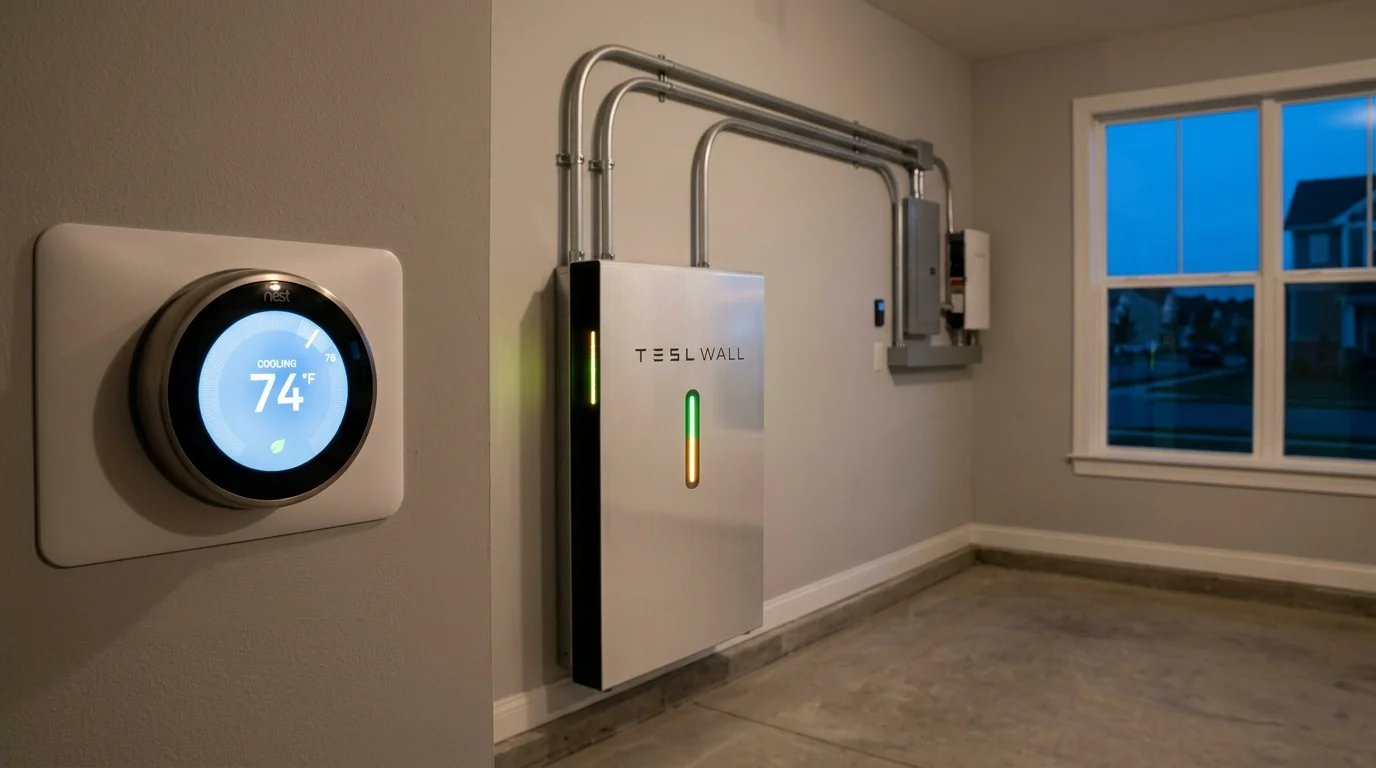
When the electric grid collapses, your central air conditioning unit transforms into a direct threat to your backup energy supply. Running an unmanaged compressor during an outage drains residential storage systems long before dawn.
Dynamic climate throttling solves this vulnerability by pairing inverter state-of-charge data directly with your smart thermostat. Raising your cooling setpoint by 1.5°F for every 10% battery drop below 50% capacity doubles your off-grid survival runtime.
This automated load shedding secures your home against sudden inverter shutdown while preserving reserves for medical devices, refrigeration, and critical communications.
The Math of HVAC Battery Depletion
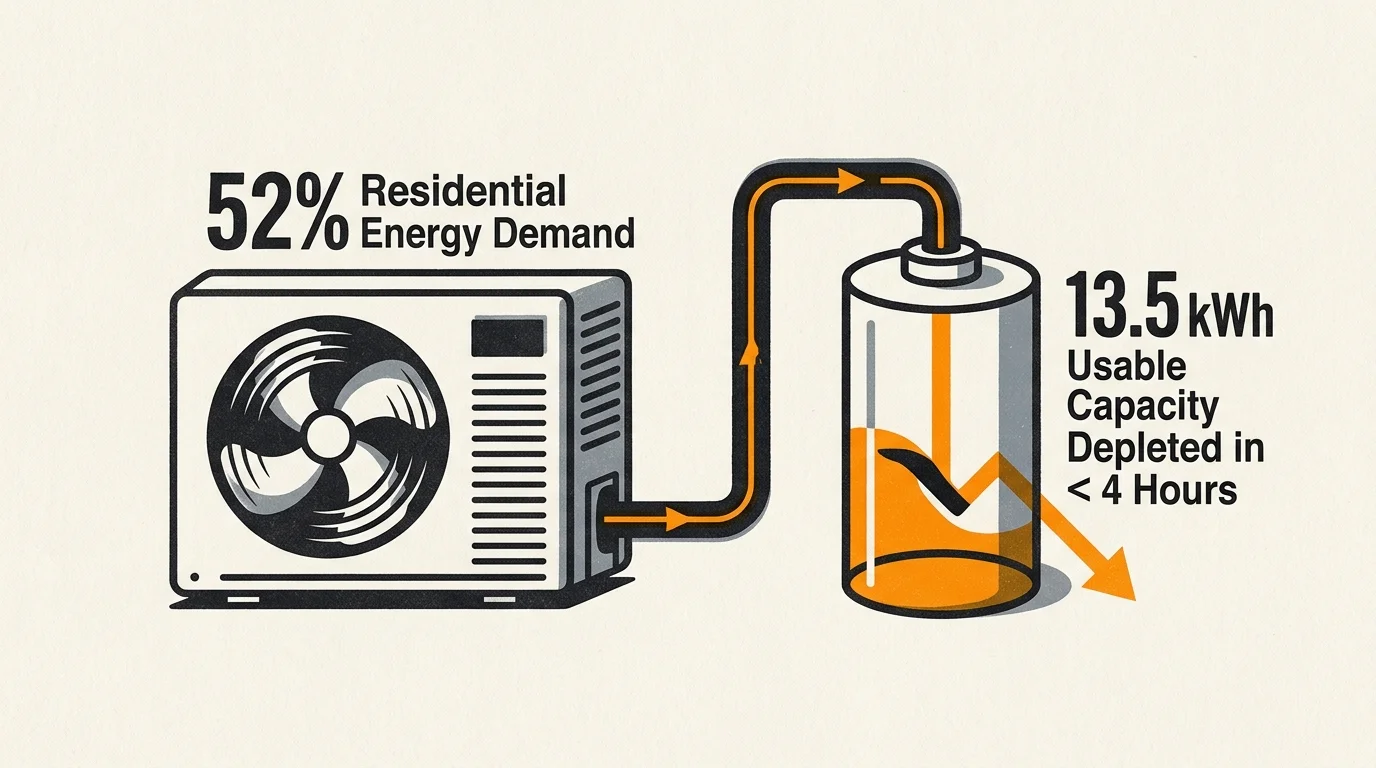
Heating and cooling equipment dominates modern residential electrical demand. According to the U.S. EIA Residential Energy Consumption Survey (RECS), space heating and air conditioning account for roughly 31% of residential electricity consumption nationwide (and 52% of total site energy across all fuels, rising sharply as homes electrify heating with heat pumps).
For households with electric vehicles, pairing climate load-shedding with smart EV charging schedules ensures multiple high-draw appliances do not overwhelm your inverter simultaneously.
A standard 3-ton to 5-ton central air conditioner draws between 2,500 and 6,000 continuous watts while cooling. This continuous load places immediate thermal and electrical stress on residential storage inverters.
Standard home energy storage units provide usable capacities between 5.0 kWh and 13.5 kWh. A single 13.5 kWh Tesla Powerwall 3 delivers immense power, but an unthrottled 3.5 kW compressor empties it in under four hours.
Without solar production, an unmanaged heat pump running at evening peak capacity will induce low-voltage battery shutdown before midnight. You must treat thermostat load shedding power outage planning as an essential survival strategy.
Standard static setpoints cannot adapt to changing state-of-charge (SOC) conditions. Dynamic throttling links real-time power generation, stored capacity, and interior temperatures into an autonomous load-balancing loop.
The Dynamic SOC Throttling Algorithm
Dynamic setpoint adjustment relies on linear and tiered mathematical offsets applied directly to your standard baseline comfort preferences. The algorithm watches your solar inverter battery state-of-charge and adjusts thermostat target temperatures upward during cooling cycles.
Layering dynamic battery offsets over established energy-saving smart thermostat settings provides a strong baseline of efficiency before grid interruptions even occur.
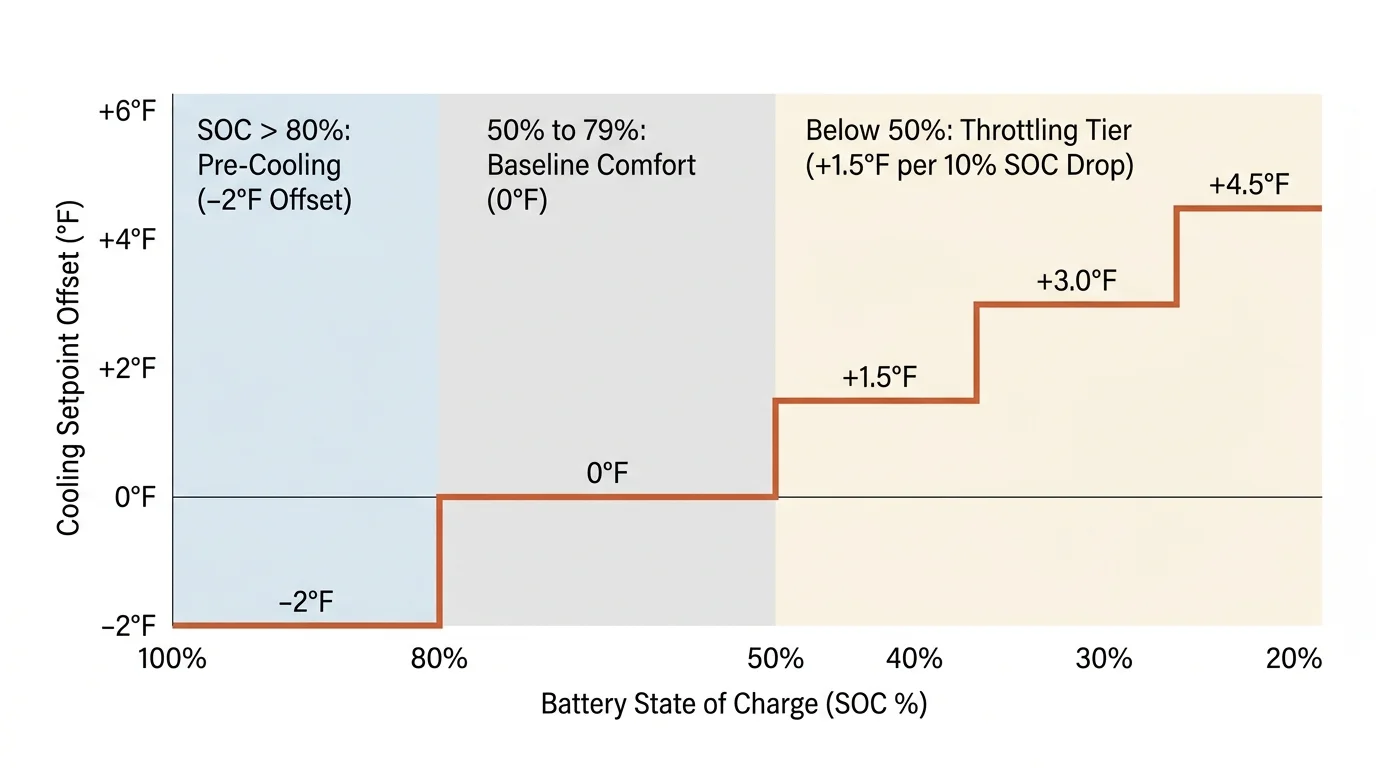
The core rule triggers the moment battery capacity drops below 50% SOC during a power outage or peak tariff window. For every subsequent 10% drop in stored energy, the system lifts cooling setpoints by exactly +1.5°F.
Conversely, during heating cycles, the automation depresses setpoints by -1.5°F per 10% drop below the 50% SOC boundary. This prevents electric resistance elements and heavy compressor stages from consuming finite kilowatt-hours.
The greenest energy is the energy you do not consume.
Implementing effective home battery climate control requires dividing your battery capacity into four operational performance tiers:
- SOC Above 80% (Thermal Pre-Cooling): Maintain target comfort setpoints or super-cool living spaces by -2°F using surplus solar generation.
- SOC 50% to 79% (Standard Conservation): Relax cooling setpoints upward by +1.0°F to reduce compressor duty cycles without sacrificing comfort.
- SOC 20% to 49% (Active Throttling): Apply the dynamic +1.5°F temperature offset for every 10% loss in stored energy.
- SOC Below 20% (Emergency Load Shedding): Shut off compressor operation completely and transition the thermostat into fan-only air circulation.
This automated structure ensures that the closer your battery gets to depletion, the harder the system works to preserve your baseline circuits.
Your refrigerator, well pump, and medical equipment maintain steady access to electricity throughout extended multi-day interruptions.
Smart Thermostat Selection and Hardware Compatibility
Not every connected climate controller supports dynamic, second-by-second target adjustments. Selecting the best thermostat requires examining API response rates, local network communication, and equipment staging controls.
Before upgrading hardware, ensure your variable-capacity system does not rely on proprietary wiring, as swapping a communicating inverter thermostat for a generic smart unit can drastically degrade your system’s rated efficiency.
Choosing equipment recognized under Energy Star Smart Thermostats guidelines ensures high baseline electrical efficiency and reliable scheduling capabilities.
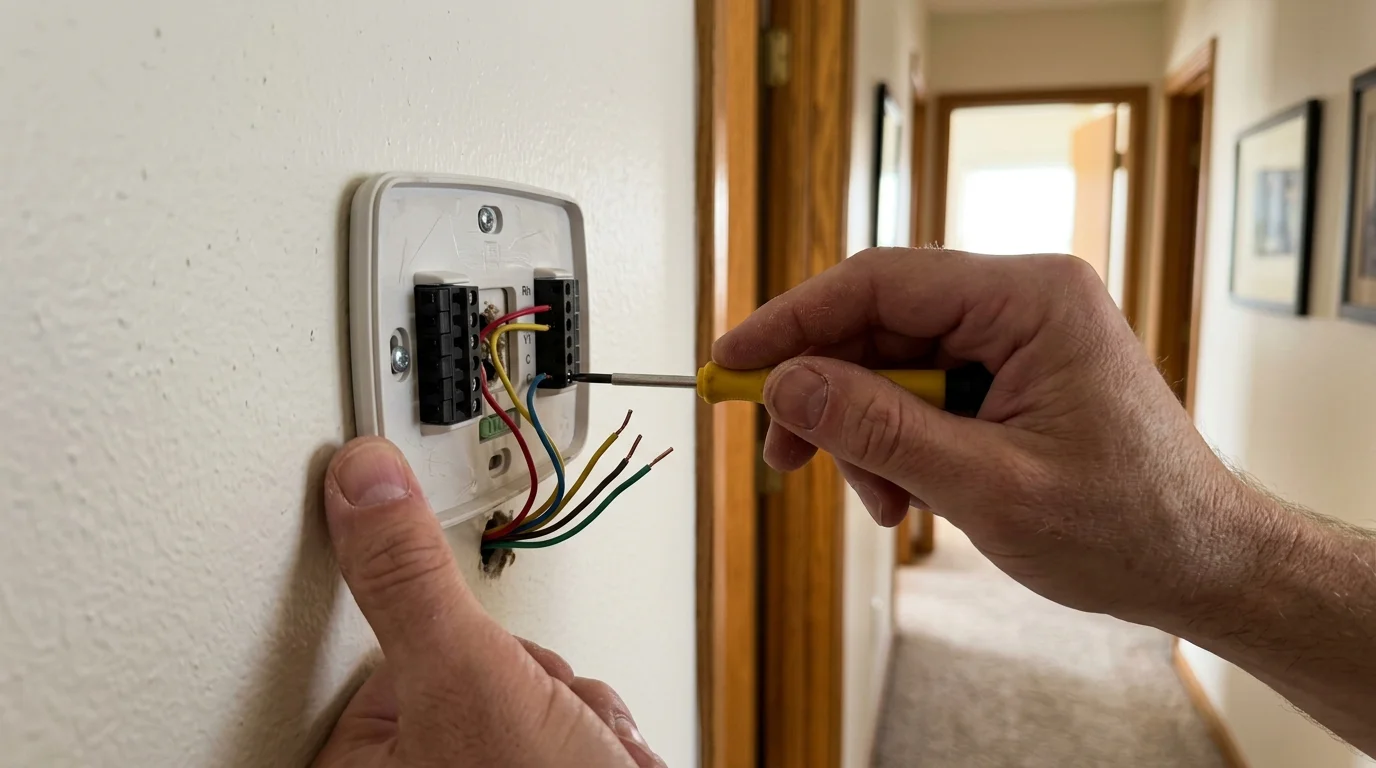
Dedicated C-wire installation represents a non-negotiable requirement for battery-aware throttling configurations. Power-stealing thermostats that lack a dedicated common wire cause severe issues when backup systems disconnect from grid frequency.
Installing a dedicated 24VAC common line delivers critical operational safeguards:
- Maintains uninterrupted Wi-Fi and radio transceiver operation during inverter transfer switches.
- Prevents premature compressor contactor chatter caused by intermittent low-voltage conditions.
- Eliminates internal thermostat battery drain during long-term off-grid operations.
- Permits continuous local API polling without entering low-power display sleep modes.
Local communication protocols remain vastly superior to cloud-based APIs for disaster resilience. Modern architectures running over the open Matter Smart Home Standard operate reliably even when public broadband networks collapse.
| Smart Thermostat Model | Primary Local Protocol | Latency to Setpoint Change | Dedicated C-Wire Required | Aux Heat Lockout Control |
|---|---|---|---|---|
| Ecobee Smart Thermostat Premium | HomeKit Local Area Network | < 1.5 seconds | Yes (or included PEK) | Advanced native staging menus |
| Google Nest Learning Thermostat (4th Gen) | Matter over Thread | < 2.5 seconds | Yes (Mandatory 24VAC) | Software staging thresholds |
| Honeywell Home T9 | Local IP via Home Assistant | < 3.0 seconds | Yes (Required) | Hardware jumper and rules |
Ecobee remains a leading choice due to its rapid response via local HomeKit integrations. It accepts dynamic target overrides without relying on cloud servers or proprietary subscription tiers.
The Google Nest Learning Thermostat (4th Gen) introduces local Matter over Thread support. This protocol significantly cuts latency during local home network communications.
Worked Example: Surviving an August Grid Outage
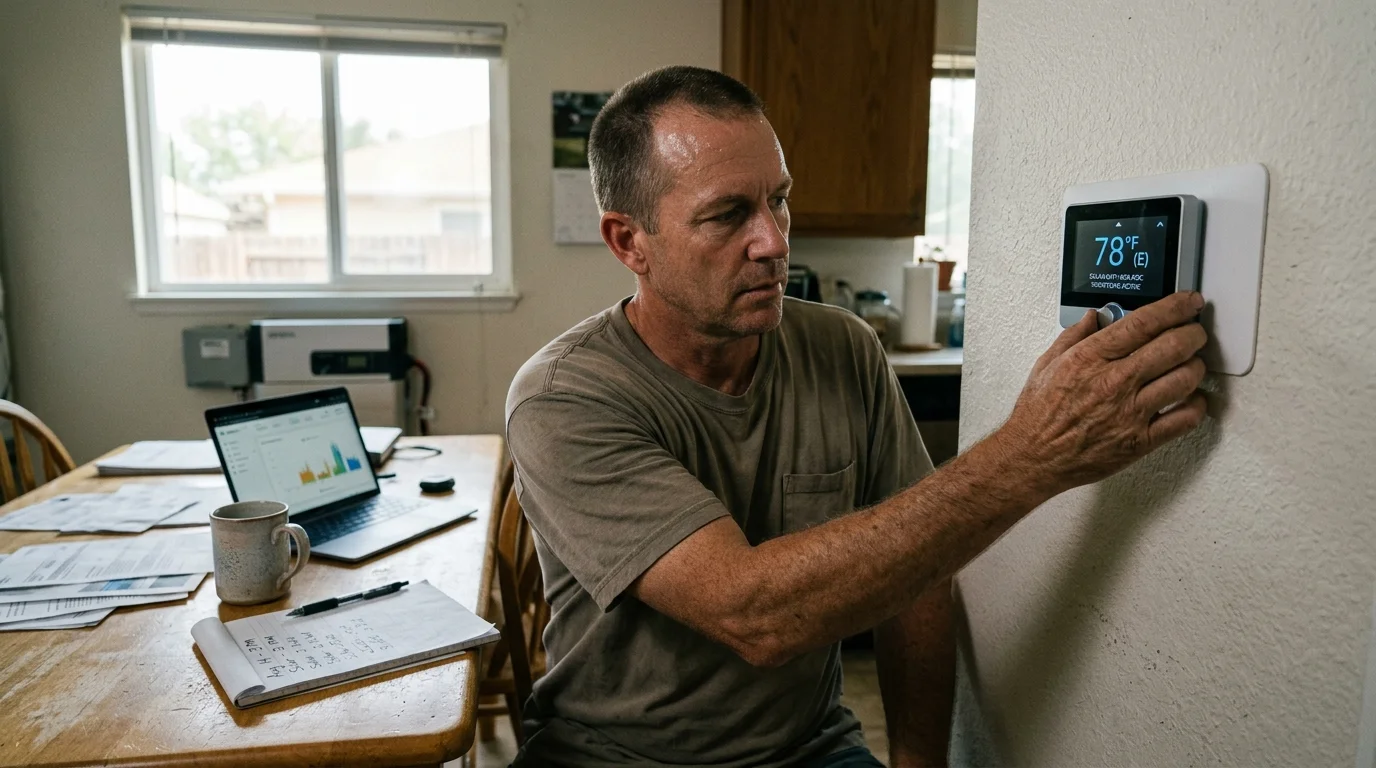
Consider an actual residential scenario during a severe summer thunderstorm in central Texas. The home operates a 10 kW rooftop photovoltaic array paired with a single 13.5 kWh Tesla Powerwall 3.
In two-story homes, fixing upstairs heat gaps with automated duct booster fans helps reduce overall compressor runtime by efficiently directing cooled air to hot bedrooms.
Optimizing your smart thermostat for summer is essential when balancing extreme cooling demands against finite stored energy.
Cooling duties rely on a 4-ton single-stage heat pump drawing 4,000 continuous watts while the compressor runs. Baseline household loads consume 500 continuous watts for refrigeration, networking, and security.
The utility grid suffers catastrophic failure at 4:00 PM with outside temperatures holding steady at 102°F. The battery bank registers 100% capacity (13.5 kWh) at the precise moment of disconnection.
Between 4:00 PM and 7:00 PM, rooftop solar output drops rapidly from 4.0 kW to 0.0 kW as dusk settles. During this twilight transition, solar arrays contribute an aggregate 4.5 kWh toward household operations.
In an unmanaged scenario, the thermostat holds a rigid 72°F comfort setpoint. The 4-ton compressor runs at an 85% duty cycle to battle intense thermal transfer through ceilings and walls.
The unmanaged system burns 3.4 kWh of cooling energy every hour alongside 0.5 kWh of baseline household loads. By 7:00 PM, the battery bank drains down to 6.3 kWh (47% SOC).
Without solar production after 7:00 PM, the 3.9 kW total household load completely drains the remaining 6.3 kWh in 1.6 hours. The entire house goes completely dark at 8:36 PM.
Now observe the exact same home operating dynamic SOC-driven climate throttling logic:
At 4:00 PM, the automation holds the baseline setpoint of 74°F while SOC remains above 50%. By 6:45 PM, solar yields decline and battery SOC crosses below the 50% capacity mark.
The automation triggers its dynamic formula, lifting the setpoint to 75.5°F immediately upon crossing 50% SOC. As storage drops to 40% SOC at 8:15 PM, the system adjusts target temperatures to 77°F.
This elevated target slashes compressor duty cycles from 85% down to 35%. Hourly HVAC consumption drops from 3,400 watt-hours to just 1,400 watt-hours.
When storage capacity declines to 30% SOC around 11:30 PM, the thermostat adjusts automatically to 78.5°F. Total hourly home consumption stabilizes at an ultra-low 1.9 kW aggregate draw.
At 3:00 AM, the battery reaches 20% SOC with 2.7 kWh of energy remaining. The system executes emergency shedding, locking the compressor off while maintaining 100-watt fan circulation.
The remaining 2.7 kWh easily sustains the 500-watt critical baseline load for over five additional hours. At 7:15 AM, morning sunlight strikes the solar array, safely recharging the battery bank without service interruption.
Locking Out Auxiliary Heat Strips and Multi-Stage Units
Electric heat pumps present extreme hazards to residential backup storage during winter utility failures. When ambient temperatures plunge, standard heat pumps engage auxiliary electric resistance heat strips.
If your home uses a dual-fuel heating system, calculating the economic balance point on your smart thermostat helps determine the precise outdoor temperature to transition to gas heat rather than drawing battery reserves.
These resistance elements draw between 5,000 and 10,000 watts of immediate, continuous power. That load will overload standard battery inverters and cause complete storage collapse within forty minutes.
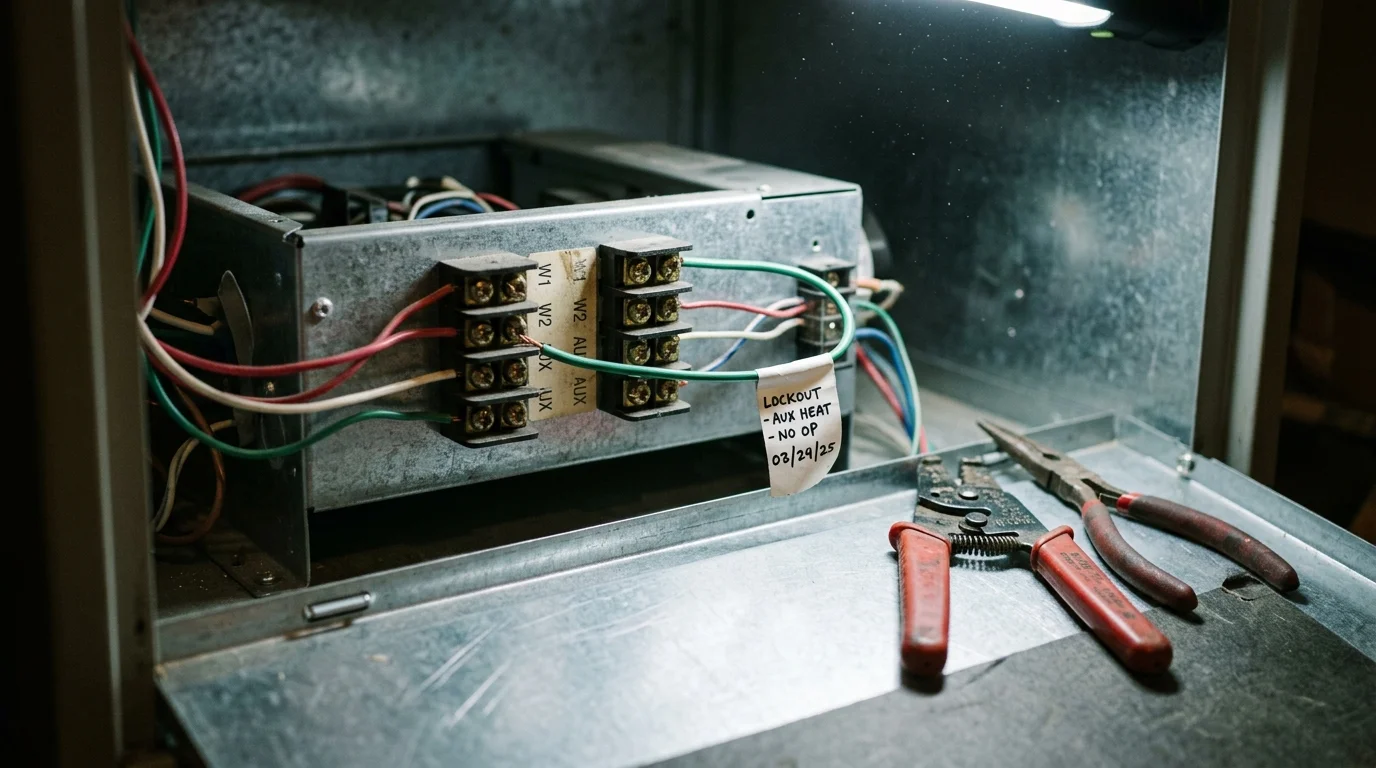
Your solar battery smart thermostat automation must enforce an aggressive software lockout on secondary heating stages. You can configure this lockout through smart thermostat staging thresholds or local automation scripting.
Modern inverter storage units like the Enphase IQ Battery 5P or Tesla Powerwall deliver finite continuous amperage. Starting an electric resistance heater while running an induction stove or well pump trips inverter safety breakers.
Mitigate auxiliary strip risks using targeted automation constraints:
- Set the auxiliary heat compressor lockout to 15°F or disable emergency heat entirely during grid outages.
- Enforce an automation script that switches the thermostat from Heat mode to Emergency-Heat-Disabled mode upon utility power loss.
- Prevent multi-stage compressors from ramping into Stage 2 whenever battery SOC registers under 60%.
- Install smart current transformers inside your main electrical panel to monitor auxiliary circuit draw in real time.
If your HVAC air handler lacks clear stage-isolation controls, consult an authorized professional technician. Modifying physical control board jumpers ensures your resistance strips never engage without utility grid support. Always turn off power at the furnace or air-handler switch and circuit breaker before touching thermostat or control-board wiring, and never jumper R to C or guess terminals.
Step-by-Step Automation Setup in Home Assistant
Home Assistant provides the premier platform for integrating energy storage telemetry with climate control hardware. You can pull real-time data from Tesla Gateway, Enphase Envoy, or SolarEdge Modbus integrations.
Begin by establishing a reliable polling pipeline for your battery state of charge. Use Modbus TCP or local REST connections rather than cloud-dependent vendor accounts.
Follow these implementation steps to construct your dynamic throttling engine:
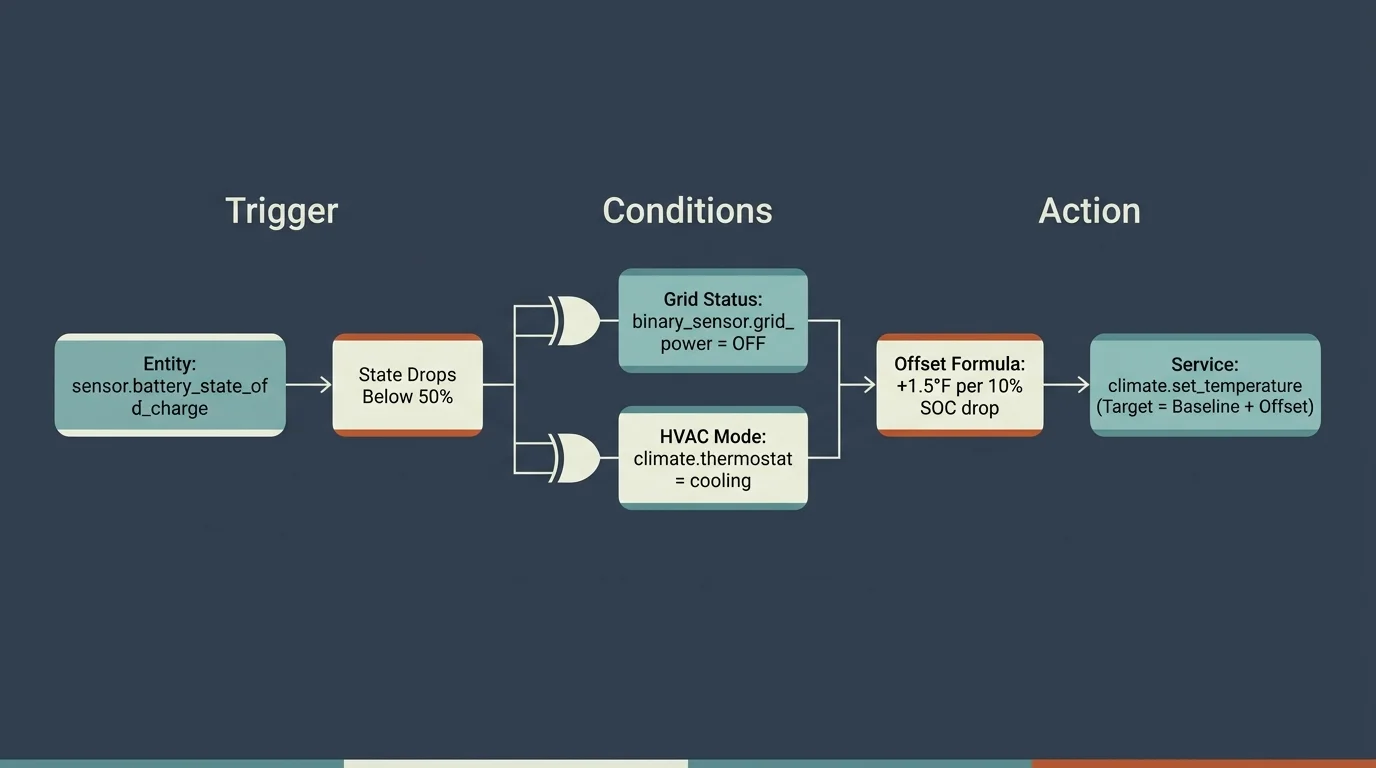
- Create a template sensor that tracks battery SOC percentage in whole numbers using local integration entities.
- Build an automation triggered whenever the battery sensor changes state, filtered by an active power outage binary sensor.
- Add a condition confirming the thermostat mode matches active heating or cooling states.
- Establish a dynamic offset calculation variable clamped at zero above 50% SOC: Setpoint Offset = max(0, (50 – SOC) / 10) * 1.5 (added to the target setpoint for cooling, or subtracted for winter heating).
- Dispatch the calculated target setpoint to your thermostat using the climate.set_temperature service call.
- Configure an emergency boundary trigger that issues a climate.turn_off call if SOC drops below 20%.
Implement a short-cycle protection constraint within your automation configuration. Never transmit setpoint adjustments more frequently than once every fifteen minutes.
Rapid target adjustments force HVAC compressors into frequent on-off cycles. Compressor short-cycling damages motor windings and consumes massive electrical surges during repeated rotor starts.
NEM 3.0 and Time-of-Use Economic Benefits
Dynamic climate throttling delivers massive financial value beyond emergency grid interruptions. Homeowners operating under California NEM 3.0 billing rules face severe economic penalties when feeding solar into utility grids.
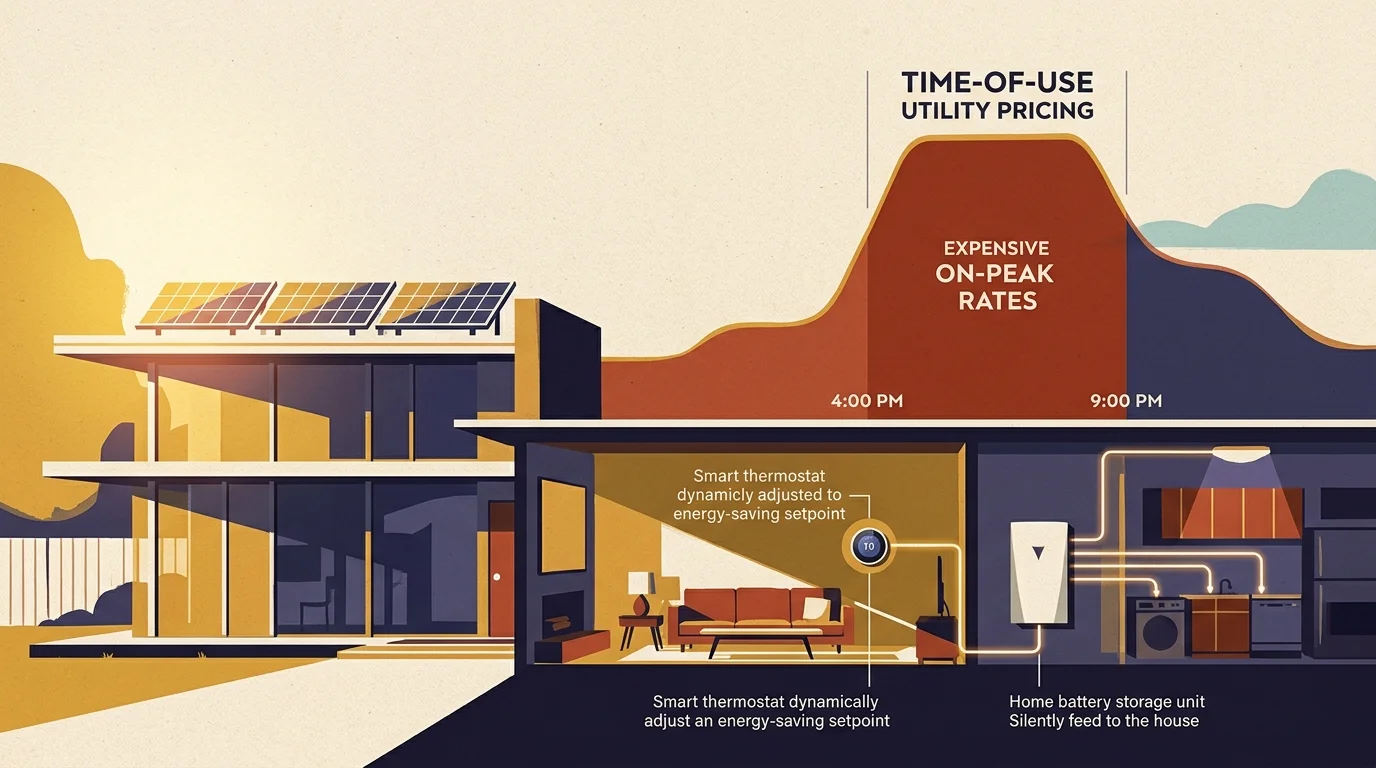
NEM 3.0 reduced export compensation rates by approximately 75%, paying a meager $0.05 to $0.08 per kilowatt-hour. Meanwhile, evening peak grid import rates frequently hit $0.45 to $0.70 per kilowatt-hour between 4:00 PM and 9:00 PM.
Dynamic throttling automates high-efficiency thermal banking. During peak solar production from 11:00 AM to 2:00 PM, your automation super-cools your home down to 70°F using cheap local solar electricity.
When expensive peak time-of-use hours arrive at 4:00 PM, your thermostat raises setpoints dynamically. The home coasts comfortably on stored thermal mass while battery reserves support basic household circuits.
Pairing smart HVAC load-shifting (such as pre-cooling or pre-heating off-peak) with home battery storage reduces peak-window battery discharge, allowing a smaller kWh battery bank to cover evening time-of-use rates.
Note on 2026 incentives: The federal Section 25D 30% Residential Clean Energy Credit expired on December 31, 2025 for homeowner-purchased batteries, so 2026 buyers should look to state/utility storage rebates (such as California SGIP or utility VPP programs) or third-party lease/PPA structures eligible under commercial Section 48E rules.
Maximizing financial and operational return requires treating your home battery and HVAC system as a unified machine. Dynamic setpoint throttling protects both your physical comfort and your household investment.
Frequently Asked Questions
Can dynamic setpoint throttling damage my HVAC compressor?
No, provided your thermostat or automation platform enforces a minimum run time and short-cycle delay. Most modern smart thermostats enforce a built-in five-minute compressor protection delay to protect internal hardware against rapid cycling.
Why is a dedicated C-wire necessary for battery-aware load shedding?
Power-stealing thermostats without a dedicated C-wire can drop Wi-Fi connectivity when your backup system changes voltage characteristics during off-grid transfers. A steady 24VAC common line ensures continuous local API communication during an active grid failure.
Does Home Assistant require internet access to throttle thermostat temperatures?
No. When you integrate your battery storage system via local protocols like Modbus TCP and control your thermostat through local Matter or HomeKit integrations, all automation logic executes entirely offline inside your local network.
How does dynamic SOC throttling interact with heat pump balance points?
Battery-aware logic overrides traditional low-temperature staging. When battery SOC drops below 50%, your automation rules must completely lock out resistive auxiliary heating elements, forcing your heat pump to rely exclusively on efficient compressor heating.
Disclaimer: This article is for informational purposes only. Smart home devices involve electrical connections and data privacy. Always follow manufacturer instructions for installation. For complex wiring or HVAC work, consult a licensed professional.