Running high-wattage appliances during a 4:00 PM to 9:00 PM peak utility window drives summer electric bills past $600 monthly. Implementing an automated peak load shedding routine systematically cuts non-critical circuits the moment your tariff spikes to 48¢ per kilowatt-hour.
Standard manual timers fail whenever household schedules drift or utility rates adjust. In contrast, dynamic load-curtailment scripting disconnects heavy electrical draws within 90 seconds of peak pricing, preventing runaway utility charges without sacrificing daily comfort.
By automating your circuit control, you can reclaim hundreds of dollars every cooling season. You will convert high-wattage appliances into responsive, interruptible assets that protect your household budget.

Understanding the True Cost of 48¢/kWh Peak Windows
Investor-owned utilities across California and the Southwest penalize afternoon power consumption heavily. Under tariffs like Pacific Gas and Electric’s E-TOU-C and E-TOU-D, prices climb from roughly 28¢ off-peak to 48¢–50¢ per kilowatt-hour between 4:00 PM and 9:00 PM.
Even if you are starting your smart home on a budget, curtailing just one or two heavy loads quickly offsets your hardware investment.
Learning how to schedule your smart devices effectively provides the foundation needed before layering on advanced dynamic curtailment rules.
San Diego Gas & Electric pushes those peak figures above 60¢ during summer billing cycles. These aggressive rate structures reflect grid stress as solar output fades while residential cooling demands spike.
Operating a continuous 3,000-watt load during this five-hour stretch costs $7.20 each afternoon. That single appliance adds more than $150 to your monthly bill if left unchecked across 22 billing weekdays.
Relying on memory to manually switch off pool pumps or vehicle chargers produces inconsistent results. True energy efficiency requires software that enforces financial discipline across your electrical panel automatically.
High-Draw Appliance Audits: Pinpointing Your Curtailment Targets
Before scripting an automation routine, you must isolate the heavy energy consumers within your home. Small electronics and LED lighting draw negligible power compared to motorized compressors and resistive heating elements.
In addition to primary appliances, setting up power-drop auto-off automations ensures secondary shop heaters and bench tools do not run unnoticed during expensive utility windows.
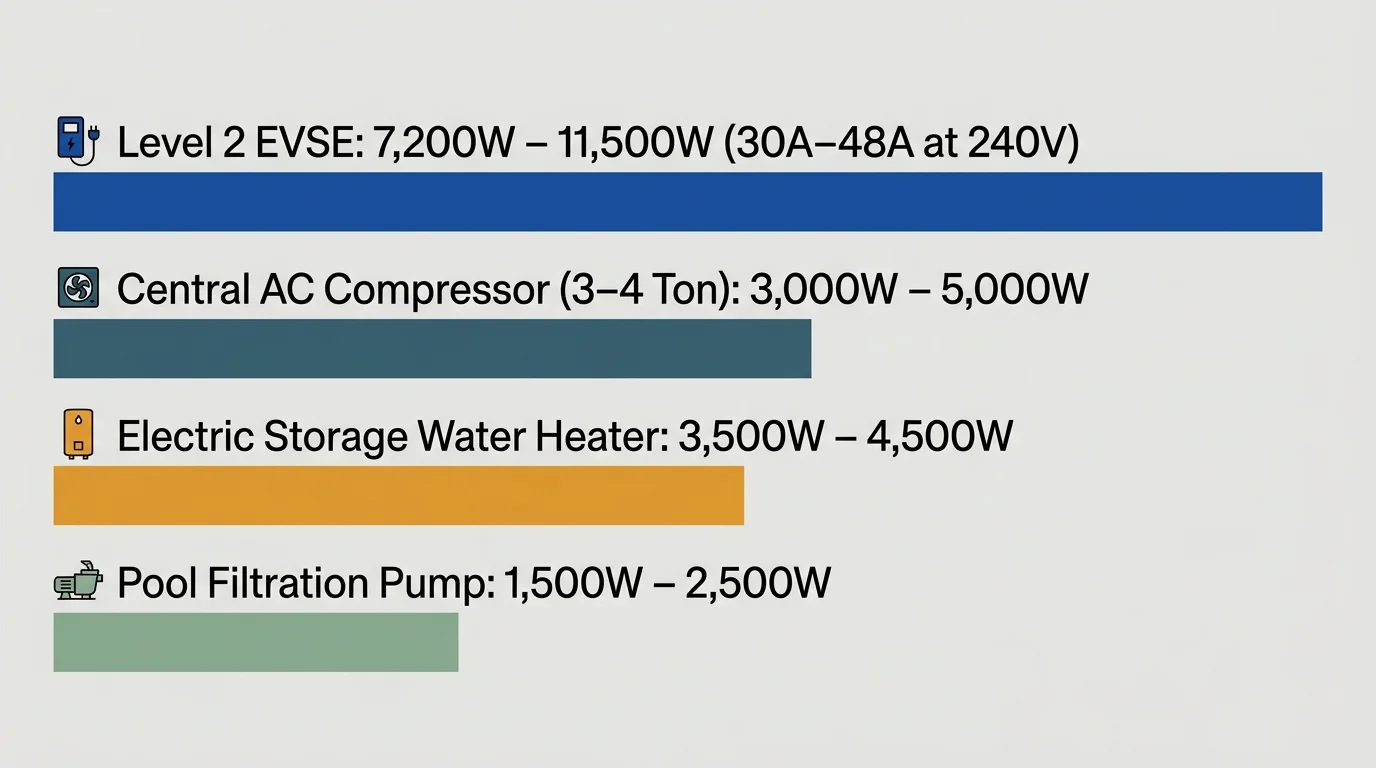
The primary curtailment candidates in suburban homes fall into four distinct operational categories:
- Level 2 Electric Vehicle Supply Equipment (EVSE): Draws 7,200W to 11,500W (30A to 48A at 240V), representing your home’s single largest discretionary load.
- Central Air Conditioning Compressors (3- to 4-Ton): Consumes 3,000W to 5,000W continuously while actively cooling during high ambient outdoor temperatures.
- Electric Storage Tank Water Heaters: Draws 3,500W to 4,500W intermittently whenever internal tank temperatures drop below setpoint thresholds.
- Single-Speed Pool Filtration Pumps: Pulls 1,500W to 2,500W continuously across multi-hour filtration runs.
- Basement Refrigerant Dehumidifiers: Consumes 450W to 700W continuously while cycling to control below-grade ambient humidity.
Curtailing an EV charger and a pool pump alone removes up to 14,000 watts of demand instantly. Shedding these loads avoids costly peak-rate multipliers entirely without interrupting your evening domestic routine.
Hardware Constraints: NEC Continuous Load Rules and Relays
Automating major circuits requires careful attention to electrical safety standards and duty cycles. You cannot simply install standard consumer smart adapters on every electrical appliance in your home.
Similar heavy-duty contactor principles apply when automating the switchover between swamp coolers and central AC to isolate inductive compressor surges safely.
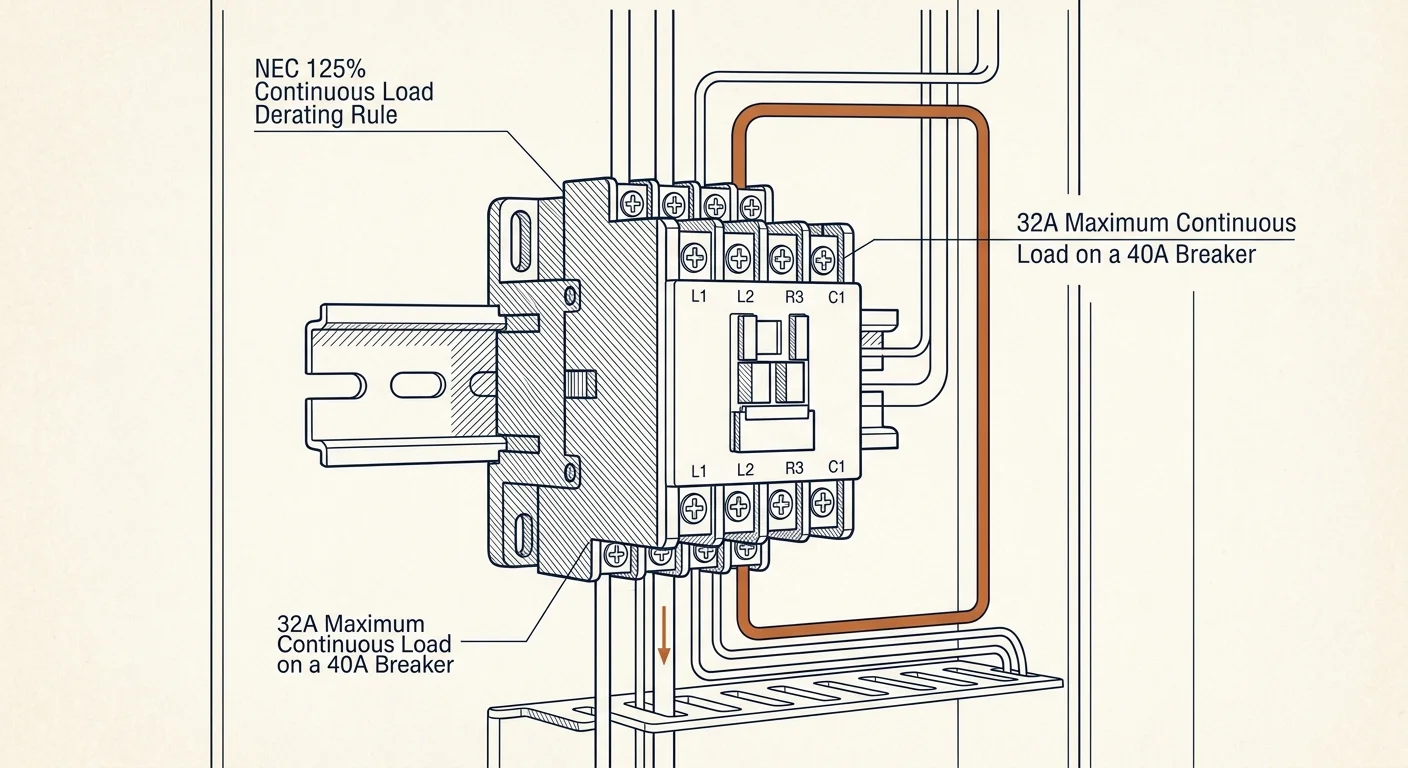
The National Electrical Code (NEC) Article 100 defines a continuous load as any draw sustained for three hours or longer. Under the NEC 80% rule, circuits and switching hardware must operate at no more than 80 percent of their rated capacity.
“Continuous loads running for three hours or more must not exceed 80 percent of the circuit rating under National Electrical Code standards.”
A typical 120V plug carries a rating of 15A or 1,800W max resistive load. Applying the continuous safety derating limits sustained operational draws to 12A or 1,440W.
A standard 15-amp time of use electricity smart plug will overheat if forced to manage prolonged dehumidifier or space-heating draws. Cheap internal relays frequently weld shut or scorch outlet enclosures under heavy, sustained duty cycles.
High-voltage 240V appliances require dedicated industrial switching equipment. Heavy-duty 30A or 40A smart contactors isolate electrical arcs safely away from delicate automation microcontrollers.
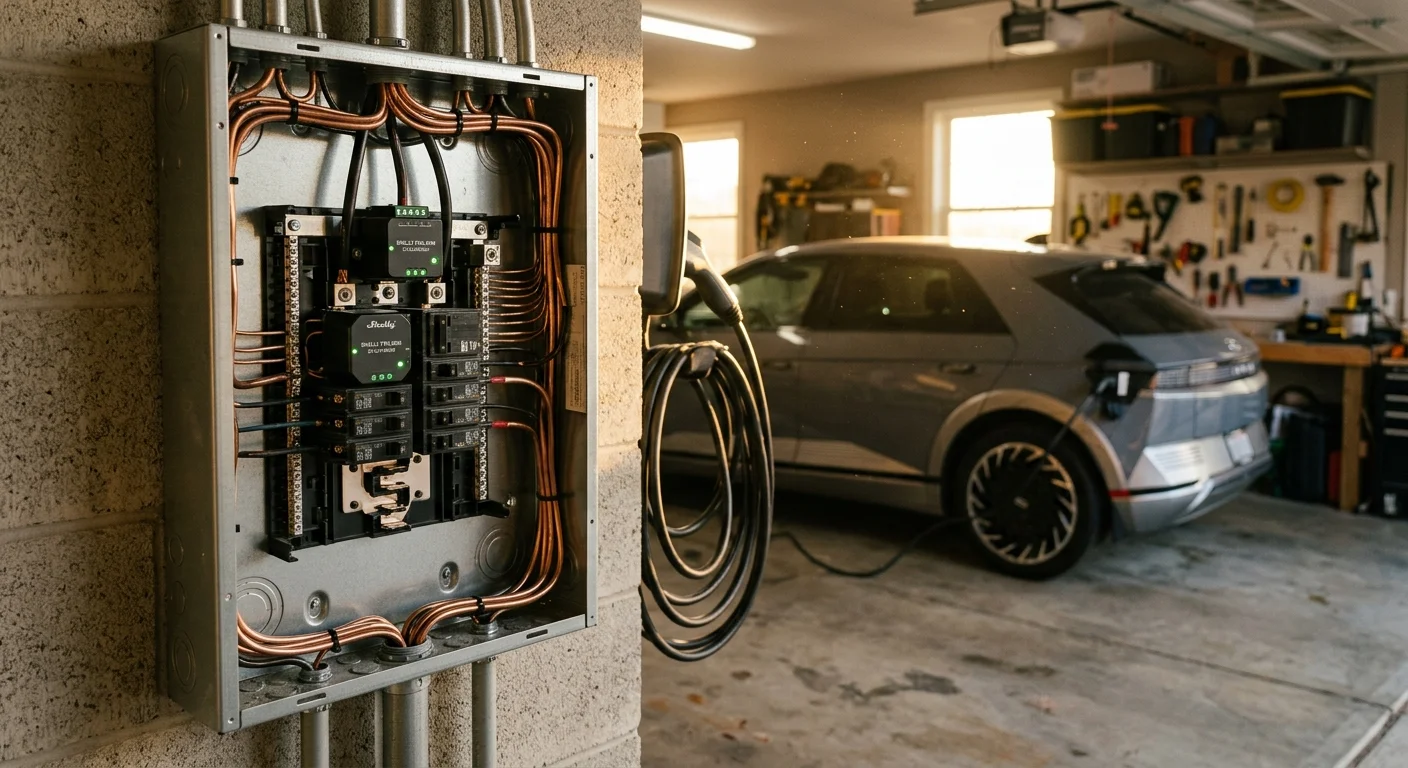
For hardwired equipment, DIN-rail relays like the Shelly Pro 1PM paired with external contactors provide safe isolation. Alternatively, smart circuit breaker panels like SPAN or Leviton Smart Load Centers switch entire branch circuits natively.

Worked Financial Model: Daily Savings on a 5-Hour Curtailment
To quantify the real-world financial return, consider a 2,400-square-foot suburban home in Walnut Creek, California. The home operates on PG&E’s E-TOU-C tariff, which charges 28¢/kWh off-peak and 48¢/kWh during peak hours.
You can also tie delayed filtration and charging cycles into a comprehensive smart home goodnight routine to ensure off-peak tasks start seamlessly after you go to sleep.
Pairing this peak curtailment strategy with other seasonal smart home automations compounds your household utility reductions across every season.
The peak rate window runs from 4:00 PM to 9:00 PM every weekday, spanning 22 billing days per month. The tariff creates a net price delta of exactly 20¢ per kilowatt-hour between rate periods.
Our worked scenario evaluates three high-draw appliances shed completely during that five-hour window:
- Tesla Wall Connector (Level 2 EVSE): Drawing 32A at 240V (7.68 kW) for four hours of vehicle charging.
- Pentair WhisperFlo Pool Pump: Drawing 1.8 kW continuously for five hours.
- Frigidaire 50-Pint Dehumidifier: Drawing 0.55 kW continuously for five hours.
Unmanaged, the EV charger consumes 30.72 kWh during peak hours, costing $14.75 each day. Shifting that charge session to 11:00 PM off-peak rates costs $8.60, saving $6.15 per day.
The unmanaged pool pump burns 9.0 kWh during peak, costing $4.32 daily. Moving that runtime to midnight off-peak hours cuts the cost to $2.52, saving $1.80 per day.
The dehumidifier draws 2.75 kWh during peak, costing $1.32 daily. Delaying that dehumidification cycle saves 55¢ daily, bringing total daily savings to $8.50 across all three loads.
Multiplying $8.50 across 22 billing weekdays produces $187.00 in direct monthly savings. Over a four-month summer tariff season, this automated load shifting routine saves $748.00 without replacing any mechanical equipment.
Building the Automated Load Curtailment Script
Executing an automated load shedding routine requires a centralized local controller like Home Assistant. Local processing ensures your shutoff scripts fire reliably even if your broadband connection experiences an outage.
Because utility peak demand often strains the local grid, integrating these scripts alongside a smart home power outage survival plan ensures your hub stays powered through regional disruptions.
With the release of the Matter Smart Home Standard 1.3 specification, connected devices gained native support for energy management and direct electric vehicle control. You can query device power telemetry and execute pause commands seamlessly across brand ecosystems.
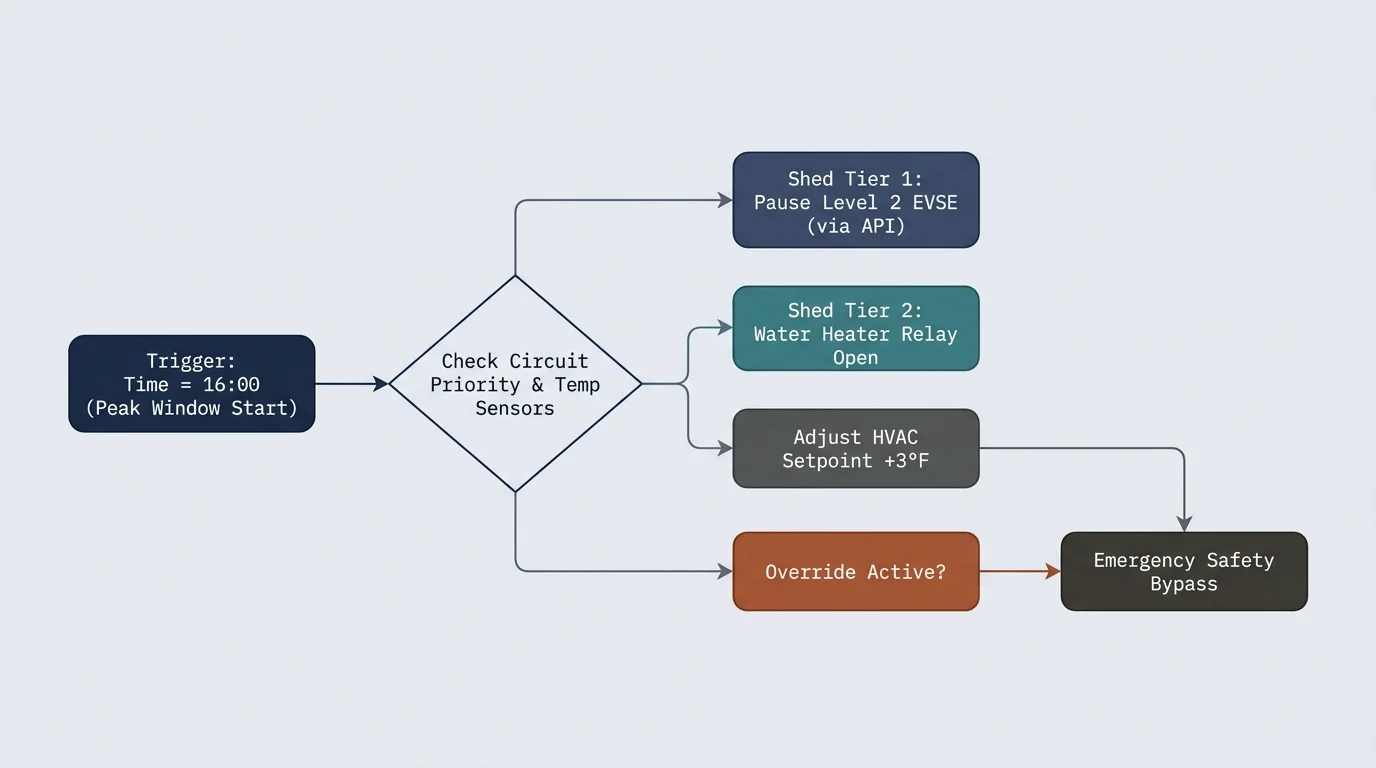
The curtailment script operates on a precise execution sequence to protect your equipment and prevent sudden electrical surges:
- Trigger Initiation (3:58:30 PM): The local controller evaluates the utility schedule helper exactly 90 seconds before the 48¢ window begins.
- EVSE Charging Interruption: The script dispatches a soft pause command via Open Charge Point Protocol (OCPP) to ramp down vehicle amperage smoothly.
- Inductive Load Disconnection: The pool pump and dehumidifier contactors open sequentially, spaced two seconds apart to minimize voltage ripples.
- Thermal Setback Activation: The HVAC thermostat receives a setpoint adjustment command, locking the compressor out for the initial peak hour.
- State Verification Check (4:01:00 PM): The script reads whole-home power telemetry via an energy monitor to confirm consumption dropped below 1,200 watts.
If consumption remains elevated at 4:01 PM, the script dispatches a high-priority push notification to your phone. This alerting mechanism flags stuck contactors or manual device overrides before excessive energy costs accumulate.
HVAC and Water Heater Pre-Cooling and Pre-Heating Protocols
Central air conditioning and water heating cannot simply be disconnected for five hours without degrading indoor comfort. Instead, you can employ thermal storage strategies to bank energy prior to rate increases.
Leveraging proven smart thermostat features that save money allows you to schedule these multi-stage temperature pre-cooling periods without manually adjusting dials.
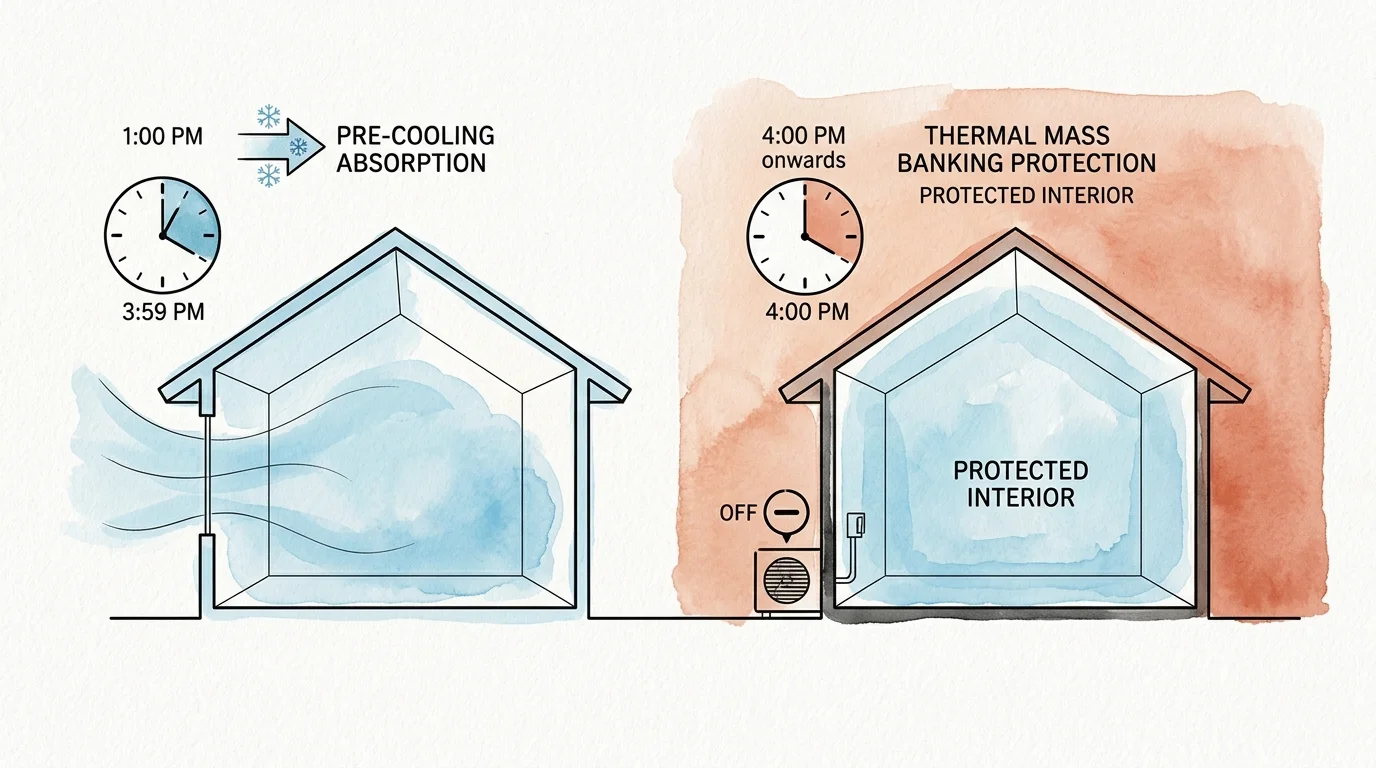
Guidance from Energy Star Smart Thermostats shows that automated thermal setbacks yield substantial energy reductions without compromising overall living space comfort. Thermal mass absorbs energy effectively when managed through calculated pre-cooling routines.
Between 2:00 PM and 3:45 PM, lower your thermostat setpoint by 2°F to 3°F while off-peak power remains inexpensive. The home’s drywall, flooring, and furniture drop in temperature, creating a cold energy reservoir.
At 3:59 PM, raise the thermostat setpoint by 4°F above your baseline comfort level. The air conditioner compressor remains idle for the first three hours of peak pricing while the home slowly absorbs heat.
Water heaters operate under an identical thermodynamic principle. Bring the storage tank to 135°F at 3:00 PM, utilizing a thermostatic mixing valve on the output line to prevent domestic scalding.
De-energize the heating elements at 4:00 PM using an EcoPort (CTA-2045) controller or heavy-duty relay. The insulated tank maintains sufficient hot water volume for evening showers without pulling 4,500 watts of peak power.
Hardware Comparison for Heavy-Duty Curtailment
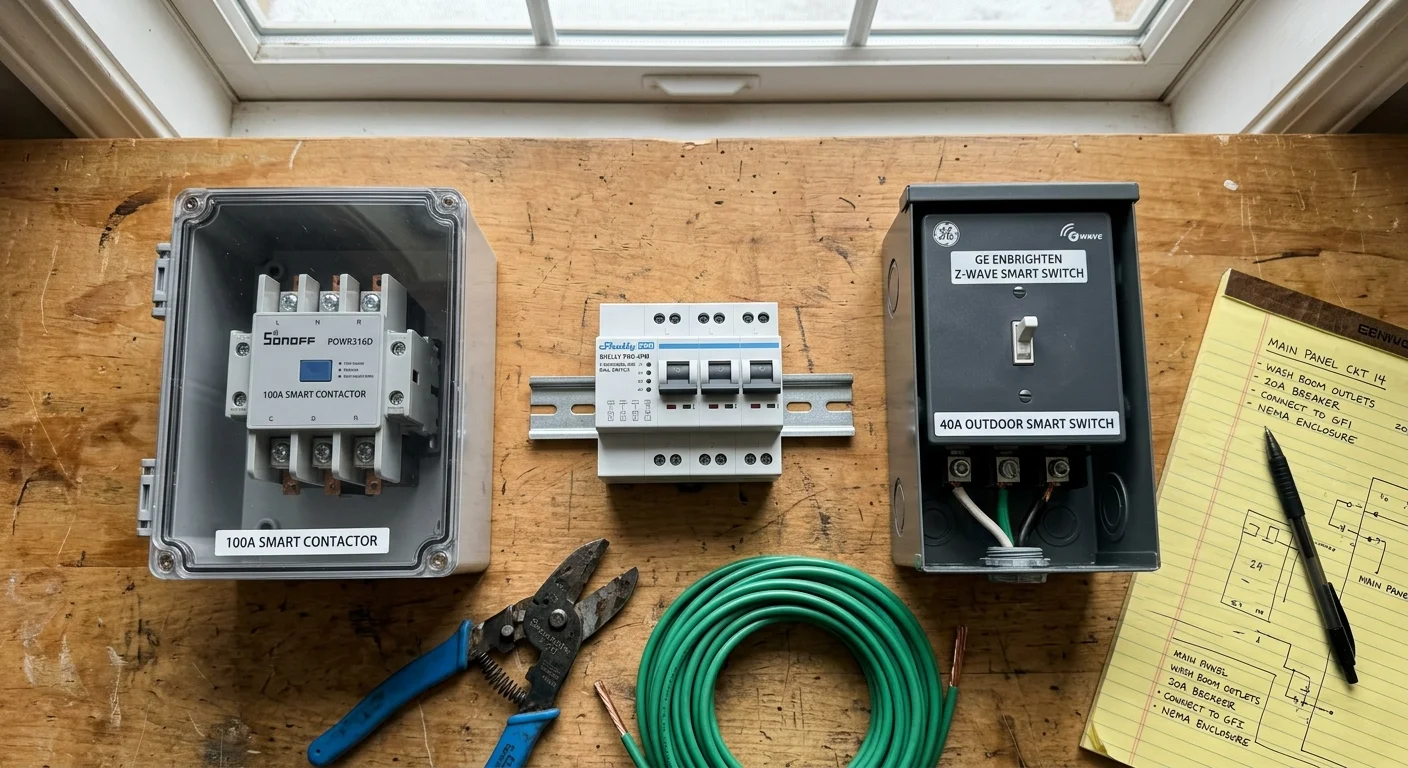
Selecting appropriate switching hardware depends on branch voltage, circuit amperage, and physical panel constraints. The following options represent proven switching devices for high-demand residential load shedding:
| Hardware Device | Form Factor | Max Continuous Rating | Communication Protocol | Power Monitoring Accuracy |
|---|---|---|---|---|
| Shelly Pro 1PM + Contactor | DIN Rail Mount | 40A at 240V (via Contactor) | Wi-Fi / Ethernet / Bluetooth | Active Power (±1.0%) |
| Aeotec Heavy Duty Switch | NEMA Enclosure Box | 32A Continuous at 240V | Z-Wave Plus | RMS Power (±2.0%) |
| Emporia Smart Plug | NEMA 5-15 Outlet Plug | 12A Continuous at 120V | Wi-Fi (Local Flashable) | Standard Power (±2.0%) |
| SPAN Smart Panel | Complete Load Center | Up to 90A per Breaker Branch | Ethernet / Wi-Fi / Cellular | Revenue Grade (±0.5%) |
| Leviton Smart Breakers | Standard Panel Slot | Up to 48A Continuous (60A Frame) | Wi-Fi | Branch Level (±1.5%) |
For standalone 240V pool pumps, the Aeotec Heavy Duty Smart Switch provides weather-resistant enclosure integration. It mounts directly beside existing outdoor timer boxes without requiring panel replacements.
For whole-home TOU rate automation across multiple high-draw lines, smart electrical panels offer unmatched versatility. They switch loads at the branch circuit level, eliminating external junction boxes entirely.
Troubleshooting Edge Cases and Fail-Safe Overrides
Complex automation routines inevitably encounter real-world exceptions that require robust fail-safe protections. If an automation fails silently, you risk paying peak rates or stranding an electric vehicle without charge.
Analysis from Wirecutter Smart Home testing emphasizes that local network control provides superior reliability over cloud-dependent platforms during critical automated events. Cloud-tethered automations introduce latency and failure points that disrupt time-critical curtailment schedules.
Incorporate the following architectural safeguards into your automation configurations:
- Vehicle State of Charge (SoC) Minimums: Script an override preventing EVSE disconnection if the vehicle battery sits below 20 percent capacity.
- HVAC Compressor Short-Cycle Protection: Enforce a strict minimum five-minute lockout between compressor states to prevent mechanical motor damage.
- Local Hardware Heartbeats: Configure your smart contactors with internal auto-off timers that trigger independently if the home hub loses connectivity.
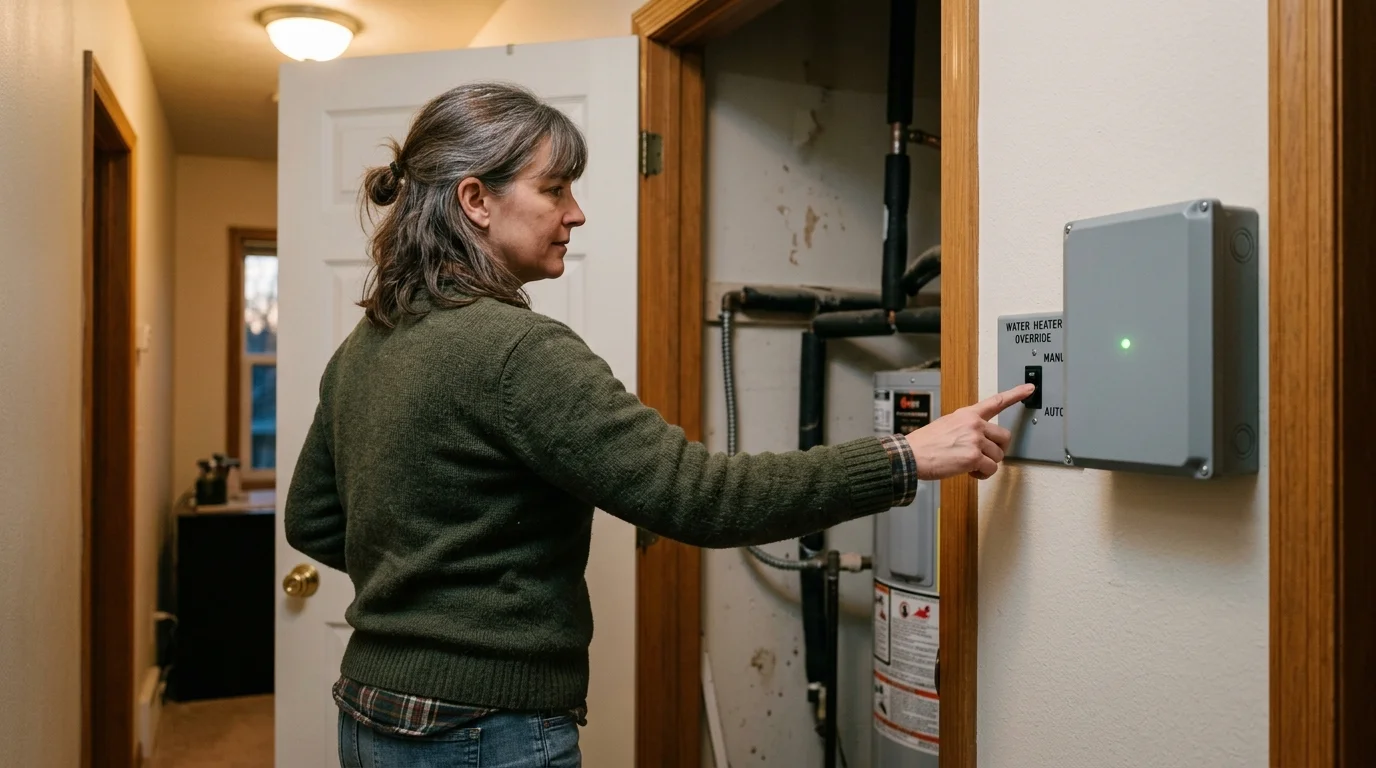
- Physical Emergency Bypasses: Wire physical three-way rotary switches parallel to your relays, allowing immediate manual activation during automation failures.
Verify that your automation engine resets all curtailment states cleanly at 9:01 PM. When off-peak rates return, the script must restore normal filtration and charging parameters automatically.
Frequently Asked Questions
Will abruptly cutting power to my Level 2 EV charger damage my vehicle’s battery pack?
No, because modern electric vehicles utilize sophisticated onboard battery management systems that isolate the battery when line power drops. However, issuing a soft pause command via Matter, OCPP, or the vehicle’s API remains preferred over abrupt contactor cuts.
How does Matter 1.3 simplify TOU rate automation for major home appliances?
Matter 1.3 introduces standardized data clusters for energy reporting, electrical metering, and device management. This standard enables automation controllers to adjust EV charging rates and appliance states directly without relying on proprietary third-party integrations.
Can I use a standard 15-amp smart plug to automate my central air conditioner?
No, central air conditioning units run on 240V electrical service and draw starting currents exceeding 30 amps. Automate central systems through a smart thermostat setpoint routine or a specialized 240V contactor wired into the system control board.
What happens if my smart home hub goes offline right before the 4:00 PM peak window?
If your hub goes offline, smart switches running internal hardware schedules will still shed loads on time. Ensure your switching devices support on-device schedules to maintain peak protection during local server restarts or firmware updates.
Disclaimer: This article is for informational purposes only. Smart home devices involve electrical connections and data privacy. Always follow manufacturer instructions for installation. For complex wiring or HVAC work, consult a licensed professional.