Saturated soil during heavy seasonal downpours turns your septic absorption field into an unyielding sponge. When your washing machine dumps 40 gallons of wastewater into that waterlogged system, raw effluent backs up through basement floor drains.
Most homeowners treat sump pits and septic systems as completely isolated utilities. In reality, reading groundwater levels in your sump pit provides an early warning trigger to halt high-discharge laundry cycles before hydraulic shock floods your leach field.
By building a smart sump pump washing machine interlock, you can automate appliance cutoffs and protect thousands of dollars in rural plumbing infrastructure.
The Physics of Septic Failure During Heavy Rainfall
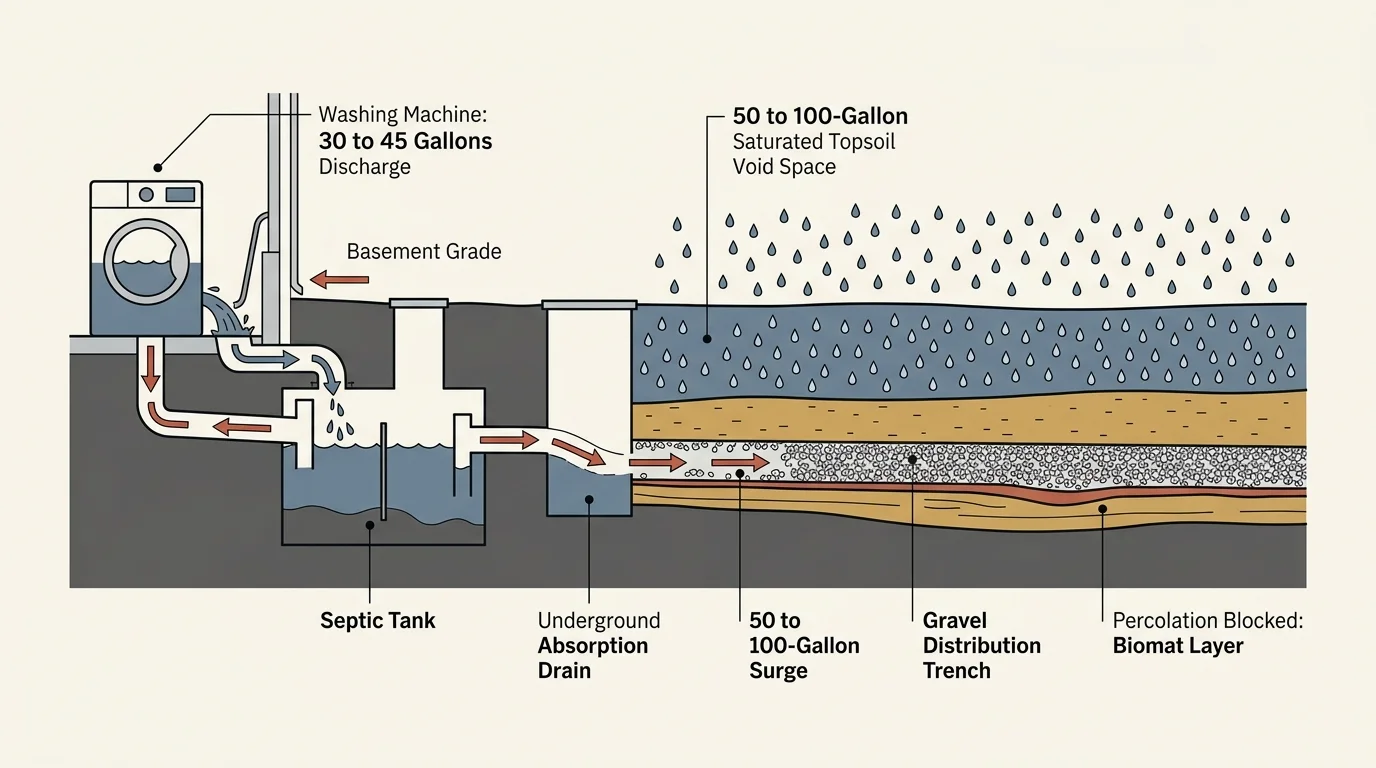
Gravity septic drain fields rely on unsaturated soil to absorb and filter clarified wastewater from your septic tank. When torrential rain falls, topsoil saturates and percolating groundwater occupies every microscopic void within the drain field trenches.
Proactive homeowners can also implement pre-storm shutdown routines driven by barometric pressure drops to pause major water usage before rain begins falling.
According to the U.S. Environmental Protection Agency, a standard top-loading washing machine discharges between 30 and 45 gallons of water per cycle. High-Efficiency front-load washers consume roughly 12 to 20 gallons per run.
Running two or three back-to-back laundry loads introduces an immediate 50- to 100-gallon hydraulic surge into your septic tank. This intense surge forces settled effluent out of the tank before suspended solids can separate.
When that surge reaches a waterlogged leach field, the water cannot percolate downward into the surrounding soil biomat. Instead, liquid backs up through your main sewer line, surfacing on your lawn or rising through basement fixtures.
Data from the Insurance Information Institute indicates that average residential water damage claims reach between $11,600 and $13,950. Most standard homeowners policies cap sewer and septic backup endorsements at $5,000 or $10,000.
Replacing a conventional septic absorption field costs between $5,000 and $15,000, while engineered aerobic systems regularly exceed $20,000. Mitigating hydraulic shock during soil saturation events protects your property and your wallet.

Why Sump Water Levels Predict Septic Saturation
Under the International Plumbing Code, sump pumps cannot discharge drainage into private septic tanks or municipal sanitary sewer systems. Sump basins collect perimeter groundwater from foundation footer tiles to relieve hydrostatic pressure against basement walls.
Automating this interlock follows the same principles as shedding high-wattage loads, shifting heavy utility demands away from peak stress periods.
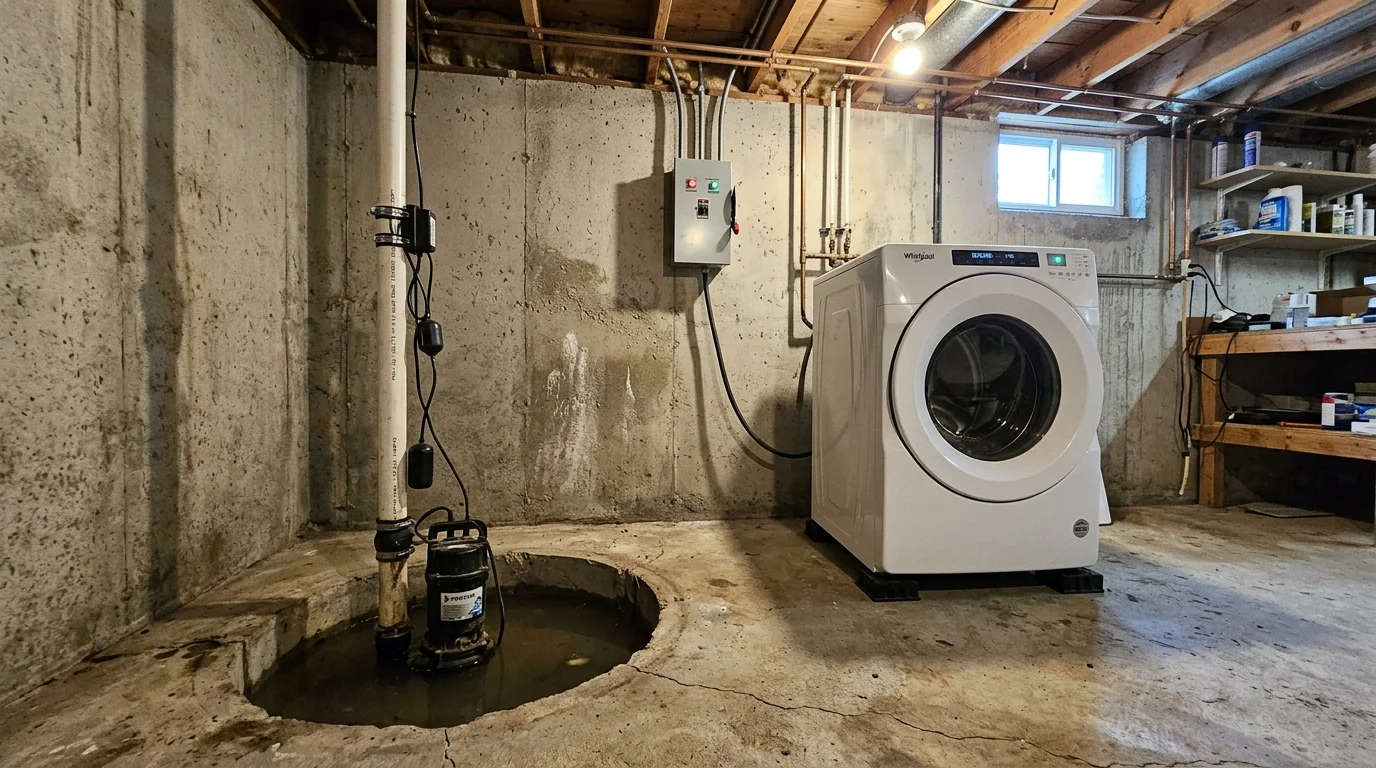
Even though the piping stays completely separate, your sump pit functions as a real-time hydrologic monitor for your entire property. The pit sits below your basement slab, making it the deepest groundwater inspection point on your parcel.
When seasonal rain storms saturate the upper soil layers, water trickles downward into your foundation drain tiles. A rapid rise in pit water depth directly reflects a rising subterranean water table across your yard.
If groundwater rises high enough to challenge your sump pump, your septic drain trenches are experiencing identical hydrostatic saturation. At that exact moment, your drain field loses its ability to accept additional liquid discharge.
You can create a smart routine that reads high water levels in the sump pit to trigger an automated appliance pause. This simple routine prevents septic overflow smart automation by stopping high-volume appliance drains before wastewater backs up into your home.
Hardware Selection: Heavy-Duty Relays vs. Smart Plugs
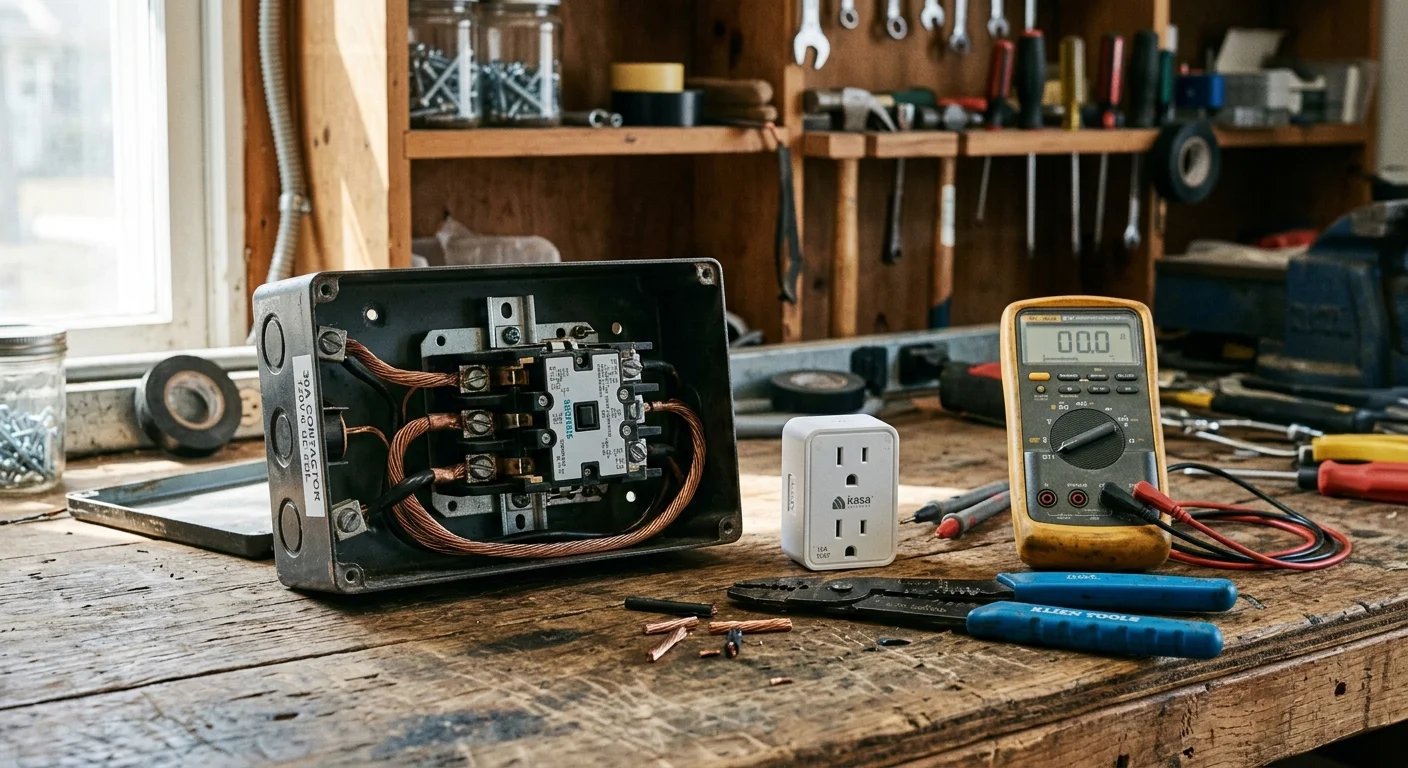
Standard household smart plugs cannot safely manage the electrical demands of a washing machine. National Electrical Code (NEC 210.11(C)(2)) requires a dedicated 20-amp branch circuit for residential laundry appliances.
Washing machine motors draw substantial inductive inrush current when starting up and during high-speed spin cycles. This inductive kick produces an electrical arc across relay contacts inside low-cost smart plugs.
In independent evaluations by Consumer Reports Smart Home testing, smart switches must match appliance electrical ratings to prevent component breakdown. Cheap 10-amp or 15-amp resistive smart plugs can weld their internal contacts shut, creating a fire hazard.
You must deploy a motor-rated heavy-duty switch, an inline smart relay, or a specialized appliance cutoff module. Consider the hardware options in the table below to select the right device for your setup.
| Device Model | Protocol | Continuous & Motor Rating | Power Monitoring | Approximate Cost |
|---|---|---|---|---|
| Zooz ZEN15 Power Switch | Z-Wave Plus | 15A continuous, 1/2 HP motor | Yes | $35 |
| Shelly Plus 1PM | Wi-Fi / Bluetooth | 16A continuous, 1 HP motor | Yes | $22 |
| YoLink Heavy Duty Relay | LoRa (Long Range) | 20A continuous, 2 HP motor | No | $42 |
| Standard Wi-Fi Smart Plug | Wi-Fi | 10A–15A resistive only (no motor rating) | Rarely accurate | $12 |
For groundwater detection in the pit, combine your appliance switch with a dedicated high-water sensor. Choose between solid-state conductivity probes, mechanical float switches wired to dry contact transmitters, or non-contact ultrasonic distance sensors.
Mechanical float switches mounted three to four inches above your primary pump switch provide bulletproof reliability. Unlike submerged electronic probes, mechanical floats resist mineral buildup and iron bacteria fouling common in rural sump wells.
Designing the Sump-to-Appliance Automation Logic
A smart routine protecting your septic tank must balance rapid shutoff capability with appliance mechanical safety. Abruptly killing power while a washing machine drum spins at 1,200 RPM causes mechanical strain on drive belts and suspension rods.
Much like configuring power-drop auto-off automations to protect equipment, cutoffs must be timed precisely to avoid mechanical strain.
Instead of hard power cuts, an ideal smart sump pump washing machine interlock monitors energy consumption to execute graceful cutoffs. Alternatively, you can use a motorized water sensor appliance cutoff valve on the supply bibbs to pause modern digital machines.
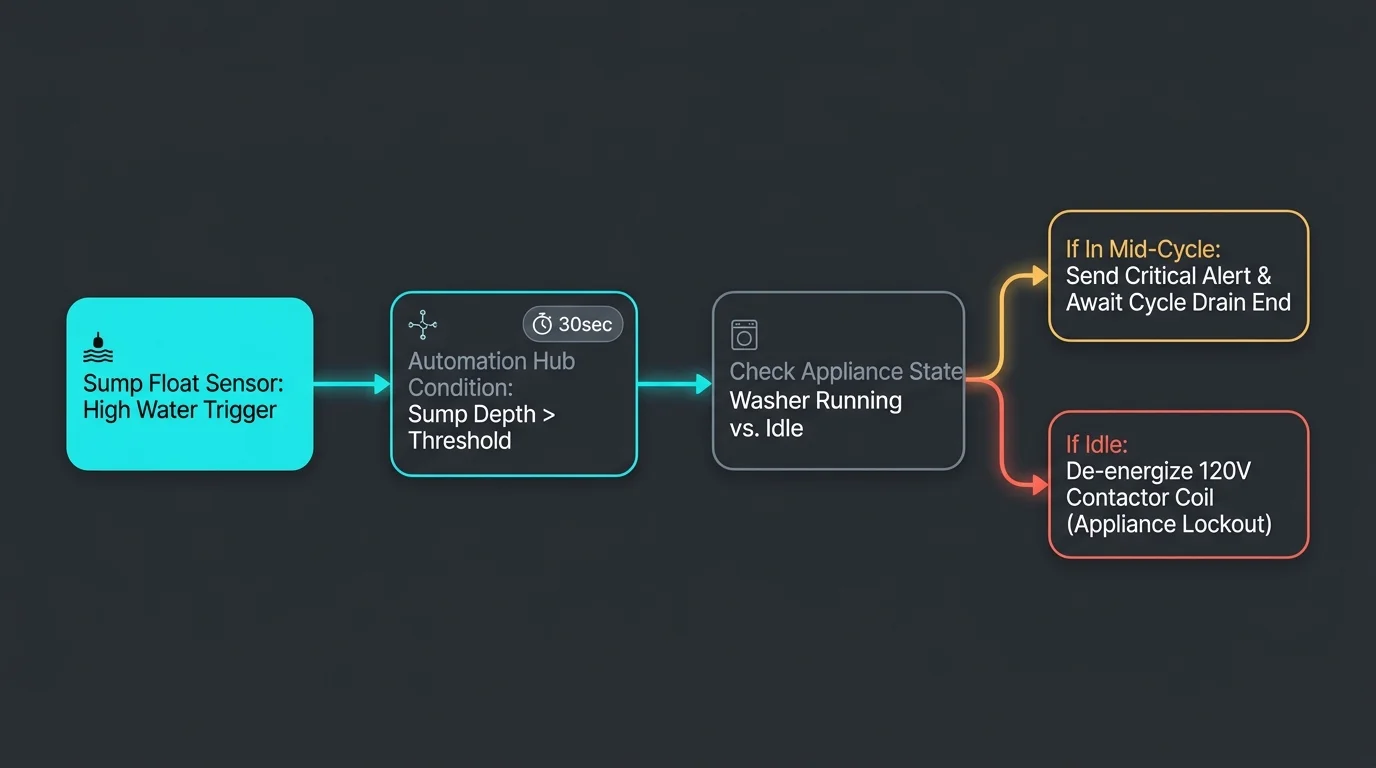
Build your automation logic inside a local smart home platform using the following sequential operational architecture:
- Normal Baseline Monitoring: The primary sump pump handles routine water ingress, keeping depth below the 14-inch mark.
- Field Saturation Detection: Persistent rain drives pit water to 18 inches, lifting the secondary smart float sensor to an open-circuit state.
- Appliance State Evaluation: The smart hub polls the laundry relay to read current power draw.
- Graceful Pause or Cutoff: If power draw is below 15 watts (between wash cycles), the relay cuts power immediately. If high wattage indicates an active spin cycle, the hub waits two minutes for the drum to decelerate before opening the circuit.
- Hysteresis and Cooldown: When water drops back below the high float, the automation initiates a three-hour cooldown timer before restoring power.
When paired with a smart dishwasher circuit, you can apply identical logic to kitchen appliances. Dishwashers contribute another 6 to 10 gallons of scalding, detergent-laden water that emulsifies fats and hinders septic tank settlement.
Staggering high-discharge appliances ensures that your septic tank handles only low-volume greywater while the surrounding soil recovers. Your automated hub acts as a digital traffic controller for wastewater distribution.

Worked Example: Retrofitting a High-Water Sump Cutoff System
Consider a rural home served by a 1,000-gallon two-compartment concrete septic tank and a 300-foot gravel drain trench. The basement features an 18-inch-diameter, 24-inch-deep sump pit driven by a 1/3-horsepower submersible pump.
Integrating these cutoff events into a broader smart home emergency alert system ensures everyone in the household is notified immediately when laundry cycles are suspended.
The laundry room houses a top-loading washing machine drawing an average of 38 gallons per normal wash cycle. Under seasonal storm conditions, the existing pump runs every two minutes, signaling high water table saturation.
To prevent hydraulic overloading, the homeowner purchases a Zooz ZEN15 smart plug ($35) and a YoLink LoRa Water Float Sensor ($32). The total hardware cost for this project totals exactly $67.
The homeowner clamps the YoLink float switch inside the sump basin, positioned 19 inches from the bottom. This mounting height sits four inches above the primary pump’s mechanical float switch activation point.
Next, the homeowner plugs the washing machine’s power cord directly into the Zooz ZEN15 heavy-duty appliance switch. The switch links to a local Z-Wave smart hub, while the YoLink sensor connects via its long-range gateway.
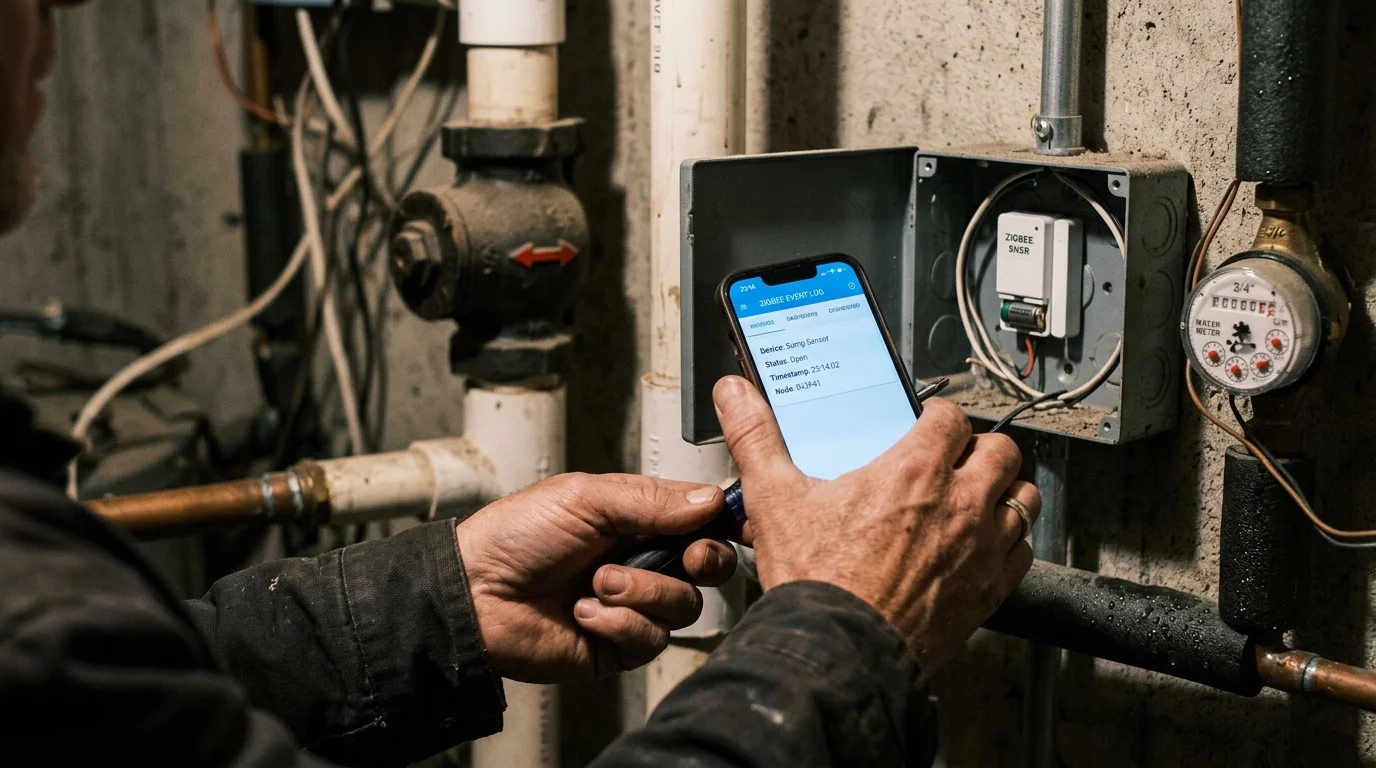
During an October storm producing 2.6 inches of rainfall, the primary sump pump develops a discharge airlock. Water rises past the 14-inch normal run line and trips the smart float at the 19-inch threshold at 3:14 PM.
The hub receives the high-water alert and dispatches an immediate cutoff command to the Zooz ZEN15 outlet. A scheduled afternoon wash cycle halts before the appliance fills, keeping 38 gallons of water out of the septic tank.
This automated intervention keeps the septic tank’s liquid level below the intake baffle, preventing effluent from backing up into the basement. The homeowner avoids a $350 emergency plumbing service call and protects their $9,000 absorption field.
Failsafes, Motor Protection, and Plumbing Code Compliance
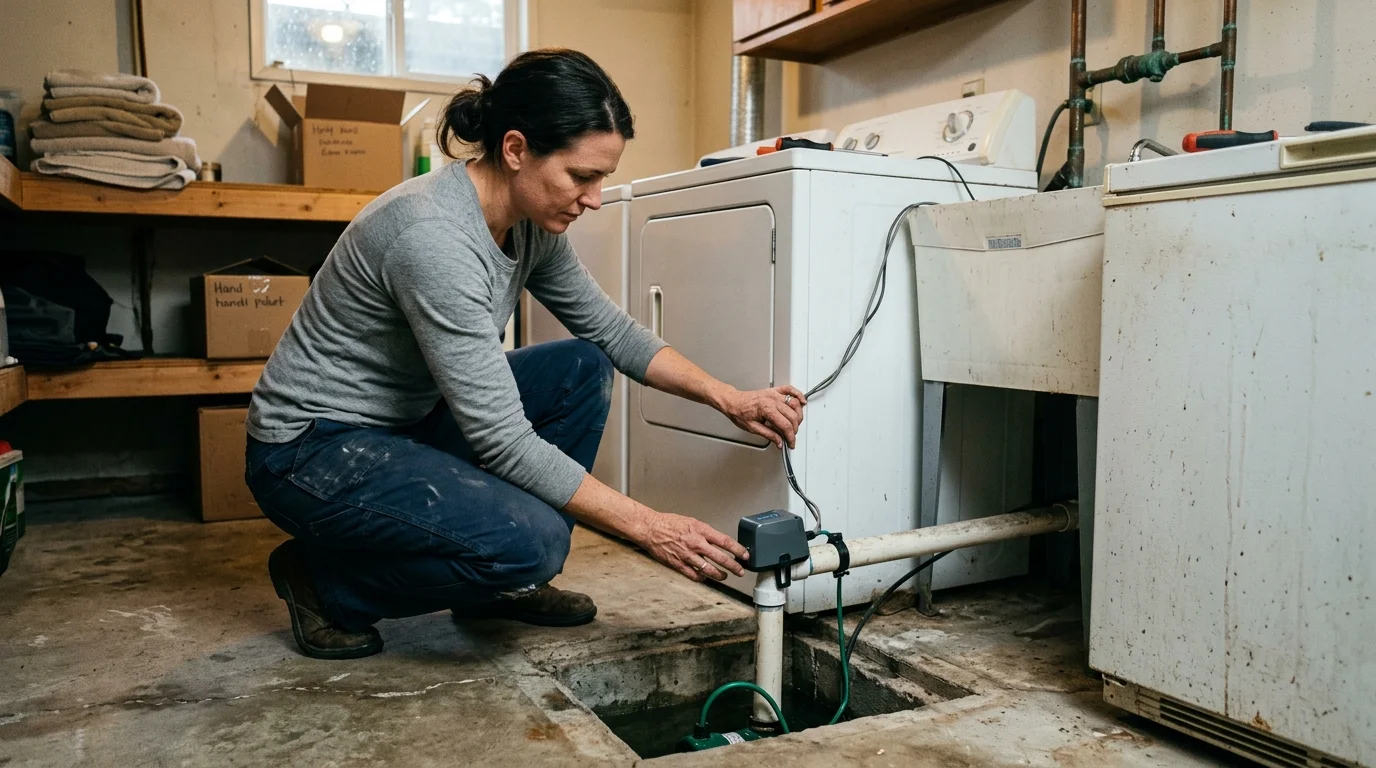
Automation routines must prioritize home safety above convenience. Whenever you install switching hardware on major plumbing or electrical lines, you must respect building codes and appliance manufacturer guidelines.
Because severe storms often bring electrical grid failures, pairing your local hub and sump systems with a dedicated smart home power outage strategy ensures continuous flood protection.
Standard household automation platforms can experience network dropouts or cloud downtime during violent storms. Expert testing from Wirecutter Smart Home reviews confirms that local execution hubs deliver superior reliability for critical automated routines.
Configure your smart devices to maintain local communications across Zigbee, Z-Wave, or local Wi-Fi protocols. If your broadband connection drops during a storm, local automations continue to fire without relying on cloud servers.
To maintain full electrical code compliance and protect machine components, enforce the following safety rules across your installation:
- Maintain Ground Fault Protection: NEC guidelines require GFCI protection for 120-volt, 15-amp, and 20-amp receptacles installed in unfinished basements and laundry areas. Ensure your smart relay sits downstream of a functional GFCI breaker or receptacle.
- Verify Relay Amperage: Confirm the smart switch or relay carries a UL or ETL safety listing with a minimum 15-amp continuous motor rating.
- Prevent Rapid Contact Chatter: Program a minimum 30-minute lockout on the smart switch to keep it from rapidly cycling power if the water float bobs.
- Install Motorized Supply Valves: Pairing power interlocks with automatic shutoff valves on the laundry hose bibbs prevents unexpected fill cycles if the electrical relay fails.
- Keep Drainage Pathways Clear: Never redirect sump pump groundwater into indoor sinks, toilets, or laundry standpipes, which violates local municipal ordinances.
Following these installation standards prevents electrical fires and protects expensive washer electronics. You preserve home safety while automating wastewater management.
Troubleshooting Automation Latency and False Triggers
Turbulent water rushing into your sump basin can trigger float sensors prematurely. Incoming drainage from basement perimeter tile creates waves and bubbling that can lift mechanical floats before the pit fills.
To stop false triggers, mount your secondary float sensor inside a stilling well. A simple 2-inch PVC pipe section with drainage holes drilled near the base shields the float from surface splashing.
Smart home protocols also introduce variable communication latency. Cloud-dependent Wi-Fi sensors may take 15 to 45 seconds to relay state changes, creating delays that could allow an appliance cycle to start.
Implement the troubleshooting steps below to resolve common automation latency and reliability problems:
- Install a Low-Pass Filter Routine: Require the high-water sensor to remain continuously active for at least 15 seconds before the hub triggers an appliance pause.
- Test Signal Attenuation: Concrete foundation walls and steel utility panels attenuate wireless signals; install a mains-powered signal repeater between your hub and basement sensors.
- Inspect for Mineral Build-Up: Rural well water often contains dissolved iron and calcium that coats mechanical float hinges; wipe down sensor arms twice a year.
- Add Push Notification Alerts: Include companion alerts within your automation so your phone notifies you whenever an appliance locks out.
Regular maintenance ensures that your smart routine executes flawlessly during catastrophic seasonal weather. Inspecting your hardware once every autumn guarantees your system stays ready for heavy rain.
Frequently Asked Questions
Why can’t I plug my washing machine into a standard smart plug?
Standard smart plugs are rated for resistive loads like lamps. Washing machine motors create inductive inrush currents that can melt or weld internal relay contacts shut, creating a persistent fire hazard.
Will abruptly cutting power to my washing machine damage its motor or control board?
Modern washing machines tolerate sudden power loss without electrical damage. However, cutting power mid-cycle leaves soapy water in the drum, making smart water supply valve cutoffs or pause commands preferable.
How does sump pit water indicate septic drain field saturation?
Your sump basin collects perimeter groundwater from the lowest point of your foundation. Rapid water accumulation in the pit signals a high local water table, meaning nearby septic absorption trenches are also waterlogged.
How long should the automation lock out appliances after water levels drop?
Maintain the lockout for at least two to four hours after the sump pit returns to normal levels. Soil drain fields require extra time to percolate standing water through the biomat before accepting new wastewater surges.
Disclaimer: This article is for informational purposes only. Smart home devices involve electrical connections and data privacy. Always follow manufacturer instructions for installation. For complex wiring or HVAC work, consult a licensed professional.