
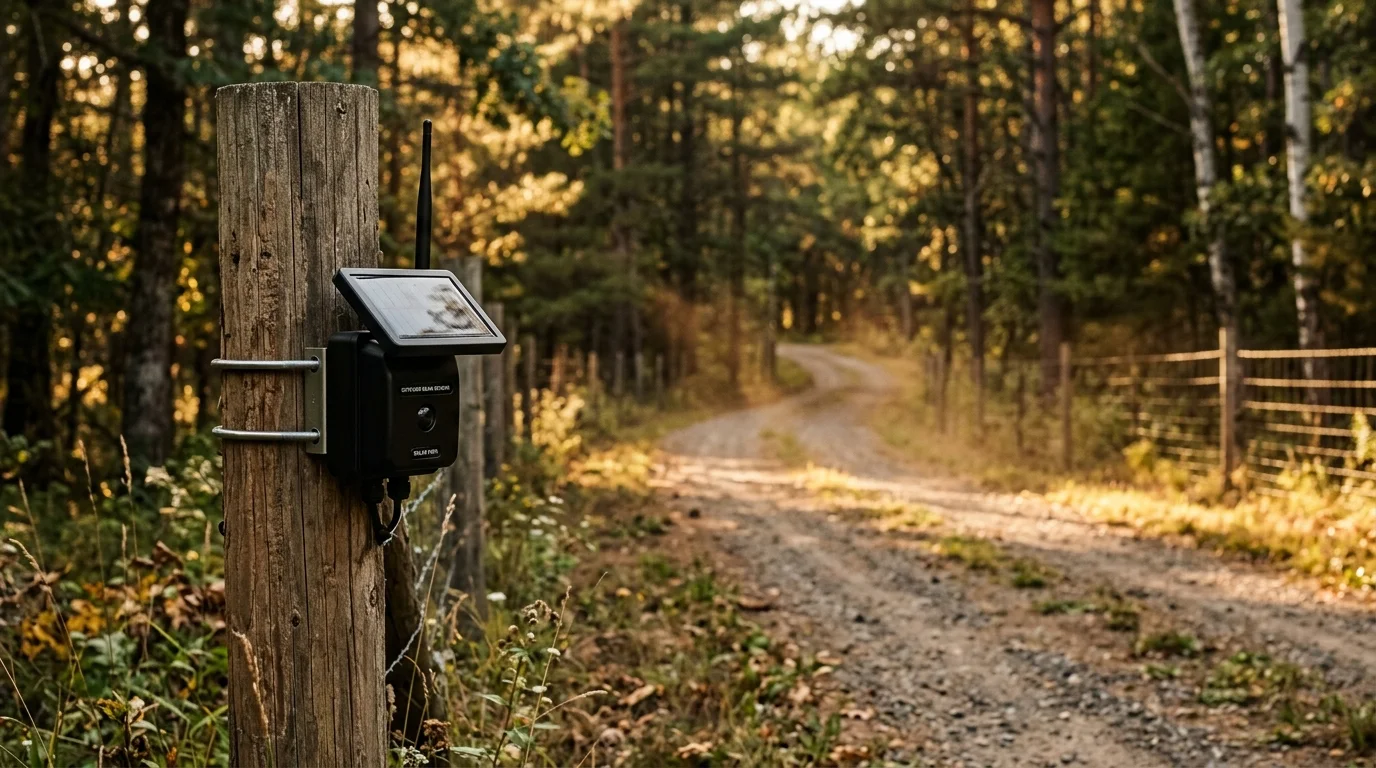
You cannot protect a 400-foot rural driveway with standard Wi-Fi or Zigbee sensors that drop offline past your front porch. Trenching AC power conduits out to your property line costs thousands of dollars and risks freeze-thaw damage.
If you decide to run dedicated underground power along the perimeter instead, ensure you are properly sizing transformers for long driveway runs to avoid severe voltage drop.
Bridging a solar-powered active infrared beam to an unlicensed 915MHz LoRa dry-contact node permanently solves this perimeter challenge. This setup creates an instant, zero-subscription intrusion signal that punches through 1,000 feet of dense forest.
You achieve reliable, false-alarm-free vehicle detection right at your property line without monthly cellular fees or trenching equipment.
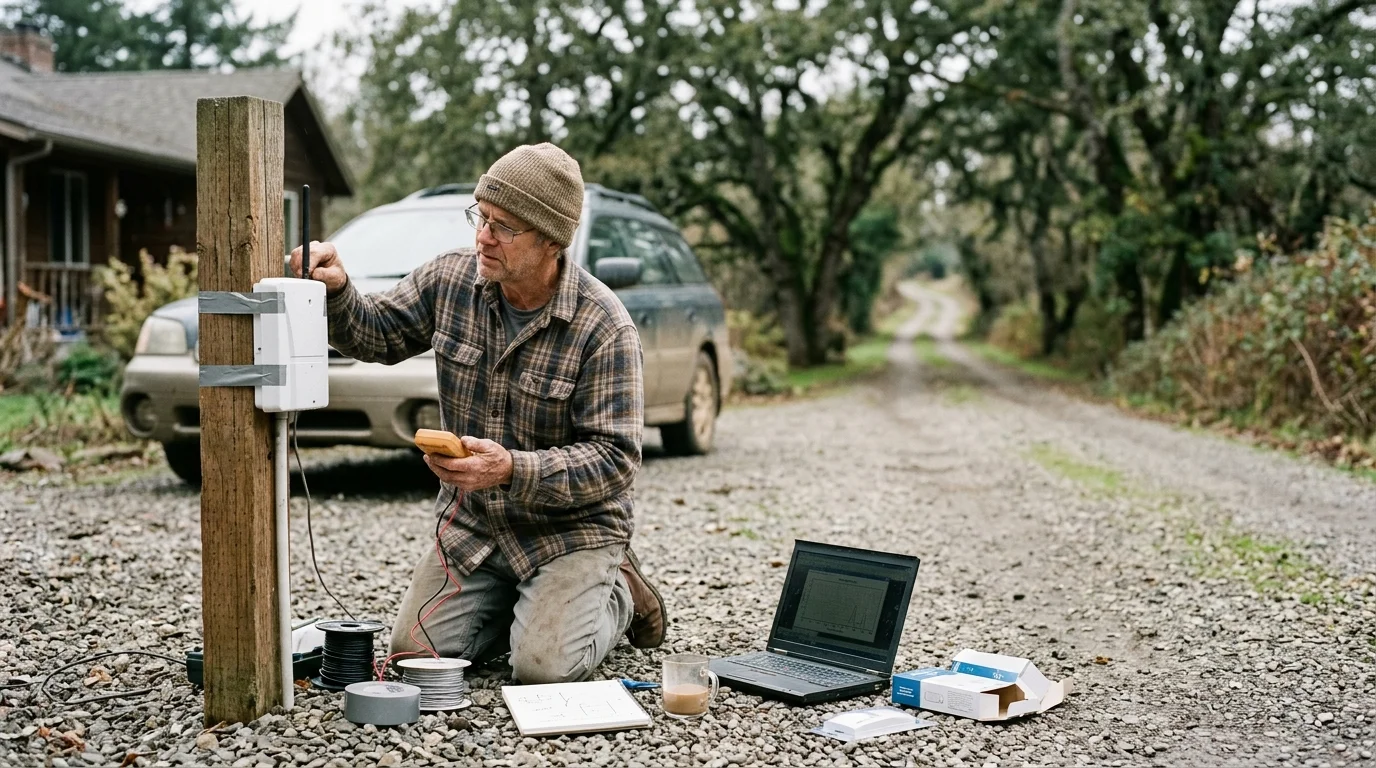
Why Standard Wi-Fi and 433MHz Alarms Fail on Long Driveways
High-frequency wireless signals degrade rapidly when traveling across acreage. A standard 2.4GHz Wi-Fi connection loses half its signal strength every time the distance doubles in open air.
Even when relying on closer cameras, eliminating motion camera false alarms with masking and confidence tuning is essential to avoid nuisance fatigue.
Even inside the home, resolving 2.4GHz spectrum crowding between Wi-Fi and Zigbee requires deliberate frequency planning, making standard consumer radios ill-suited for outdoor perimeters.
When you add wet oak leaves, pine branches, and uneven terrain, 2.4GHz waves scatter within 120 feet. Zigbee and Z-Wave face identical physical limits because their low-power mesh radios cannot penetrate dense tree lines.
Off-the-shelf wireless driveway alarms running on the 433MHz band offer better theoretical distance than Wi-Fi. However, these budget consumer kits transmit raw, unencrypted amplitude-shift keying bursts without error correction or delivery confirmation.
Nearby garage door openers, weather stations, and amateur radios cause severe signal collisions on 433MHz. Your receiver misses vehicle arrivals because environmental radio noise garbles the transmission before it reaches your house.
Passive infrared (PIR) driveway sensors introduce another major failure point. These thermal detectors trip whenever wind blows sun-baked leaves across the optical path or a deer walks past the lens.
You end up silencing your indoor chime after five false alarms in an afternoon. That habit defeats the entire purpose of a long range driveway alarm smart home installation.
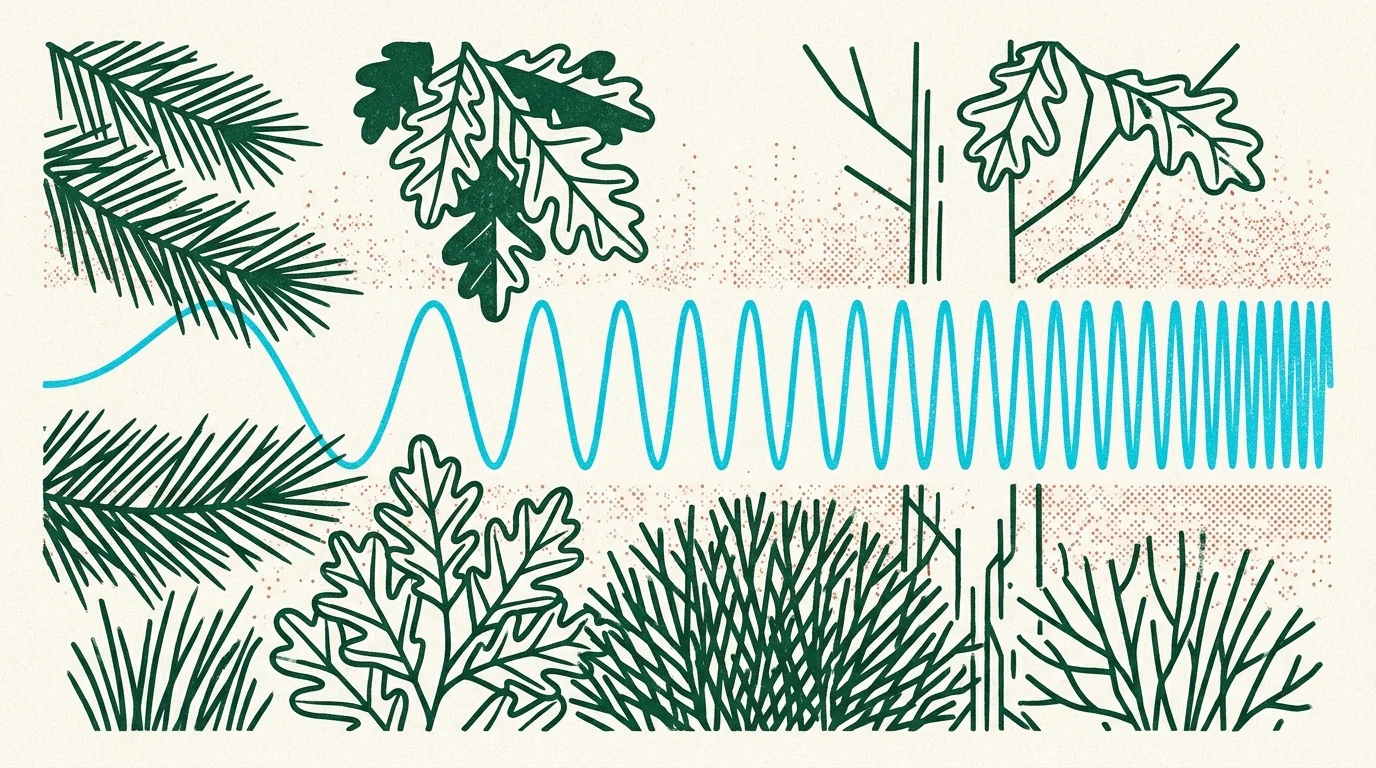
The 915MHz LoRa Advantage: Link Budgets and Foliage Penetration
LoRa stands for Long Range, a proprietary chirp spread spectrum radio modulation developed by Semtech. The protocol encodes digital data inside continuous frequency-swept pulses that cut cleanly through background environmental noise.
In North America, consumer LoRa devices operate on the unlicensed 902–928MHz Industrial, Scientific, and Medical (ISM) band. The Federal Communications Commission regulates this spectrum under FCC Part 15 rules.
Under FCC Part 15.247, spread-spectrum systems can emit up to 30 dBm (1 Watt) of transmitter output power. They permit an Effective Isotropic Radiated Power (EIRP) of up to 36 dBm (4 Watts).
If you build this system in Europe or the UK, you must purchase 868MHz hardware under ETSI standards. Operating a 915mhz perimeter sensor in Region 1 violates local cellular frequency allocations.
LoRa achieves incredible distances through its remarkable receiver sensitivity of -130 dBm to -148 dBm. The receiving radio decodes incoming data packets transmitted far below the ambient thermal noise floor.
While 2.4GHz Wi-Fi requires an unobstructed Fresnel zone to maintain link stability, sub-gigahertz radio waves diffract around terrain. The 915MHz wavelength easily passes through heavy timber and damp soil with minimal signal attenuation.
A standard consumer LoRa transmitter broadcasts payloads past 1,320 feet across heavily wooded lots. Your 400-foot driveway requires only a fraction of this link budget to guarantee zero dropped packets.
Perimeter security requires physical reliability before digital convenience.
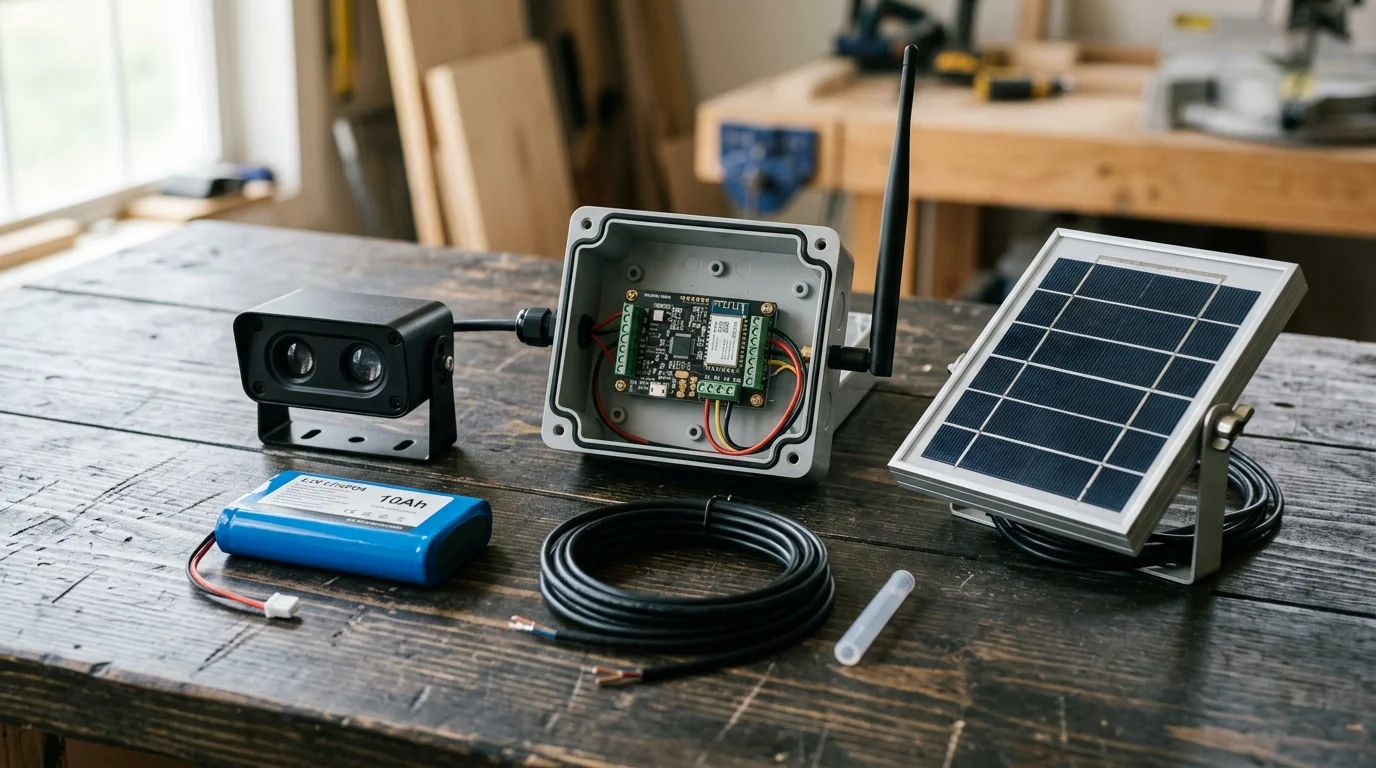
Hardware Breakdown: Active Infrared Beams and LoRa Nodes
You can build an industrial-grade perimeter system by pairing active infrared (AIR) dual-beam sensors with a lora driveway sensor node. This design isolates intrusion detection from long-range radio transmission.
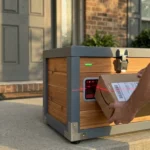
Homeowners can deploy similar sub-gigahertz hardware when building a long-range smart mailbox alert to monitor street-side deliveries without trenching signal cables.
Active infrared hardware features two separate weather-sealed enclosures mounted on opposite sides of your driveway. One enclosure houses an infrared transmitter, while the opposing unit houses an optical receiver.
The transmitter projects two continuous, invisible beams of infrared light across your driveway apron. The internal alarm relay trips only when an object breaks both light paths at the same instant.
Falling leaves, songbirds, and rabbits interrupt only one beam at a time, completely eliminating nuisance false triggers. Only tall obstructions, such as a truck, an ATV, or a person, break both optical paths.
Solar-powered AIR sensors feature integrated lithium-iron-phosphate batteries and miniature photovoltaic arrays. These solar panels keep the internal capacitors charged throughout weeks of continuous overcast winter weather.
To broadcast that optical trip event back to your residence, you need three core hardware components:
- Solar Active Infrared Dual-Beam Kit: Hardware pairs such as the HTZSAFE or Hosmart solar dual-beam units provide optical spans between 100 and 300 feet ($70–$120).
- 915MHz LoRa Dry-Contact Transmitter: Devices like the YoLink Outdoor Contact Sensor (YS7707-UC) accept standard relay input wires and broadcast over 1,000 feet ($25–$35).
- Indoor Smart Home LoRa Hub: A central gateway like the YoLink Hub or YoLink SpeakerHub connects to your home network and sounds local audio alerts ($24–$40).
- Weatherproof NEMA Enclosure: An IP66-rated polycarbonate electrical junction box shields your wiring terminals and external radio module from driving rain ($12–$20).
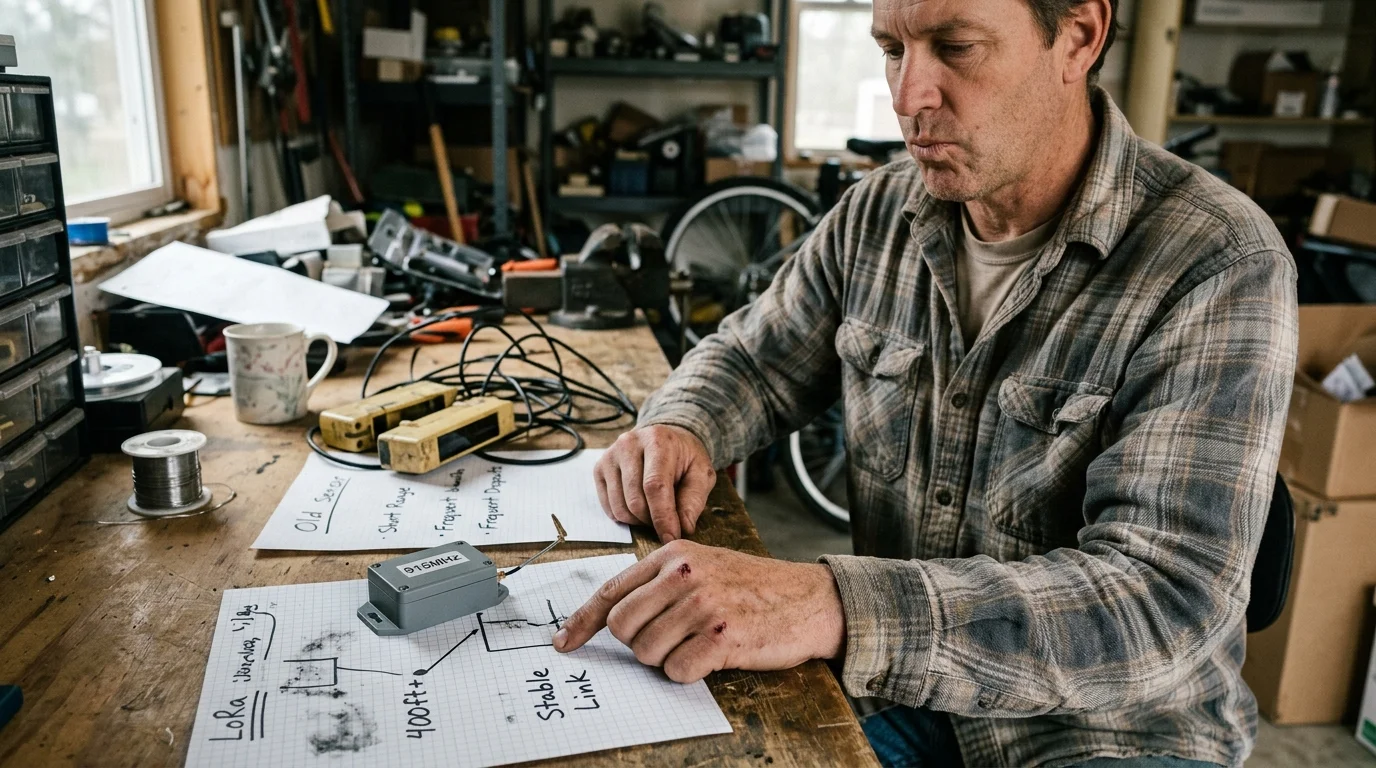
Driveway Sensor Comparison: LoRa vs. Legacy Alternatives
Selecting the right driveway detection technology requires balancing installation labor against long-term maintenance and false-alarm frequency. The table below compares the four primary perimeter alert systems for rural properties.
For long rural boundaries where visual surveillance is also necessary, building an off-grid security camera array can supply video footage without cellular fees.
If your perimeter requires live high-definition video rather than dry-contact trip alerts, look into bridging PoE security camera networks to detached outbuildings using dedicated point-to-point wireless bridges.
| Detection Technology | Reliable Foliage Range | Power Architecture | False Alarm Resistance | Monthly Service Cost | Average Upfront Cost |
|---|---|---|---|---|---|
| 2.4GHz Wi-Fi Smart Camera | 75–120 feet | Solar + 18650 Li-ion | Moderate (AI filtering) | $0–$10 / month | $150–$250 |
| 433MHz Legacy Wireless PIR | 150–250 feet | Replaceable 9V Alkaline | Poor (heat & wind triggers) | $0 | $40–$70 |
| 4G Cellular Trail Sensor | Unlimited (tower link) | Solar + AA Lithium | Moderate (single PIR) | $10–$25 / month | $180–$320 |
| 915MHz LoRa Dual-Beam AIR | 1,000–2,500 feet | Solar + LiFePO4 internal | Excellent (dual break-beam) | $0 | $120–$180 |
Cellular trail cameras solve the distance problem but burden you with recurring subscription contracts. When cellular towers experience heavy network congestion, cloud photo uploads can lag by several minutes.
According to comparative testing by PCMag’s smart home reviews, locally integrated smart security hardware delivers significantly faster notification speeds than cloud-dependent cellular platforms.
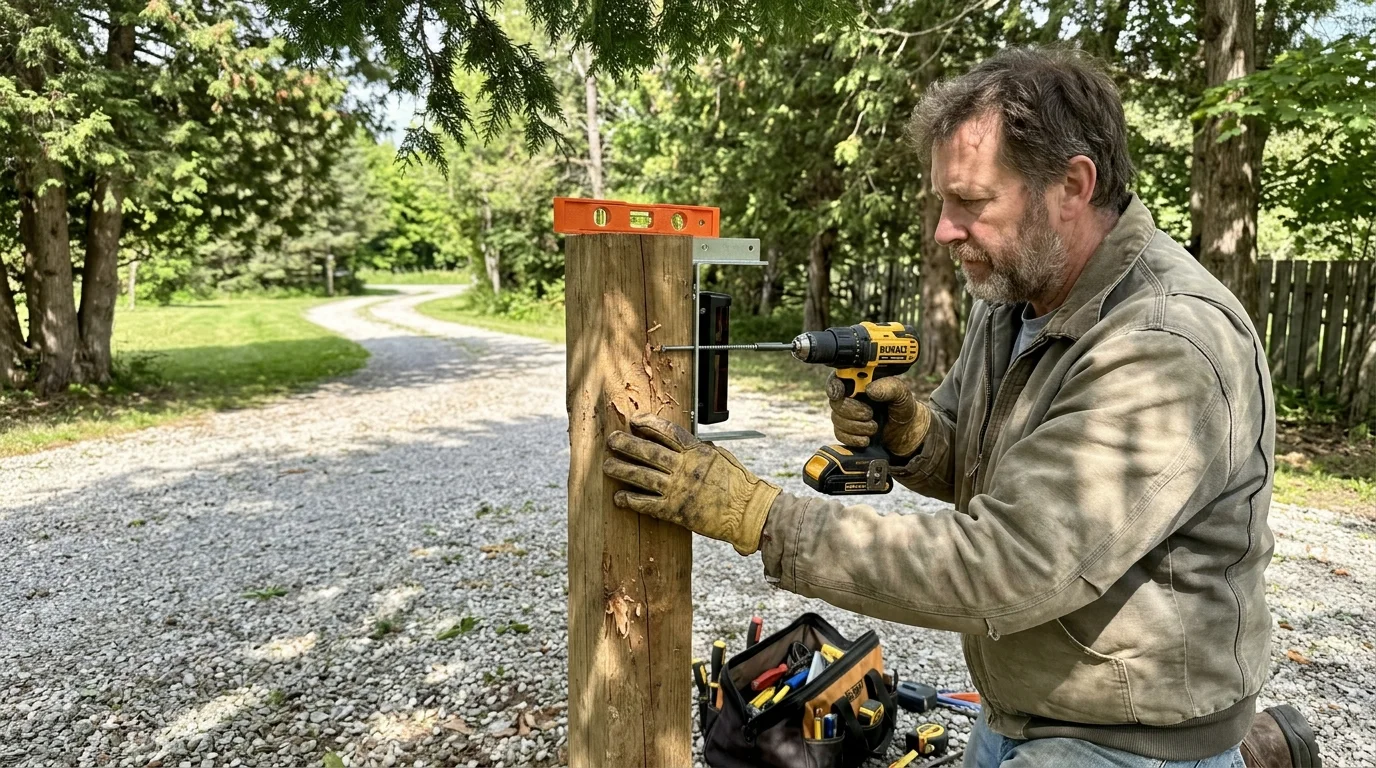
Step-by-Step Installation: Building the 400-Foot Solar Beam Link
To illustrate the setup, consider a 420-foot gravel driveway in Virginia bordered by dense mature pine trees. The homeowner quoted $2,400 for utility trenching but spent $165 on off-the-shelf solar LoRa hardware instead.
Once your beam sensor is operational, you can configure your hub to automate porch lights for safety whenever a vehicle passes through the gate at night.
Follow this numbered installation procedure to build your physical detection perimeter at the driveway entrance:
- Set Your Mounting Posts: Dig two 30-inch post holes on opposite sides of your driveway entrance, spaced 20 to 35 feet apart. Secure two 8-foot pressure-treated 4×4 posts in concrete, ensuring the posts stand perfectly plumb.
- Establish the Sensor Height: Mount the active infrared transmitter and receiver brackets 28 inches above the gravel surface. This height allows foxes, dogs, and snow buildup to pass underneath while catching vehicle bumpers and adult bodies.
- Orient Solar Collectors South: Position the top photovoltaic panels facing magnetic south at an angle of roughly 45 degrees. This tilt maximizes winter solar harvest and prevents snow from resting across the glass.
- Align the Optical Beams: Power on the optical receiver and use the built-in alignment viewfinder or alignment beep tone. Adjust the horizontal and vertical optical screws until the signal indicator LED shows continuous optical lock.
- Test the Beam Break: Walk through the optical path at a normal pace. The receiver should click its internal mechanical relay and light the trigger indicator LED instantly.
Always clear tree limbs and tall grass within a three-foot cylinder around the optical beam path. Heavy summer growth blowing across the infrared lens can cause intermittent alignment errors during windstorms.
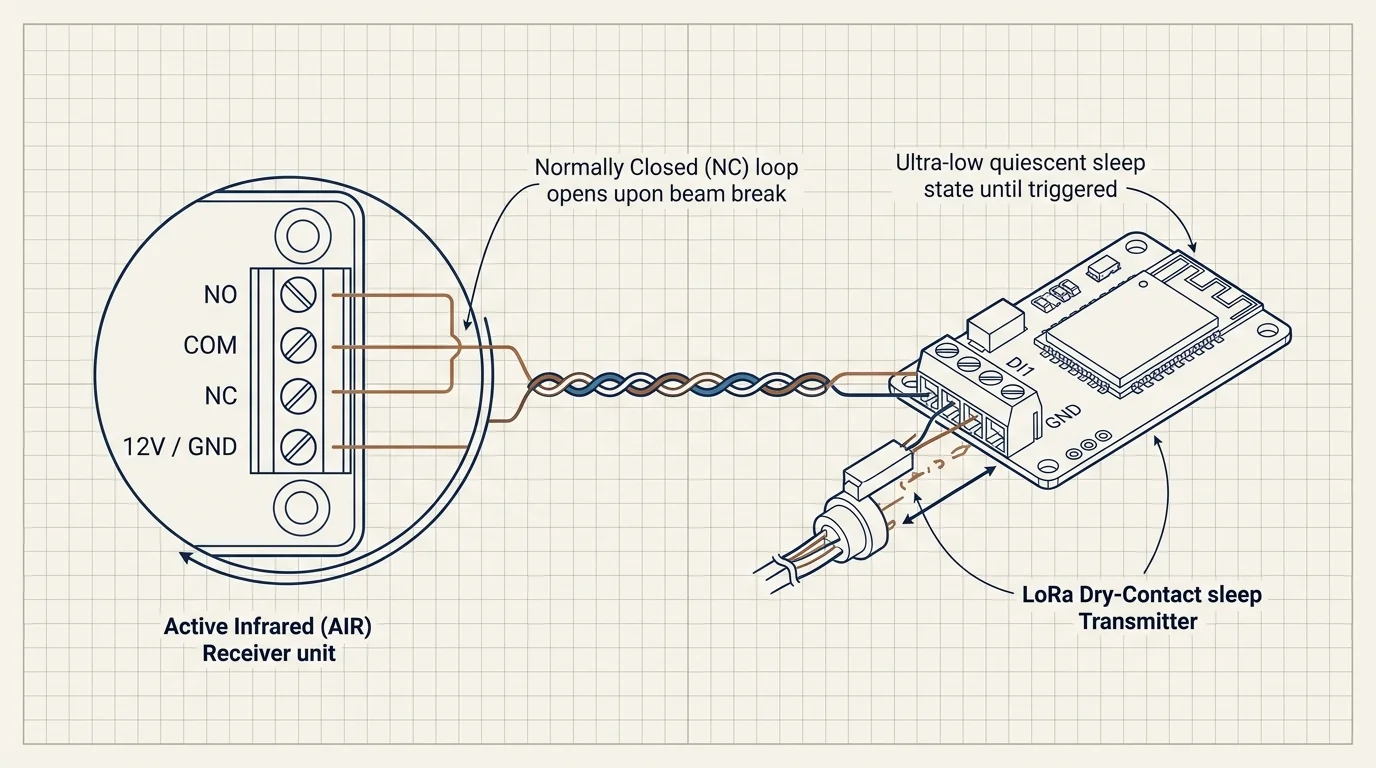
Wiring the Active Infrared Relay to the LoRa Transmitter
The solar active infrared receiver contains an internal screw terminal block that manages the relay output. You will find terminals marked COM (Common), NO (Normally Open), and NC (Normally Closed).
Your 915MHz LoRa contact sensor uses a two-wire detection pigtail that monitors circuit continuity. When an intruder breaks the beams, the relay switch toggles and triggers the LoRa transmitter immediately.
Follow these wiring steps to connect the two devices safely:
- Run Connection Wires: Strip a 12-inch length of two-conductor 20 AWG UV-resistant outdoor cable through the receiver base grommet.
- Terminate the Relay Contacts: Fasten one copper conductor to the COM terminal and the second conductor to the NC terminal. Using Normally Closed wiring creates a fail-secure system that alerts you if an animal chews the wire.
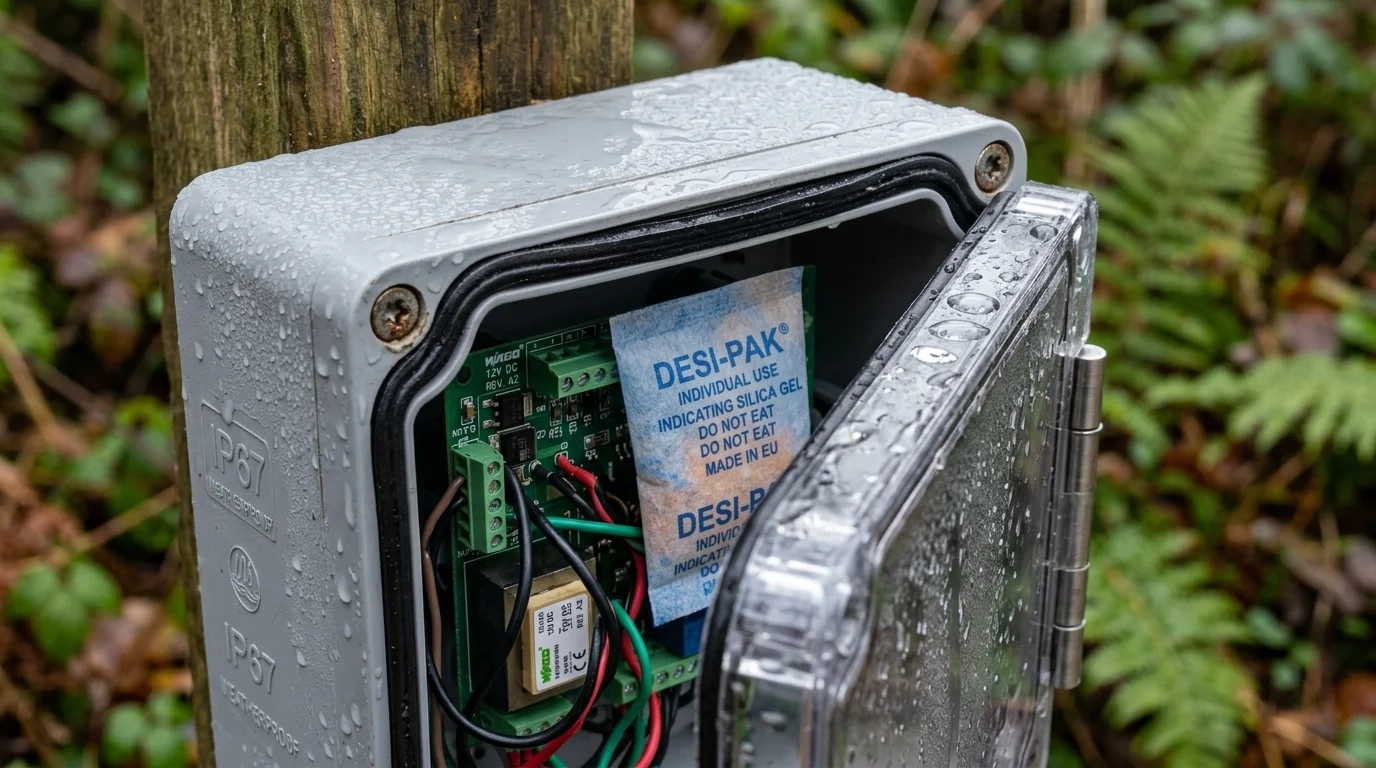
- Mount the Weatherproof Box: Mount an IP66 junction box directly beneath the optical receiver on the back of the wooden post. Feed your two-conductor cable through a waterproof compression gland in the box bottom.
- Connect the LoRa Transmitter: Strip the pigtail leads on your YoLink Outdoor Contact Sensor and join them to your two-conductor cable using silicone-filled waterproof wire nuts.
- Seat the Transmitter: Place the LoRa transmitter inside the junction box, ensure the external antenna faces upright, and latch the box cover tightly.
Avoid coiling excess antenna wire inside metal boxes or wrapping the antenna around steel post hardware. Keep the radio whip upright and clear of grounding lines to preserve your full 915MHz broadcast range.
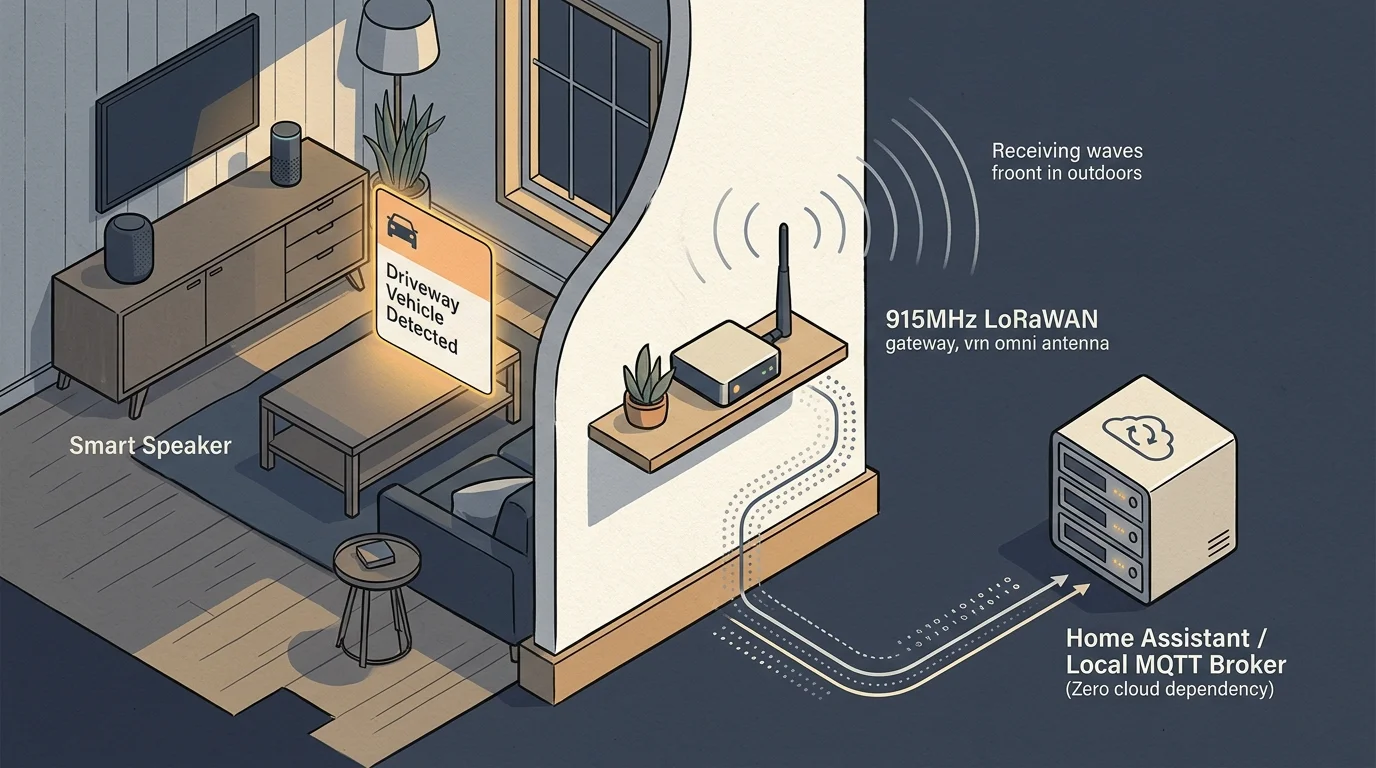
Integrating 915MHz Payloads into Home Assistant and Local Hubs
When an incoming vehicle breaks the infrared beams, the LoRa sensor transmits an encrypted 915MHz packet to your house. Your indoor hub decodes the transmission and updates the sensor state within 300 milliseconds.
Testing by Wirecutter’s outdoor home security analysis confirms that instant audible alerts prevent the missed notifications typical of busy smartphone lock screens.
You can automate immediate security responses through standard smart home platforms using the following logic paths:
- Daytime Spoken Announcement: Configure your smart hub or Home Assistant speaker to announce, “Vehicle entering main driveway,” whenever the relay state trips.
- Nighttime Perimeter Lighting: Trigger an automation between sunset and sunrise that switches on outdoor floodlights and porch lighting via Z-Wave or Matter wall switches.
- Camera Preset Pan: Instruct an RTSP-connected pan-tilt-zoom (PTZ) camera on your garage to rotate toward the driveway apron and record a 60-second video clip.
- Gate Opening Integration: Wire a secondary relay output into an automated driveway gate controller to unlock access when an authorized RFID card or secondary keypad trips.
Home Assistant users can pull YoLink entities directly via the official cloud push integration or through local MQTT bridges. This setup allows your automation routines to run completely independent of proprietary cloud services.
Weatherproofing, Alignment, and Seasonal Maintenance
Outdoor hardware exposed to humidity, snow, and summer heat requires routine physical maintenance to operate without interruption. Preventative care protects your optical alignment and prevents battery degradation.
Follow this seasonal checklist every six months to keep your long-range driveway detection operating smoothly:
- Wipe Optical Lenses: Clean pollen, dust, and spider webs from the receiver and transmitter plastic lenses using a soft microfiber cloth and isopropyl alcohol.
- Inspect Gaskets and Glands: Verify that the rubber seals around your wiring box and sensor base remain pliable and seated firmly against moisture.
- Apply Silicone Grease: Coat exposed relay screw terminals with dielectric silicone grease to prevent galvanic corrosion across bare copper wires.
- Prune Surrounding Brush: Trim creeping ivy, weeds, and tree branches growing within four feet of the optical path before summer growth peaks.
- Check Battery Diagnostics: Monitor the battery voltage indicator inside your hub mobile app to confirm the solar cells are charging the internal packs.
If you experience false triggers during torrential rainstorms, check your beam optical alignment screws. Heavy downpours can scatter misaligned infrared light if the sensors are not locked dead-center on each other.
Frequently Asked Questions
Can dense fog or falling snow trip an active infrared driveway beam?
Modern dual-beam active infrared sensors use pulsed frequencies and adjustable sensitivity timers to ignore atmospheric scatter. Only whiteout blizzards or fog thick enough to obscure visibility past five feet will interrupt the optical connection.
Do I need an active internet connection for the LoRa alert to chime inside my house?
No, you do not need internet access if you use a local smart home setup. Standalone gateways like the YoLink SpeakerHub can sound local audio tones via direct device pairing even when your home router loses broadband service.
What happens if a deer or large animal walks across the driveway?
A full-grown deer will break both optical beams and cause a detection alert. However, positioning your sensors at 28 inches above grade allows smaller wildlife, including dogs, foxes, raccoons, and rabbits, to pass underneath undetected.
How long do the internal backup batteries last without direct sunlight?
The rechargeable lithium cells inside high-efficiency solar beam sensors provide continuous power for 30 to 60 days without sun. The microscopic current draw of active infrared transmitters allows them to survive protracted winter weather easily.
Disclaimer: This article is for informational purposes only. Smart home devices involve electrical connections and data privacy. Always follow manufacturer instructions for installation. For complex wiring or HVAC work, consult a licensed professional.
1 Comment