
Standard smart bulbs trigger debilitating migraines by pulsing current through LEDs at frequencies your brain detects even when your eyes cannot. Replacing them requires switching to true zero-PWM or ultra-high-frequency drivers.
Most commercial guides recommend standard smart bulbs that strobe at an unsafe 1,000 Hz when dimmed. This guide demonstrates how engineering true constant-current reduction and programming custom logarithmic curves below 2,000 Kelvin eliminates neurological visual triggers.
By bypassing the optical flaws of basic consumer drivers, you can finally illuminate your living space without risking a neurological flare-up.
The Neurological Cost of PWM: Why Standard Bulbs Trigger Migraines
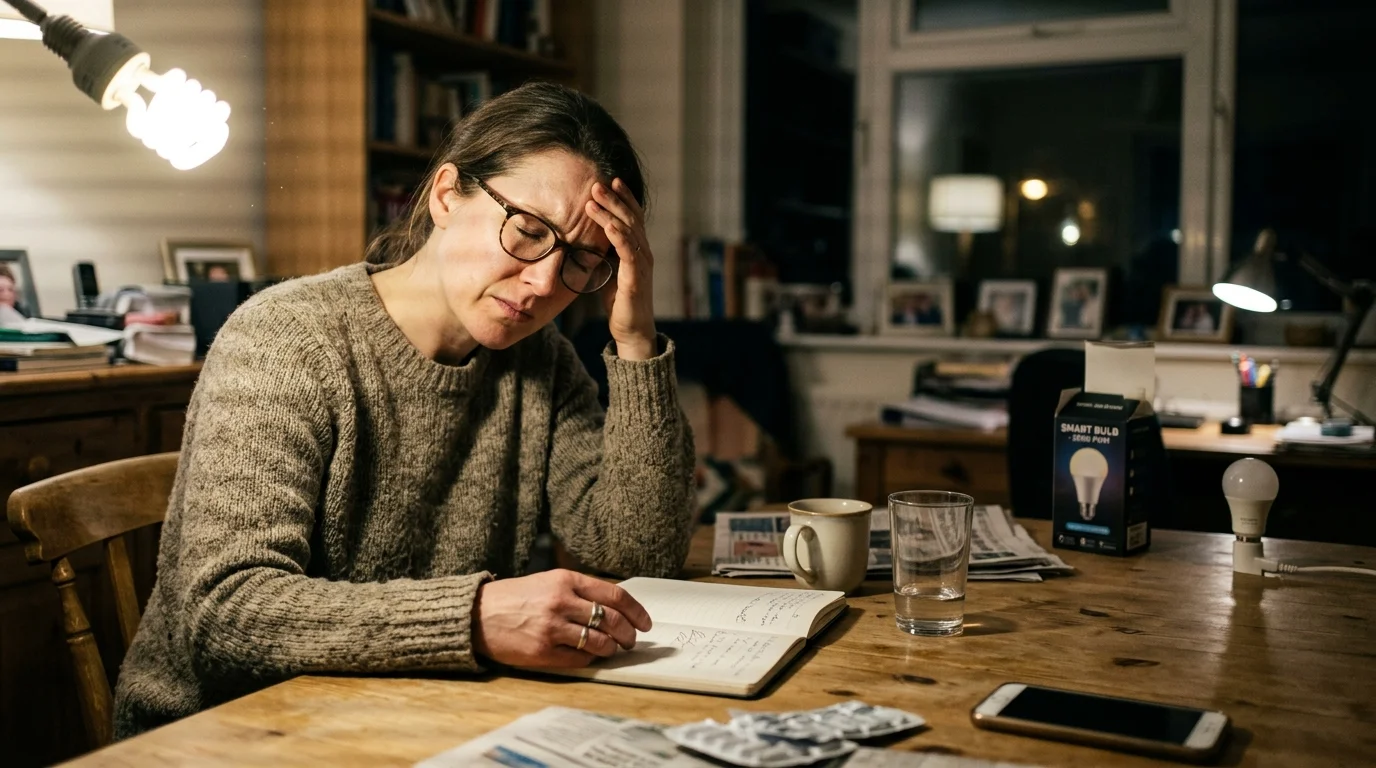
Pulse-width modulation dims an LED by rapidly switching the diode between full brightness and complete darkness. Rather than lowering electrical current, the driver alters the percentage of time the diode remains powered during each millisecond cycle.
Managing pulse frequency is only one part of creating a healthy environment, as properly balancing smart lighting color temperature is equally vital for avoiding neurological and circadian strain.
Beyond triggering acute pain, the invisible fatigue caused by high-modulation lighting disrupts your evening wind-down, reinforcing the importance of smart lighting for better sleep.
Your visual cortex fuses these pulses into what seems like steady light once switching exceeds roughly 80 Hz. However, subcortical pathways between the retina and brainstem track stroboscopic transitions at vastly higher speeds.
Research documented in the IEEE 1789-2015 standard confirms that invisible optical strobing causes involuntary micro-contractions in the iris. These fluctuations stimulate trigeminal nerve pathways and generate severe cortical hyperexcitability in migraine sufferers.
Dimming standard consumer bulbs makes this neurological irritation worse. At an 80% brightness setting, the LED stays on for most of the duty cycle, minimizing visual disruption.
When you dim that bulb down to 10%, the LED remains completely dark for 90% of every operating cycle. This massive modulation depth forces your retinal receptors to constantly recover from alternating saturation and total darkness.
The resulting neural firing triggers photophobia, optical auras, and autonomic nausea long before you consciously detect a visible flicker.
Driver Circuit Architecture: Constant Current Reduction vs. High-Frequency PWM
Preventing neurological strain requires addressing the underlying driver circuit architecture. Smart lighting fixtures regulate light using either Constant Current Reduction, pulse-width modulation, or a hybrid combination of both.
Selecting high-frequency or zero-PWM drivers is particularly crucial when configuring smart lighting for home offices, where hours of screen focus magnify visual fatigue.
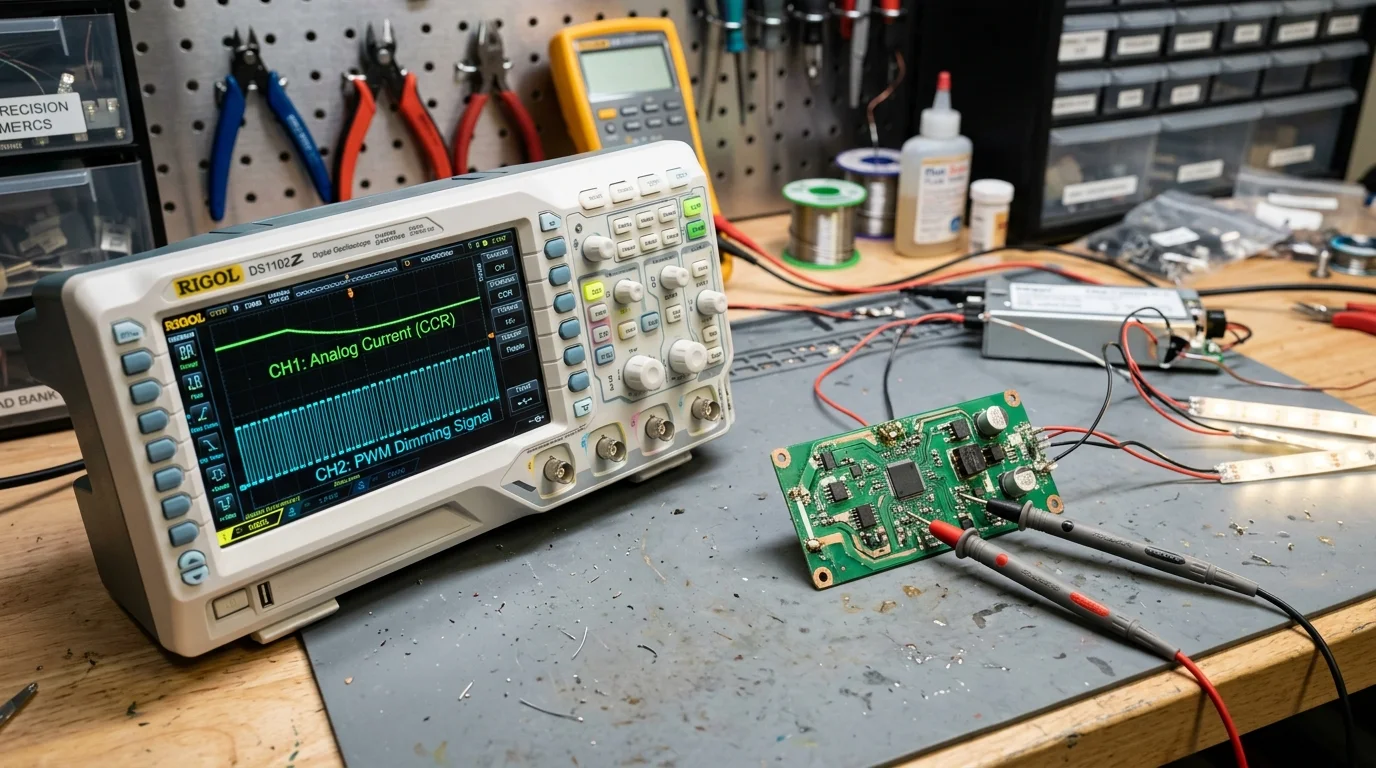
Constant Current Reduction (CCR) is an analog dimming method that continuously alters the milliamp amperage delivered to the diode. Because the electrical stream flows uninterrupted without switching cycles, CCR produces true zero-PWM smart lighting with zero stroboscopic modulation.
However, pure CCR driver circuits encounter physical limitations at very low electrical current levels. Driving an LED diode below 5% to 10% of its rated current can destabilize phosphor coatings, causing chromaticity shifts and irregular hardware dropout.
To overcome this analog floor, premium architectural drivers utilize high-frequency hybrid regulation. These units employ continuous analog reduction across the upper brightness range, then transition to high-frequency digital pulses below the 10% threshold.
For migraine-safe performance, that secondary digital stage must operate far above biological detection thresholds. Premium drivers push switching frequencies between 25,000 Hz (25 kHz) and 50,000 Hz (50 kHz).
At 25 kHz, the interval between pulses is forty microseconds. Retinal photoreceptors cannot process electrical fluctuations at that speed, effectively protecting sensitive visual pathways from fatigue.
Regulatory Metrics and Safety Standards: Decoding SVM, PstLM, and IEEE 1789
Evaluating flicker-free smart bulbs requires looking past marketing claims on the box and checking verifiable engineering metrics. Regulatory agencies define light stability using three critical test parameters:
Adhering to strict flicker metrics is especially critical when setting up red-spectrum nightlight automations designed to preserve dark adaptation without stimulating photoreceptors.
- IEEE 1789-2015 NOEL: The No Observable Effect Level mandates operating frequencies at or above 3,000 Hz when drivers operate at 100% modulation depth.
- IEEE 1789-2015 Low-Risk: Sets a baseline threshold of 1,250 Hz for standard, non-sensitive populations under full modulation.
- Short-Term Flicker Indicator (PstLM): Measures direct visual flicker below 80 Hz; a compliant fixture must register a value of 1.0 or lower.
- Stroboscopic Visibility Measure (SVM): Quantifies phantom array effects across frequencies up to 2,000 Hz in motion environments.
- California Title 24 (JA8/JA10): Mandates that residential light sources maintain less than 30% flicker for frequencies below 200 Hz down to 20% output.
International lighting rules have become considerably stricter to protect consumer health. Effective September 1, 2024, the European Union Ecodesign Regulation 2019/2020 lowered the mandatory full-load SVM threshold from 0.9 to 0.4.
Independent evaluation platforms like Wirecutter Smart Home regularly highlight how differing internal components affect everyday domestic performance. Regrettably, most mainstream consumer bulbs are engineered solely to pass minimum baseline requirements.
Standard retail bulbs rarely publish SVM values across their lower dimming ranges. When a bulb dims beneath 20%, modulation depth spikes toward 100%, causing SVM levels to exceed medical comfort thresholds.
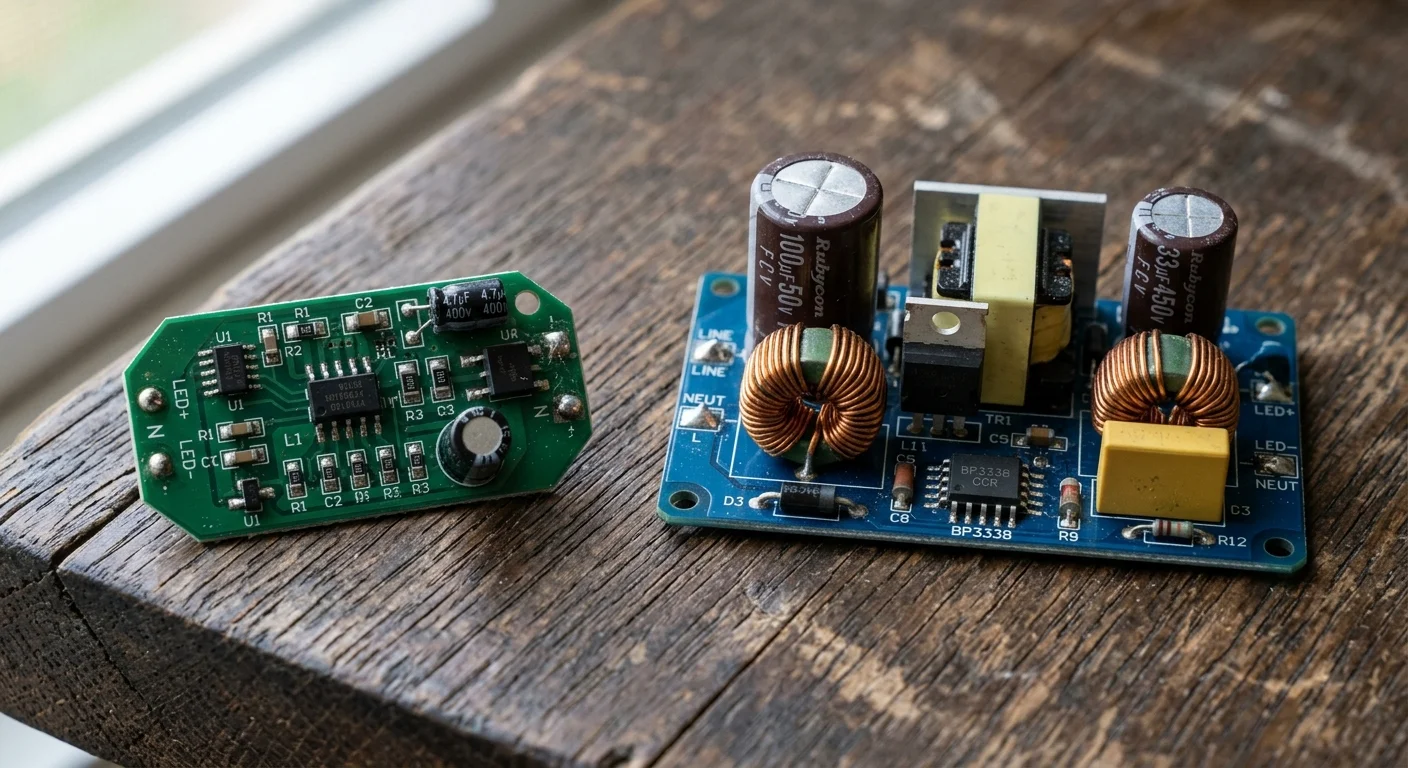
Comparing Driver Architectures in Consumer and Professional Hardware
Consumer smart bulbs vary significantly in how their internal drivers handle voltage regulation. The following comparison breaks down concrete electrical specifications across four distinct lighting categories:
Stable driver engineering is equally critical in complex accent installations like cascading smart stair lighting, where rapid stepping transitions can reveal stroboscopic artifacts.
If you prefer controlling dedicated architectural drivers from wall boxes rather than wireless apps, pairing them with compatible smart dimmer switches provides smooth manual dimming without reintroducing flicker.
| Hardware Model | Driver Architecture | Dimming Method | PWM Frequency | Low-End Measured Floor | Migraine Safety Rating |
|---|---|---|---|---|---|
| Philips Hue White & Color (A19) | Digital Switched Driver | Pulse-Width Modulation | ~1,000 Hz | 1.0% (10% perceived) | Poor (Causes photophobia below 20% duty cycle) |
| LIFX Clean / Color (E26) | Hybrid Switched Driver | High-Frequency PWM | ~4,000 Hz | 1.0% (10% perceived) | Moderate (Exceeds IEEE NOEL baseline) |
| Lutron Hi-lume 1% EcoSystem | Linear Constant-Current | Pure CCR (Analog DC) | 0 Hz (Continuous DC) | 1.0% (10% perceived) | Excellent (Zero stroboscopic pulsation) |
| EldoLED ECOdrive 30W | Hybrid Dynamic Architecture | CCR to 1%, 25 kHz PWM below | 25,000 Hz | 0.1% (3.2% perceived) | Exceptional (Medical-grade stability) |
Standard Philips Hue bulbs operate their PWM drivers at roughly 1,000 Hz. While this frequency avoids conscious visual detection, it falls significantly short of the 3,000 Hz IEEE NOEL threshold.
LIFX bulbs elevate switching frequencies to roughly 4,000 Hz, surpassing standard biological minimums. However, their 1% hardware limit still outputs too much physical light for an eye experiencing active migraine sensitivity.
Lutron Hi-lume and EldoLED commercial drivers solve this problem at the component level. By eliminating low-frequency pulse modulation, they provide the optical stability necessary to prevent neurological strain.
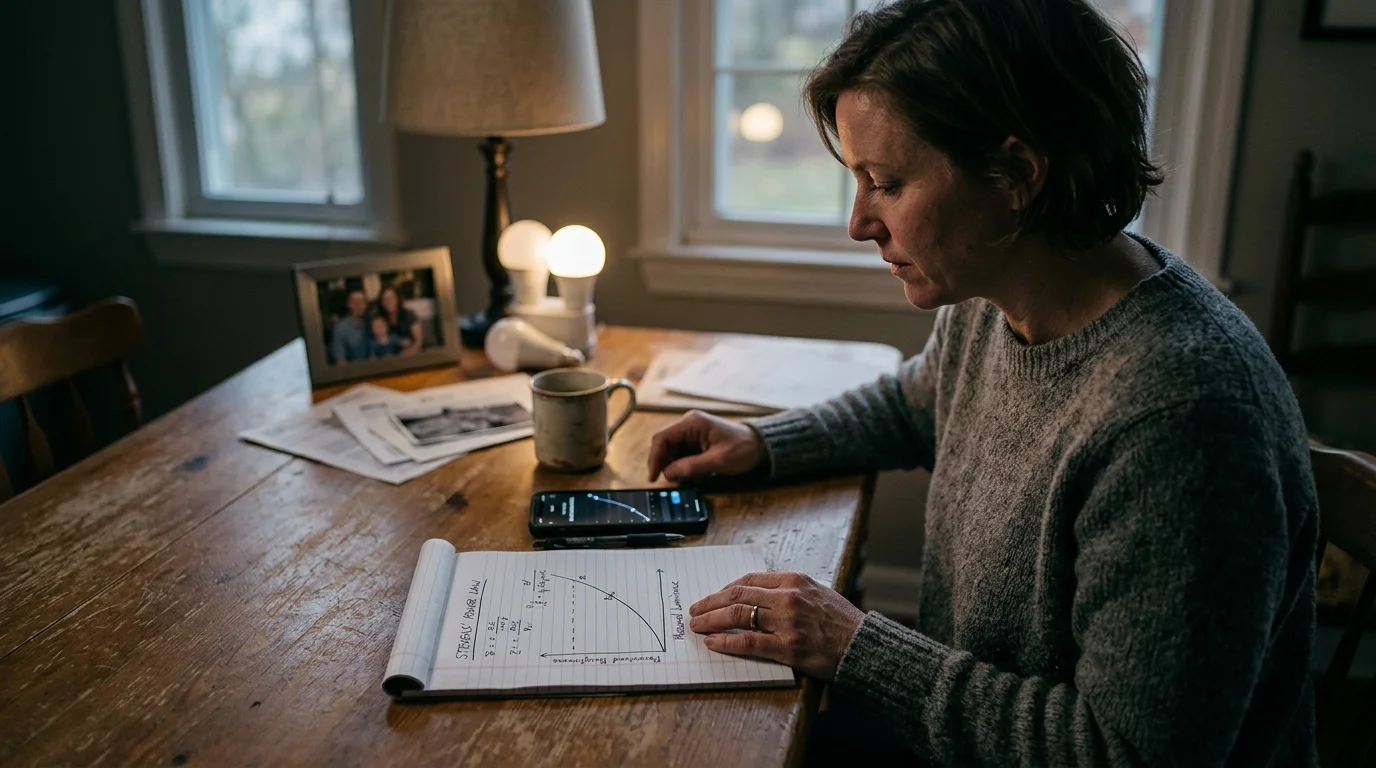
The Mathematics of Low-Lux Dimming: Stevens’ Power Law
Dimming bulbs to prevent eye strain introduces another challenge: human vision interprets radiant energy non-linearly. In low-light environments, human pupils dilate, significantly increasing optical sensitivity.
Accounting for non-linear optical perception is indispensable when dialing in bias and ambient smart lighting inside small rooms that lack natural daylight.
The Illuminating Engineering Society models this biological phenomenon using Stevens’ Power Law. The equation calculates perceived light based on physical output:
Perceived Light (%) = 100 × √(Measured Light (%) ÷ 100)
When a standard smart bulb slider shows 1% measured output, your dark-adapted eye perceives roughly 10% brightness. For a migraine sufferer who needs true darkness during an aura, 10% perceived brightness feels overwhelming.
To drop perceived brightness down to 3.2%, the lighting hardware must deliver a measured flux of 0.1%. Standard consumer bulbs cannot reach this floor because their budget drivers shut down below 1%.
Standard linear application sliders drop brightness abruptly at the bottom of their range. Creating a smooth, comfortable transition requires programming a logarithmic or square-law curve into your smart home platform.
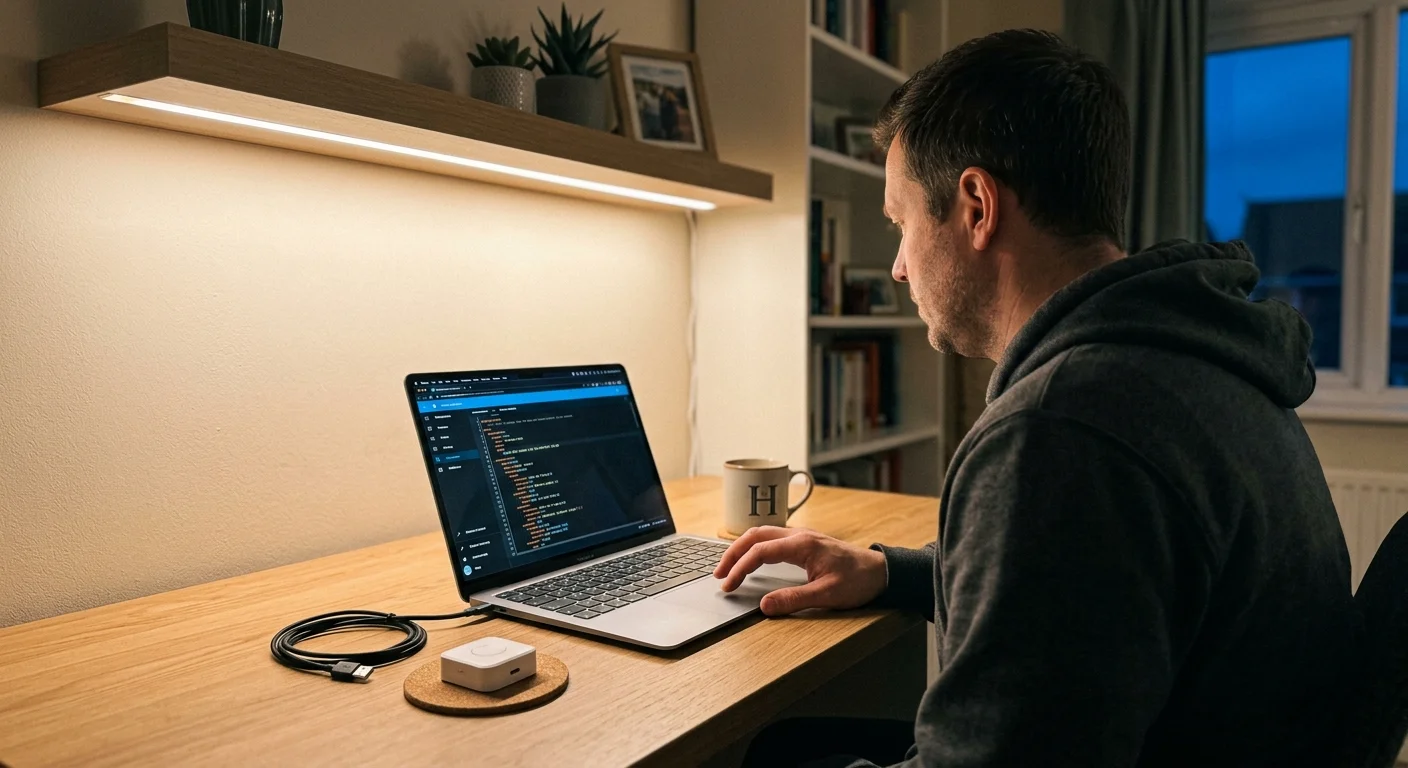
Step-by-Step Programming: Building Migraine-Safe Dimming Curves in Home Assistant
You can correct non-linear optical perception by mapping software sliders to a quadratic dimming curve. This worked example uses an 800-lumen tunable white fixture paired with a zero-PWM driver in Home Assistant.
Once individual fixtures are calibrated with gentle transitions, you can configure unified smart lighting zones in your home to maintain consistent low-lux thresholds across multiple rooms.
After mapping your low-lux mathematical curves, you can integrate these calibrated brightness levels into custom smart lighting scenes tailored for relaxing evening routines.
A standard linear 10% setting outputs 80 lumens, which your eye perceives as roughly 31.6% brightness. Applying a quadratic formula maps that same 10% slider setting to an output of 8 lumens, delivering a soothing, perceived 10% illumination level.
- Open Home Assistant and navigate to Settings > Devices & Services > Helpers.
- Click Create Helper, select Number, and name it “Migraine Safe Master Brightness”.
- Set the minimum value to 1, the maximum value to 100, and the step size to 1.
- Open your `automations.yaml` file to build the quadratic curve translator script.
- Paste the following automation configuration to map the slider input to your physical fixture:
alias: "Apply Quadratic Dimming Curve"
trigger:
  - platform: state
    entity_id: input_number.migraine_safe_master_brightness
action:
  - variables:
      slider_val: "{{ trigger.to_state.state | float(1) }}"
      duty_cycle: "{{ ((slider_val / 100) ** 2 * 255) | round(0) | int }}"
      target_kelvin: "{{ (1800 + (slider_val / 100) * 900) | round(0) | int }}"
  - service: light.turn_on
    target:
      entity_id: light.bedroom_zero_pwm_fixture
    data:
      brightness: "{{ [1, duty_cycle] | max }}"
      kelvin: "{{ target_kelvin }}"
      transition: 2
This script executes two vital adjustments. First, it squares the input percentage to convert the linear slider into an exponential dimming curve.
Second, it synchronizes color temperature with illumination levels. When dimmed to a setting of 1, the fixture automatically shifts to a soothing 1,800 Kelvin.
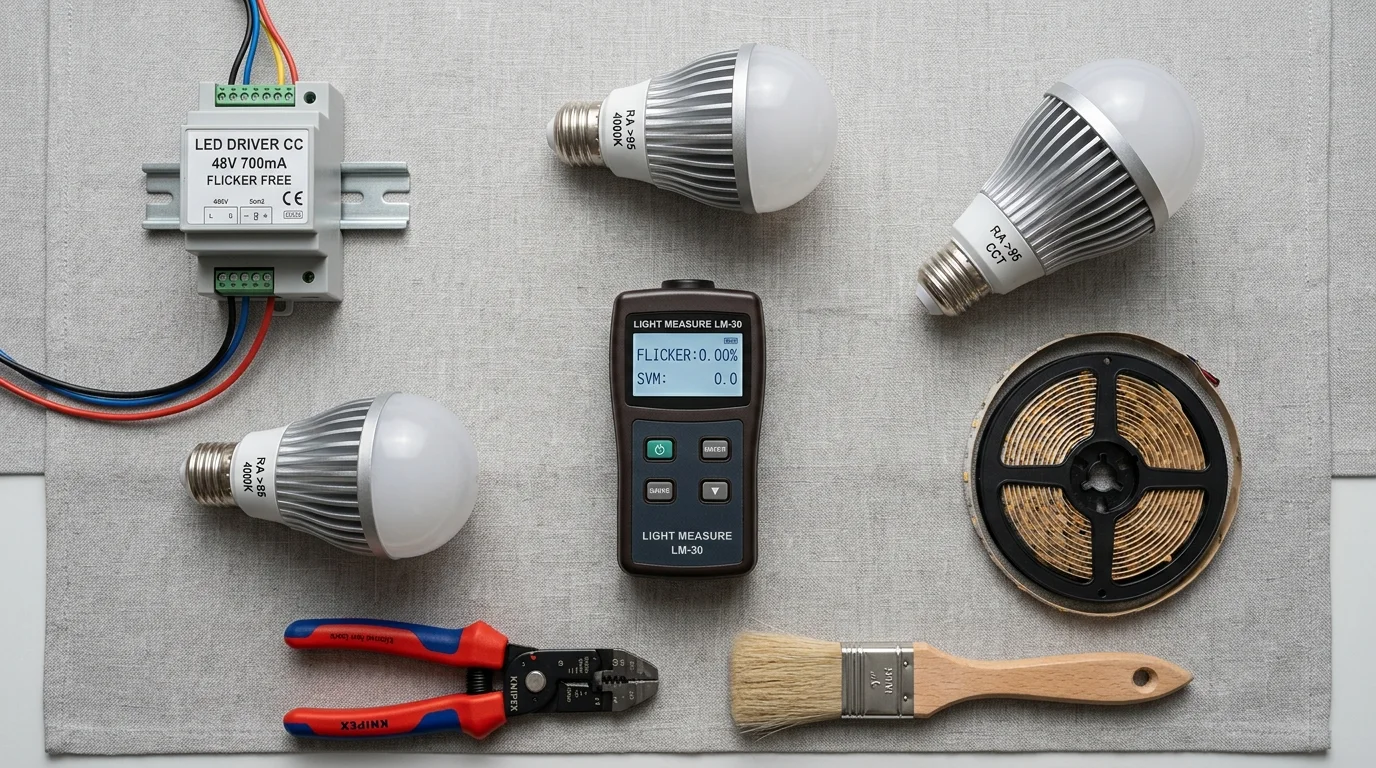
Hardware Selection Guide: Vetting Migraine-Safe Smart Bulbs and Drivers
Sourcing migraine-safe smart bulbs requires checking the driver design before making a purchase. Use these specific engineering guidelines when evaluating potential lighting options:
- Standalone Smart Bulbs: Choose units running high-frequency PWM above 25 kHz if analog CCR is unavailable.
- Modular Strip Controllers: Pair 24V constant-voltage LED strips with controllers that feature configurable high-frequency PWM switching.
- Hardwired In-Wall Drivers: Replace standard architectural drivers with Lutron Hi-lume A-Series or EldoLED units running analog DC reduction down to 1%.
- Smart Ecosystem Control: Prioritize local wireless protocols like Zigbee or the Matter Smart Home Standard to avoid cloud latency when running custom dimming curves.
If you live in a rental property where replacing electrical wiring is not an option, consider tabletop lamps powered by commercial DC desktop drivers. High-CRI LED modules running on regulated DC power eliminate stroboscopic modulation entirely.
When installing hardwired drivers in ceiling junction boxes, verify that total circuit wattage stays within local electrical code requirements. Always consult a licensed electrician when configuring high-voltage architectural installations.
Nighttime Automation Strategies: Circadian Anchors Below 2,000 Kelvin
Flicker elimination provides the foundation, but optical wavelength distribution is just as critical for managing light sensitivity. Intrinsically photosensitive retinal ganglion cells (ipRGCs) are most sensitive to light between 460 nm and 490 nm.
This blue-cyan band activates the photopigment melanopsin, directly exciting neural pathways linked to migraine symptoms. Filtering out light wavelengths below 500 nm helps suppress hyperactive trigeminal pain responses.
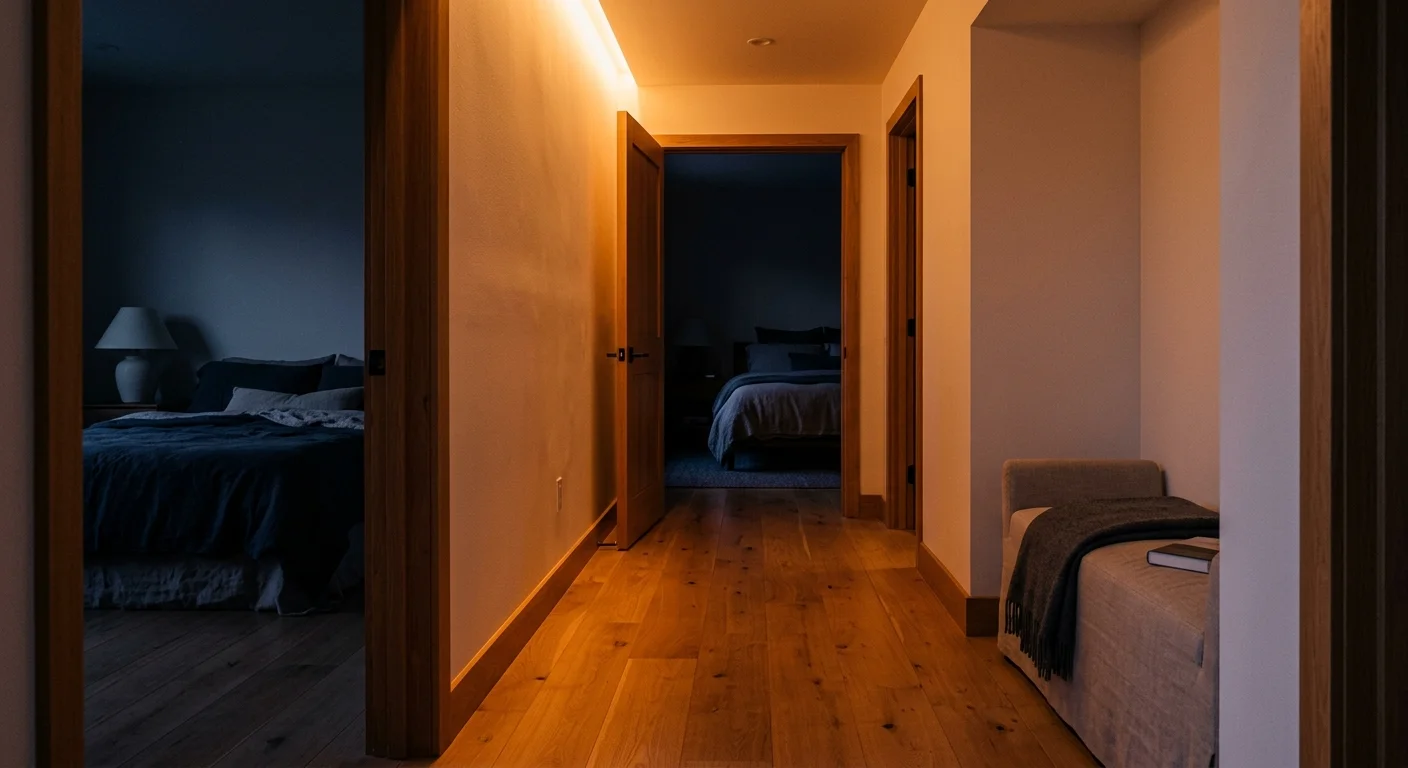
Configure your smart home automations to automatically alter spectral output when night falls. Anchor your post-sunset lighting between 1,800K and 2,000K to completely cut out stimulating blue wavelengths.
Pair low-kelvin profiles with passive infrared motion sensors in hallways and bathrooms. Program these sensors to trigger fixtures at a low 0.2% measured floor between 10:00 PM and 6:00 AM.
This low-lux illumination provides enough visibility to navigate safely without overwhelming dark-adapted eyes. By eliminating both PWM strobing and blue-light glare, you protect your visual pathways around the clock.
Frequently Asked Questions
Can standard smart bulbs like Philips Hue trigger migraines?
Yes. Most Philips Hue bulbs use pulse-width modulation at roughly 1,000 Hz, which falls below the 3,000 Hz IEEE 1789 NOEL safety threshold for photophobia.
What is the difference between zero-PWM and flicker-free lighting?
Flicker-free marketing often only denotes speeds above the 80 Hz human visual fusion rate. Zero-PWM lighting uses Constant Current Reduction to alter amperage without digital pulsing.
How can I detect PWM flicker on my current smart bulbs?
Point your smartphone camera at the dimmed bulb and record in slow motion at 240 frames per second. Rolling black bars reveal stroboscopic driver pulsing.
Why does a smart bulb dimmed to 1% still feel glaring at night?
Human vision interprets brightness non-linearly under Stevens’ Power Law. A measured 1% light output is perceived by dark-adapted human eyes as roughly 10% brightness.
Disclaimer: This article is for informational purposes only. Smart home devices involve electrical connections and data privacy. Always follow manufacturer instructions for installation. For complex wiring or HVAC work, consult a licensed professional.



1 Comment