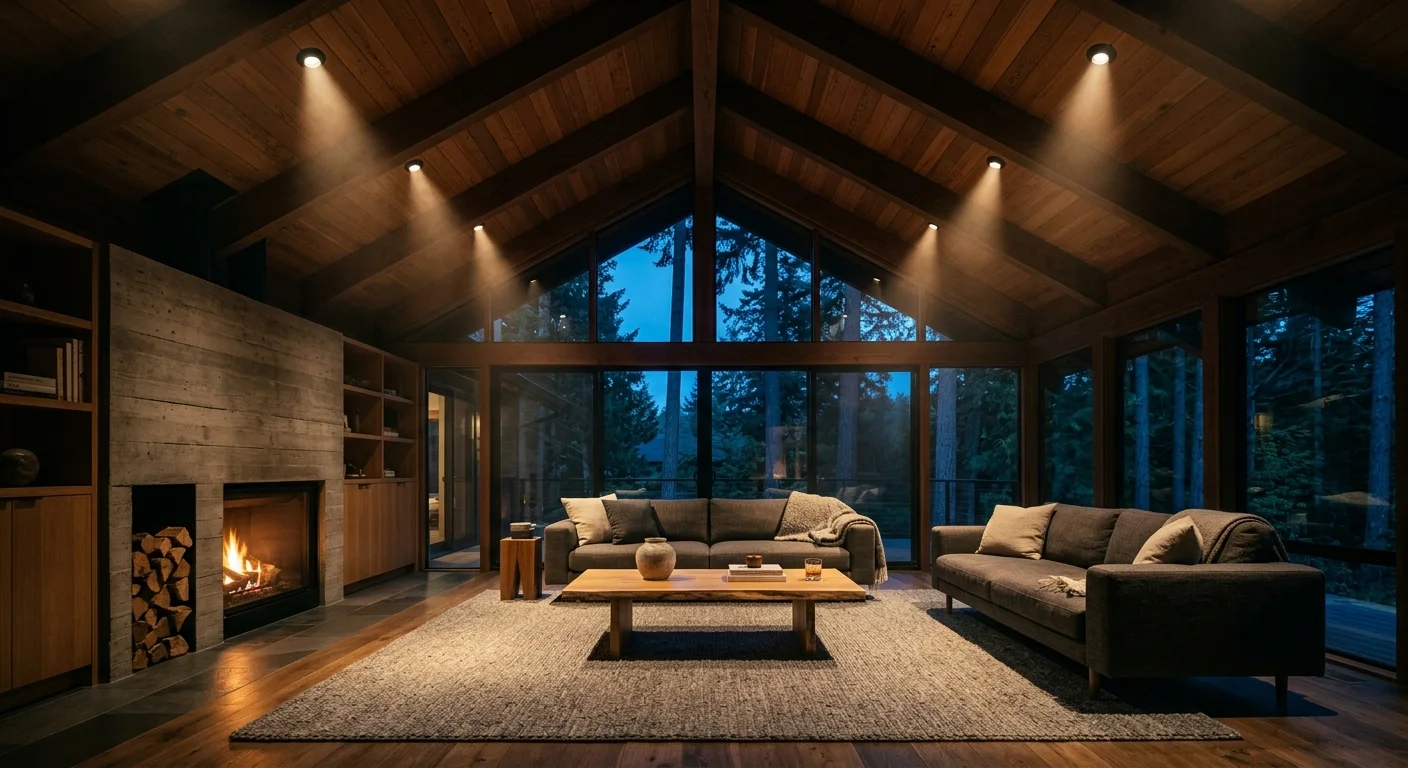
Standard 120-degree flood bulbs turn an 18-foot cathedral ceiling into an illuminated cavern while leaving living room seating in the dark. Switching to directional smart bulbs solves this by focusing throw energy straight downward.
Most guides tell you to buy higher-lumen bulbs, but raw lumen output cannot overcome beam dispersion over an 18-foot drop. The true fix is optical control using narrow-angle smart PAR38 lamps instead of diffuse BR40 floods.
This optical switch triples floor-level foot-candles while cutting dangerous ladder climbs entirely for the next two decades.
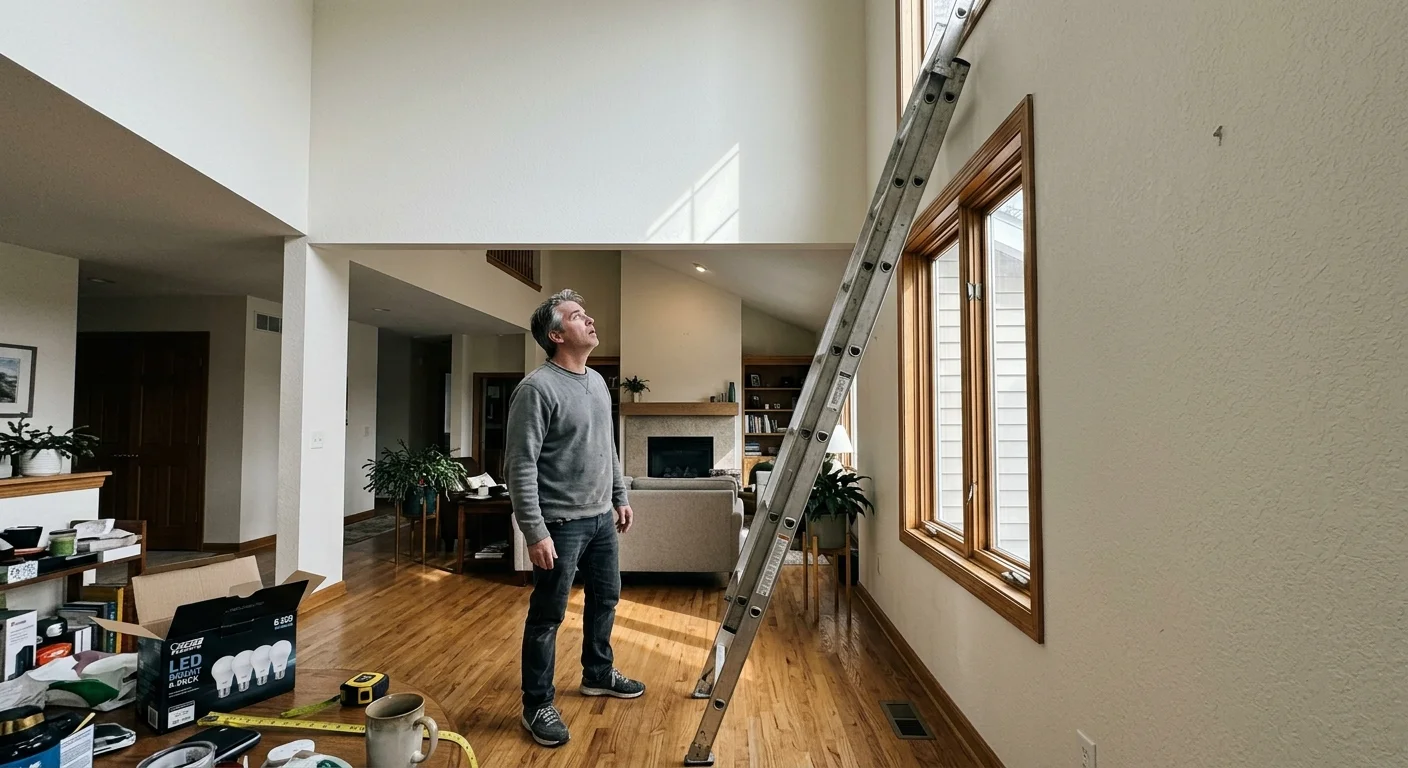
The 18-Foot Ceiling Dilemma: Lux Decay and Ladder Hazards
Vaulted cathedral ceilings create dramatic architectural volume in modern homes. Unfortunately, that same vertical volume makes functional illumination exceptionally difficult to balance.
Most builders install standard 6-inch recessed cans and fit them with wide-beam flood bulbs. While these bulbs produce plenty of light at the ceiling line, light levels decay drastically before reaching your seating area.
This rapid loss of intensity happens because wide-angle bulbs throw photons outward across upper walls instead of downward. You end up with washed-out upper drywall, harsh horizontal glare, and dark tabletops.
Replacing burned-out incandescent or cheap LED floods at high elevations poses severe physical risks. Reaching an 18-foot ceiling requires a working reach of nearly 20 feet.
According to data tracked by the American Academy of Orthopaedic Surgeons, over 500,000 ladder-related injuries receive medical treatment each year in the United States. Furthermore, ladder falls account for more than 300 fatal domestic accidents annually.
Every trip up a towering ladder increases your risk profile. Transitioning to long-life smart connected lamps removes the need to drag heavy climbing gear through your living room every eighteen months.
- Diffused flood lamps waste up to 70 percent of their output on upper walls.
- Floor-level reading areas frequently drop below 10 foot-candles with standard bulbs.
- Ladder climbs to heights above 14 feet carry disproportionate risks of catastrophic falls.
- Smart LED lamps deliver up to 25,000 hours of maintenance-free operation.
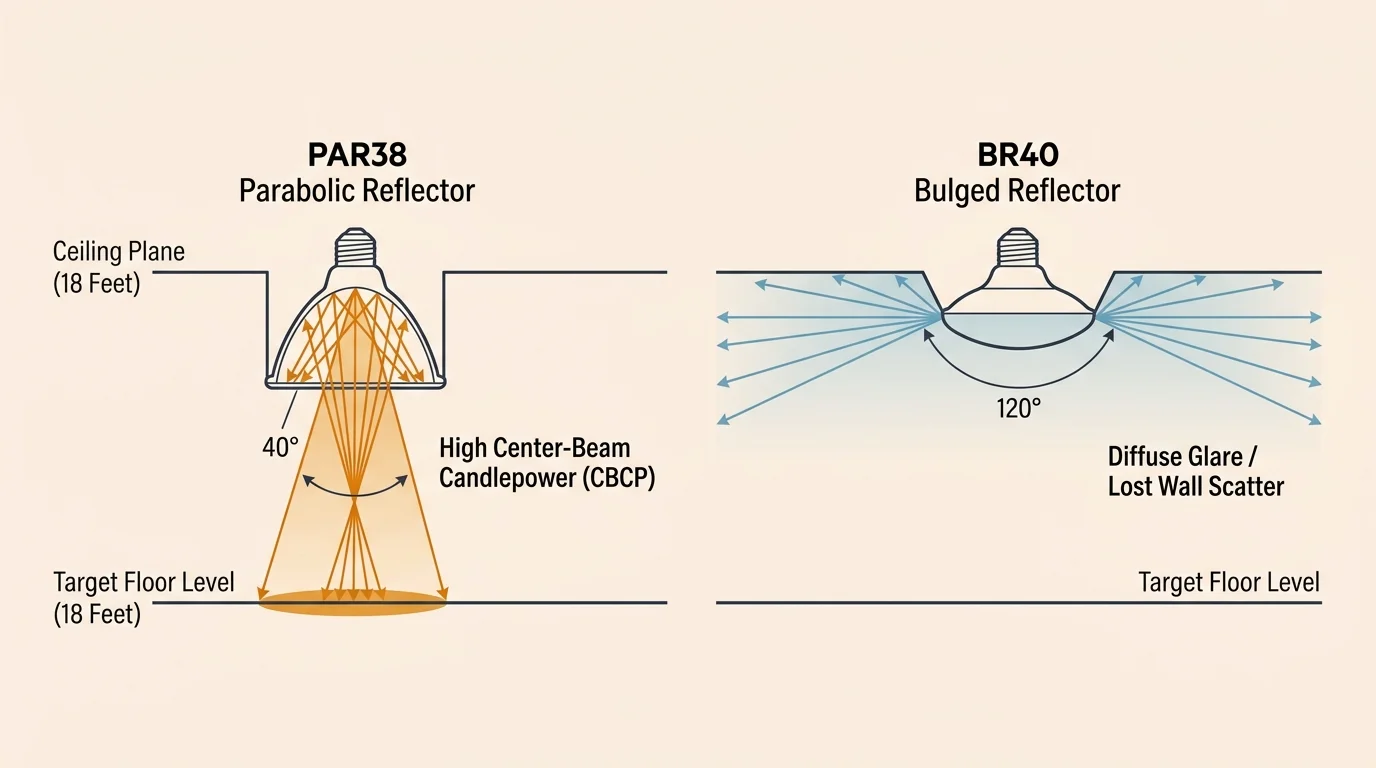
PAR38 vs BR40 Optics: Beam Angle and Center-Beam Candlepower
Understanding bulb designations explains why your current lighting feels inadequate. The abbreviations PAR and BR refer to distinctly different reflector technologies and optical designs.
PAR stands for Parabolic Aluminized Reflector. These bulbs use a precisely engineered internal parabolic mirror and a pressed-glass lens to concentrate light into a tight, directional cone.
Smart PAR38 bulbs typically feature beam angles between 35 and 45 degrees. This concentrated throw maximizes Center-Beam Candlepower (CBCP), projecting illumination straight toward your furniture.
BR stands for Bulged Reflector. These bulbs feature an expanded neck with a simple reflective coating and a diffuse, frosted front dome.
A BR40 bulb produces an ultra-wide beam angle spanning 90 to 120 degrees. While ideal for standard 8-foot basement ceilings, this wide dispersion severely dilutes floor illumination at high elevations.
The numbers after the letters denote bulb diameter measured in eighths of an inch. A PAR38 bulb measures 38 eighths of an inch, or 4.75 inches across the face.
A BR40 bulb measures 40 eighths of an inch, or 5.0 inches across its widest point. Both bulb styles utilize the standard E26 medium screw base found in common residential cans.
- PAR38 Beam Focus: Tight 35-degree to 45-degree distribution designed for directional downlighting.
- BR40 Beam Spread: Broad 90-degree to 120-degree distribution designed for general wash lighting.
- PAR38 Construction: Heavy-duty optical lens with internal parabolic focus.
- BR40 Construction: Thin bulged glass envelope with a frosted diffuser dome.
The Photometric Math: Inverse-Square Law and Floor-Level Foot-Candles
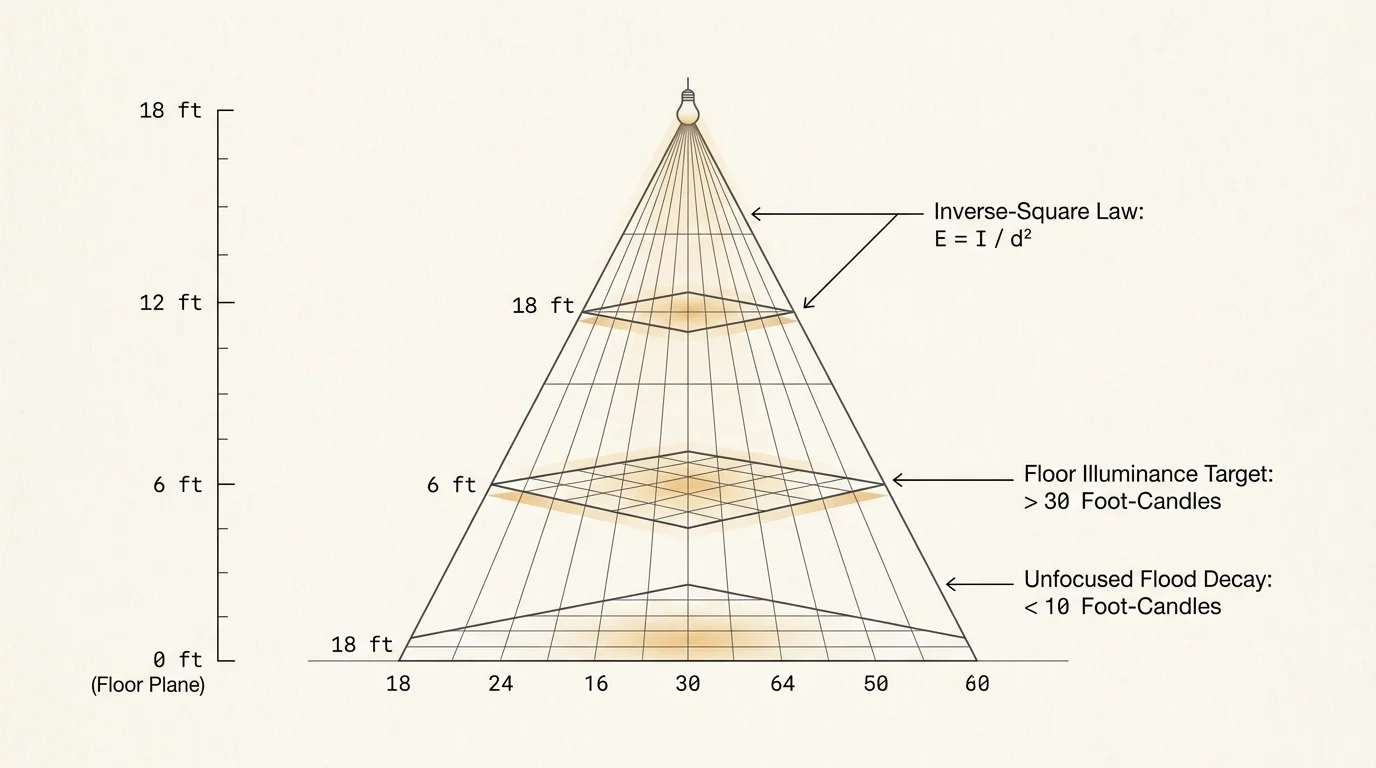
Lighting physics is governed by the inverse-square law. This fundamental law states that illumination on a surface drops in inverse proportion to the square of the throw distance.
When you double the distance from a light source, the illumination drops to one-quarter of its initial value. When you increase the distance from an 8-foot ceiling to an 18-foot ceiling, decay accelerates rapidly.
We calculate illuminance using the point-source formula: Foot-Candles = Candela / Distance Squared. Candela represents Center-Beam Candlepower, while distance is measured in feet from bulb to target.
Consider a standard 1,300-lumen BR40 bulb with a 110-degree beam spread. Because it disperses light across a broad hemisphere, its center-beam intensity reaches only about 480 candela.
At an 18-foot ceiling height, square the distance to reach 324 (18 × 18 = 324). Dividing 480 candela by 324 yields just 1.48 foot-candles directly below that single bulb.
Now consider a 1,300-lumen smart PAR38 bulb with a focused 40-degree beam spread. Its parabolic reflector concentrates light tightly, boosting center-beam intensity to approximately 3,500 candela.
Dividing 3,500 candela by 324 yields 10.8 foot-candles directly under that same individual lamp. The PAR38 bulb delivers more than seven times the floor-level punch of the BR40 using the exact same lumen output.
The best smart home is the one you do not have to manage.
To evaluate fixture performance, reviewers at Wirecutter Smart Home emphasize verifying both actual lumen ratings and real-world beam containment before making high-elevation investments.
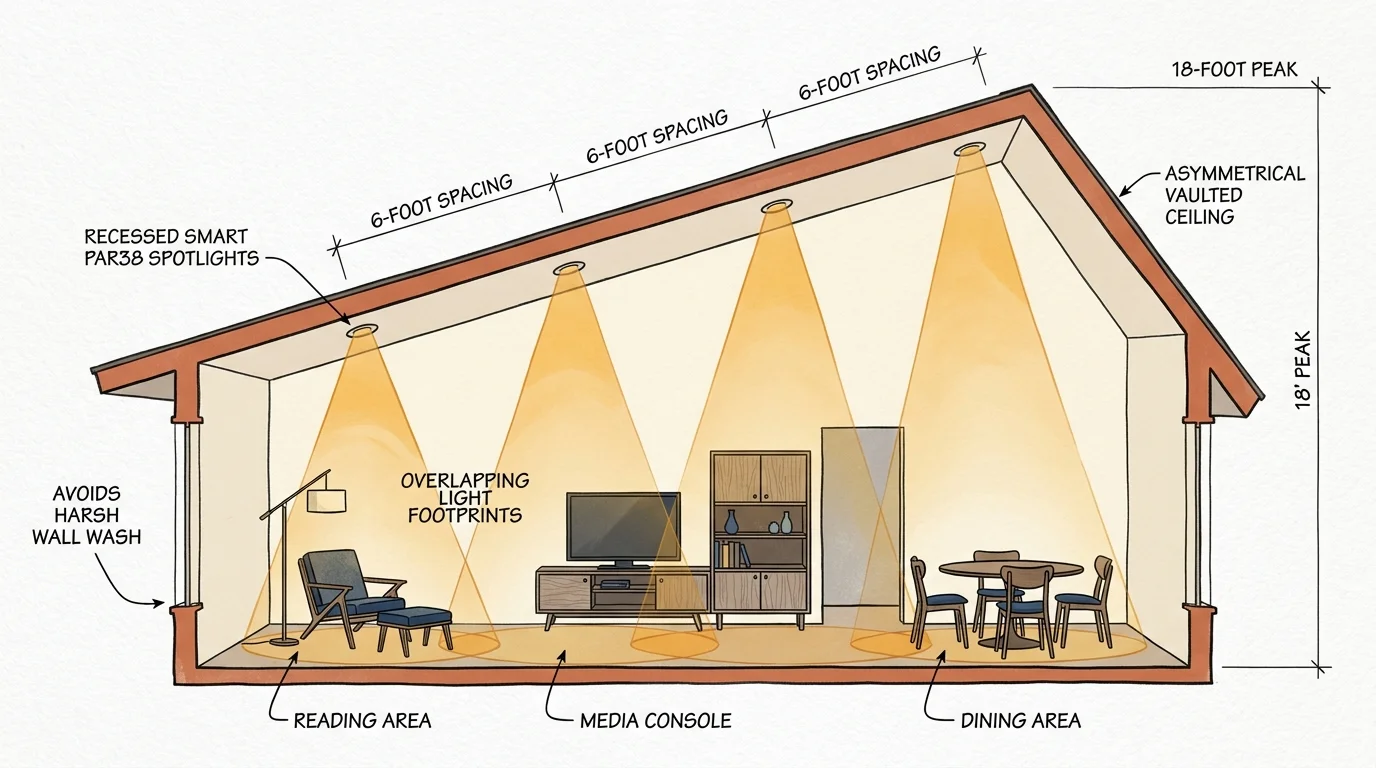
Worked Calculation: Lighting an 18-Foot Cathedral Living Room
Let us work through a concrete calculation for a cathedral living room. The room measures 20 feet long by 16 feet wide, totaling 320 square feet, with an 18-foot ceiling peak.
The builder installed four standard 6-inch recessed can fixtures arranged in a symmetrical rectangular grid. The fixtures sit spaced 8 feet apart across both axes, centered directly over the main seating zone.
Our target illumination standard is 30 foot-candles at table height (30 inches off the floor). That reduces our effective vertical throw distance to 15.5 feet (186 inches).
Squaring the 15.5-foot throw distance yields 240.25. Let us compare our real-world illumination outcomes using this target distance.
- Scenario A (Four BR40 Smart Bulbs): Each BR40 outputs 1,300 lumens at a 110-degree spread, generating roughly 480 center-beam candela. Dividing 480 by 240.25 produces 2.0 foot-candles directly beneath each fixture. Combining direct light and wide overlap from all four fixtures yields only 6.5 foot-candles across the central coffee table.
- Scenario B (Four PAR38 Smart Bulbs): We install four Philips Hue White and Color Ambiance PAR38 bulbs rated at 1,300 lumens with 40-degree optics. Each lamp delivers approximately 3,500 center-beam candela. Dividing 3,500 by 240.25 produces 14.5 foot-candles per bulb directly at nadir.
- Overlap Addition: At a 15.5-foot throw, a 40-degree beam creates an effective cone diameter of roughly 11.3 feet on the floor. With fixtures spaced 8 feet apart, adjacent beam edges overlap smoothly across the central seating zone.
- Cumulative Output: Direct illumination from adjacent overlapping beams adds another 18 foot-candles to the center of the room. The seating area reaches a comfortable 32.5 foot-candles without harsh horizontal glare or underlit shadows.
This layout achieves professional-grade task and ambient illumination entirely through correct optical selection. You achieve this visual clarity without cutting new drywall holes or installing supplemental fixtures.
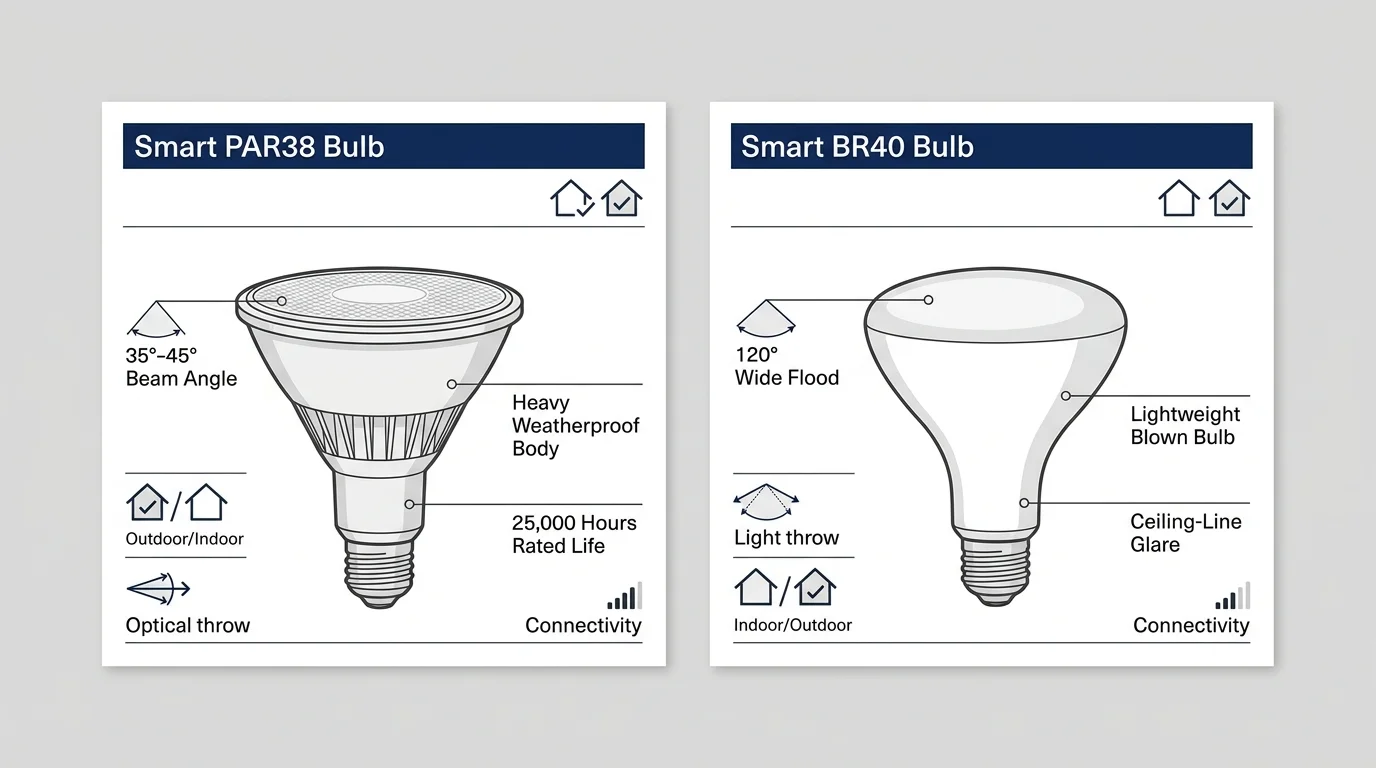
Smart PAR38 vs BR40 Comparison: Form Factors, Lumens, and Lifespan
Choosing the right hardware requires balancing physical dimensions, energy consumption, and long-term operating costs. Smart bulbs also require stable wireless protocols that maintain reliable connectivity inside metallic ceiling cans.
The table below compares three concrete options commonly installed in high residential ceiling cans. Review these verified physical specifications and performance metrics carefully.
| Metric | Philips Hue PAR38 Color | Sengled Smart PAR38 | Philips Hue BR40 Color |
|---|---|---|---|
| Base Type | E26 Medium | E26 Medium | E26 Medium |
| Face Diameter | 4.75 inches | 4.72 inches | 5.0 inches |
| Beam Angle | 40 degrees | 40 degrees | 110 degrees |
| Lumen Output | 1,300 lumens | 1,050 lumens | 1,100 lumens |
| Power Draw | 14 Watts | 13 Watts | 12.5 Watts |
| Rated Lifespan | 25,000 hours | 25,000 hours | 25,000 hours |
| Center Candela (CBCP) | ~3,500 cd | ~2,800 cd | ~420 cd |
| Approximate Retail Price | $159.99 (2-pack) | $49.99 (2-pack) | $119.99 (2-pack) |
Notice the massive difference in center candela despite similar raw lumen figures. The Philips Hue PAR38 directs more than eight times the candela toward the floor compared to its BR40 counterpart.
Operating these lamps at an average residential rate of 3 hours per day yields 22.8 years of service life. Increasing your burn rate to 5 hours per day still delivers roughly 13.7 years of continuous use.
Because metallic recessed cans can attenuate wireless signals, protocol selection matters. When building or expanding your setup, look for devices certified under the unified Matter Smart Home Standard to ensure seamless local control across platforms.
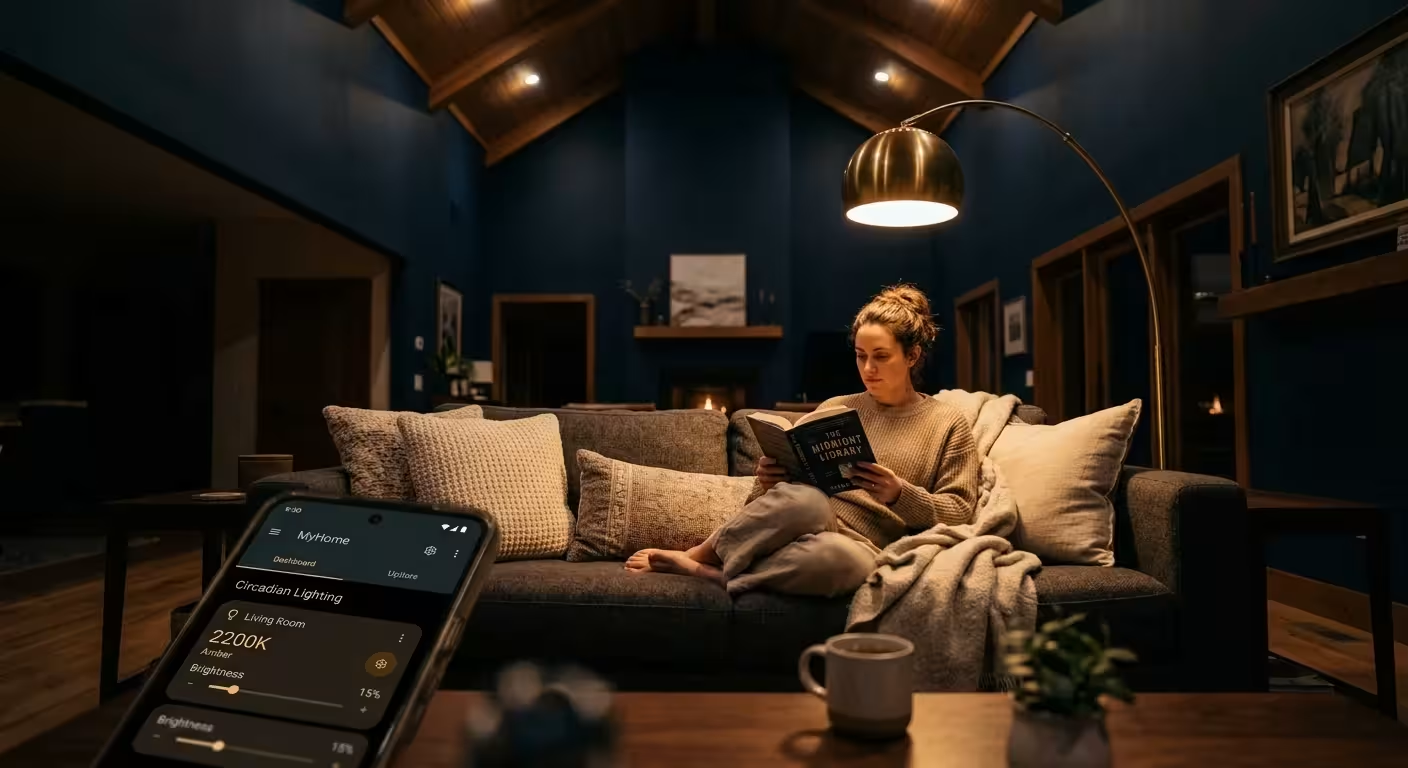
Automated Lighting Controls: Circadian Rhythms and Grouped Dimming
Once you install directional smart bulbs high overhead, controlling them from a wall switch becomes counterproductive. Turning off the primary wall switch cuts electrical power, rendering smart scheduling offline.
Automating overhead fixtures to gradually shift toward warmer color temperatures in the evening aligns with circadian rhythm lighting strategies that support natural melatonin production.
Instead, fit a physical smart switch cover or wireless dimmer remote over your existing toggle switch. This locks continuous electrical current to the bulbs while giving family members intuitive tactile control.
Configure automated color temperature adjustments based on local astronomical cycles. In high-ceiling spaces, harsh blue-toned white light bouncing off upper walls late at night disrupts evening melatonin production.
Program your smart hub to execute a dynamic circadian automation cycle throughout the day.
- 07:00 AM: Ramp bulbs from zero to 60 percent brightness at a crisp 4,000K neutral white to encourage morning alertness.
- 12:00 PM: Increase output to 100 percent brightness at 5,000K daylight to match high ambient sunshine streaming through clerestory windows.
- 06:00 PM: Lower output to 70 percent brightness while dropping color temperature to a warm 2,700K incandescent tone.
- 09:30 PM: Drop brightness to 30 percent at an ultra-warm 2,200K amber glow to signal natural sleep readiness.
Group all high-ceiling cans into an isolated lighting zone inside your smart home app. This allows you to dim directional downlights during evening movie watching while accent light strips illuminate surrounding baseboards.
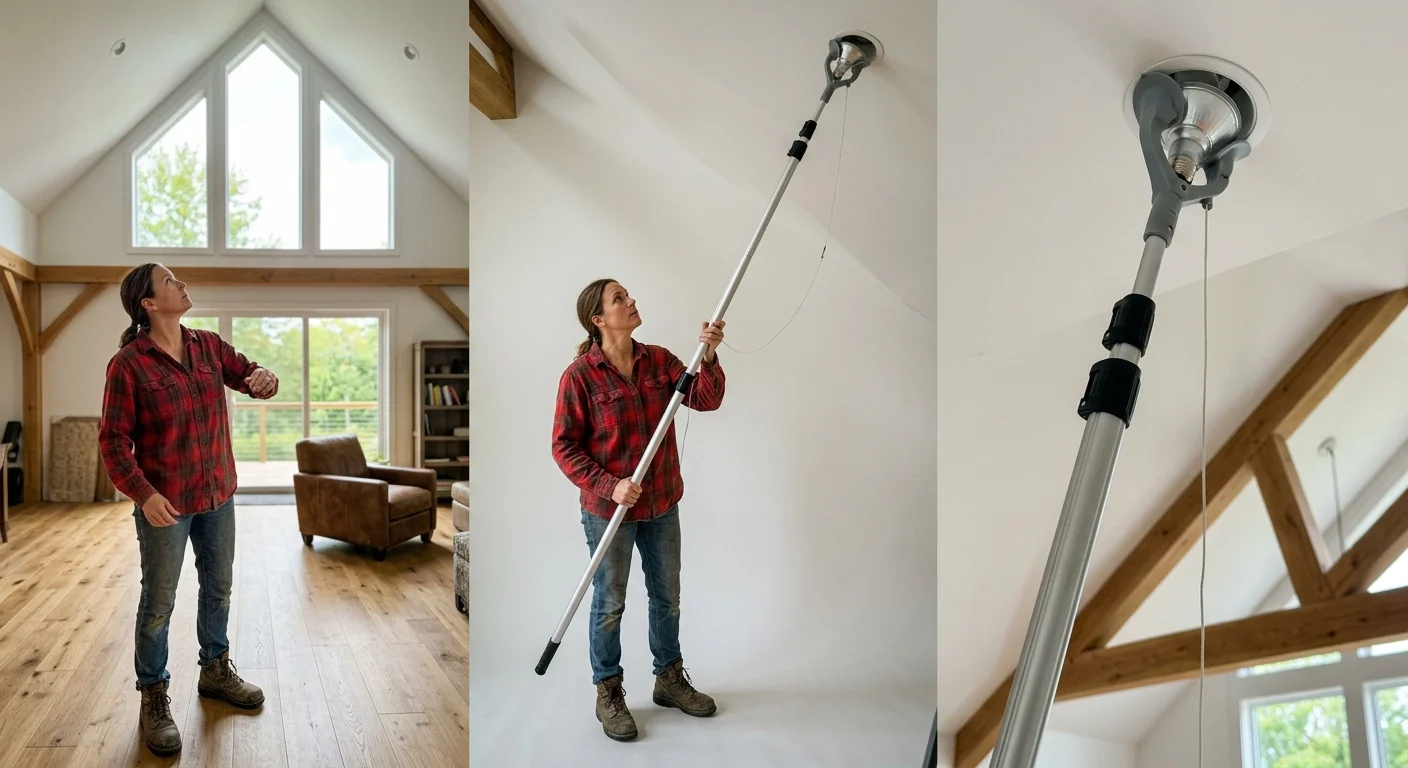
Safe High-Ceiling Bulb Swaps: Ladders, Tools, and Safety Protocols
Installing smart PAR38 bulbs requires ascending to elevated heights one final time. Rushing this installation introduces severe fall hazards that can cause debilitating orthopedic injuries.
Do not attempt this installation using a standard 6-foot or 8-foot household ladder. An 18-foot ceiling requires a 14-foot or 16-foot commercial-grade A-frame stepladder with an ANSI Type IA (300-pound) or Type IAA (375-pound) rating.
American National Standards Institute safety regulations strictly forbid standing on the top two rungs or top cap of any stepladder. Reaching overhead while balancing on tiptoes shifts your center of gravity outside the ladder base.
- Clear the Operating Radius: Remove all coffee tables, rugs, and furniture from beneath the ceiling cans to create a wide, stable perimeter.
- Inspect Floor Stability: Ensure ladder feet rest flat on solid, unyielding flooring. Never place ladder legs on slippery throw rugs or unstable cardboard protectors.
- Lock Ladder Spreaders: Open the stepladder fully and push both steel spreader arms down until they lock securely into their rigid horizontal position.
- Pre-Pair Bulbs on the Ground: Screw each smart PAR38 into a nearby desk lamp and add it to your smart home hub before ascending. Label each bulb by its target ceiling socket name.
- Use a Second Spotter: Always position a second adult at the base of the ladder to secure the rails and hand up fresh bulbs. Never climb while carrying bulky boxes in your hands.
- Maintain Three Points of Contact: Keep two feet and one hand—or two feet and your torso—firmly braced against the ladder frame while unscrewing the old bulbs.
Suction-cup telescopic extension poles rarely work reliably on smart PAR38 bulbs. Smart bulbs possess significant internal heat sink mass, making them too heavy for rubber suction cups to grip reliably from 18 feet below.
Take the time to execute a proper ladder setup for this final swap. Once these 25,000-hour smart bulbs lock into place, you can retire your heavy climbing ladder for decades.
Frequently Asked Questions
Can I use standard BR40 bulbs in an 18-foot vaulted ceiling?
You can physically screw them in, but BR40 bulbs scatter light across a wide 110-degree cone. Over an 18-foot throw, this dispersion causes severe lux decay, leaving floor living spaces underlit and dim.
How many foot-candles do I need for living room ambient lighting?
The Illuminating Engineering Society recommends 20 to 30 foot-candles for general living room illumination. Concentrated reading tasks or detailed work may require closer to 40 to 50 foot-candles in designated task zones.
Will smart PAR38 bulbs fit inside standard 6-inch recessed cans?
Yes. PAR38 bulbs measure 4.75 inches across the face and feature a standard E26 medium screw base. They slide easily into standard 6-inch recessed cans with ample mechanical clearance around the baffle.
How long will a smart LED PAR38 bulb last in my ceiling?
A smart PAR38 bulb rated for 25,000 hours will last roughly 22.8 years when operated for 3 hours daily. This longevity effectively eliminates recurring ladder climb maintenance for decades.
Disclaimer: This article is for informational purposes only. Smart home devices involve electrical connections and data privacy. Always follow manufacturer instructions for installation. For complex wiring or HVAC work, consult a licensed professional.