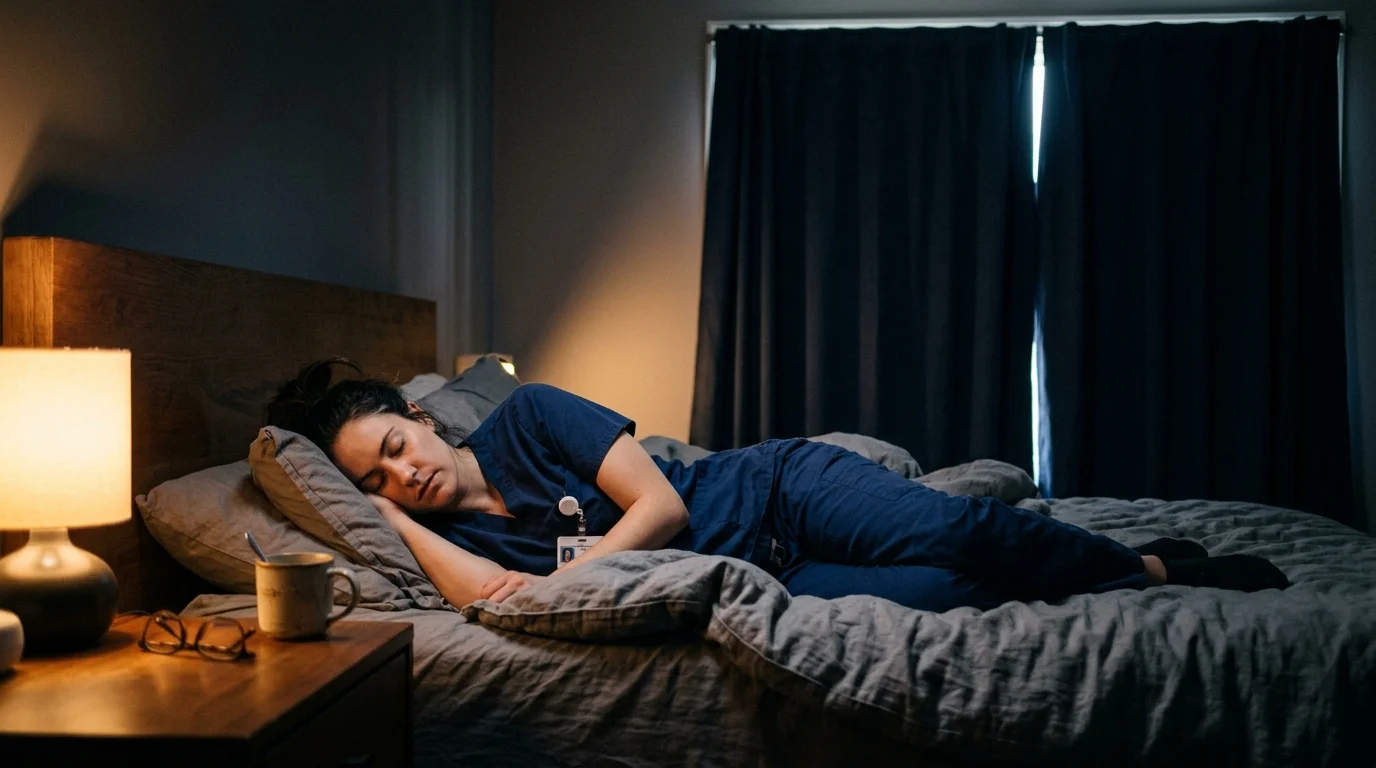
Waking up at 3:45 PM for an emergency department shift feels brutal when standard alarms abruptly shatter your sleep. A customized shift worker dawn simulator primes your nervous system by stimulating retinal receptors before your feet touch the floor.
Commercial smart lighting apps lock rigidly to daytime solar schedules, which leaves overnight healthcare professionals stranded in artificial gloom. Our manual step-gradient timetable shifts your biological clock independently of afternoon sunlight while protecting your sleeping partner.
By shifting from 5 to 650 lux across precise color temperatures, you can eliminate persistent sleep inertia. This guide outlines how to build an inverted sunrise inside your bedroom.
The Biology of Reversed Circadian Entrainment
Over 5 million Americans work permanent overnight shifts, according to data from the U.S. Bureau of Labor Statistics. Operating against natural solar rhythms forces your central circadian pacemaker into continuous conflict with environmental cues.
Aligning your light exposure across the entire home using a room-by-room smart lighting guide helps sustain alertness when waking during inverted cycles.
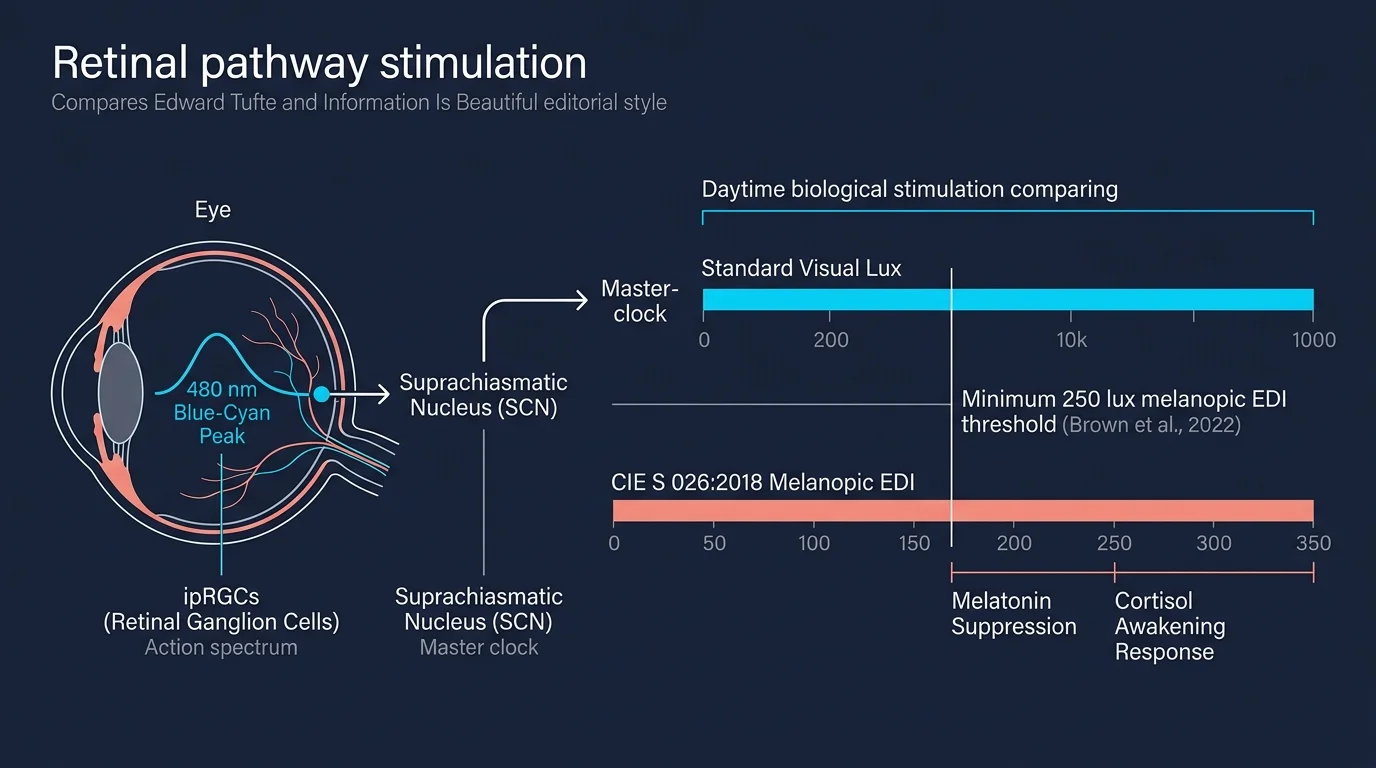
Your master biological clock resides within the hypothalamic suprachiasmatic nucleus. Special photoreceptors in your eyes, called intrinsically photosensitive retinal ganglion cells, synchronize this master clock by detecting ambient light.
These cells contain melanopsin, a photopigment tuned specifically to blue-cyan light wavelengths near 480 nanometers. When morning light strikes these receptors, it triggers the Cortisol Awakening Response and halts melatonin production.
The global scientific consensus published by Brown et al. (PLOS Biology, 2022) recommends a minimum daytime threshold of 250 lux melanopic Equivalent Daylight Illuminance to drive wakefulness and suppress melatonin.
Standard visual lux measures brightness perceived by human visual cones rather than biological stimulation. Modern circadian photobiology relies on the CIE S 026:2018 standard to quantify melanopic Equivalent Daylight Illuminance.
A clinical dawn simulation ramping across 45 minutes halves sleep inertia duration compared to sudden auditory chimes. You wake up with heightened cognitive alertness, stabilized blood pressure, and faster motor reflexes.
The Blackout Baseline: Taming South-Facing Windows
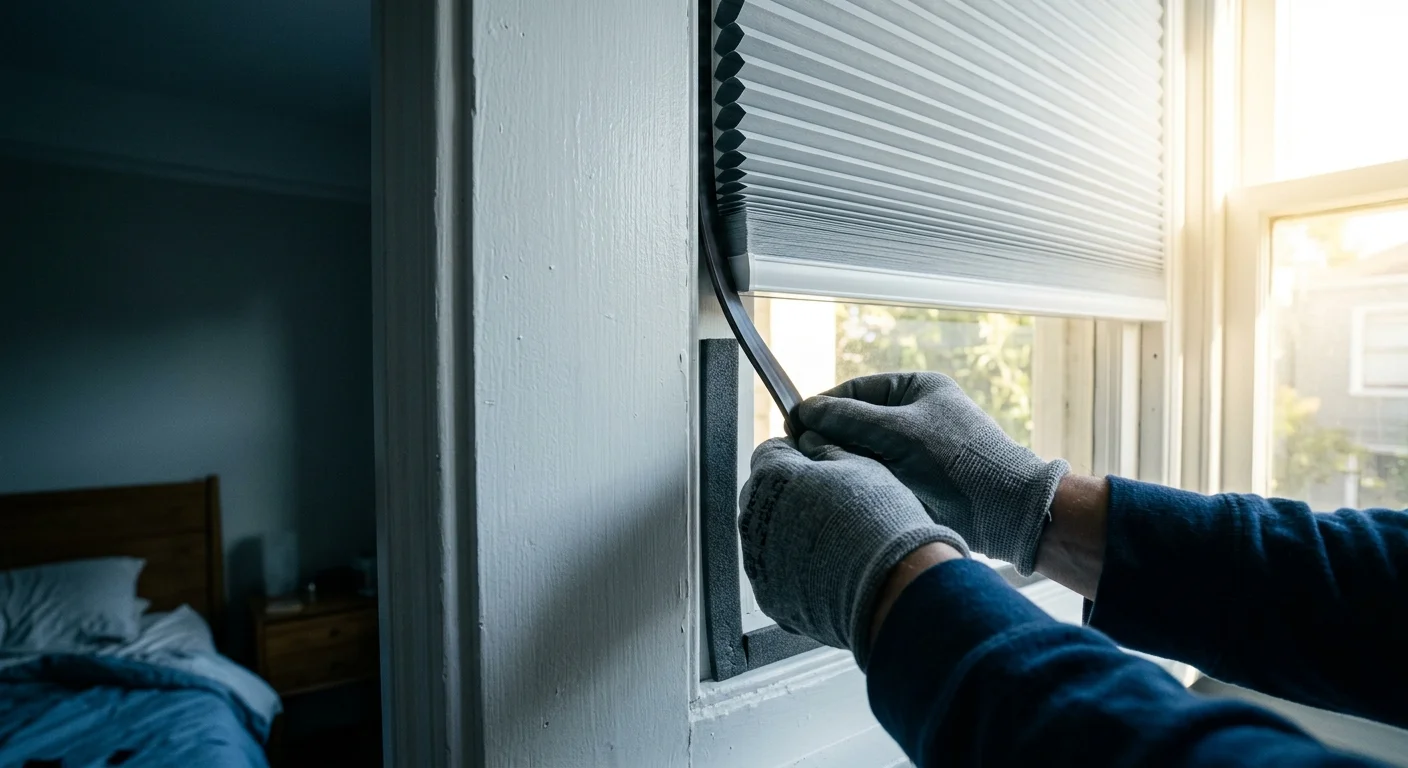
You cannot build an artificial dawn without first creating complete biological darkness. High, south-facing windows present a massive obstacle because direct afternoon sunlight often exceeds 80,000 visual lux.
If you share your living space with family, childproofing smart light switches prevents household members from accidentally flooding your darkened room mid-sleep.
Establishing an automated goodnight routine ensures your motorized shades, thermostat, and perimeter lighting align simultaneously before daytime rest.
If you need to navigate the bedroom during your sleep block, integrating red-spectrum nightlight automations prevents melatonin suppression during nighttime wake-ups.
The Brown et al. consensus specifies maintaining less than 1 lux melanopic EDI during intended sleep periods. Stray afternoon beams penetrating window seams will suppress daytime melatonin and fracture deep slow-wave sleep.
- Mount custom interior blackout cell shades inside the window jamb to block front-facing light transmission.
- Install aluminum side-retention channels along window frames to seal edge gaps where bright halos leak into the room.
- Hang floor-length, high-density blackout drapery on wraparound French return rods to trap perimeter light spills.
- Apply matte black felt tape over equipment status indicators and electronics LEDs across the entire room.
Sealing edge perimeter light prevents unwanted daytime photic stimulation. Once you achieve total darkness, your smart lighting can orchestrate a controlled, artificial sunrise on your schedule.
The 45-Minute Step-Gradient Timetable
Commercial dawn simulators fail overnight workers because their preset transitions last only 20 or 30 minutes. A rapid lux spike during deep non-REM sleep triggers startled awakenings and spikes acute stress hormones.
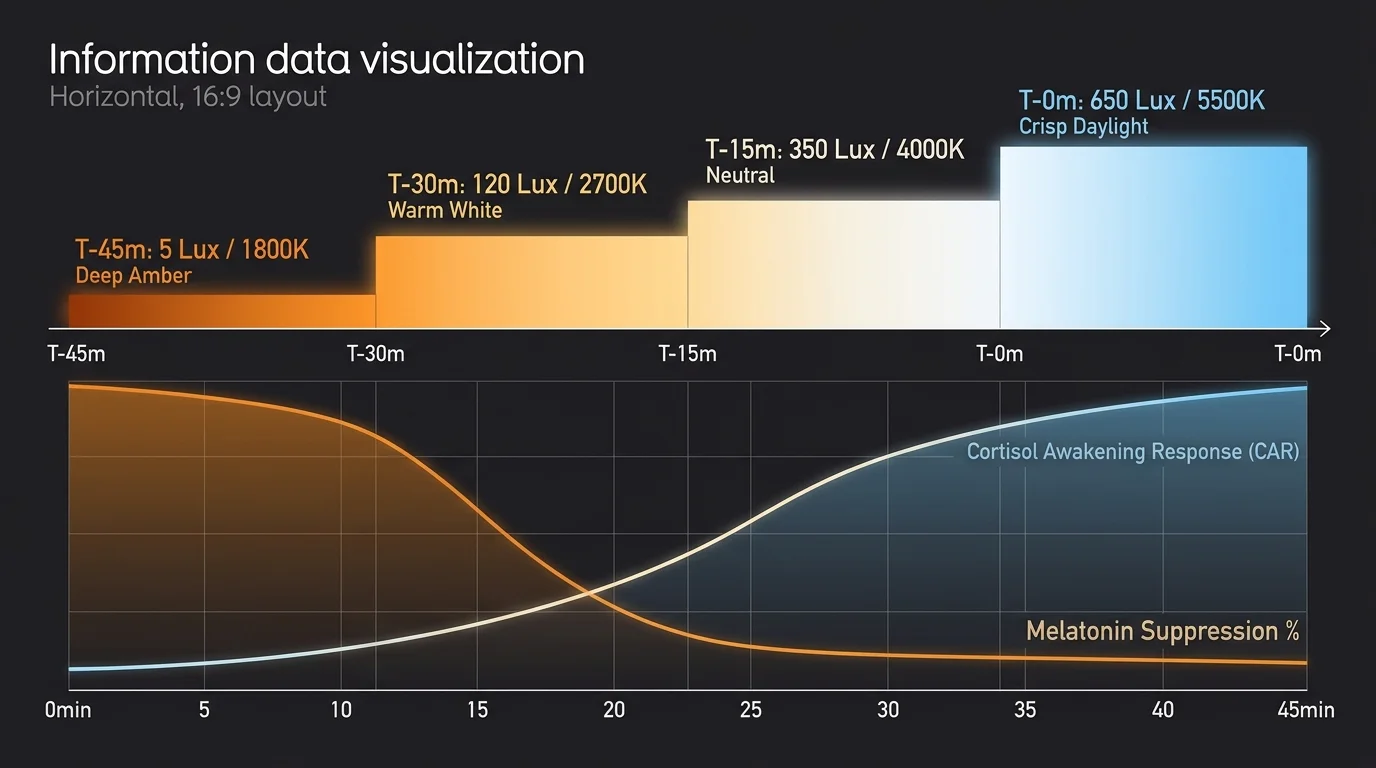
A 45-minute ramp provides the physiological ramp-up necessary to suppress melatonin smoothly. The timetable begins at 3:15 PM to prepare an emergency nurse for full cognitive alertness by 4:00 PM.
- 3:15 PM (Step 1): 5 lux at 2,200K. The bulb emits a deep amber glow that penetrates eyelids without triggering arousal.
- 3:20 PM (Step 2): 25 lux at 2,400K. Warm illumination begins lowering baseline melatonin levels in the bloodstream.
- 3:25 PM (Step 3): 60 lux at 2,700K. Incandescent-grade warmth mimics the early stages of a natural horizon sunrise.
- 3:30 PM (Step 4): 120 lux at 3,000K. Body core temperature begins its ascent as sleep architecture lightens into stage N1.
- 3:35 PM (Step 5): 220 lux at 3,500K. Retinal ganglion cells receive sufficient stimulation to trigger early cortisol synthesis.
- 3:40 PM (Step 6): 350 lux at 4,000K. Neutral white light promotes spontaneous eyelid opening before audible alarms sound.
- 3:45 PM (Step 7): 480 lux at 4,500K. Melanopsin activation rapidly accelerates, lifting sleep inertia fog from the prefrontal cortex.
- 3:50 PM (Step 8): 580 lux at 4,800K. Bright, cool-white illumination approaches full biological saturation at eye level.
- 3:55 PM to 4:00 PM (Step 9): 650 lux at 5,000K. Full illumination delivers over 250 lux melanopic EDI to complete the circadian reset.
This deliberate circadian light curve night nurse schedule prevents the disorientation caused by jarring audio alarms. You wake up naturally during light sleep rather than groggily during deep slow-wave cycles.
Directional Optics and Partner Light Isolation
Graveyard-shift workers frequently share sleeping quarters with partners operating on traditional daytime schedules. Flooding the entire master bedroom with 650 lux at 3:45 PM inevitably awakens your partner.
For tight bedroom spaces or custom headboards, compact solutions like low-clearance bed lighting help isolate focused beams directly onto your pillow plane.
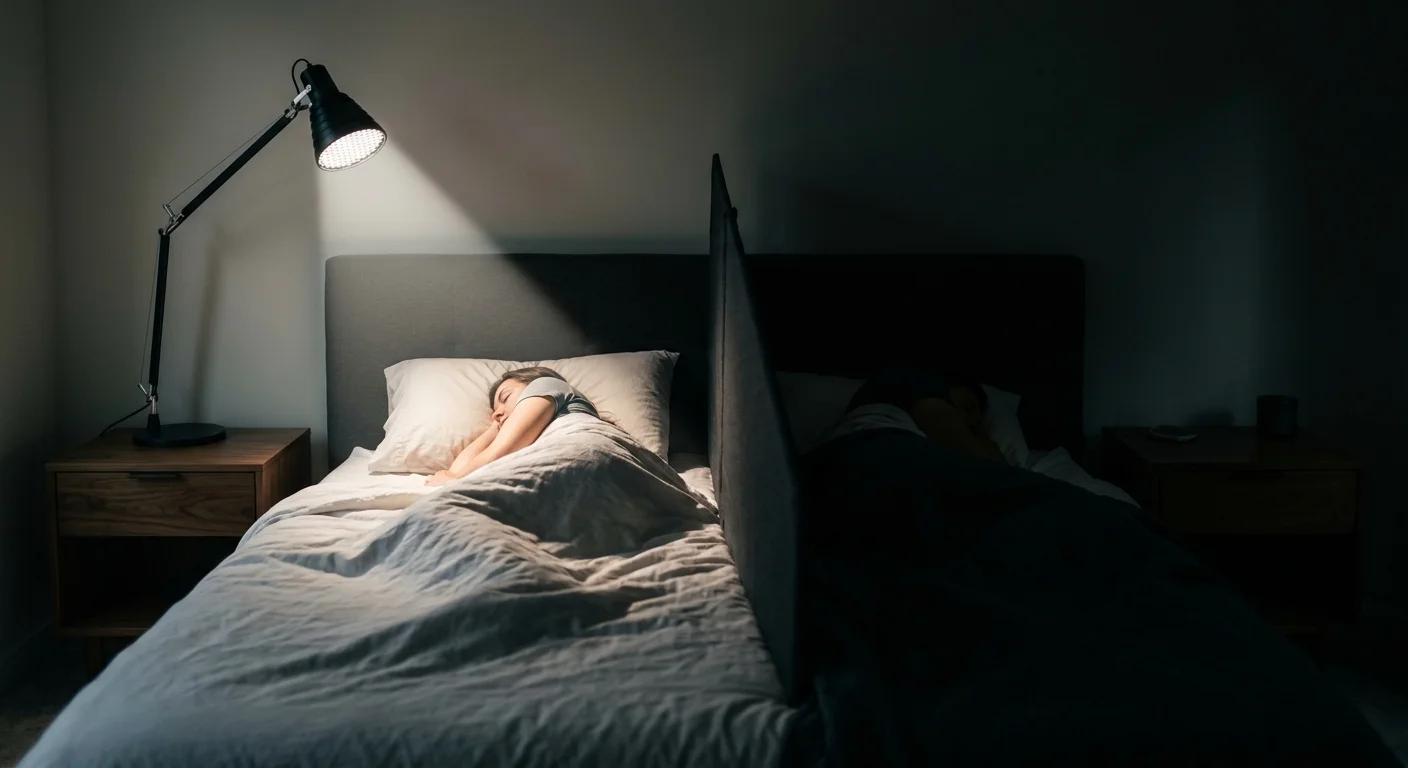
Light follows the inverse-square law, meaning illuminance drops off exponentially over distance. By controlling optical direction, you can deliver clinical-grade illumination to your pillow while keeping the opposite side below 10 lux.
- Mount an articulated, deep-cone task sconce directly to your bedpost or headboard rail.
- Attach an optical cylindrical snoot or barn doors to the fixture rim to eliminate peripheral flare.
- Aim the beam downward at a 45-degree angle across your pillow plane, centering the focal hotspot near your forehead.
- Position an opaque, fabric-wrapped acoustic privacy divider down the mattress centerline to catch stray spill photons.
This optical containment keeps the spillover at your partner’s head below 8 visual lux. Your side reaches full biological saturation while your partner remains undisturbed in deep rest.
Smart Bulb and Luminaire Hardware Comparison
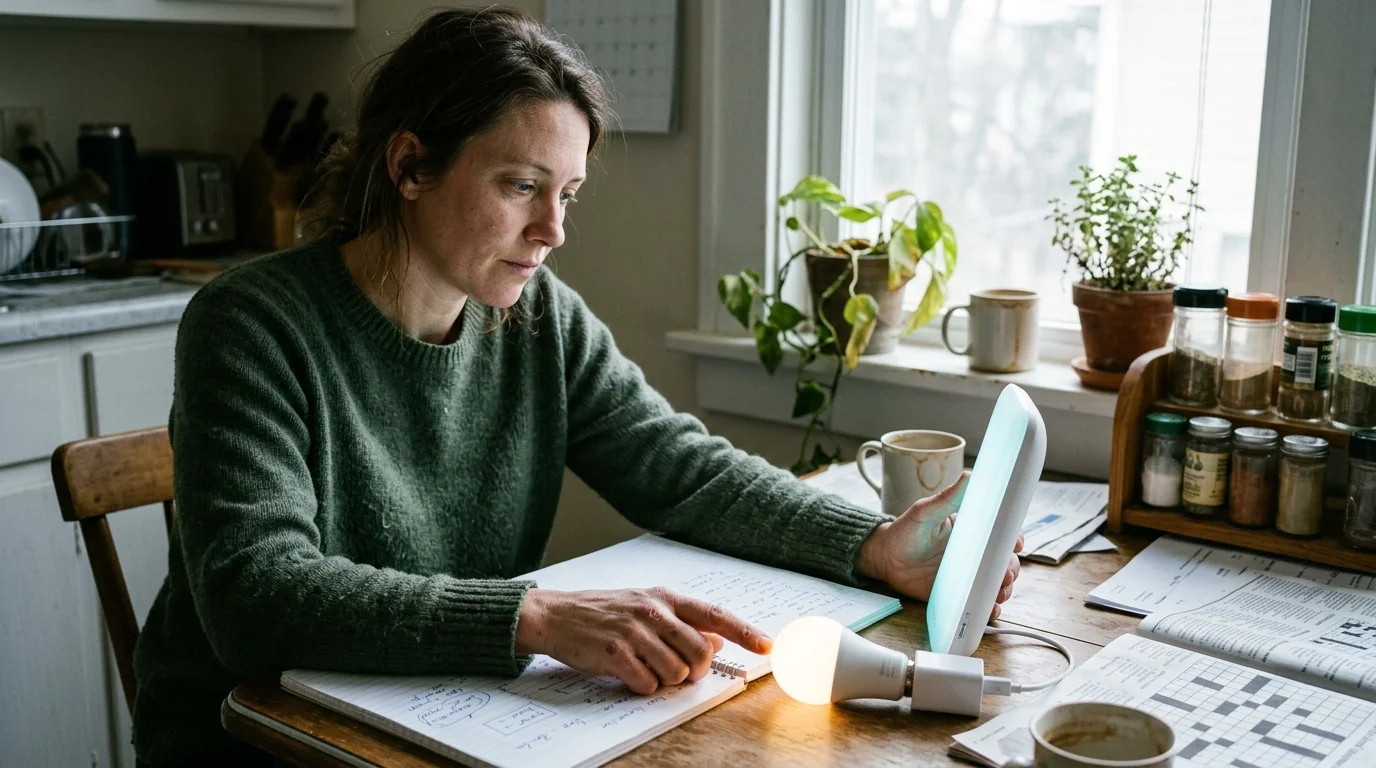
Executing an inverted dawn simulation requires smart lighting hardware that delivers low minimum dimming and precise color control. Many entry-level bulbs flicker violently below 10% brightness or jump abruptly from dark to bright.
A thorough understanding of color temperature in smart bulbs ensures you choose fixtures capable of wide kelvin shifts without unnatural discoloration at low levels.
The comparative evaluation below outlines four connected hardware options based on protocol, luminous flux, and beam control. Testing insights from Wirecutter’s smart home testing show that protocol stability is critical for time-sensitive health routines.
| Smart Lighting Hardware | Form Factor & Protocol | Peak Output & CCT Range | Minimum Stable Dimming | MSRP |
|---|---|---|---|---|
| Philips Hue White & Color Ambiance A19 | A19 Bulb / Zigbee & Bluetooth | 1,100 lm (2,000K–6,500K) | 0.2% (Smooth ramp) | $54.99 |
| LIFX Color A19 | A19 Bulb / Wi-Fi | 1,100 lm (1,500K–9,000K) | 1.0% (Software step) | $49.99 |
| Philips SmartSleep HF3650 | Standalone Luminaire / Non-Connected | ~315 lux at 45cm (2,200K–4,000K) | 0.5% (Internal DAC) | $179.99 |
| Nanoleaf Essentials Matter A19 | A19 Bulb / Thread & Matter | 1,100 lm (2,700K–6,500K) | 1.5% (Hardware step) | $19.99 |
The Philips Hue ecosystem excels here because its Zigbee hardware controller supports fractional brightness transitions down to 0.2%. That bottom-end precision prevents the jarring initial light burst that wakes sensitive sleepers prematurely.
For cross-ecosystem smart home setups, products supporting the Matter smart home standard ensure your scheduled waking routines run reliably across platforms. Matter devices communicate directly across your local network without relying on remote internet cloud servers.
Automation Blueprints: Bypassing Solar Defaults
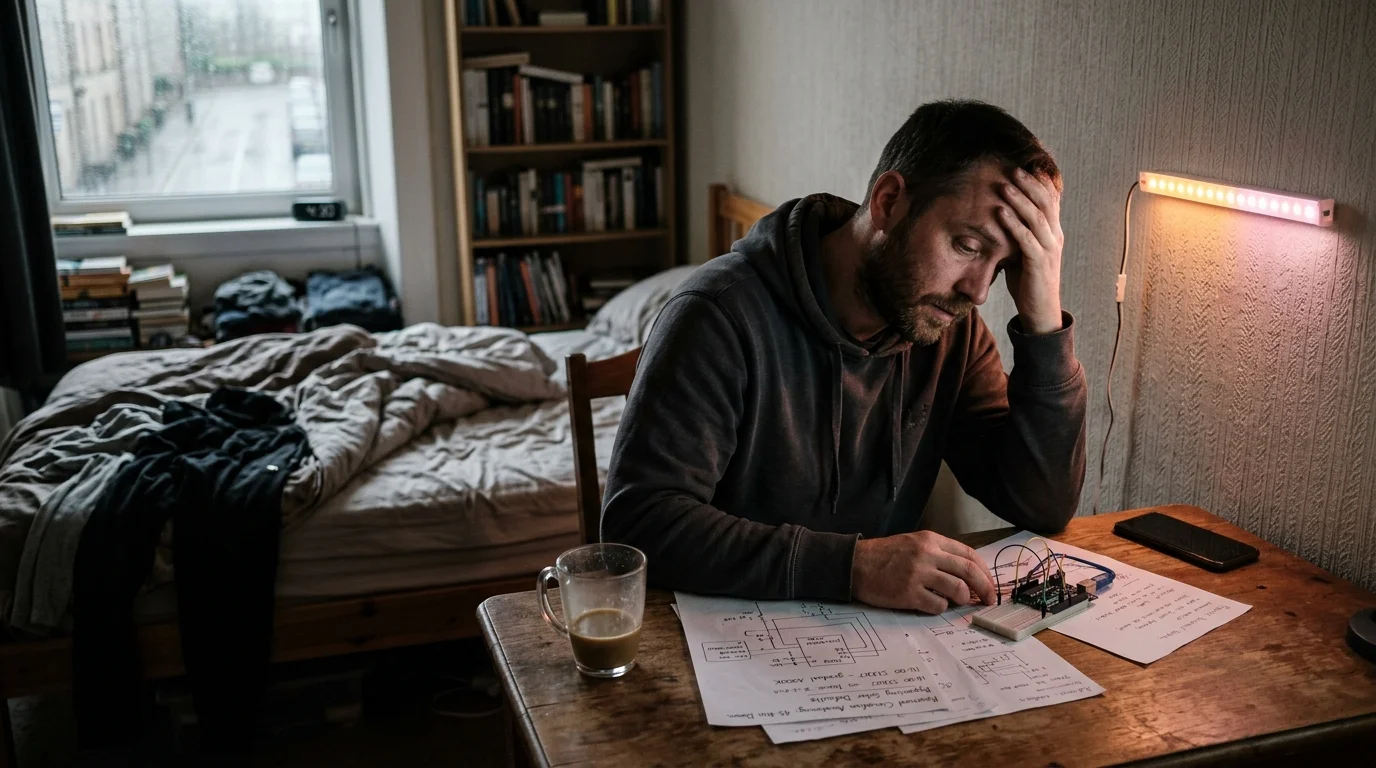
Native smart lighting features create headaches for shift workers. Apple HomeKit Adaptive Lighting and Philips Hue Natural Light tie color adjustments directly to the local solar cycle.
When running custom sleep automations during the afternoon, building a smart home emergency alert system guarantees critical household alarms bypass your lighting and do-not-disturb overrides.
If your hospital shifts rotate weekly, pairing these schedules with calendar-driven shift automations ensures your lighting timetable updates automatically from your digital calendar.
When you wake at 3:15 PM, these native systems output warm afternoon amber light instead of morning-stimulating blue wavelengths. You must override these solar presets with dedicated local automations.
- Open your smart home platform and disable dynamic solar synchronization on your bedroom fixtures.
- Create a dedicated software scene for each of the nine steps outlined in the step-gradient timetable.
- Program a sequence of timed automation triggers starting at 3:15 PM, spaced exactly five minutes apart.
- Set the transition duration on each step trigger to 300 seconds to produce an imperceptible, continuous ramp.
- Add a shut-off condition that extinguishes the light automatically at 4:30 PM after you depart for work.
Local automation engines like Home Assistant or a local Philips Hue Bridge run these routines on hardware clocks. Your wake-up dawn will fire reliably even if your home internet connection drops mid-sleep.
Worked Example: The 3:15 PM Bedroom Retrofit
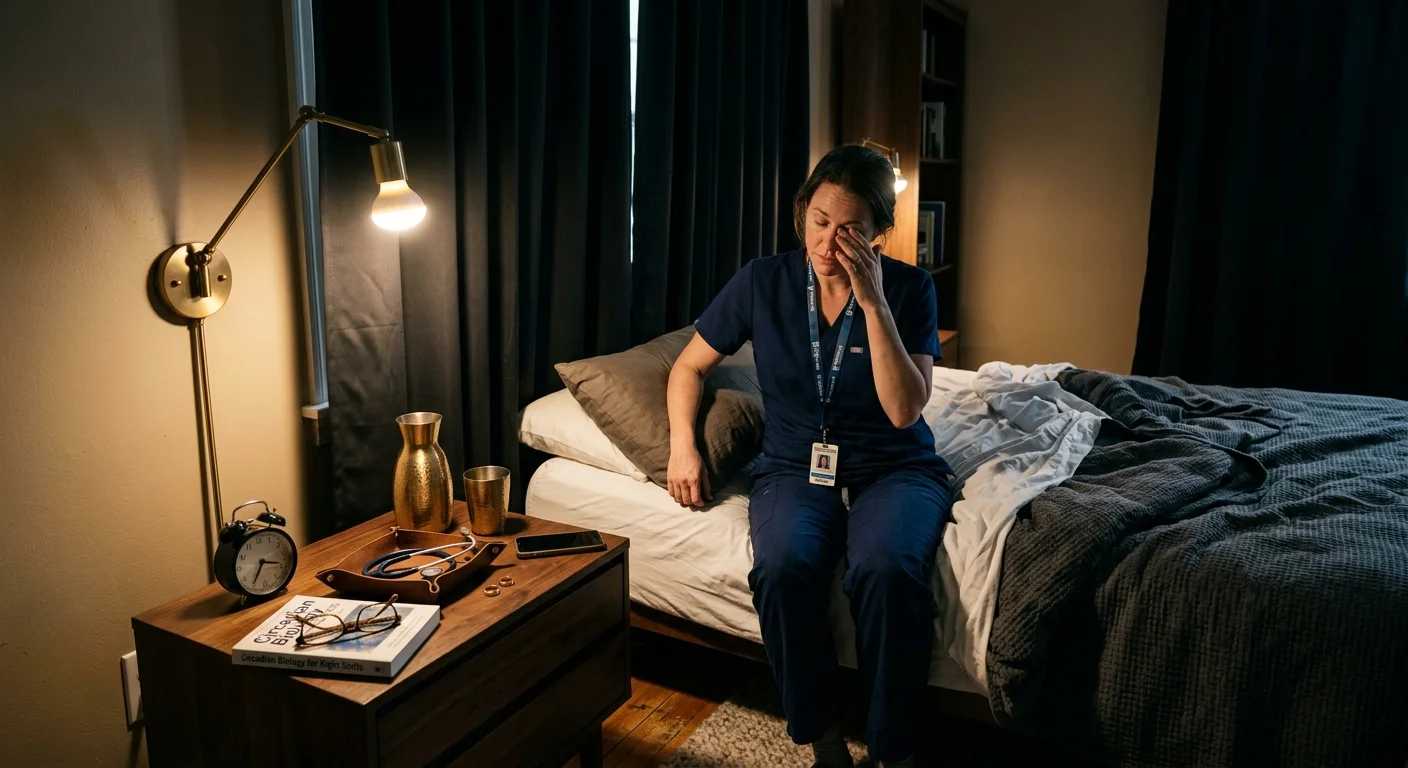
Consider an emergency nurse who works 7:00 PM to 7:00 AM three days a week. She sleeps from 8:00 AM to 4:00 PM in a 12×14 foot master bedroom with high, south-facing windows.
Direct afternoon sunlight leaks around standard blinds, registering 340 lux at pillow level. Her partner works standard daytime office hours and sleeps until 7:30 AM before leaving for work.
To eliminate light leaks, she installs custom interior U-channel blackout tracks alongside heavy blackout drapes for $135 total. Ambient light across the bedroom drops below 0.4 lux melanopic EDI by midday.
She mounts a matte black gooseneck sconce with an internal baffle cone ($38) directly above her side of the bed. She installs an 1,100-lumen Philips Hue White and Color Ambiance bulb ($54.99), directed 28 inches from her face.
At 3:15 PM, the Hue Bridge activates Step 1 at 5 lux and 2,200K, slowly climbing to 650 lux and 5,000K by 4:00 PM. A calibrated light meter shows 272 lux melanopic EDI at her eye level.
Her partner’s side of the king mattress measures just 6.8 visual lux during the 4:00 PM peak. Total equipment cost for the retrofit sits at $227.99, completely solving her morning grogginess.
Troubleshooting Circadian Drift and Sleep Inertia
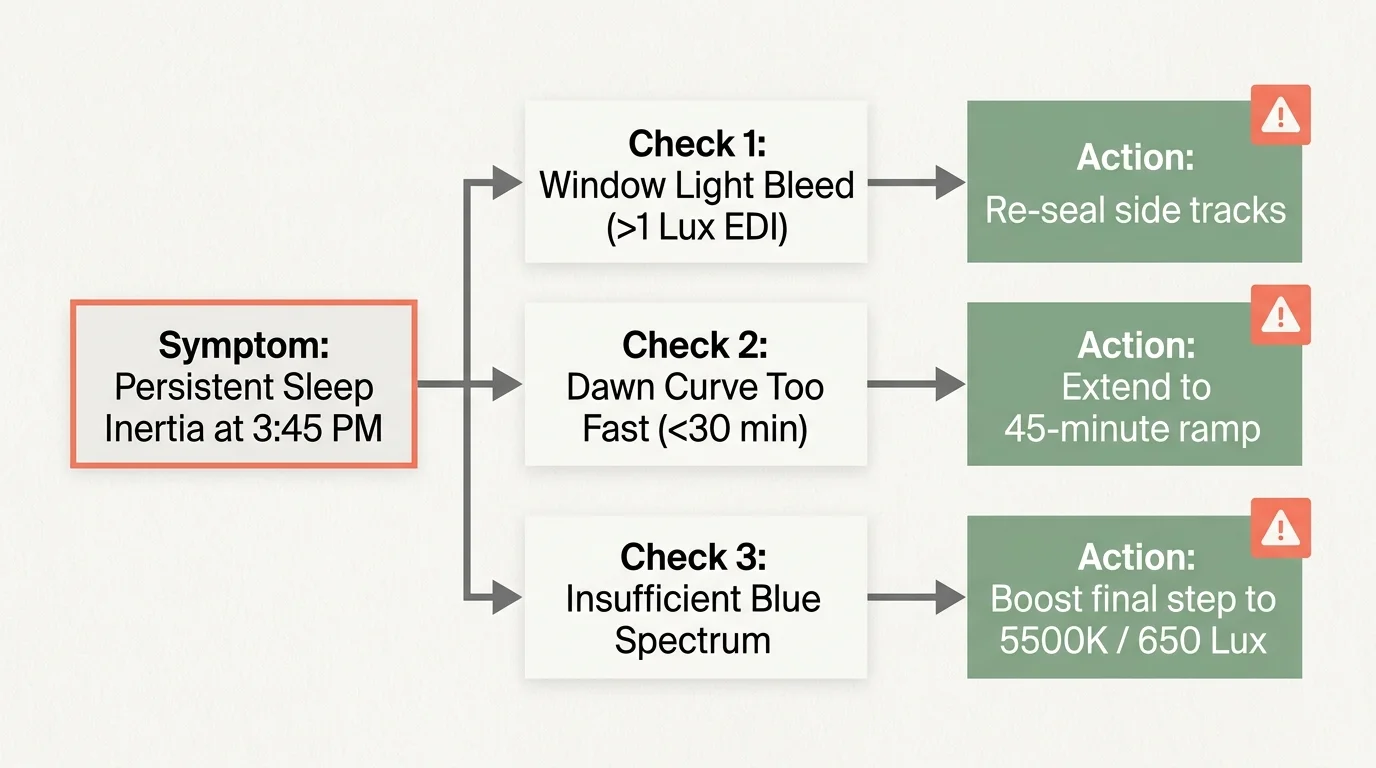
If you still wake up feeling heavy and disoriented after five days, your biological clock may have drifted. Sleep inertia that persists past 20 minutes indicates insufficient melanopic activation during the final 15 minutes.
Move the fixture four inches closer to your headboard to increase incident lux via the inverse-square law. Alternatively, adjust your final automation step to 5,500K to introduce stronger blue-cyan wavelengths into the beam.
If the 3:15 PM start wakes you too early, your eyes may be exceptionally sensitive to low light. Lower Step 1 to a 1% hardware limit and set the color temperature to an ultra-deep 2,000K amber glow.
Maintain your night shift smart lighting schedule even on transitional rest days between shifts. Keeping consistent photic timing protects your suprachiasmatic nucleus from destabilizing, multi-hour circadian jet lag.
Frequently Asked Questions
Can a standard daylight-spectrum bulb work as a dawn simulator?
Standard static daylight bulbs cannot smoothly ramp up from sub-five-lumen minimums. Turning on a static 5,000K bulb instantaneously shocks your nervous system and causes rapid sleep disruption.
Why is melanopic lux more important than standard visual lux for shift workers?
Visual lux measures light perceived by vision cones, while melanopic lux measures stimulation of non-visual retinal ganglion cells. These non-visual cells control melatonin suppression, core body temperature, and systemic alertness.
Will a sunrise simulator wake me up if I sleep wearing a contour eye mask?
Padded blackout eye masks block the vast majority of photic transmission through eyelids. You must sleep without eye protection by fully blacking out the surrounding bedroom architecture instead.
Do I need an internet connection for my dawn simulation routines to run?
Automations stored locally on a Zigbee bridge, Matter controller, or Home Assistant server run without internet access. Cloud-dependent Wi-Fi smart plugs and bulbs will fail if your internet service provider experiences downtime.
Disclaimer: This article is for informational purposes only. Smart home devices involve electrical connections and data privacy. Always follow manufacturer instructions for installation. For complex wiring or HVAC work, consult a licensed professional.