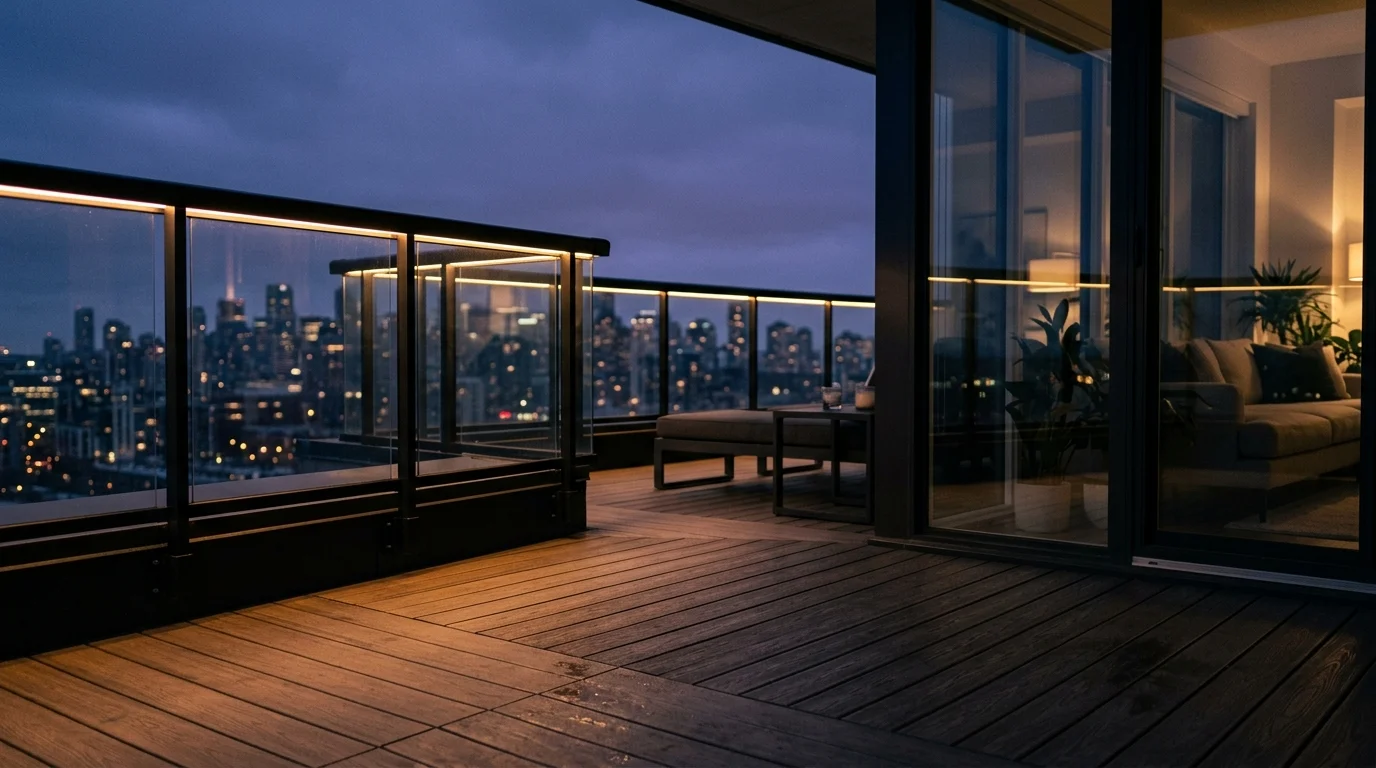
You can install architectural deck lighting without violating HOA covenants or drilling into your balcony’s waterproof envelope. Non-invasive friction clamps paired with low-voltage smart fixtures deliver modern illumination while protecting your security deposit.
Adapting creative smart LED strip light installations beneath perimeter rails delivers subtle, glare-free downward illumination that preserves building aesthetics.
Extending illumination outdoors also helps when choosing the best smart lighting for small apartments, as it expands your functional living area past the patio door.
Most condo boards fine owners for penetrating Limited Common Elements or causing light trespass into neighboring units. You can overcome these hurdles using DarkSky-compliant downlighting and wireless mesh protocols that penetrate insulated hurricane glass.
This guide details how to build a reliable Matter-over-Thread outdoor accent system using non-destructive mechanical friction clamps and strategic boundary mesh routing.
Navigating HOA Bylaws and Limited Common Elements
Condominium Covenants, Conditions, and Restrictions (CC&Rs) govern every square inch of your building’s exterior. Most condominium declarations legally classify balconies, railings, and exterior patios as Limited Common Elements (LCE).
Balcony regulations often mirror the restrictions surrounding apartment hallway code compliance for doorbells, where modifying shared building exteriors invites strict board enforcement.
For balconies with overhead soffits, sizing weatherproof smart light strips for covered condo balconies provides another drill-free method to stay within board rules.
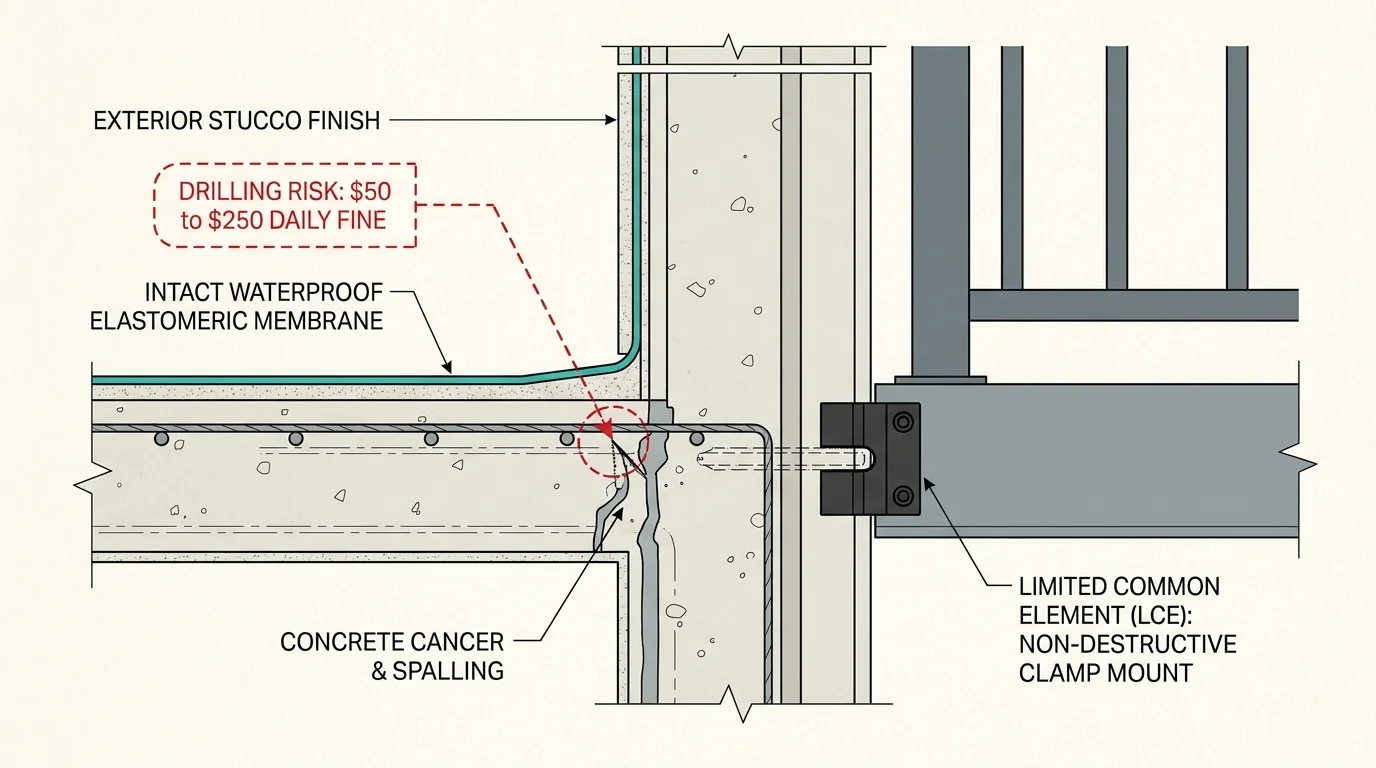
While an LCE grants you exclusive physical use of the deck space, the homeowners association retains legal ownership of the structural surfaces. You cannot alter, paint, or mechanically penetrate these components without prior written board approval.
Drilling into exterior brick, stucco cladding, or concrete slabs voids developer warranties and punctures weatherproofing membranes. Water intrusion beneath damaged balcony membranes can cause structural rebar spalling and expensive concrete cancer inside the subfloor.
Property management companies employ routine visual inspections to identify unauthorized exterior modifications. Fines for architectural violations frequently range from $50 to $250 per day until the resident removes the hardware and repairs the damage.
Standard condominium lease agreements also impose severe financial penalties for exterior damage. Property managers routinely deduct the cost of professional masonry patching and industrial repainting directly from your security deposit.
A non-destructive mounting system completely bypasses the formal architectural review board submission process. By avoiding structural penetrations, your balcony lighting remains a temporary, personal decorative installation rather than an illegal structural alteration.
DarkSky Standards and Condominium Light Trespass
HOA boards strictly enforce exterior illumination standards to preserve residential quietude and maintain building uniformity. Light trespass occurs when unshielded balcony illumination casts unwanted glare into an adjacent unit’s living room or bedroom.
Borrowing scheduling techniques used when automating porch lights for safety ensures outdoor zones remain visible during late returns before automatically dimming for neighborhood quiet hours.
Mastering these fixture cutoffs aligns with core tenets of outdoor smart lighting for security and ambiance, providing targeted visibility without annoying adjacent neighbors.
Most architectural committees model their rules on DarkSky International environmental recommendations. These standards limit stray lumen emissions, eliminate upward night-sky glow, and mandate strict limits on color temperature.
High correlated color temperatures (CCT) contain significant spikes in blue light wavelengths that disturb human circadian rhythms. Because of this disruption, standard architectural guidelines restrict outdoor deck fixtures to a maximum threshold of 3,000 Kelvin.
Setting your smart fixtures between 2,200 Kelvin and 2,700 Kelvin produces warm amber illumination that satisfies HOA review standards. This warm spectrum provides comfortable evening lounge lighting while preserving your neighbors’ privacy.
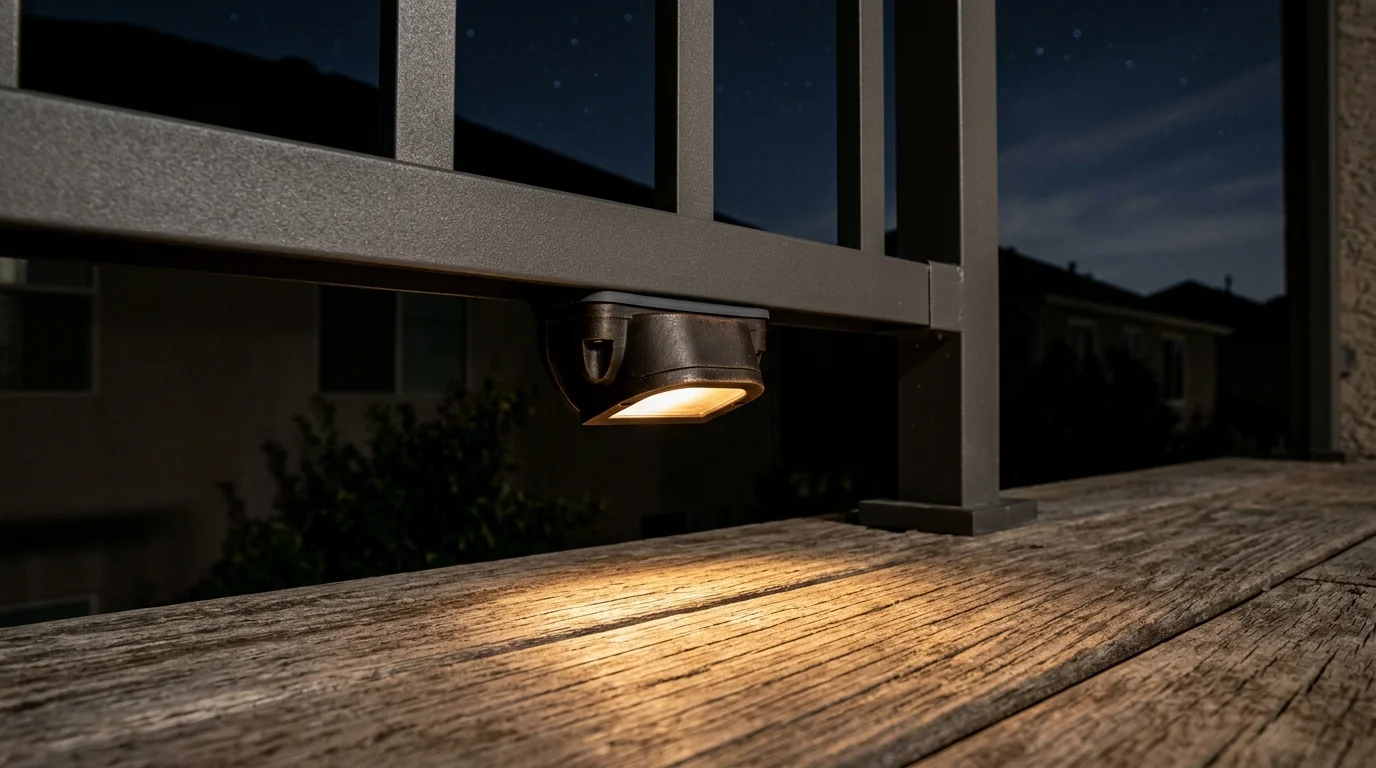
Directional fixture orientation is equally vital for neighborhood compliance. Fixtures must offer full-cutoff shielding, which projects 100 percent of light downward onto the walking surface without side spillage.
Zero percent of total fixture lumens should project horizontally or escape upward into the evening atmosphere. Downward-aimed deck accents illuminate flooring surfaces evenly without alerting sensitive board members.
Covenants also mandate scheduled dimming or full shutoff parameters for outdoor spaces. Exterior deck fixtures must support continuous dimming down to 10 percent of maximum output or switch off automatically by 10:00 PM.
Thread Border Routers and Hurricane-Grade Glass Propagation
Balcony automation frequently fails because of modern building materials. Coastal condominiums and mid-rise developments use heavy laminated hurricane impact glass to resist severe windstorm pressures.
Isolating exterior balcony fixtures into dedicated smart lighting zones ensures outdoor routines run smoothly without affecting your interior living spaces.
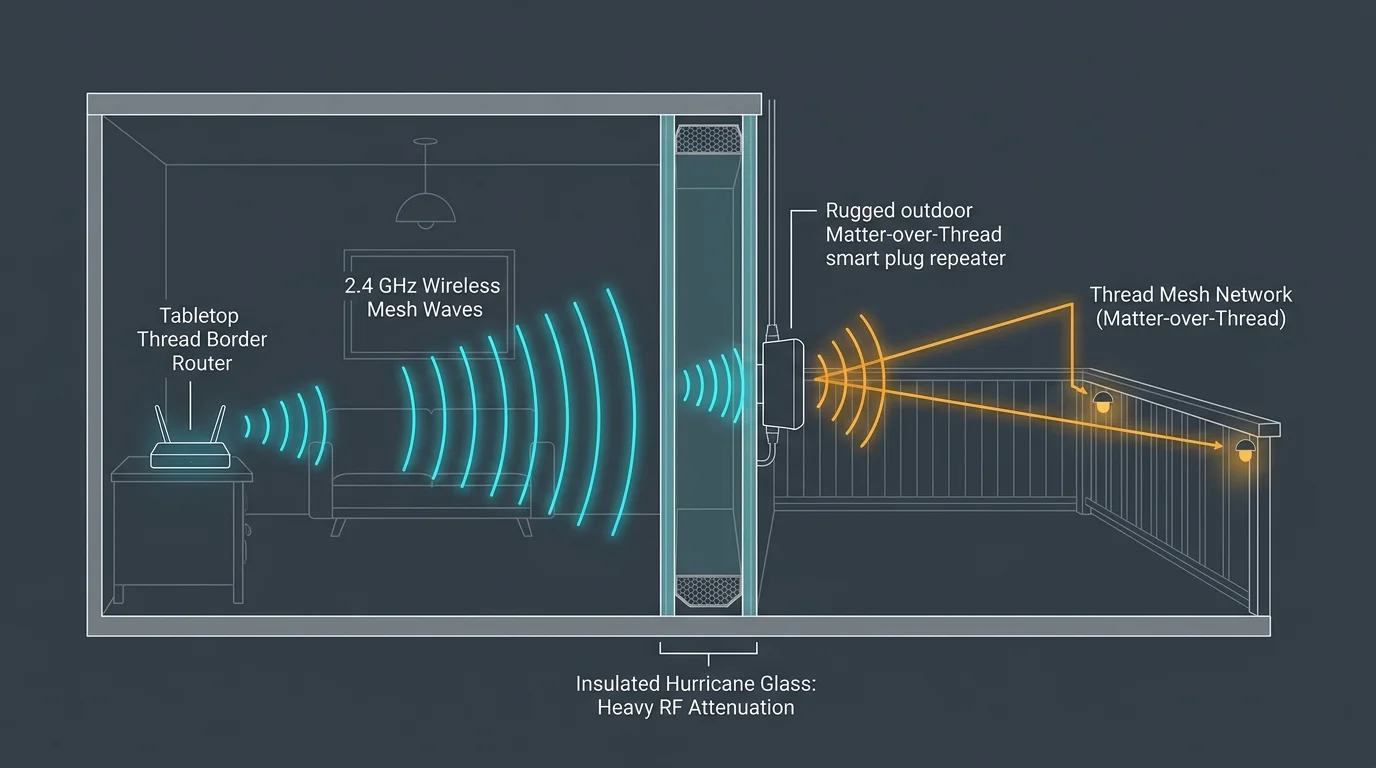
These insulated window assemblies incorporate microscopic metallic oxide low-emissivity (Low-E) coatings designed to reflect solar thermal radiation. Unfortunately, these dense metal layers also reflect wireless radio frequencies, functioning as an unintended Faraday shield.
Low-E hurricane sliding doors can attenuate 2.4 GHz wireless signals by 15 dB to 30 dB. This severe signal degradation causes standard Wi-Fi smart bulbs to drop offline whenever the patio door remains shut.
The Matter Smart Home Standard addresses this physical barrier through its native integration with Thread networking technology. Thread operates as an IPv6-based, low-power mesh protocol running on IEEE 802.15.4 radio frequencies.
Unlike star-topology Wi-Fi devices that struggle to reach your central router, Thread devices communicate directly with neighboring mesh nodes. Mains-powered Thread devices automatically forward encrypted data packets across the local mesh network.
Thread eliminates dependence on third-party cloud servers and proprietary bridge hardware. Your lighting automations execute entirely inside your local living space with sub-second response times.
Bridging your balcony mesh through hurricane-rated glass requires strategic border router positioning. A Thread Border Router connects the 802.15.4 radio mesh to your local household Wi-Fi or Ethernet network.
You should position an indoor Thread Border Router within two to three feet of your sliding glass door. Hardware options like an Apple TV 4K or an Apple HomePod mini act as high-performance boundary anchors.
Placing an indoor smart plug node adjacent to the interior glass perimeter reinforces boundary radio strength. The 2.4 GHz Thread signal easily penetrates the frame perimeter gaps, feeding the exterior deck controller without interruption.
Follow these strategic placement principles to maintain a resilient Thread mesh across your balcony boundary:
- Keep the indoor border router within line of sight of the balcony glass slider.
- Deploy a mains-powered Thread smart plug immediately inside the doorway threshold.
- Mount the exterior smart controller on the balcony rail closest to the indoor node.
- Avoid placing border hardware behind large metal appliances or structural concrete columns.
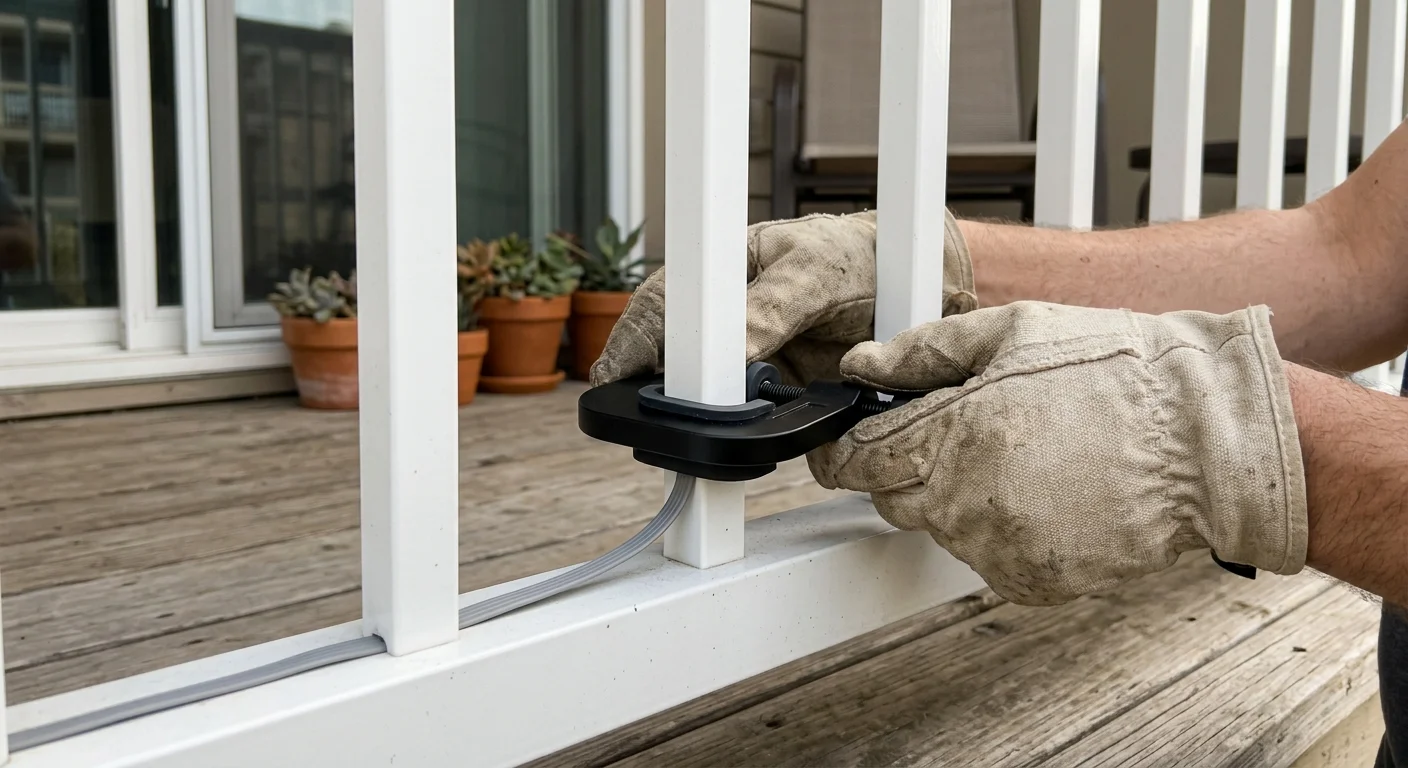
Non-Drill Mechanical Friction Clamps and Flat Cable Routing
Preserving the structural integrity of your balcony railing requires purpose-built mechanical mounting hardware. Friction clamps eliminate the need for screws, self-tapping anchors, or messy polyurethane adhesives.
Just as renters rely on damage-free mounting tactics on rental drywall indoors, exterior friction clamps keep fixtures secure without risking costly security deposit deductions.
Similar to other smart home devices for renters, friction-fit rail mounts can be completely uninstalled within minutes when moving.
Marine-grade 316 stainless steel C-clamps resist salt-air corrosion and hold firm against high balcony wind gusts. These clamps feature threaded thumb screws that apply uniform mechanical pressure against railing flanges.
Always install ethylene propylene diene monomer (EPDM) rubber buffer pads between the metal clamp jaws and your railing. EPDM rubber absorbs thermal expansion cycles and prevents galvanic corrosion between dissimilar metals.
Black UV-resistant nylon 6/6 zip ties offer an effective supplementary method for securing low-voltage wiring looms. Standard white zip ties degrade quickly under direct sunlight, turning brittle and snapping within three months.
Marine silicone rail brackets clamp securely over standard 1.5-inch to 2-inch aluminum top rails. These flexible mounts grip the railing channel tightly without scratching the protective powder-coated finish.
Magnetic mounting brackets with rubber coatings offer another non-destructive option for iron or steel railings. Make sure to test your balusters with a refrigerator magnet beforehand, as aluminum structures will not hold magnetic mounts.
Condo units rarely feature dedicated outdoor electrical receptacles on exterior balcony walls. Puncturing the exterior wall to run standard Romex wire creates severe structural liability and violates municipal fire codes.
You can safely bring low-voltage DC power through closed sliding patio doors using flat ribbon jumper cables. These ultra-thin flat cables measure less than 0.5 millimeters thick, sliding harmlessly beneath standard sliding door seals.
The flexible copper traces rest flat against the door frame track without breaking weatherproofing compression gaskets. Your sliding glass door locks securely over the ribbon cable without pinching conductors or causing air leaks.

Low-Voltage Electrical Safety and NEC Article 411 Codes
Exterior electrical installations must strictly adhere to the National Electrical Code to maintain tenant safety. Understanding these safety parameters protects your home against fire risks and electrical shorts during rainstorms.
Selecting hardware engineered with robust IP65 ratings and weatherproof driver performance ensures your low-voltage controller withstands driving rain and seasonal freezing temperatures.
Under NEC Article 411, low-voltage outdoor lighting installations must operate below 30 volts AC or 60 volts DC in dry locations. When installed in exposed outdoor areas subject to wet contact, systems must not exceed 15 volts AC or 30 volts DC.
Most modern smart LED deck systems run on regulated 24-volt direct current power supplies. This standard operating voltage sits safely beneath municipal high-voltage permitting requirements while providing steady illumination.
Safety codes mandate the use of Class 2 power supplies governed by UL 1310 and NEC Article 725. Class 2 transformers strictly limit total electrical output to a maximum of 100 volt-amperes and 5 amperes.
Because Class 2 power circuits carry limited energy, they cannot ignite surrounding structural materials or cause electrocution. This classification legally eliminates the need to encase exterior wiring inside rigid metal conduit pipes.
Moisture resistance ratings dictate where you can position specific system components across your balcony. The Ingress Protection (IP) rating scale measures resistance against solid particles and liquid penetration.
Exposed deck fixtures and downward accent pucks require an IP65 rating to withstand high-pressure driving rain. This level of protection prevents internal water ingress even during intense coastal storms.
Inline smart controllers and external transformers demand a higher IP67 rating. An IP67 enclosure withstands temporary immersion in pooling rainwater, ensuring electronics survive standing puddles on balcony floors.
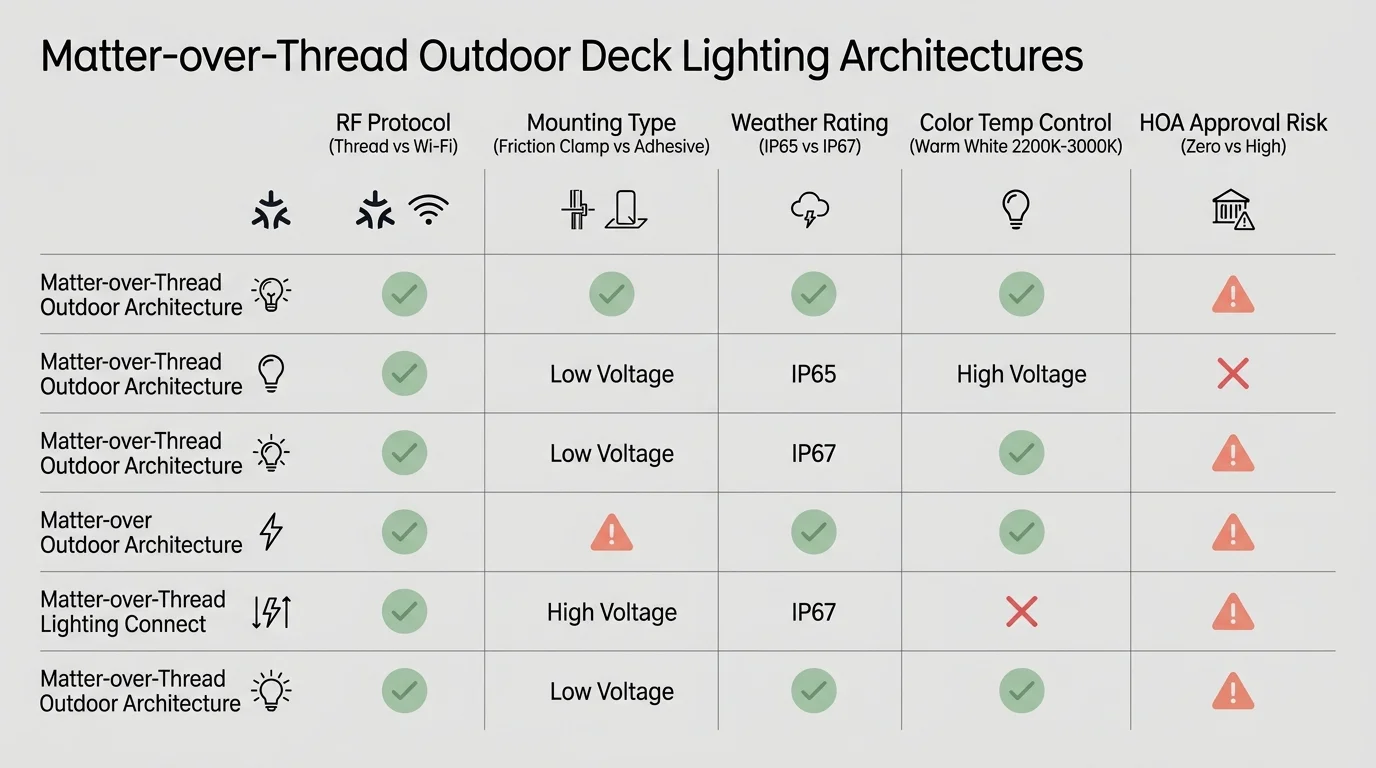
Comparing Matter-Compatible Balcony Lighting Systems
Selecting the right smart lighting platform depends on your existing home automation ecosystem and network infrastructure. Each system offers unique advantages regarding power architecture, color rendering, and network responsiveness.
Condo owners must evaluate fixtures based on communication protocols, ingress protection, and mounting adaptability. The following comparison highlights three leading low-voltage systems engineered for outdoor balcony environments.
| System Model | Wireless Protocol | Operating Voltage | IP Enclosure Rating | Color Temp & Output | Starting Price |
|---|---|---|---|---|---|
| Aqara Outdoor String Lights H1 | Matter over Thread / Zigbee 3.0 | 24V DC (Class 2, 36W) | IP65 Strand / IP67 Controller | 2,200K–6,500K CCT (1,200 lm) | $99.99 |
| Nanoleaf Essentials Outdoor Lights | Matter over Wi-Fi (2.4 GHz) | 24V DC (Class 2, 48W) | IP65 Strand / IP67 Power Brick | 2,700K–6,500K CCT (1,500 lm) | $129.99 |
| Philips Hue 24V Low-Voltage Spot/Strip | Matter via Hue Bridge (Zigbee) | 24V DC (Class 2, 40W–100W) | IP65 Strip / IP67 Power Supply | 2,000K–6,500K CCT (2,050 lm) | $159.99 |
Each lighting option satisfies Class 2 electrical limits while allowing straightforward, drill-free installation. Choosing a native Thread system provides the highest operational reliability when routing signals through thick glass.
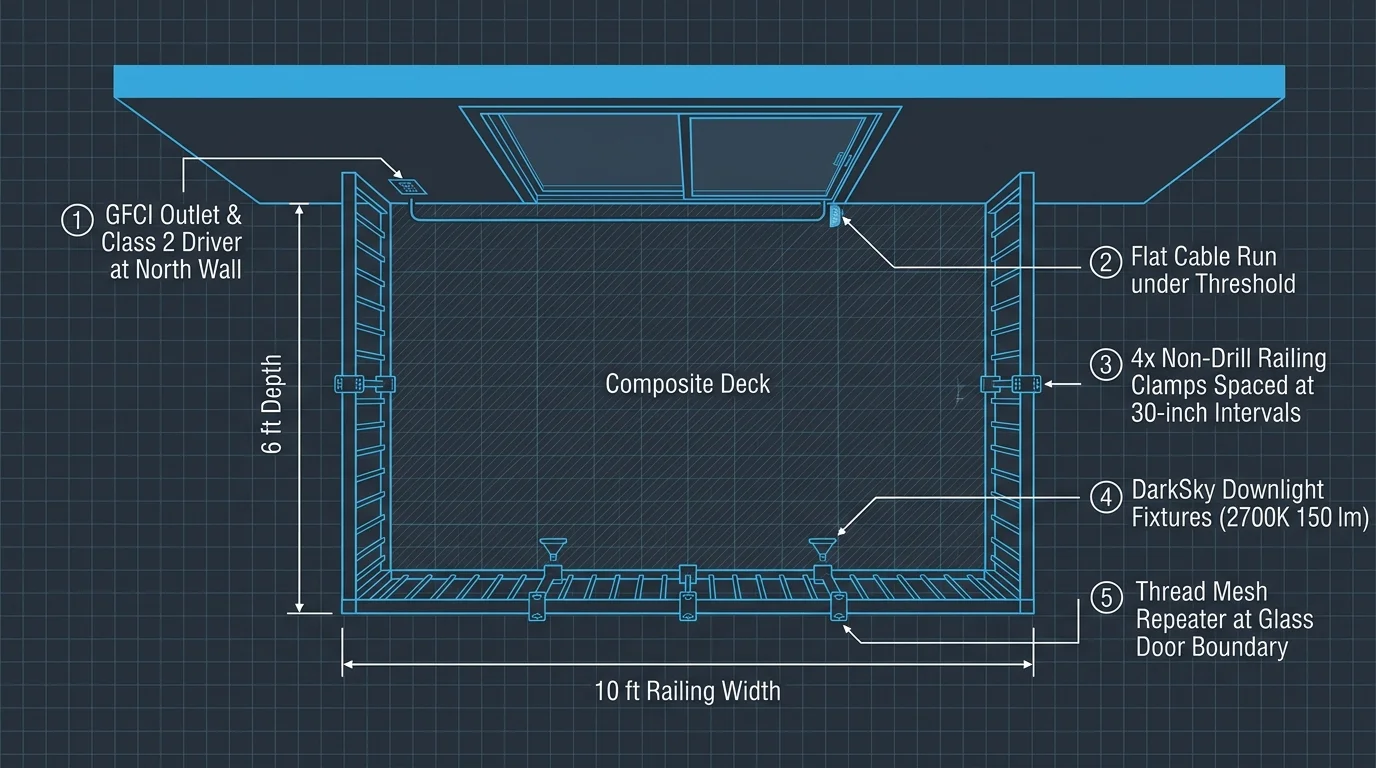
Step-by-Step Worked Installation: 10×6 Condo Deck Example
To visualize how this non-drill setup operates in practice, consider a standard ten-foot by six-foot condo balcony. This worked scenario demonstrates exact component costs, hardware dimensions, and installation procedures.
The balcony features an anodized aluminum top railing measuring 1.5 inches wide by 3.5 inches deep. Concrete wall drilling is strictly prohibited by building rules, requiring an entirely clamp-based deployment.
The component budget for this project remains under $160 while meeting all HOA and DarkSky parameters:
- Aqara Outdoor String Lights H1 (15-meter length): $99.99
- SmallRig 316 stainless steel friction cool-clamps (pack of 4): $28.00
- Heavy-duty 50-pound rated black UV nylon 6/6 cable ties (100-pack): $8.49
- Commercial flat window low-voltage pass-through DC ribbon cable: $14.99
- Custom EPDM protective rubber gripping strips (sheet cut to size): $6.50
- Total Hardware Expenditure: $157.97
Following an organized installation sequence prevents cable snagging and ensures your smart lighting integrates smoothly into your home platform:
- Clean the underside of the aluminum railing track using isopropyl alcohol to remove accumulated urban grit.
- Wrap 1-inch strips of EPDM rubber around each clamp contact zone to safeguard the railing’s powder coating.
- Fasten the stainless steel friction clamps at 30-inch intervals along the bottom rail, tightening screws firmly by hand.
- Orient fixture lenses pointing directly downward at 180 degrees to guarantee complete DarkSky-compliant light cutoff.
- Route low-voltage cabling along the lower rail channel, securing excess slack with black UV-stabilized zip ties.
- Connect the flat ribbon jumper cable to the outdoor controller and slide the ribbon beneath the sliding door frame.
- Plug the indoor end of the flat jumper into the Class 2 24V power supply inside your living room.
- Scan the native Matter QR code using your smartphone smart home app to pair the fixtures via Thread.
The total mechanical assembly takes approximately 45 minutes from start to finish. Once connected, the lighting fixtures output downward accent glow without casting glare into neighboring windows.
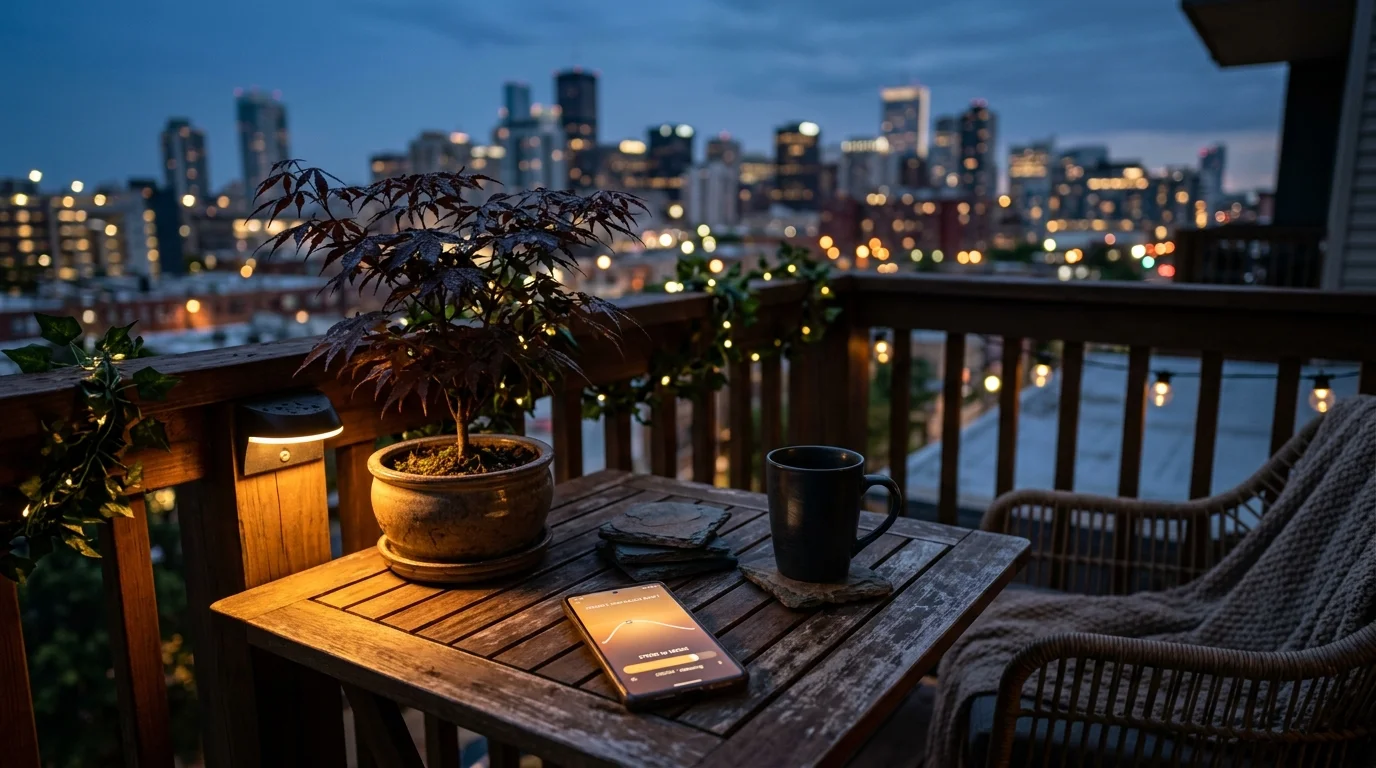
Automations, Sunset Triggers, and Circadian Color Shifts
Automating your balcony lighting ensures compliance with community rules without requiring daily manual adjustments. Matter-over-Thread platforms let you create localized automations that run reliably even during home internet outages.
The best smart home is the one you don’t have to manage.
You should schedule your lighting to mirror natural twilight transitions using astronomical sunset triggers. Setting the fixtures to power on ten minutes after official sunset creates seamless outdoor illumination as natural daylight fades.
Integrate a circadian color shifting routine to protect evening rest cycles and respect community noise and lighting curfews. Begin dusk illumination at 2,700 Kelvin warm white with an initial brightness level of 60 percent.
Configure an automated step-down rule at 10:00 PM to satisfy HOA nighttime quietude regulations. The lighting platform gradually dims the fixtures to 10 percent output while shifting color temperature down to 2,200 Kelvin.
Connecting an indoor wireless door contact sensor unlocks reactive convenience automations. When you slide open the balcony door after dark, your smart home temporarily raises lighting levels to 40 percent.
Closing the patio door triggers a five-minute countdown timer before returning the accent lights to dimmed curfew levels. If the door remains closed after midnight, an automated shutdown routine powers the entire system off.
Testing and configuring schedules through cross-platform home automation apps ensures synchronized routines. According to Wirecutter Smart Home, local-first protocols significantly reduce latency and eliminate missed triggers in multi-device automations.
Frequently Asked Questions
Can an HOA legally prohibit non-drilled deck lighting?
Homeowners associations govern visible exterior aesthetics and structural modifications. If your lighting causes zero structural alterations, emits warm downward light below 3,000K, and obeys curfews, it generally complies with CC&Rs.
How do flat ribbon cables maintain sliding door energy efficiency?
Flat low-voltage ribbon cables measure less than 0.5 millimeters thick, compressing neatly beneath bottom rubber door sweeps. This flexible profile preserves the door’s weatherstripping seal without causing drafts, thermal bridging, or acoustic leaks.
Will Matter-over-Thread balcony lights work without a proprietary bridge?
Yes, Matter-over-Thread lights connect directly to any compatible Thread Border Router on your network. You do not need manufacturer-specific hubs, as devices communicate across Apple Home, Google Home, and SmartThings interchangeably.
What happens if an outdoor low-voltage wire gets pinched or severed?
Class 2 power supplies feature built-in short-circuit protection that immediately shuts down current flow if a cable is severed. The low 24V DC operating voltage eliminates fire hazards and electric shock risks.
Disclaimer: This article is for informational purposes only. Smart home devices involve electrical connections and data privacy. Always follow manufacturer instructions for installation. For complex wiring or HVAC work, consult a licensed professional.