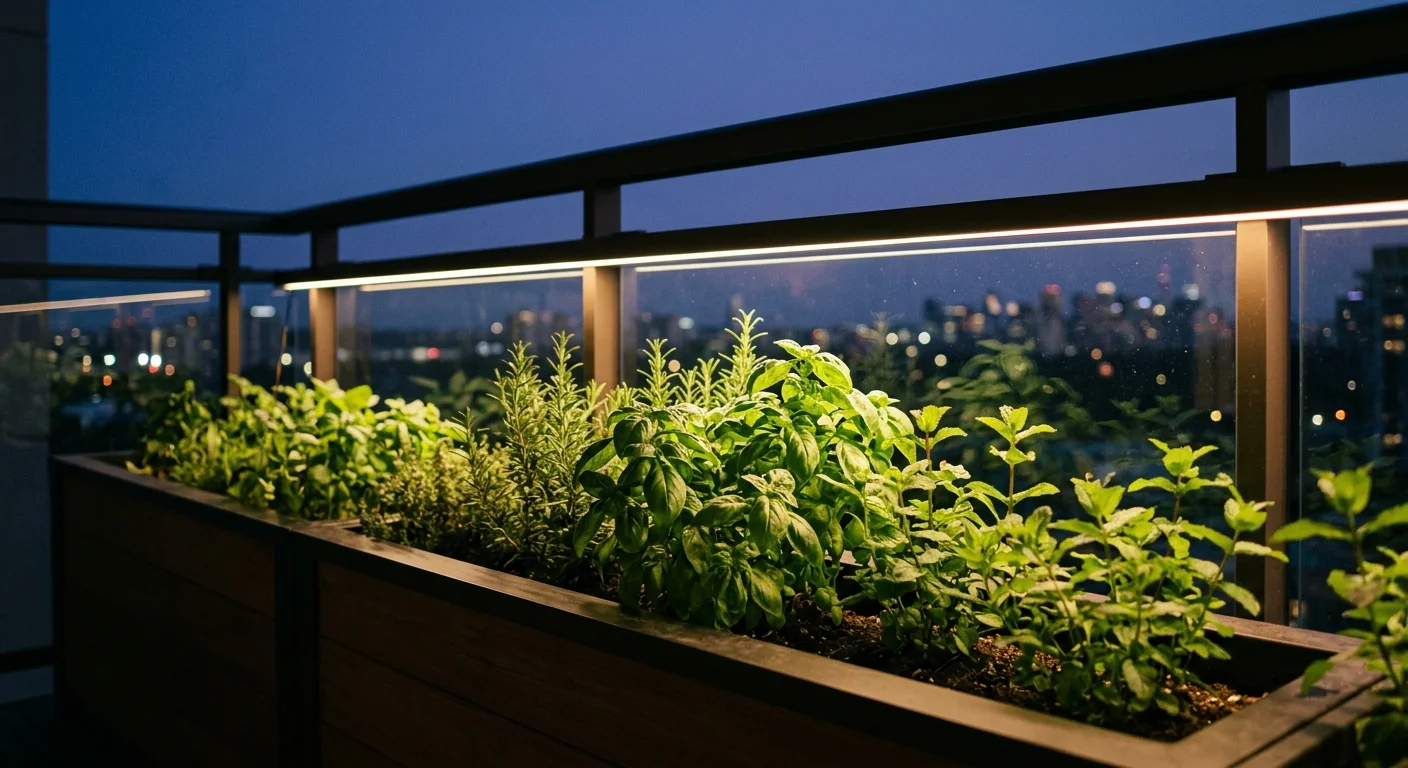
You can grow thriving culinary herbs on your condo balcony without violating strict architectural rules or drilling into exterior walls. Standard full-spectrum warm white LEDs provide the exact photosynthetic wavelengths your plants demand without emitting HOA-banned purple light.
Sizing these systems requires balancing fixed strip lengths against National Electrical Code outlet mandates and moisture ratings. By pairing an IP67-rated strip with an outdoor smart plug, you maintain non-permanent status while automating a compliant daylight feeding schedule.
This guide walks through the exact wattage, mounting, and dimensional calculations needed to keep your HOA happy and your herbs productive.
HOA Architectural Bylaws and Limited Common Element Restrictions
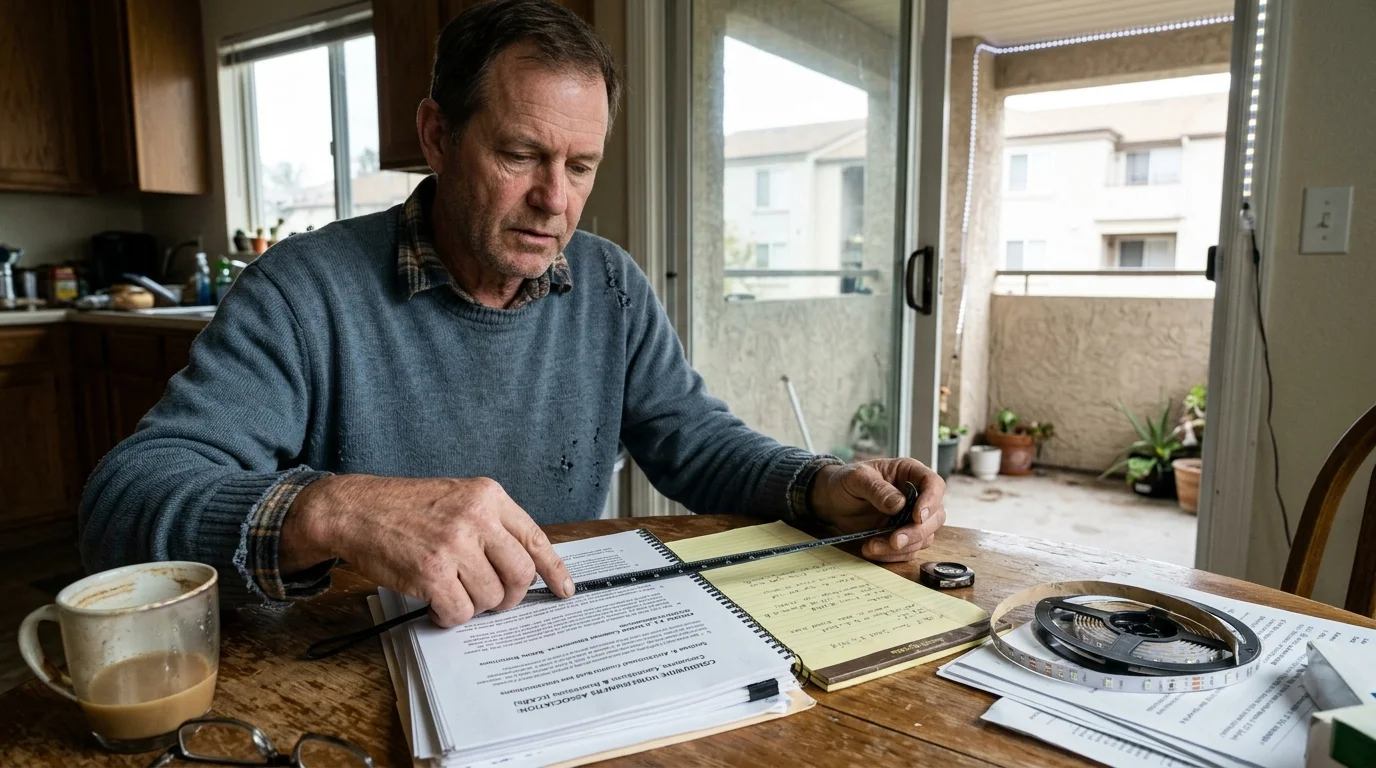
Condominium master deeds categorize exterior walls, balcony railings, and overhangs as Limited Common Elements (LCE). You hold exclusive rights to enjoy the balcony space, but the association owns and regulates the exterior building envelope.
Drilling mounting screws into exterior stucco, fiber cement siding, or concrete voids structural waterproofing warranties. Doing so immediately triggers property damage assessments and formal violation notices from your condominium board.
Architectural Review Committees (ARCs) strictly regulate visual uniformity across exterior facades. Fixtures that alter building aesthetics or emit glare visible from common areas or street level violate standard association bylaws.
Exterior lighting should protect the night environment by directing light only downward where needed, shielding the light source from neighboring properties.
Most condominium communities adopt municipal DarkSky International standards to curb urban light pollution. These guidelines require full-cutoff shielding, meaning light diodes cannot be visible to adjacent units or passersby below.
Dark sky regulations also cap Correlated Color Temperature (CCT) at 3000K or lower. Traditional horticultural glow lamps emit saturated magenta or violet light, which breaches HOA visual nuisance clauses within minutes of activation.
NEC Mandates and the IP67 Waterproofing Mismatch
Balcony electrical infrastructure must comply with national safety standards. According to safety evaluations documented by Consumer Reports Smart Home testing, exterior electrical connections require robust physical protection against ambient environmental exposure.
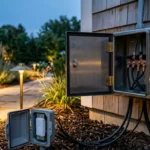
The National Electrical Code (NEC 210.52(E)(3)) mandates at least one outdoor receptacle on any balcony accessible from inside the dwelling. This outlet must sit no higher than 6.5 feet above the walking surface.
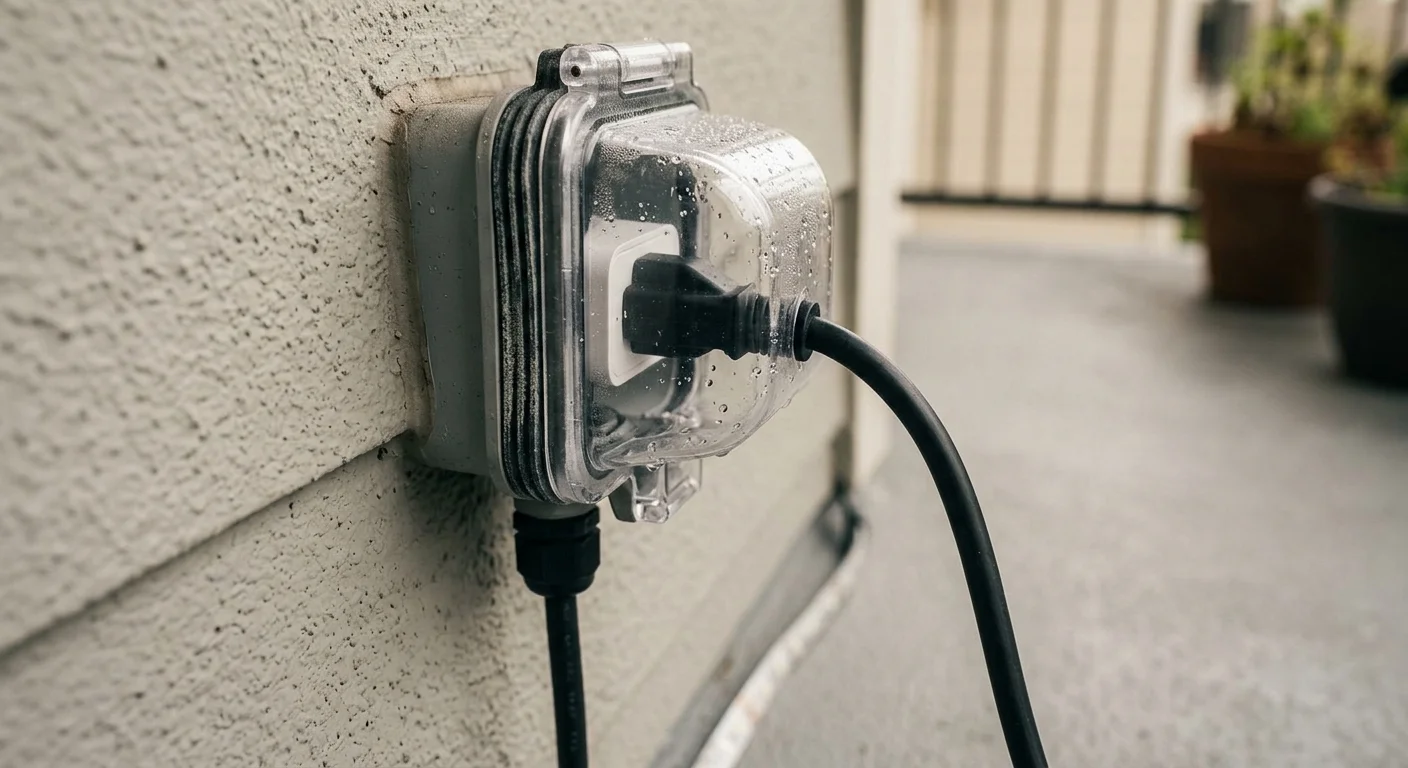
Under NEC 406.9(B)(1) and NEC 210.8, all exterior balcony receptacles require Ground-Fault Circuit-Interrupter (GFCI) protection. Wet locations also mandate an “extra-duty” while-in-use bubble cover that seals out moisture while cords remain connected.
A dangerous equipment rating mismatch frequently catches condo owners off guard. Most commercial outdoor light strips advertise an Ingress Protection rating of IP67 for the lighting tube itself.
Under IEC 60529 testing standards, an IP67 rating ensures the silicone sleeve resists dust penetration and withstands water immersion up to one meter for thirty minutes. You can safely expose the strip to wind-driven rain.
However, the inline radio controller and AC power brick rarely share this submersible IP67 rating. Most power supplies are rated IP44 or IP65, meaning they only tolerate water splashing or low-pressure water jets.
Resting an IP44 power supply directly on a concrete balcony floor invites short circuits during heavy rain. Water pools quickly against balcony scuppers, transforming your low-voltage controller into a submerged electrical hazard.
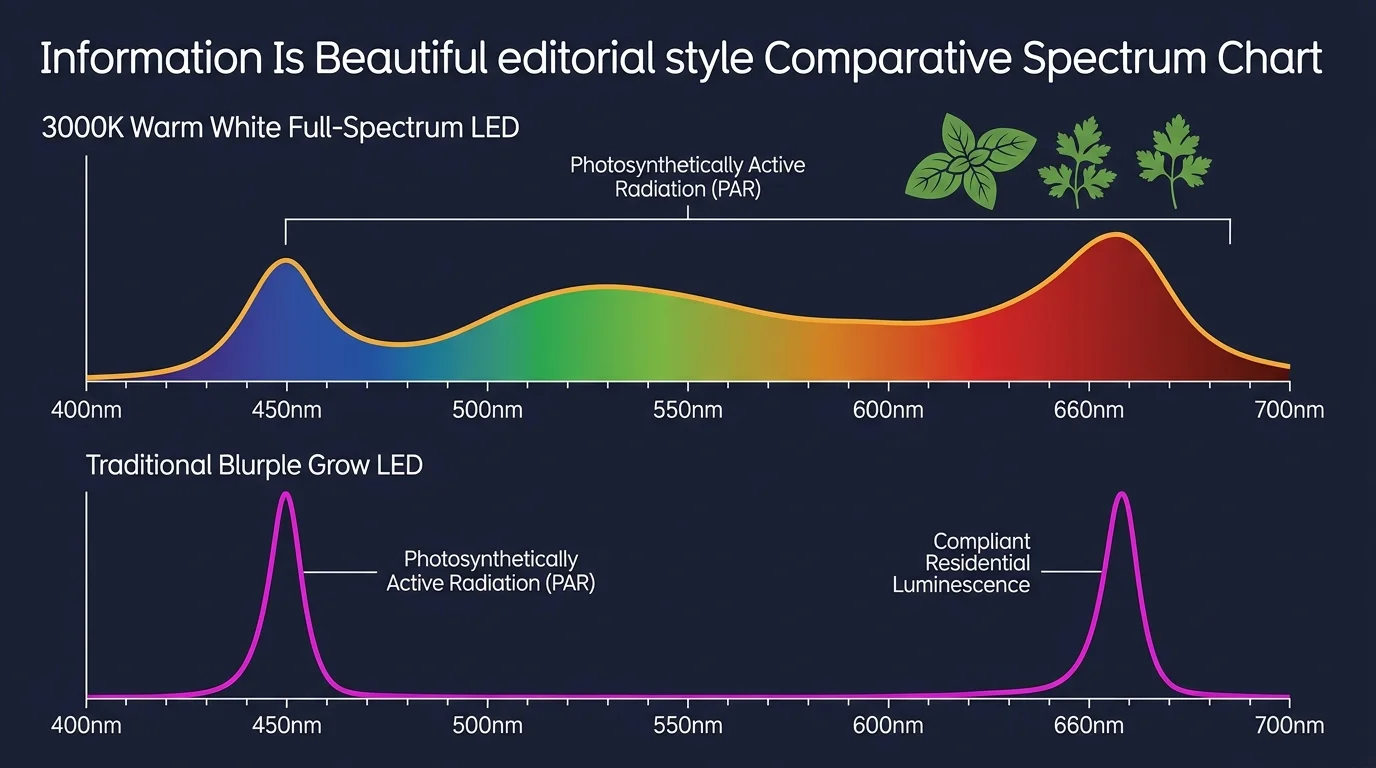
Balcony Plant Biology: Why 3000K Warm White Outperforms Magenta Lights
Covered north-facing or deeply recessed balconies present severe light deficits for culinary herbs. Basil, rosemary, and mint require a Daily Light Integral (DLI) of 12 to 18 moles of photons per square meter daily.
Deep balcony overhangs often reduce natural sunlight exposure to less than 3 to 5 moles daily. This dramatic photon shortage produces spindly, leggy growth, pale leaves, and weak flavor concentrations.
Commercial growers rely on specialized magenta fixtures because chlorophyll strongly absorbs 450-nanometer blue and 660-nanometer red wavelengths. However, plants do not require monochromatic light to achieve healthy photosynthetic activity.
Broad-spectrum white light containing a high Color Rendering Index (CRI) covers the entire Photosynthetically Active Radiation (PAR) range between 400 and 700 nanometers. Green wavelengths within white light actually penetrate deeper into dense plant canopies.
A 3000K warm-white LED delivers substantial red and orange output alongside necessary blue wavelengths. This spectrum sustains active photosynthesis without alerting your HOA to an unauthorized indoor-gardening operation on your patio.
By positioning high-output warm-white LEDs 12 to 16 inches above your foliage, you deliver adequate Photosynthetic Photon Flux Density (PPFD). Your herbs flourish while the lighting looks identical to high-end architectural accent illumination.
Sizing Calculations: Managing Fixed Strip Lengths and Run Wattage
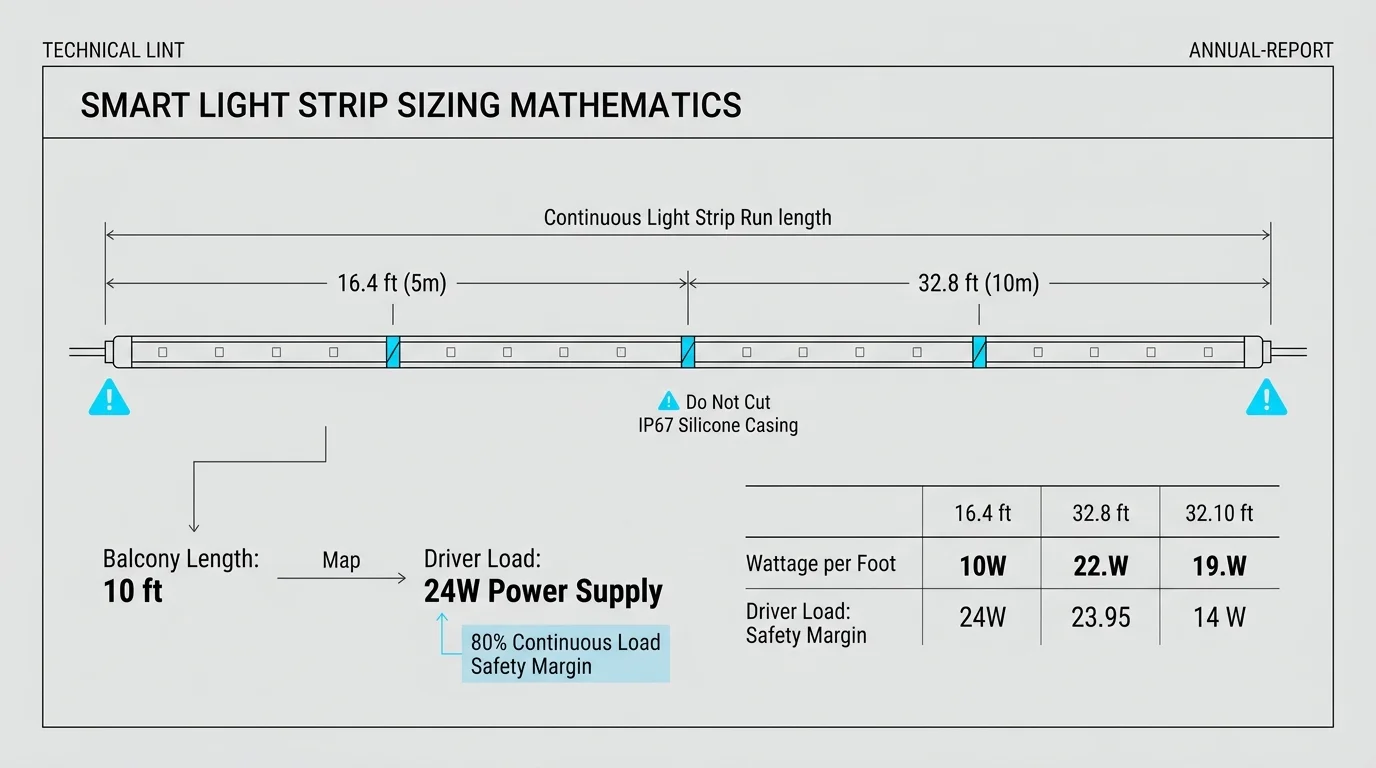
Indoor LED light strips allow you to trim copper pads every few inches to fit specific cabinet profiles. Outdoor IP67 smart strips cannot be cut or shortened under any circumstances.
Cutting through an IP67 silicone extrusion breaches the factory seal, invites water infiltration, and creates severe shock risks. You must design your installation around predetermined, fixed product lengths.
Leading manufacturers offer outdoor strips in strict dimension tiers. Philips Hue produces fixed outdoor strips in 2-meter (6.5-foot) and 5-meter (16.4-foot) lengths, while Govee supplies 5-meter (16.4-foot) and 10-meter (32.8-foot) models.
To calculate linear requirements, map a continuous run across planter boxes and railing profiles before buying hardware. Add the vertical distance required to reach your GFCI outlet while-in-use bubble cover.
Power consumption also dictates your equipment sizing. Outdoor strips draw substantial direct current to push high lumen output through protective silicone sheathing.
A standard 5-meter outdoor smart strip consumes between 36 and 40 watts at maximum 100% white output. An outdoor smart plug condo patio setup comfortably handles these electrical requirements without thermal throttling.
Outdoor smart plugs feature typical ratings of 15 amps or 1,875 watts at 125 volts. You can safely power multiple light strips, low-voltage drip pumps, and air-quality monitors from a single dual-outlet smart plug.
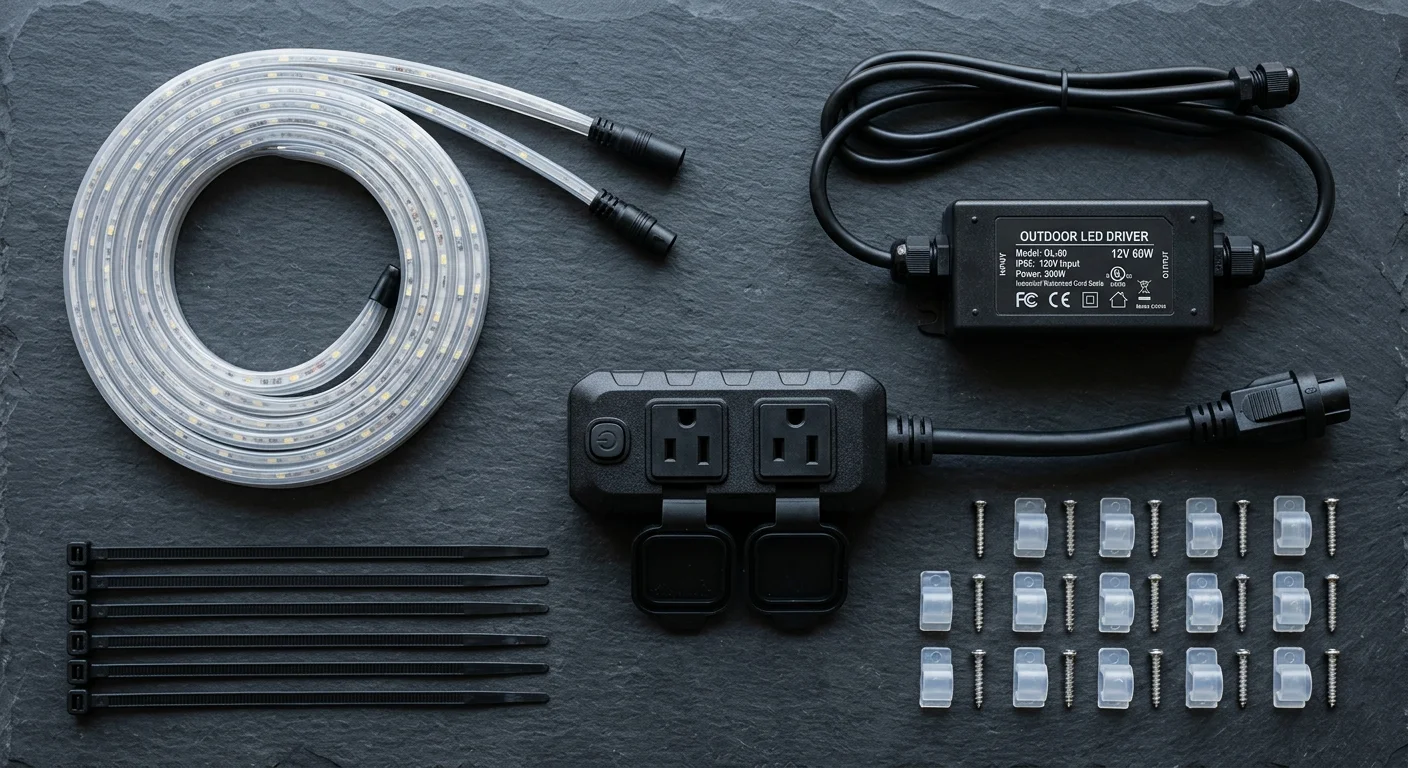
Hardware Comparison: Outdoor Smart Strips and Controllers
Selecting the right hardware requires balancing luminous output, physical dimensions, and communication protocols. The following table outlines verified performance metrics for compliant condo installations.
| Model Name | Fixed Run Length | Strip Ingress Rating | Power Supply Ingress Rating | Rated Wattage | Max Light Output | Protocol Compatibility |
|---|---|---|---|---|---|---|
| Philips Hue Outdoor Lightstrip | 16.4 feet (5m) | IP67 Submersible | IP65 Jet-Resistant | 37.5W | 1,650 Lumens | Zigbee, Matter (via Bridge) |
| Govee Outdoor Neon LED Strip | 16.4 feet (5m) | IP67 Submersible | IP44 Splash-Resistant | 36W | 1,400 Lumens | Wi-Fi, Bluetooth |
| LIFX Outdoor Neon Flex | 16.4 feet (5m) | IP67 Submersible | IP65 Jet-Resistant | 42W | 1,800 Lumens | Wi-Fi, Matter |
| TP-Link Kasa KP400 Smart Plug | Dual Outlets | IP64 Splash-Resistant | N/A (Direct Wall Mount) | 1875W Max | N/A (Power Only) | Wi-Fi (2.4 GHz) |
| Tapo P400M Outdoor Smart Plug | Dual Outlets | IP65 Weather-Resistant | N/A (Direct Wall Mount) | 1875W Max | N/A (Power Only) | Matter over Wi-Fi |
For cross-platform setups, choose hardware certified with the Matter Smart Home Standard to ensure local control across Apple Home, Amazon Alexa, and Home Assistant ecosystems.
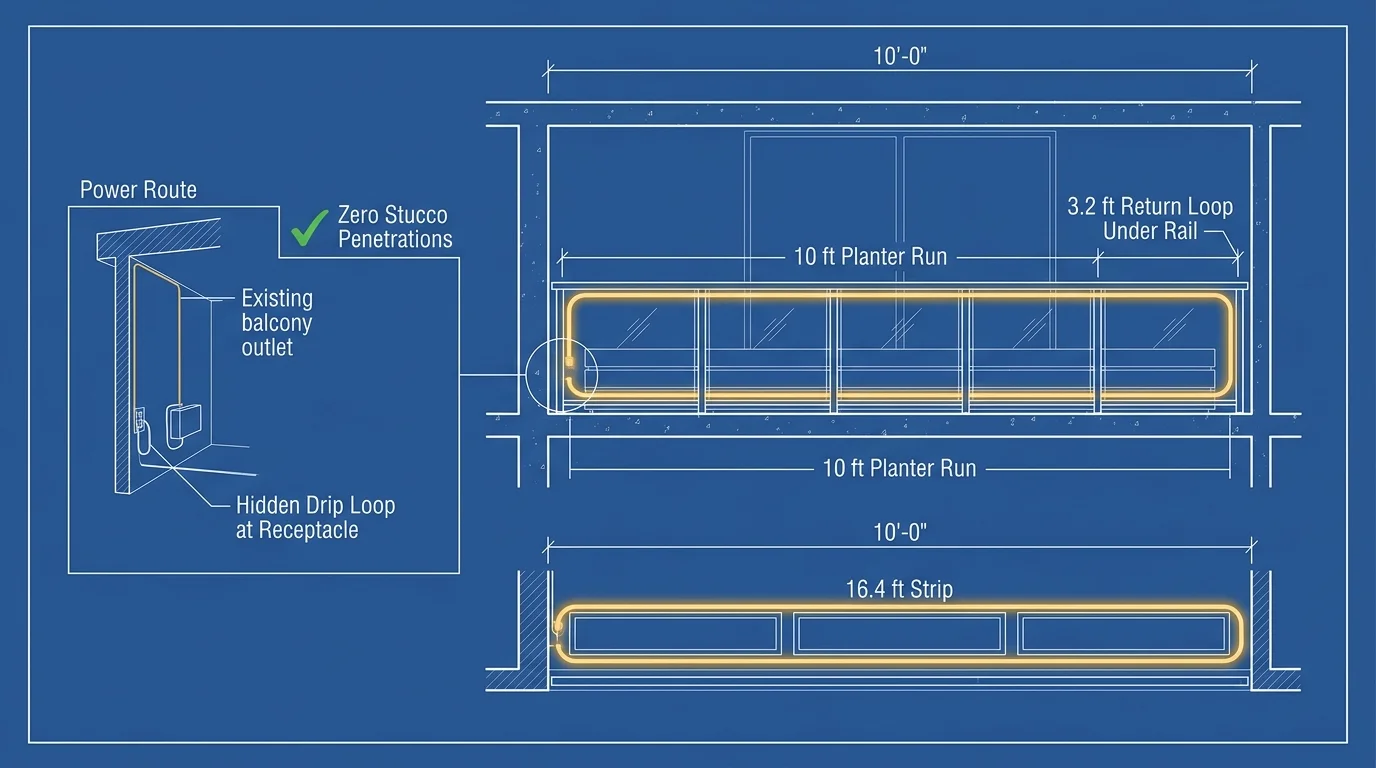
Worked Scenario: Sizing a 10-Foot Covered Balcony Setup
Consider a practical scenario involving a residential condo balcony measuring 10 feet wide by 4 feet deep. The space features concrete decking, a 42-inch steel baluster railing, and a 9-foot covered concrete ceiling.
The resident maintains three railing-mounted planter boxes containing sweet basil, flat-leaf parsley, and rosemary. The planters span a total width of 8.5 feet along the interior top rail.
The balcony contains one exterior GFCI duplex outlet mounted 18 inches above the deck on the left wall. The distance from the outlet to the railing corner measures exactly 4 feet.
Selecting a 5-meter (16.4-foot) smart strip provides the precise physical reach required. The run utilizes 8.5 feet directly above the herb containers, 3.5 feet along the left side railing, and 4.4 feet of lead slack.
The chosen strip produces 1,650 lumens at full warm-white output, which translates to roughly 100 lumens per linear foot. Mounted 14 inches above plant foliage, the strip delivers an estimated 135 µmol/m²/s of supplemental PPFD.
Operating the 37.5-watt strip for 8 hours daily during daytime hours provides approximately 3.88 moles of supplemental PAR per day. This energy input raises total plant exposure above the critical 12-mole threshold.
Daily power consumption equals 0.30 kilowatt-hours (37.5 watts multiplied by 8 hours divided by 1,000). At an average utility rate of $0.16 per kWh, operating these balcony smart grow lights costs roughly $1.44 per month.
Step-by-Step Non-Destructive Railing Installation
Maintaining legal Limited Common Element compliance requires completely non-destructive mounting hardware. Never drill holes into exterior metal balusters, concrete decking, or exterior siding.
Gather the following materials before beginning assembly:
- One IP67 weatherproof smart light strip (5 meters).
- One IP64 or IP65 outdoor dual-outlet smart plug.
- Heavy-duty black nylon UV-resistant cable zip ties (50-pound tensile strength).
- Outdoor acrylic mounting saddles with pre-cut zip-tie slots.
- 70% isopropyl alcohol cleaning pads.
- UV-rated adhesive cable clips for wire management.
Follow these steps to complete your IP67 smart strip installation without damaging condo property:
- Clean the underside of the top railing bar thoroughly with isopropyl alcohol to remove accumulated exterior soot and grime.
- Let the metal surface dry completely for five minutes to ensure maximum mechanical adhesion for mounting hardware.
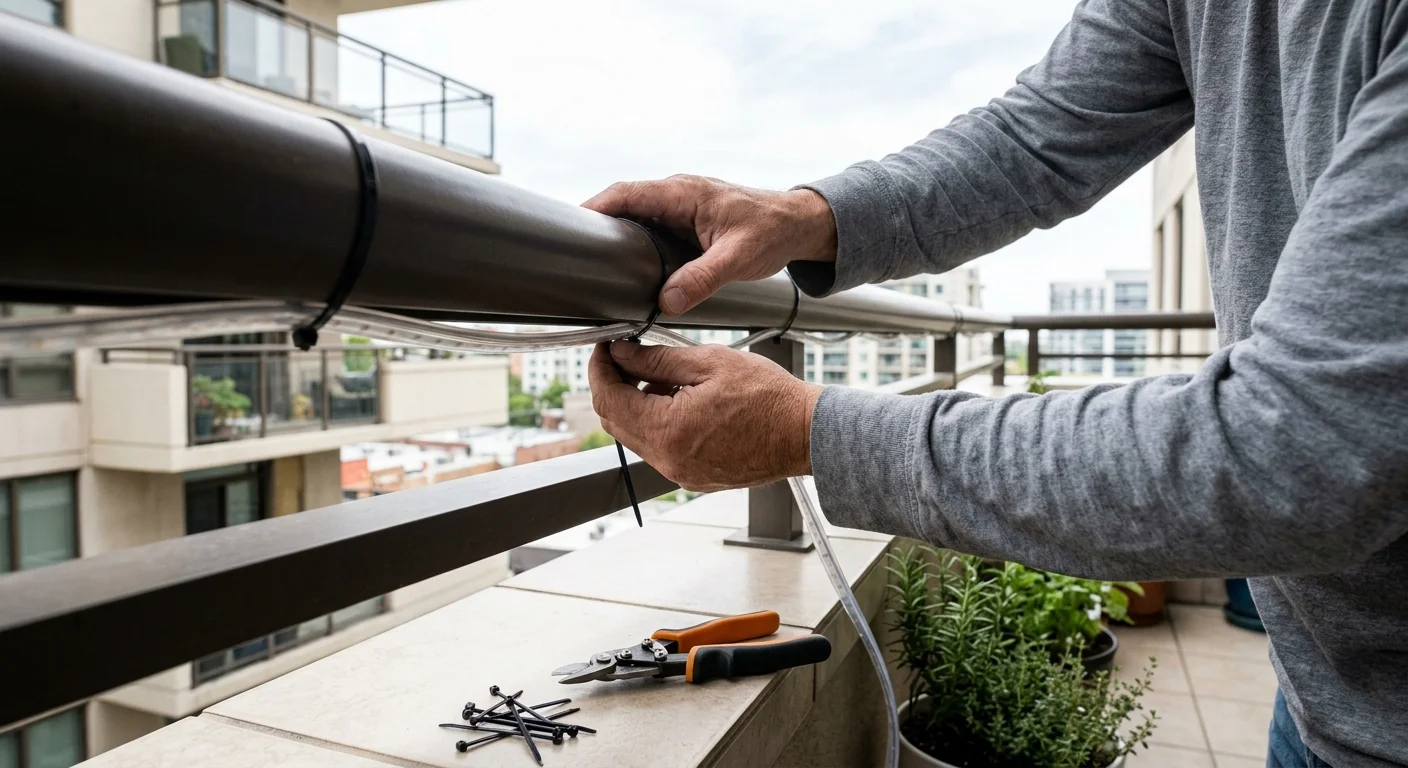
- Position the light strip along the bottom lip of the railing bar, aiming diodes directly downward into your planters.
- Secure the strip every 12 inches using UV-resistant black zip ties wrapped firmly around the steel railing structure.
- Mount the AC power supply vertically against a railing support post at least 12 inches above the concrete floor using two heavy-duty zip ties.
- Form a downward 4-inch “drip loop” in the low-voltage cable beneath the power supply to prevent rainwater from tracking into the casing.
- Insert the power plug into the outdoor smart plug housed inside your exterior outlet’s while-in-use bubble cover.
This layout ensures diodes remain fully shielded from outside view by the metal railing face. Property managers viewing the building from the street will see zero direct glare or exposed wiring.
Designing Daylight Automations and Dark Sky Schedules
Automating your lighting schedule prevents human error from triggering HOA noise or light complaints. Smart automations align supplemental photosynthetic delivery with natural solar hours.
Configure the following schedule inside your smart home automation platform:
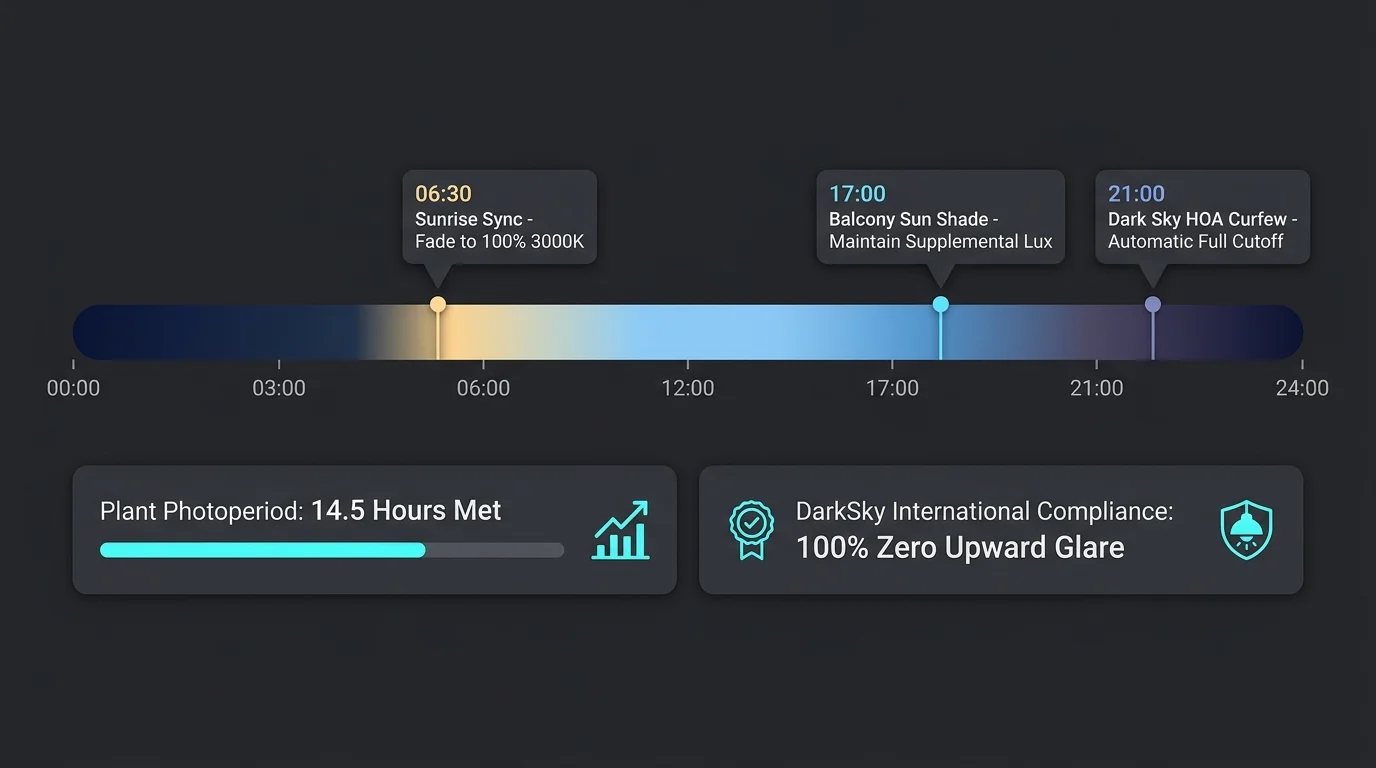
- Daylight Supplement (8:00 AM – 4:00 PM): Strip turns on at 100% brightness; color temperature locks at 3500K for maximum PAR delivery.
- Evening Architectural Ambiance (Sunset – 9:30 PM): Strip dims to 25% brightness; color temperature drops to 2200K warm amber for hospitality accent.
- Curfew Shutoff (9:30 PM): Strip powers off completely to ensure zero light trespass during residential sleep hours.
You can refine this automation by linking outdoor light schedules to local cloud cover or weather conditions. If ambient lux drops below standard daytime thresholds, your platform can increase strip output automatically.
Matter-enabled plugs communicate locally across your home network. Even if your condo building experiences an internet service interruption, your herb lighting schedule continues running without disruption.
Frequently Asked Questions
Can my condo board fine me for using outdoor smart light strips?
Your HOA board can issue fines if your light installation damages Limited Common Elements or violates lighting bylaws. Using non-destructive zip ties and downward-facing warm-white light beneath railing lip profiles avoids visual and physical violations.
Can I cut an IP67 outdoor smart strip if my balcony railing is too short?
No, you must never cut an IP67 outdoor smart strip. Trimming the strip severs its waterproof silicone seal, voids the manufacturer warranty, and exposes internal electronics to moisture infiltration and electrical short circuits.
Do I need an outdoor smart plug if my light strip already has Wi-Fi?
An outdoor smart plug condo patio setup provides a vital physical power cutoff. Many smart strips draw phantom power when off, and a smart plug lets you power-cycle frozen controllers remotely without opening the weather cover.
Are 3000K LEDs sufficient to grow herbs indoors and on balconies?
Yes, 3000K white LEDs emit balanced spectrum lighting across the PAR range from 400 to 700 nanometers. They supply ample red and blue wavelengths to sustain herb photosynthesis without emitting HOA-violating purple hues.
Disclaimer: This article is for informational purposes only. Smart home devices involve electrical connections and data privacy. Always follow manufacturer instructions for installation. For complex wiring or electrical work, consult a licensed professional.