
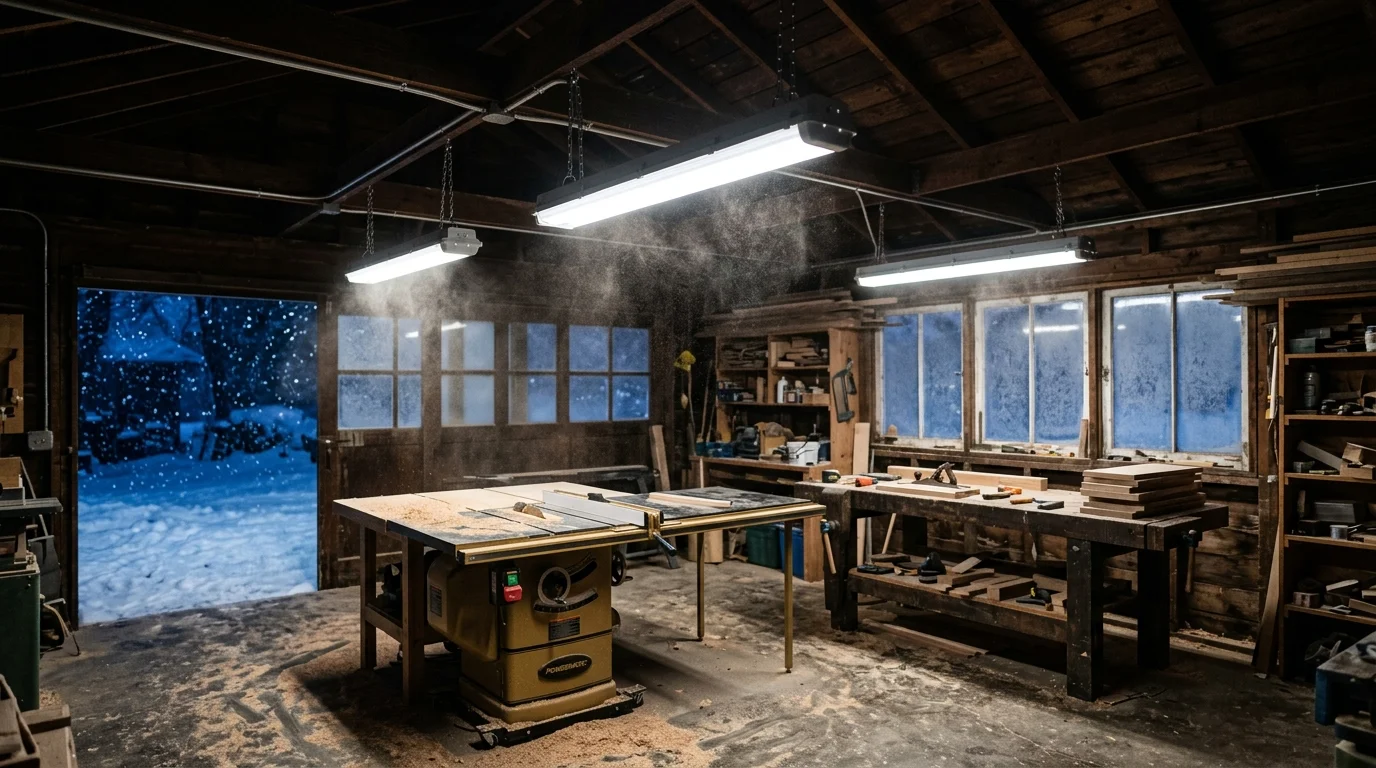
Your unheated detached workshop demands lighting that strikes instantly at -10°F without choking on airborne sawdust. Off-the-shelf smart shop lights fail in these brutal conditions because unsealed housings draw in fine wood dust while sub-zero temperatures freeze basic driver capacitors.
The only reliable, dustproof automation under $150 decouples control from the luminaire by pairing industrial IP65 vapor-tight LED fixtures with sub-zero external smart relays. This architecture eliminates cold-boot driver failure and prevents particulate buildup entirely.
You can build an automated, professional-grade illumination grid this weekend that ignites instantaneously in sub-zero winter temperatures.
Sub-Zero Physics: Why Unsealed Shop Lights Fail in Winter
Operating a woodworking space in northern winter climates subjects electronics to intense environmental stress. When temperatures drop below zero, unheated shops create an unforgiving combination of thermal contraction and airborne contaminants.
Much like hardening outdoor smart lighting against freeze-thaw cycles, unheated shop fixtures require sealed components to endure sub-zero exposure.
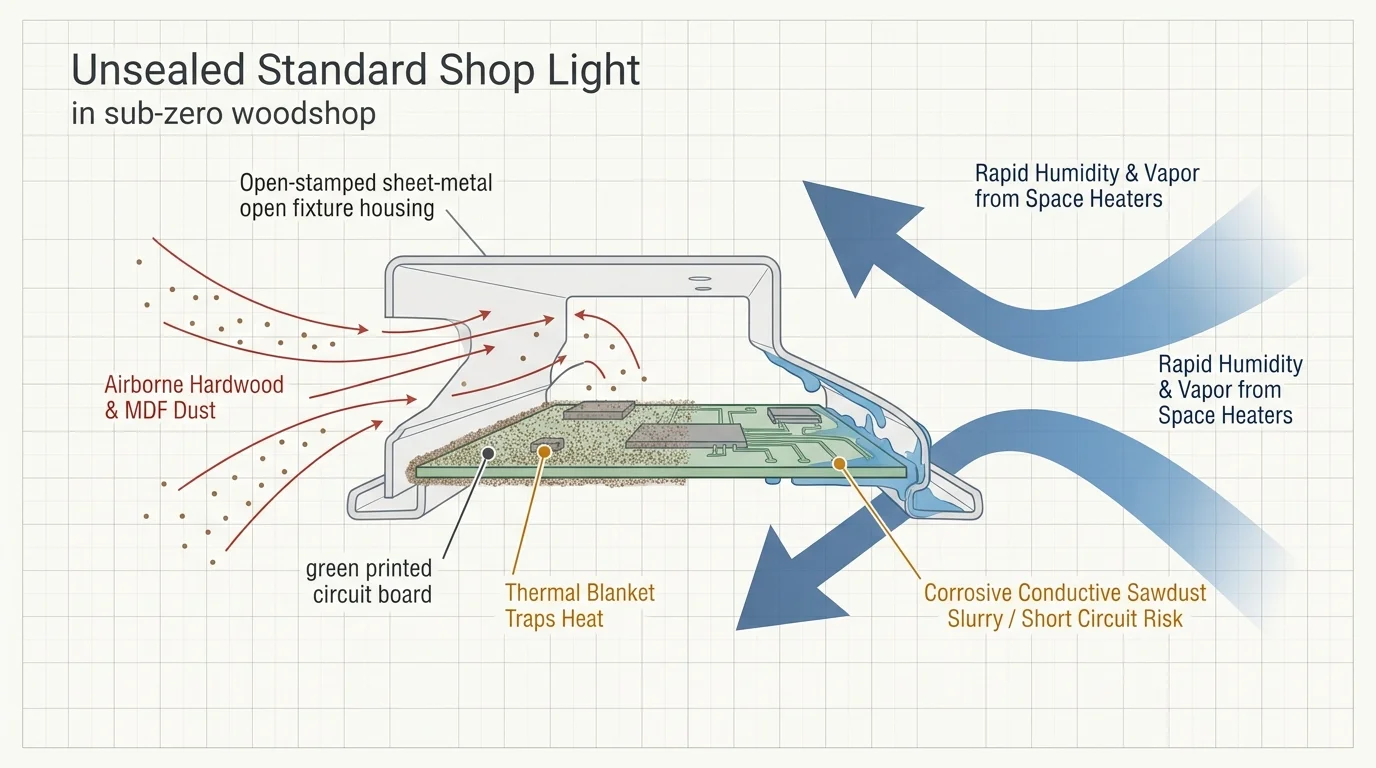
Standard indoor LED fixtures feature stamped sheet-metal housings with open ventilation slots. Convection currents pull fine hardwood and MDF dust directly into the enclosure while you cut, sand, or plane lumber.
This fine particulate creates a dense thermal blanket over internal circuit boards. When dust traps heat on localized components, delicate driver circuitry quickly overheats and degrades prematurely.
Worse, detached garages experience dramatic humidity fluctuations when you run kerosene or propane space heaters. As ambient air warms rapidly, water vapor condenses directly onto cold metal surfaces and settled dust piles.
This moisture turns non-conductive wood dust into a corrosive, mildly conductive slurry. Over time, that paste bridges electrical pathways, tripping GFCI breakers and destroying integrated smart microcontrollers.
Unsealed shop fixtures commonly exhibit several predictable failure modes during freezing winter cycles:
- Short circuits across circuit board traces caused by hygroscopic sawdust paste.
- Premature diode failure driven by localized thermal insulation from accumulated debris.
- Severe optical lumen loss as sawdust coats internal polycarbonate lenses and reflectors.
- Corroded driver terminals from trapped moisture during freeze-thaw workshop cycles.
Ingress Protection Decoded: Why IP65 Is Non-Negotiable for Woodshops
Choosing proper workshop lighting requires understanding industrial enclosure specifications. The International Electrotechnical Commission outlines these enclosure standards under IEC Standard 60529.
Similar ingress principles apply when installing low-voltage landscape lighting, where moisture-sealed connections prevent ground faults in wet soil.
The standard uses two characteristic numerals to define environmental protection levels. For woodworkers and mechanics, understanding both digits prevents expensive buying mistakes.
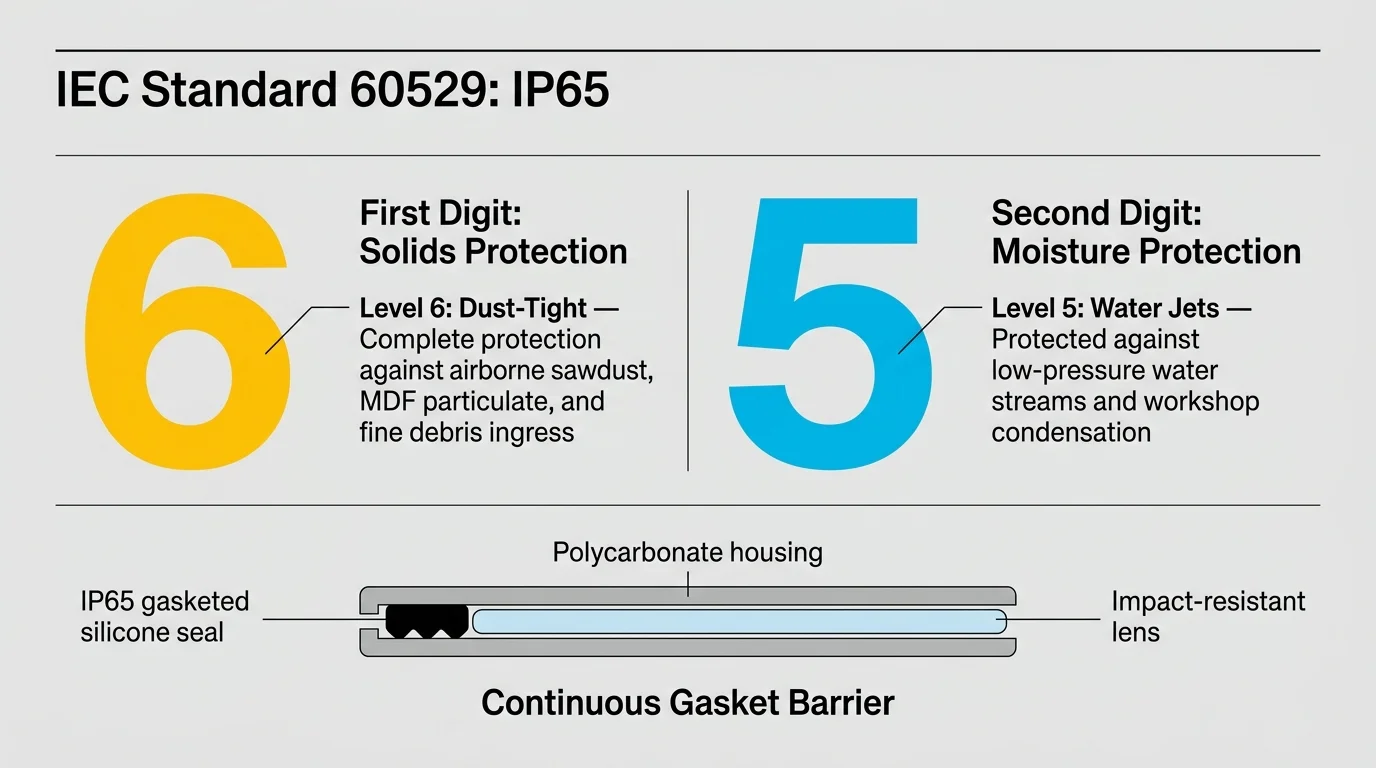
The first numeral represents solid particle ingress protection on a scale from zero to six. A rating of 6 signifies complete protection against dust over an eight-hour vacuum test.
To pass IP6X testing, the manufacturer creates negative pressure inside the light fixture. The unit must prevent any measurable particulate from penetrating the sealed perimeter housing.
The second numeral measures protection against water and liquids on a scale from zero to nine. An IP65 rating denotes survival against low-pressure water jets from any angle.
Testing requires projecting water through a 6.3-millimeter nozzle at 12.5 liters per minute under 30 kilopascals of pressure. The test runs for three minutes across all exterior seams.
Industrial vapor-tight luminaires meet IP65 criteria using continuous molded silicone or polyurethane gaskets. Heavy-duty cam-action latches compress the gasket against a thick polycarbonate body to lock out fine airborne particles.
Fixtures rated only IP20 or IP40 allow fine dust to penetrate immediately. Sealed IP65 housings ensure your workshop lighting remains pristine regardless of how much sawdust your tablesaw produces.

Driver Capacitors vs. Cold Starts: What Happens Below Freezing
Solid-state LED diodes actually perform exceptionally well in sub-zero ambient conditions. Cold air pulls heat away from diode junctions, boosting efficiency and raising overall lumen output.
Maintaining steady, flicker-free illumination is also essential for visual comfort, echoing best practices for smart lighting productivity across dedicated work areas.
The true operational bottleneck in sub-zero garages is the electronic LED driver. The driver converts incoming 120-volt alternating current into steady, low-voltage direct current.
Most commercial LED drivers rely on aluminum electrolytic capacitors to smooth electrical ripple. These critical components contain a liquid chemical electrolyte solution that facilitates internal charge storage.
When shop temperatures dip below 32°F, that liquid electrolyte becomes increasingly viscous. By the time ambient garage air reaches -40°F, electrolyte conductivity drops precipitously.
Electrical engineers measure this phenomenon as Equivalent Series Resistance (ESR). In sub-zero environments, capacitor ESR can spike five to ten times higher than its rated baseline at 68°F.
This massive resistance spike limits current delivery when you flip the power switch. The driver struggles to generate enough forward voltage to excite the LED diode strings.
This chemical sluggishness results in three common cold-start symptoms:
- Stroboscopic flickering that lasts several seconds while internal components generate heat.
- Significant lumen suppression, often dropping cold-boot light output by 20 to 40 percent.
- Delayed ignition, where fixtures take up to five seconds to produce visible light.
Commercial-grade drivers mitigate these failures through cold-weather chemical electrolytes and solid polymer capacitors. These robust components guarantee reliable, instant ignition at temperatures down to -20°C (-4°F) or -40°C (-40°F).

The Hybrid Architecture: Industrial Fixtures with Smart Relays
Integrated consumer smart shop lights seem appealing because they bundle Wi-Fi radios directly into the fixture. However, these consumer designs cut costs on housing gaskets and driver cold tolerances.
Using multi-channel relays makes it easy to set up smart lighting zones so you can illuminate heavy machinery stations separately from general walkways.
If your workspace currently relies on basic utility sockets, you can first convert pull-chain ceiling fixtures to smart switches to simplify circuit control before running overhead conduit.
Nearly all consumer smart lights carry damp ratings instead of true IP65 dust ratings. Placing them in a dusty, unheated workshop leads to premature hardware failure within two seasons.
A superior strategy separates lighting hardware from automation controls using a hybrid architecture. You install sealed, commercial-grade IP65 vapor-tight LED fixtures and control them with an industrial-grade smart switch.
Independent analysis from PCMag smart home guides shows that modular smart devices simplify maintenance in extreme workspaces. Replacing a damaged switch takes minutes without disturbing overhead lights.
The Shelly 1 Gen3 smart relay serves as an ideal controller for sub-zero lighting. This compact module operates reliably down to -4°F and tucks inside an external weatherproof box.
Crucially, the Shelly 1 Gen3 supports local Wi-Fi control and the Matter smart home standard. This ensures your lights trigger instantly from motion sensors without requiring cloud communication.
If you prefer a plug-and-play approach without hardwiring, choose an outdoor smart plug. High-grade smart plugs provide IP64 or IP65 weather ratings while handling cold-boot inrush currents up to 15 amps.

Head-to-Head Comparison: Cold-Weather Shop Lighting Configurations
Selecting the right hardware combination requires balancing environmental ingress protection, operational thermal limits, and total costs. The table below evaluates the four leading equipment combinations for unheated workshops.
Evaluating lumen output alongside ingress ratings follows the same principles as choosing the right smart lighting tailored to a space’s functional needs.
When retrofitting switch controls into older workshop framing, reviewing techniques for installing smart switches in shallow metal junction boxes helps avoid crowded enclosures and wire pinch.
| Configuration | Ingress Protection | Cold-Start Floor | Lumen Output | Housing Construction | Estimated Cost |
|---|---|---|---|---|---|
| Feit Smart Shop Light (4-Foot) | Damp Rated (Unsealed) | 32°F (0°C) | 5,000 Lumens | Vented Stamped Steel | $55.00 |
| Commercial IP65 + Shelly 1 Gen3 | IP65 Dust-Tight | -4°F (-20°C) | 20,000 Lumens (4-pk) | Polycarbonate with Silicone Gasket | $132.00 |
| Commercial IP65 + Kasa KP400 | IP64 Splash-Resistant | -4°F (-20°C) | 20,000 Lumens (4-pk) | Polycarbonate with Silicone Gasket | $139.00 |
| Commercial IP65 + Lutron Caséta Outdoor | IP65 Weatherproof | -4°F (-20°C) | 20,000 Lumens (4-pk) | Polycarbonate with Silicone Gasket | $199.00 |
While the integrated Feit fixture costs less initially, its vented housing and narrow thermal window invite failure. The commercial IP65 setup with a Shelly relay delivers four times the illumination under a $150 budget ceiling.
Worked Example: Automating a 24×24 Detached Woodshop Under $150
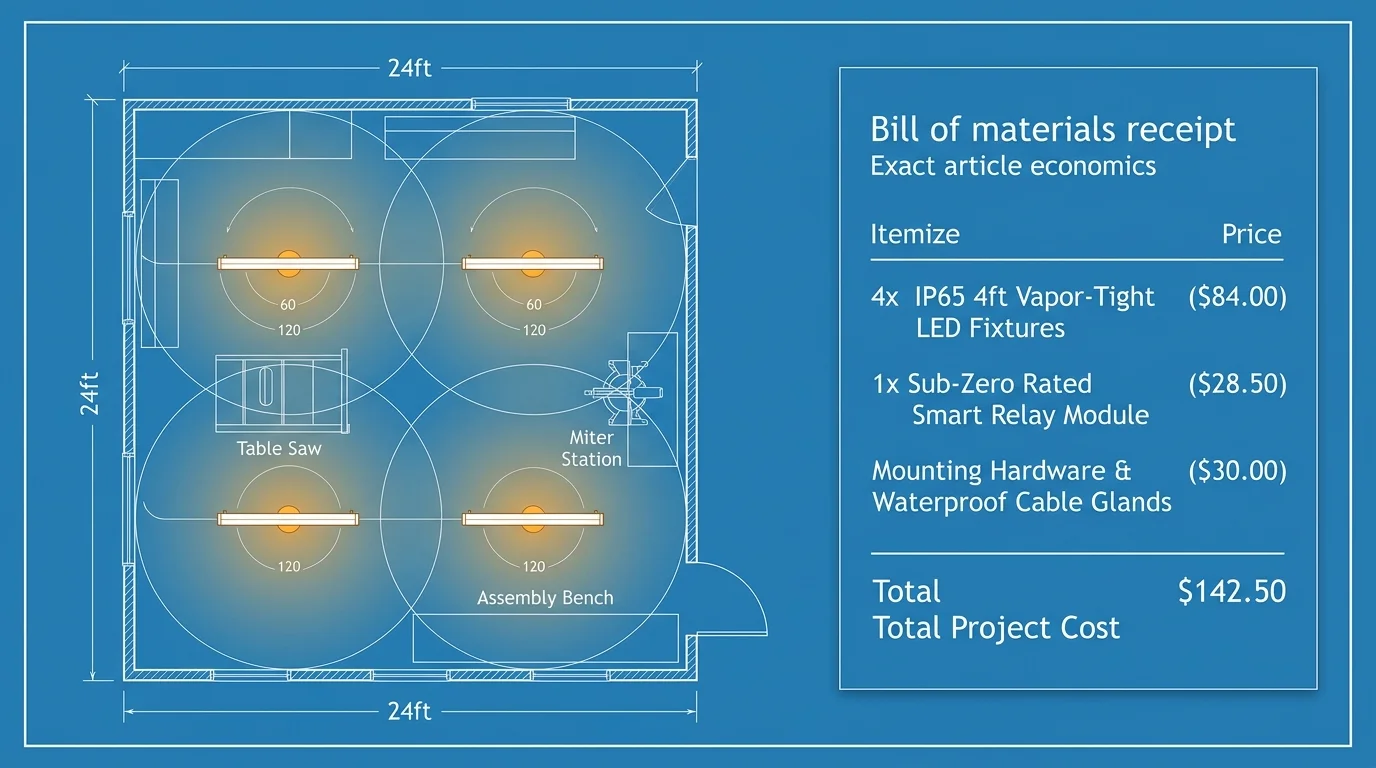
To demonstrate practical affordability, consider a standard detached 24-foot by 24-foot two-car garage converted into a woodworking shop. The space totals 576 square feet of unheated floor area with an eight-foot ceiling.
You can tie your shop illumination routines to exterior pathways, similar to how you automate porch lights for safety when navigating between buildings after dark.
Detailed woodworking demands a minimum ambient illumination baseline of 35 foot-candles across the room. Multiplying 576 square feet by 35 foot-candles establishes a target output of 20,160 lumens.
A contractor multi-pack containing four 4-foot IP65 vapor-tight LED fixtures provides exactly 20,000 lumens of light. Each fixture consumes 44 watts of power and utilizes a commercial driver rated down to -4°F.
Here is the exact cost and component breakdown for the entire installation:
- Four 4-foot IP65 Vapor-Tight Luminaires (5,000 lumens each, 4000K CCT): $104.99
- One Shelly 1 Gen3 Smart Relay (Matter-compatible, rated to -4°F): $17.50
- One Carlon 1-Gang Weatherproof Non-Metallic Electrical Junction Box: $7.25
- Two Liquid-Tight Cord Grip Connectors (1/2-inch NPT): $5.80
- Fifteen feet of 14/2 NM-B Romex electrical branch wire: $8.40
The total investment for this industrial-grade lighting package comes to exactly $143.94, leaving you beneath the $150 budget limit.
Next, calculate the electrical loads to ensure absolute system stability in freezing conditions. Four 44-watt luminaires pull a continuous load of 176 watts total.
Dividing 176 watts by your standard 120-volt line voltage yields a continuous draw of just 1.47 amps. Even when sub-zero startup causes a momentary inrush surge of 12 amps for 15 milliseconds, the 16-amp Shelly relay handles it easily.
Assuming you work in the shop four hours daily, the lights consume 21.1 kilowatt-hours per month. At a national average rate of $0.16 per kilowatt-hour, operating this high-output grid costs just $3.38 each month.
Step-by-Step Installation: Building a Sub-Zero Dustproof Smart Grid
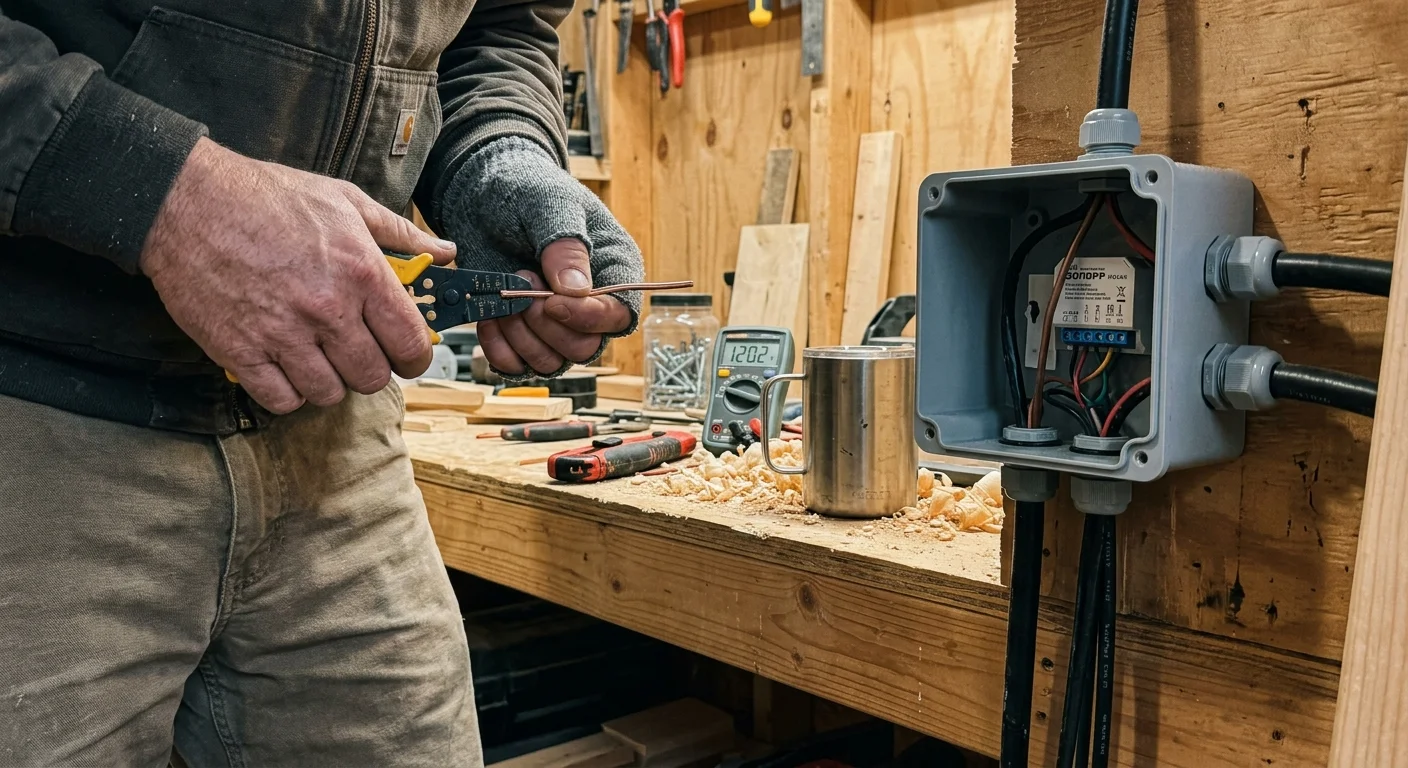
Installing this cold-weather smart lighting grid requires basic electrical hand tools and careful adherence to safety procedures. Follow these steps to build your sealed overhead workshop network.
- Disconnect power to your garage branch circuit at the main breaker panel and verify zero voltage with a reliable non-contact tester.
- Fasten the stainless steel mounting brackets for all four vapor-tight housings directly into ceiling joists spaced six feet apart across the work area.
- Snap the polycarbonate fixture bodies into the ceiling brackets and pop open the lateral cam latches to access the inner gear tray.
- Connect the four fixtures in parallel using 14/2 wire routed through liquid-tight compression strain reliefs to preserve enclosure sealing.
- Mount the external weatherproof junction box adjacent to your primary ceiling power drop.
- Wire line power into the Shelly 1 Gen3 relay terminals, connecting the switch output wire to your daisy-chained fixture circuit.
- Tuck the relay inside the sealed junction box and secure the gasketed cover plate tightly with stainless steel screws.
- Restore circuit breaker power, open the control app on your phone, and connect the relay to your local network.
Always inspect the perimeter silicone gasket on each light housing before locking the outer latches. Pinched gaskets compromise dust exclusion, allowing fine sanding particles to foul internal components over time.

Workshop Automation Recipes: Presence Sensing and Schedules
Once you install your dust-tight luminaires and cold-rated relay, practical automations transform everyday usability. You no longer have to fumble for wall switches with gloved hands or armfuls of sheet stock.
Pairing a sub-zero wireless door sensor with your lighting controller enables an instantaneous entry trigger. When you swing the entry door open, the sensor triggers the relay over local radio signals in under 100 milliseconds.
According to smart home guides on The Verge smart home coverage, local hub automations run reliably without an internet connection. This offline capability prevents winter Wi-Fi dropouts from leaving you in the dark.
You can also create a tool-interlock automation using an energy-monitoring smart plug connected to your dust collector. When the collector pulls active power, an automated rule boosts shop lighting to 100 percent brightness.
To eliminate wasted electricity in detached buildings, establish an automated evening curfew sequence. A rule can turn fixtures off at 10:00 PM whenever ceiling motion sensors register no activity for twenty consecutive minutes.
These simple automations protect your energy bill while ensuring your workshop is brilliantly illuminated the instant you walk inside.
Frequently Asked Questions
Can standard indoor smart bulbs survive in an unheated woodshop?
Standard smart bulbs fail rapidly in unheated woodshops because fine sawdust enters their cooling vents. Accumulated dust traps heat, while ambient winter condensation corrodes delicate internal radio circuits.
Why do LED shop lights flicker when turned on in sub-zero winter temperatures?
Sub-zero flickering occurs because liquid chemical electrolytes inside driver capacitors thicken in extreme cold. This increases internal resistance, preventing the driver from delivering stable forward current until it warms up.
How do I keep a smart relay connected to Wi-Fi in a detached garage?
Ensure reliable connectivity by mounting a Wi-Fi access point near the garage or choosing devices supporting the Thread protocol. Thread creates a resilient mesh network that requires less wireless bandwidth than traditional cloud Wi-Fi.
What is the difference between IP64 and IP65 ratings for shop lights?
Both ratings offer level-6 dust-tight protection against fine airborne particles. However, IP65 provides substantially greater moisture defense, withstanding direct pressurized water jets where IP64 only resists light splashing.
Disclaimer: This article is for informational purposes only. Smart home devices involve electrical connections and data privacy. Always follow manufacturer instructions for installation. For complex wiring or HVAC work, consult a licensed professional.



1 Comment