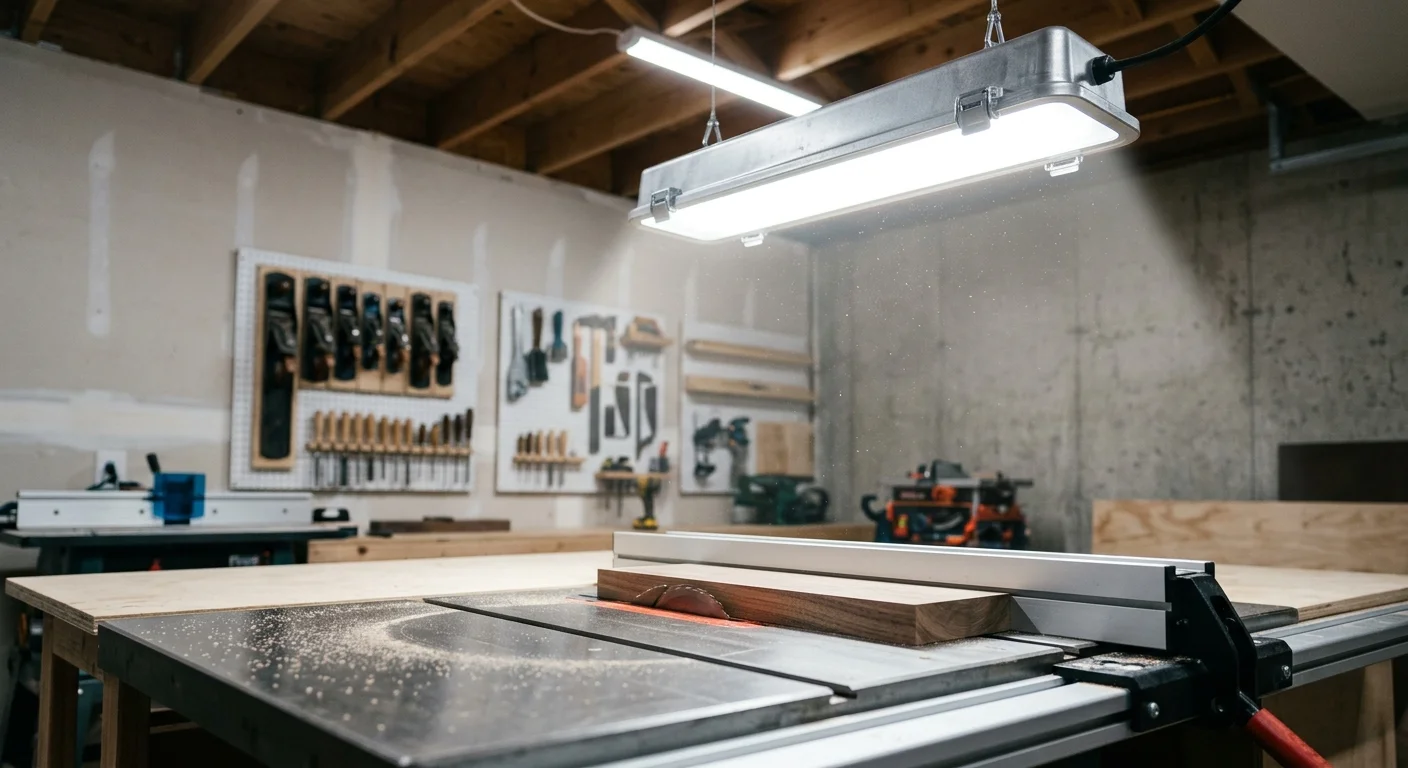
High-vibration tools like cabinet saws and thickness planers destroy consumer smart bulbs through mechanical shock and fine particulate infiltration. You need industrial-grade illumination engineered specifically for demanding workshop conditions.
Standard garage guides overlook how heavy sawdust accumulation cuts light output by up to 30 percent while motor back-EMF crashes unshielded microcontrollers. Reliable workshop illumination demands exact lumen formulas, sealed enclosures, and isolated smart controls.
This guide details how to calculate working lux, specify dust-tight enclosures, and automate high lumen smart shop lights that survive harsh shop environments.
Calculating Target Lumens and Foot-Candles for Woodworking Machinery
General residential garages require modest illuminance levels, but stationary woodworking machinery demands significantly higher visual accuracy. Dim lighting disguises cut lines, blade guards, and rotating tool edges, creating severe safety risks.
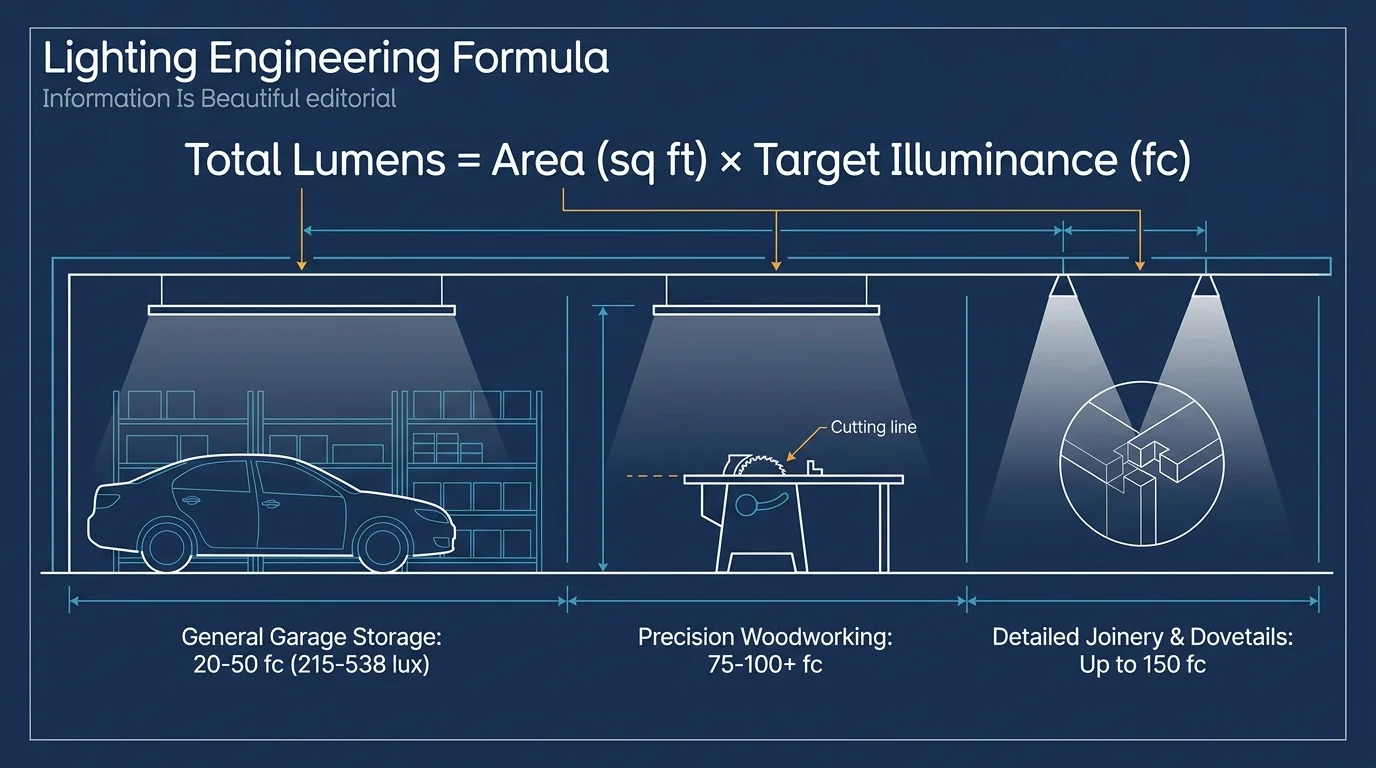
The Illuminating Engineering Society establishes clear baseline recommendations for manual utility tasks and fine assembly work. General garage storage requires 20 to 50 foot-candles, which equals roughly 215 to 538 lux.
In contrast, precision woodworking tasks and heavy tool operation require 75 to 100+ foot-candles. Highly detailed operations—such as cutting dovetails or aligning jointer knives—often require up to 150 foot-candles for adequate contrast.
To establish your base lighting load, use the standard luminous flux equation:
Total Lumens = Area (Square Feet) × Target Illuminance (Foot-Candles)
One foot-candle represents one lumen evenly distributed over one square foot of surface area. Calculating your workshop lighting requires segmenting your garage footprint into distinct ambient and machinery zones.
Ambient pathways need lower illuminance, whereas machine tables require concentrated optical output. Balancing these zones prevents eye fatigue caused by excessive contrast shifts when you move between workstations.

Worked Example: Lumens for a 440-Square-Foot Workshop
Consider a standard detached two-car garage measuring 20 feet wide by 22 feet deep. This footprint provides 440 square feet of total floor space for parking, storage, and woodworking machinery.
You can divide this floor plan into two distinct functional lighting zones to maximize visibility without overspending on electrical hardware:
- Zone 1 (General Circulation and Sheet Storage): 300 square feet requiring 50 foot-candles of ambient coverage.
- Zone 2 (Active Tool Footprint): 140 square feet covering the table saw, jointer, and planer requiring 100 foot-candles.
First, calculate the required luminous flux for Zone 1:
300 sq ft × 50 fc = 15,000 raw lumens
Next, calculate the luminous flux required for the active machinery in Zone 2:
140 sq ft × 100 fc = 14,000 raw lumens
Summing these targets establishes an initial baseline of 29,000 raw lumens across the entire ceiling plane. However, simply hanging 29,000 lumens of raw lighting will leave your workshop significantly underlit within a few weeks of active cutting.
You must incorporate optical losses caused by mounting height, ceiling reflectance, and airborne debris before purchasing fixtures.
Accounting for Sawdust: Lumen Dirt Depreciation
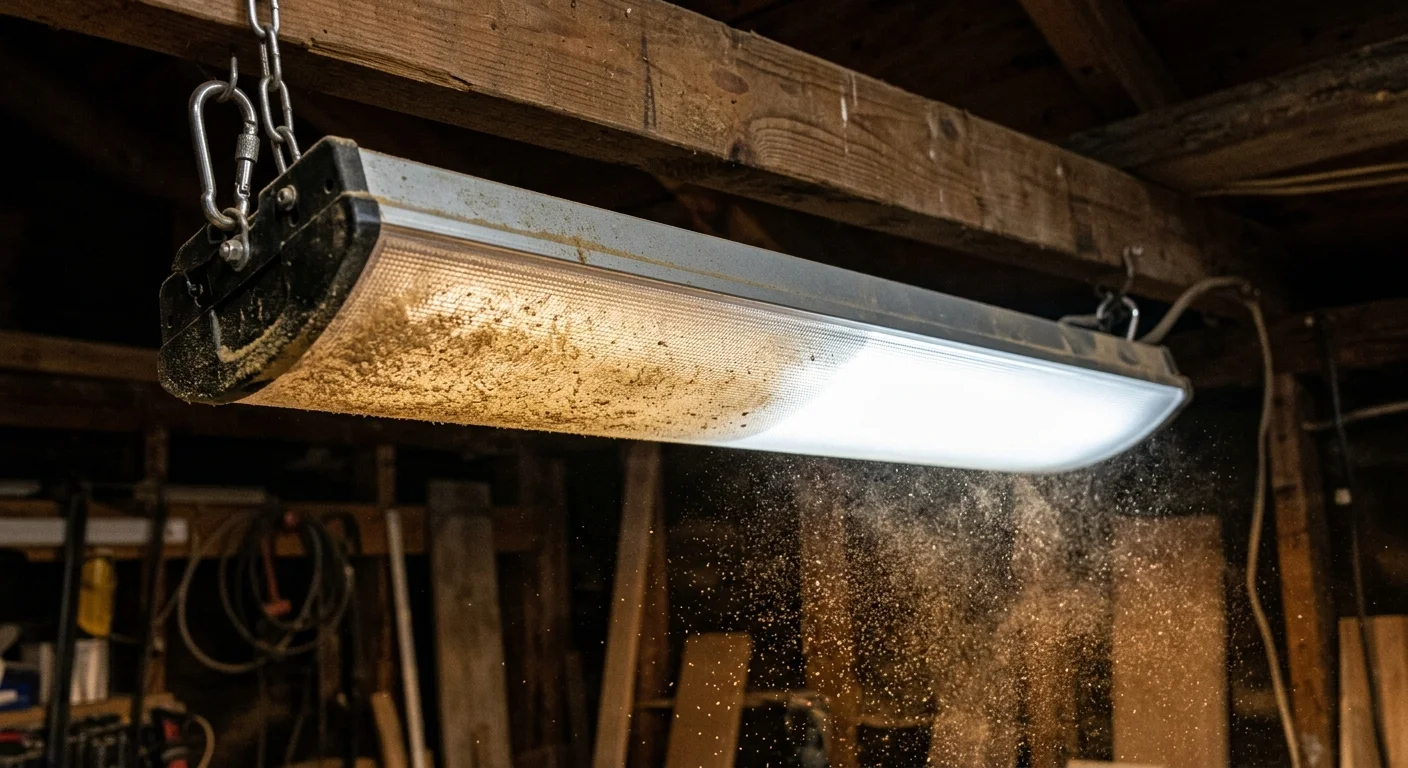
Airborne sawdust is the primary enemy of optical clarity in any active woodshop. Table saws, routers, and thickness planers release microscopic particulate that coats every horizontal and vertical surface.
Lighting engineers compensate for particulate accumulation using the Lumen Dirt Depreciation (LDD) factor. In clean commercial offices, the LDD rarely drops below 0.90 over a multi-year maintenance cycle.
In high-particulate workshops, airborne wood dust creates an optical film over polycarbonate diffusers within weeks. Cited engineering data shows that fine sawdust coatings degrade delivered light transmission by 20 to 30 percent between washdown cycles.
To calculate true delivered light, divide your baseline requirement by your expected dirt depreciation factor:
Design Lumens = Target Lumens ÷ LDD Factor
Applying an LDD factor of 0.75 to your 29,000-lumen baseline yields your true required output:
29,000 lumens ÷ 0.75 = 38,667 design lumens
Over-specifying your fixture output by roughly 33 percent ensures your machinery stays illuminated at the target 100 foot-candles. You can then dim the fixtures electronically when the lenses are freshly cleaned.
Selecting a sawdust proof smart light system allows you to schedule brightness offsets automatically based on operational runtimes.
Dust-Sealing Ratings: Why IP65 Trumps IP54
The International Electrotechnical Commission outlines mechanical enclosure protection against solid foreign objects and liquids under standard IEC 60529. Choosing the wrong Ingress Protection (IP) rating causes premature driver burnout and potential combustion hazards.
Many consumer-grade garage fixtures carry an IP54 rating, which manufacturers often market as weather-resistant. However, the numeric digits reveal critical functional limitations under real-world woodworking conditions:
- First Digit (Dust Protection): 5 denotes dust-protected, permitting limited talcum-sized dust infiltration during low-pressure cycles.
- First Digit 6 (Dust-Tight): 6 completely prevents all dust penetration under continuous vacuum testing.
- Second Digit 4 (Water Splash): 4 protects only against splashing water from any angle.
- Second Digit 5 (Water Jets): 5 protects against low-pressure water jets and direct washdowns.
Hardwood flour and MDF dust consist of particles significantly smaller than 75 micrometers. Because IP54 enclosures permit dust penetration, thermal currents pull fine particulates directly past gasket seams.
Once inside, wood dust settles onto hot LED circuit boards and driver capacitors. This particulate layer insulates sensitive components, accelerating heat-related component degradation.
Wood dust also carries an electrostatic charge, which causes short circuits across open low-voltage traces. You must deploy IP65 or IP66 vapor-tight enclosures to lock out airborne wood particulate completely.
Vibration Resistance: Specifying IK Impact Ratings
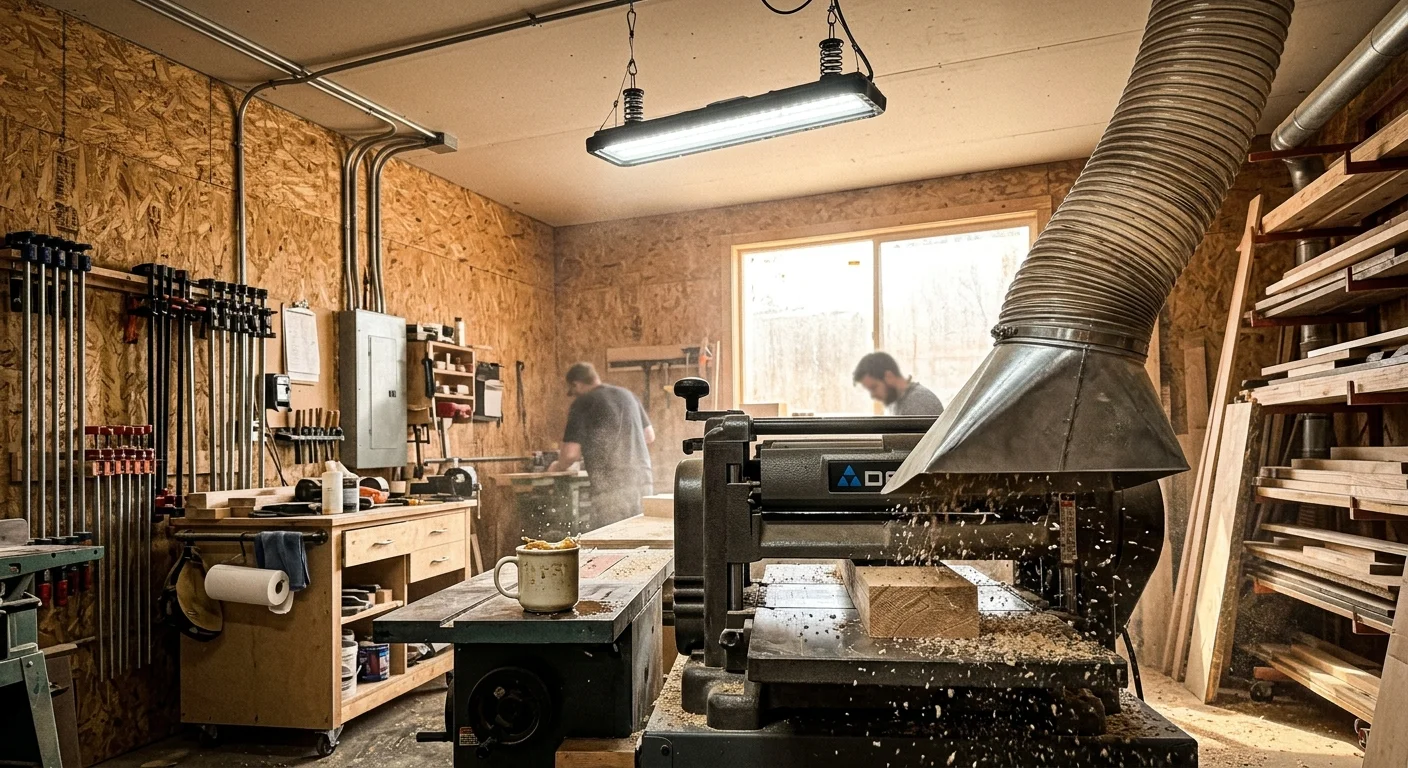
Machinery-induced vibration presents another destructive force inside detached garage workshops. A three-horsepower cabinet saw running an unbalanced dado stack sends continuous harmonic vibrations through framing members.
Overhead garage door operators and thickness planers compound this structural vibration, shaking ceiling joists and conduit runs. Standard commercial lighting fixtures utilize thin acrylic lenses secured by brittle friction clips.
Continuous vibration fatigues these mounting clips, causing lenses to rattle loose, break seals, or drop into spinning machinery. To protect your investment, specify fixtures evaluated under the IEC 62262 standard for mechanical impact protection.
The European standard EN 62262 defines IK ratings based on the mechanical impact energy an enclosure can absorb:
- IK06: Absorbs 1.0 Joule of impact energy; standard commercial ceiling fixtures.
- IK08: Absorbs 5.0 Joules of energy; resistant to heavy shop vibration and direct board strikes.
- IK10: Absorbs 20.0 Joules of energy; vandal-proof enclosures fabricated from thick reinforced polycarbonate.
Select heavy-duty fixtures rated at IK08 or higher equipped with continuous poured-in-place polyurethane gaskets. Pair these fixtures with stainless steel cam-action latches rather than flexible plastic clips.
Suspend your fixtures using high-tensile aircraft cables or strut channels isolated with neoprene vibration dampeners. Neoprene dampeners absorb continuous harmonic energy, preventing vibrations from degrading your internal driver connections.
Filtering Electrical Noise and Motor Inrush Current
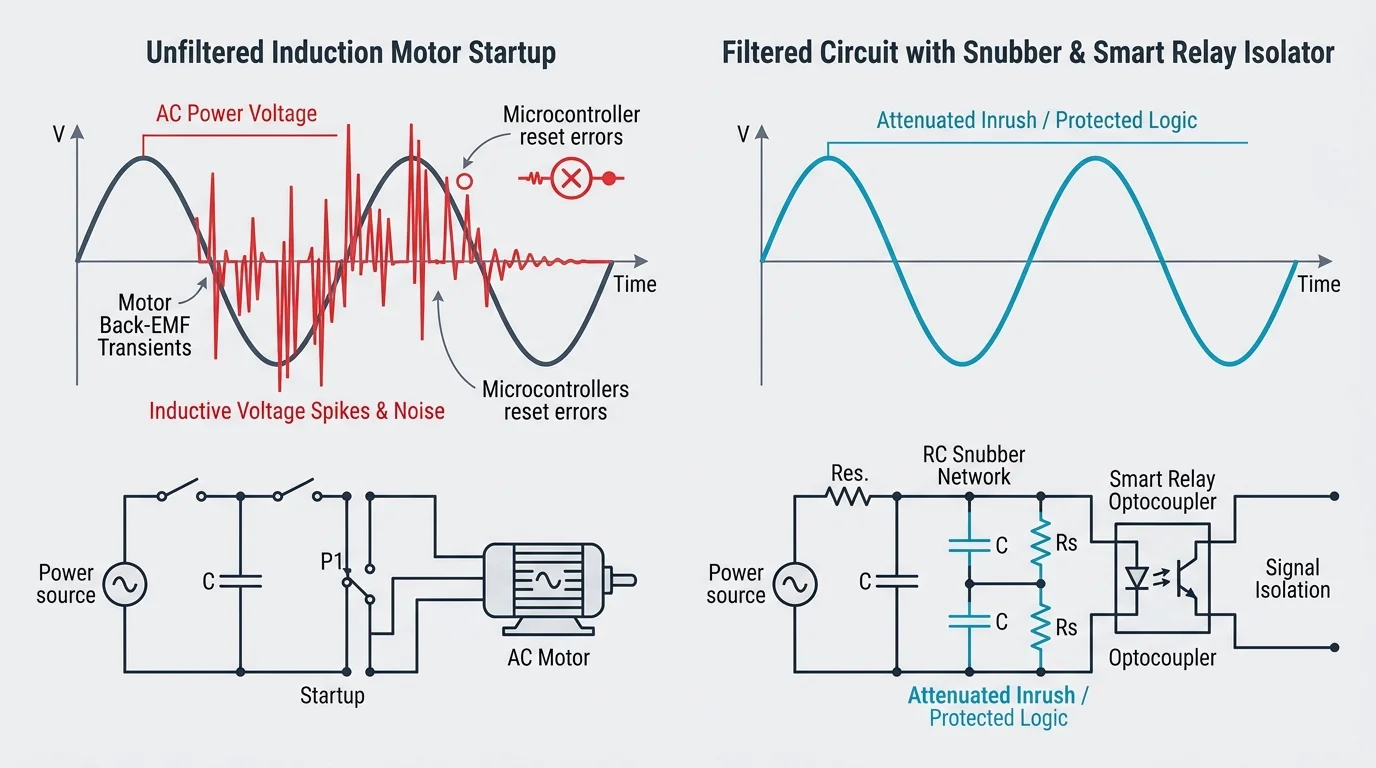
Woodworking machinery creates a hostile electrical environment that wreaks havoc on consumer-grade smart home hardware. Induction motors draw massive inrush current when starting up under load.
A typical 120-volt, 15-amp table saw motor can pull up to 60 surge amps during startup. When the motor shuts off, the collapsing magnetic field dumps high-voltage inductive kickback into your garage wiring.
Integrated smart bulbs fail quickly in these conditions because their miniaturized step-down converters cannot suppress large voltage spikes. Furthermore, inductive voltage dips cause integrated Wi-Fi microcontrollers to restart continuously, dropping your smart lighting off the network.
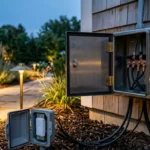
Instead of deploying integrated smart bulbs, decouple your intelligent controls from your luminaires. Wire rugged, industrial IP65 vapor-tight fixtures to dedicated smart switches or smart relays housed inside shielded metallic junction boxes.
Hardware testing guides from PCMag Smart Home emphasize that hardwired smart switches and dedicated relays offer superior longevity compared to connected consumer bulbs in harsh spaces.
Deploy modern automation hardware running the Matter smart home standard to ensure seamless local control across independent lighting zones without cloud dependency.
Install an RC snubber circuit in parallel across your smart relay’s switch terminals. The snubber absorbs high-voltage inductive transients, protecting relay contacts from pitting and preventing microcontrollers from freezing.

Fixture Comparison: Vapor-Tight and High-Bay Options
Selecting appropriate hardware requires balancing lumen output, physical enclosure durability, and mounting height constraints. Standard 8-foot ceiling garages require linear distribution to minimize glare, whereas 12-foot ceilings can accommodate high-bay designs.
The following table outlines measurable attributes for fixtures designed to withstand vibration and dust accumulation in industrial workshops:
| Fixture Style | IP / IK Rating | Luminous Output | Mounting Method | Unit Cost |
|---|---|---|---|---|
| 4-Foot Vapor-Tight Linear LED | IP65 / IK08 | 5,500 lumens | Surface bracket or cable | $45 – $65 |
| 8-Foot Heavy-Duty Tri-Proof LED | IP66 / IK10 | 11,000 lumens | Strut channel or cable | $95 – $140 |
| 150W UFO LED High-Bay | IP65 / IK08 | 21,000 lumens | Hook with locking ring | $75 – $110 |
| Consumer Smart Shop Light | IP20 / IK02 | 4,000 lumens | Lightweight hanging chain | $30 – $50 |
For ceilings under 10 feet, 4-foot and 8-foot linear vapor-tight fixtures provide the most uniform visual spread. Their wide frosted diffusers eliminate the blinding point-source glare common to circular high-bay fixtures.
For ceilings exceeding 12 feet, circular UFO high-bay fixtures offer unmatched luminous density per square foot. However, you must pair UFO units with external smart relays, as virtually no high-bay models include native smart radios.
Wiring Smart Relays for Inductive Workshop Loads
Automating high lumen smart shop lights in a machine-dense garage requires clean circuit isolation. Follow these structured steps to configure a resilient lighting automation loop:
- Isolate Lighting Branch Circuits: Supply your lighting fixtures from a dedicated 15-amp branch circuit completely separate from your 20-amp and 240-volt tool circuits.
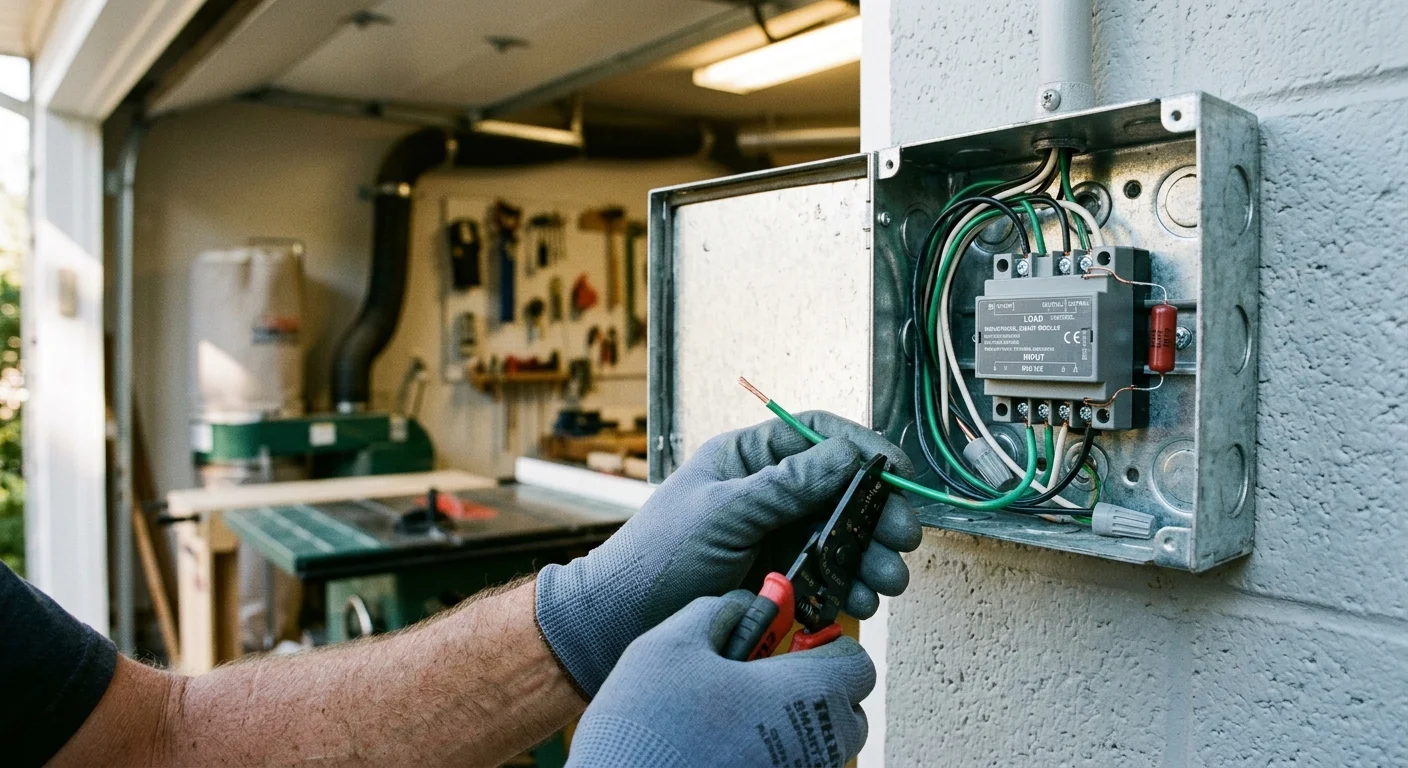
- Mount a Metal NEMA Enclosure: Install a deep metallic junction box to shield your smart relay from electromagnetic interference generated by brush-type universal motors.
- Install an In-Line Smart Relay: Mount an industrial smart relay, such as a Shelly Plus 1PM, inside the enclosure to switch your LED drivers safely.
- Wire an RC Snubber: Connect an RC snubber across the load and neutral terminals of the relay to suppress inductive inrush spikes from multi-driver arrays.
- Integrate Sealed Motion Sensors: Pair your smart relay with an IP65-rated wireless motion sensor to automate lighting routines whenever you enter with full hands.
Separating your lighting feed from your power equipment eliminates voltage sag and prevents machine cycling from resetting your automation network. It also ensures that a tripped tool breaker never plunges your workshop into complete darkness while machinery blades wind down.
Always verify local electrical codes before altering breaker panels or pulling branch circuits through detached garage conduits.
Frequently Asked Questions
Why do standard smart bulbs fail in a woodworking shop?
Standard smart bulbs fail because continuous vibration loosens internal solder joints and heatsinks. Furthermore, airborne wood flour penetrates unsealed enclosures, causing thermal buildup and micro-arcing on delicate Wi-Fi and Zigbee microcontrollers.
How many lumens do I need directly above my table saw?
You should aim for 75 to 100 foot-candles directly over your table saw blade and outfeed table. In a typical 40-square-foot cut zone, this translates to roughly 3,000 to 4,000 raw delivered lumens before applying dirt depreciation buffers.
Can I wire smart lighting controls to the same circuit as my dust collector?
No, you should never share lighting circuits with high-draw induction motors. The startup inrush current and inductive voltage spikes can damage sensitive relay contacts and cause unshielded smart controllers to drop off your network.
How does fine sawdust affect LED fixture lifespan?
Sawdust acts as an insulating blanket across the fixture body, preventing the aluminum heatsink from dissipating thermal energy. Trapped heat elevates junction temperatures, degrading internal LED chips and halving expected operational hours.
Disclaimer: This article is for informational purposes only. Smart home devices involve electrical connections and data privacy. Always follow manufacturer instructions for installation. For complex wiring or HVAC work, consult a licensed professional.