
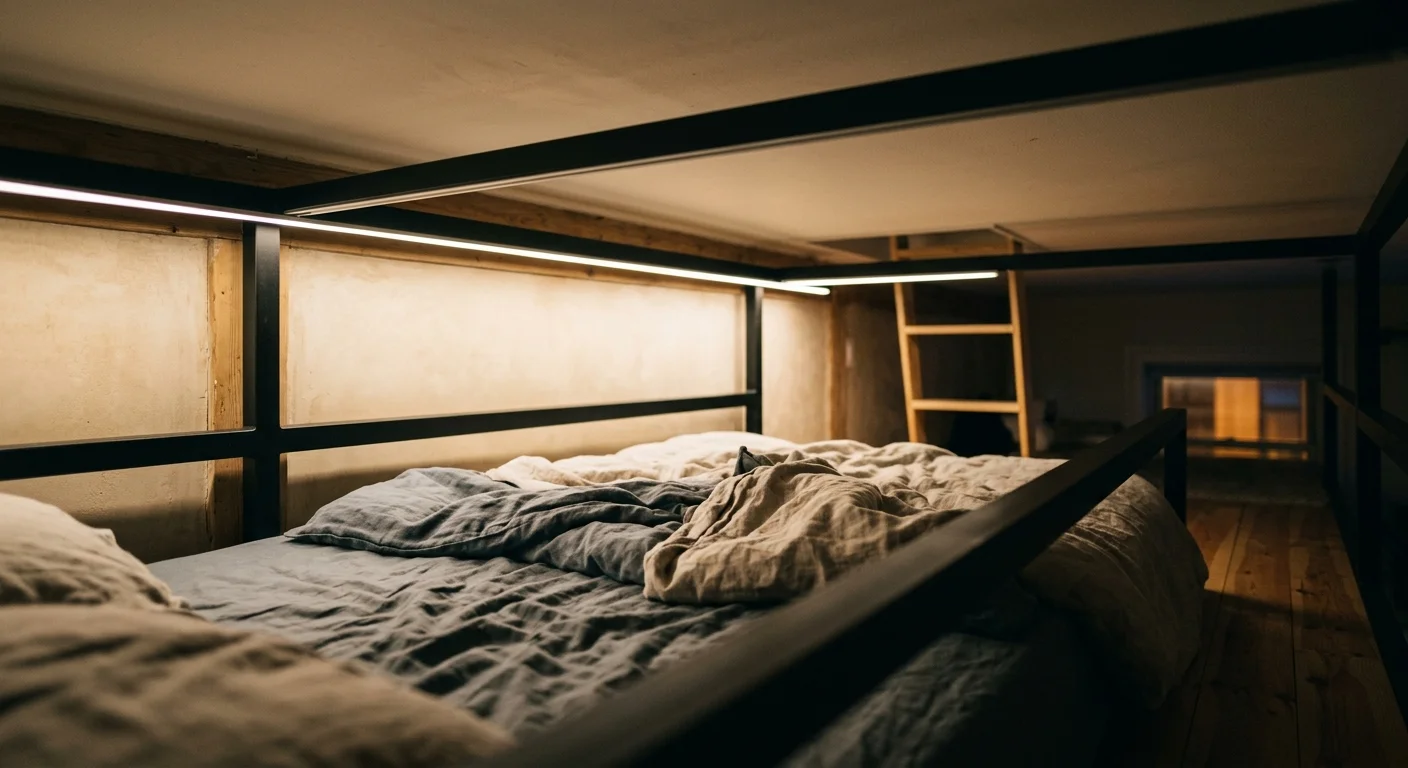
Waking up with an exposed light source just 18 inches above your pillow triggers severe visual fatigue. If you sleep in a low-clearance loft bed, standard overhead fixtures overwhelm your retinas almost instantly.
Standard lumen ratings fail to predict visual comfort in ultra-tight quarters. Preventing optical strain requires evaluating surface luminance in nits and beam diffusion angles before choosing between micro-pucks and linear channels.
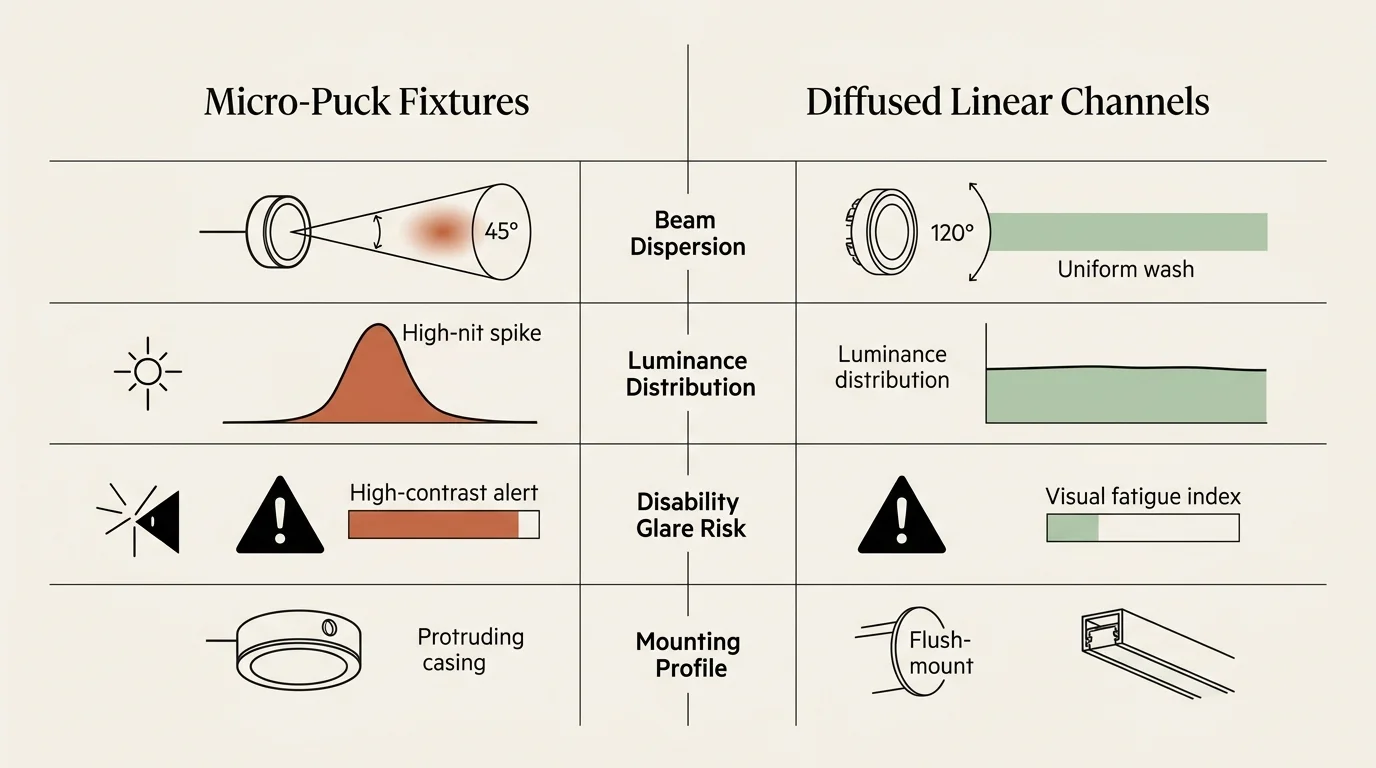
While micro-pucks offer compact footprints, their concentrated point-source luminance creates harsh shadows and blinding hotspots at close range. Diffused under-rail channels distribute gentle, uniform light across your mattress without exposing your eyes to raw diode glare.
The Optical Physics of an 18-Inch Loft Bed Clearance
Most bedroom lighting designs assume a ceiling height between eight and nine feet. In that standard configuration, light expands across a conical volume, scattering off walls to illuminate the room softly.
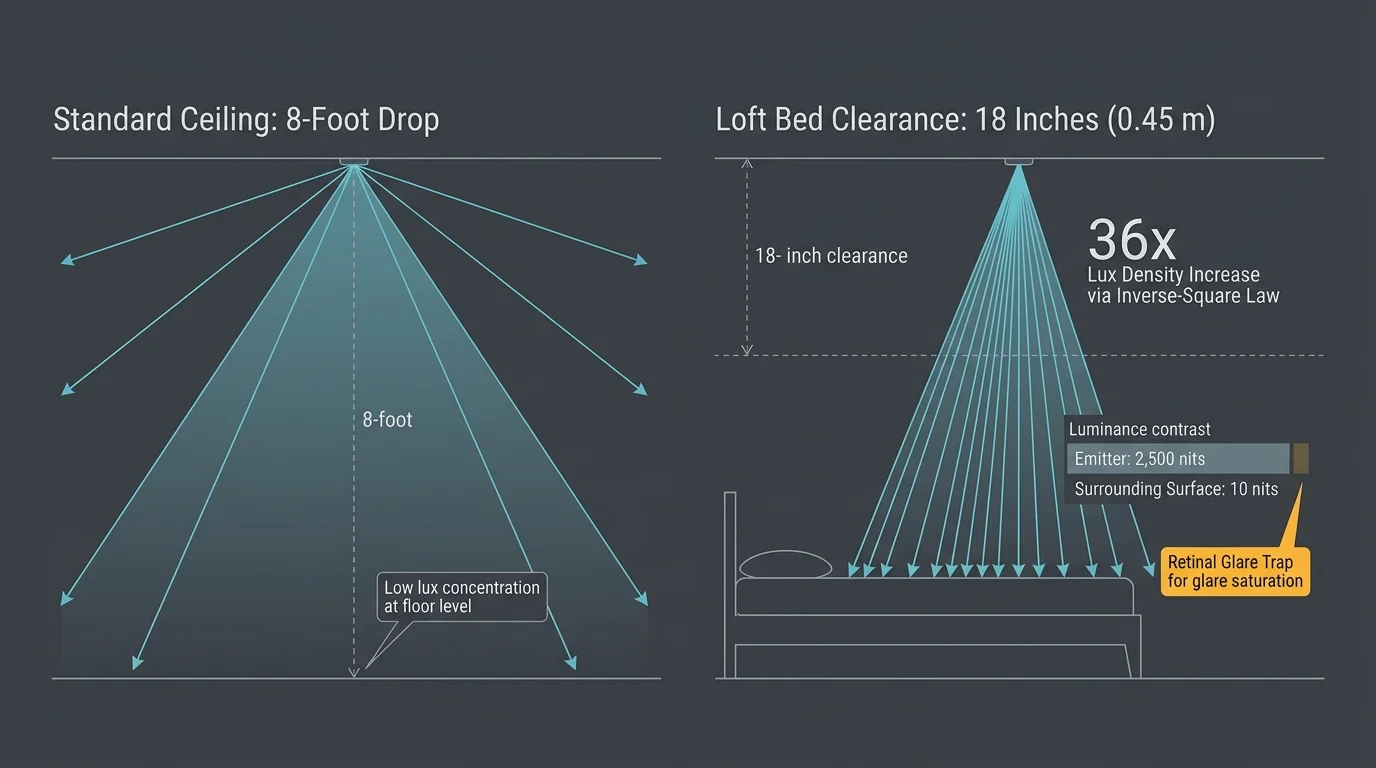
When you sit or lie in a studio loft bed with only 18 inches of overhead space, that physics model breaks down completely. The inverse-square law dictates that light intensity diminishes exponentially with distance.
At an 18-inch distance (0.45 meters), a compact light source delivers roughly 36 times the lux density to your eyes compared to the same emitter positioned at eight feet. This extreme proximity exposes you to unfiltered luminance.
Luminance measures the light emitted from or reflected off a specific surface area, quantified in candelas per square meter (nits). Lumens measure total volumetric output, but nits determine whether a light causes you to wince.
The human retina struggles to adapt when adjacent fields within your field of view present extreme luminance ratios. If an emitter produces 2,500 nits while the surrounding ceiling sits at 10 nits, retinal saturation causes instant discomfort.
To establish an ergonomic lighting environment in cramped vertical quarters, you must optimize three primary optical variables:
- Luminous Area Expansion: Spreading photons across a larger physical surface reduces localized nits without sacrificing overall usable ambient lux.
- Beam Cutoff Angle: Preventing the bare emitter from entering your direct line of sight while you recline eliminates disability glare.
- Sub-Visual Flicker Suppression: Utilizing high-frequency pulse-width modulation (PWM) drivers prevents micro-stroboscopic headaches during close-proximity reading.
According to lighting analysis from Wirecutter’s smart home coverage, diffusing localized diode sources remains the single most effective way to eliminate harsh contrast zones in compact spaces.
When designing smart lighting for loft bed frameworks, controlling surface luminance is not merely an aesthetic choice. It is a biological requirement for sustained eye comfort and healthy sleep architecture.
Micro-Pucks Analyzed: Beam Spreads, Glare Traps, and Limitations
Micro-pucks are compact, circular light fixtures generally measuring between two and three inches in diameter. Manufacturers often market them for under-cabinet kitchen installations, closet shelves, or display casework.
These units typically house a cluster of three to nine surface-mounted diodes (SMDs) behind a simple plastic lens. When placed inside a tight sleeping loft, micro-pucks introduce distinct mechanical and photometric compromises.
Most commercial smart pucks feature beam angles ranging between 40 and 90 degrees. Because the total light output originates from a tiny, concentrated aperture, the surface luminance routinely exceeds 3,000 nits.
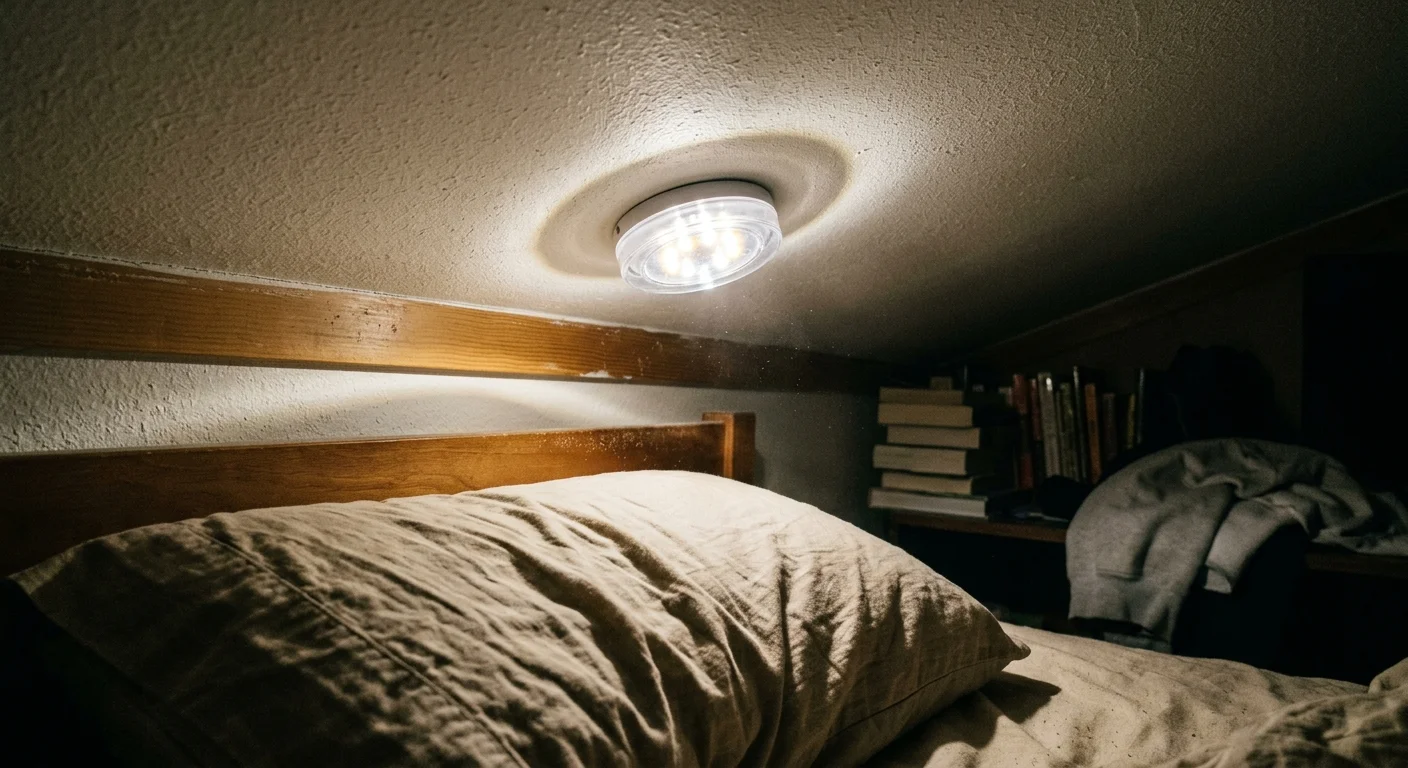
If you mount a diffuse smart puck light bedroom fixture directly to the drywall ceiling 18 inches above your head, that concentrated beam creates an aggressive optical hotspot on your bedding.
Any slight head movement while reading shifts your eyes between deeply shadowed perimeters and high-intensity focal points. This rapid, repetitive pupil constriction triggers noticeable ocular muscle fatigue.
Micro-pucks exhibit several practical limitations when deployed in low-clearance loft frameworks:
- Localized Glare Cones: A 60-degree puck mounted at 18 inches illuminates a circular floor pool only 20 inches wide, leaving the rest of the mattress completely dark.
- Direct Line-of-Sight Exposure: Lying down places your retinas directly beneath the fixture’s lens, exposing unprotected eyes to maximum forward candela.
- Cable Clutter Bottlenecks: Connecting three or four distinct pucks across a bed frame requires spiderweb-style DC wiring harnesses that are difficult to conceal along exposed metal loft posts.
- Discontinuous Dimming Transitions: Inexpensive wireless pucks frequently drop out entirely below a 10% brightness setting rather than fading down smoothly to a true low-nit moonlight glow.
While micro-pucks offer fast installation using basic double-sided adhesive, their fundamental optical geometry works against the constraints of an 18-inch ceiling clearance. Point-source lighting creates optical turbulence in tight volumes.
Diffused Under-Rail Channels: COB Strips and Aluminum Extrusions
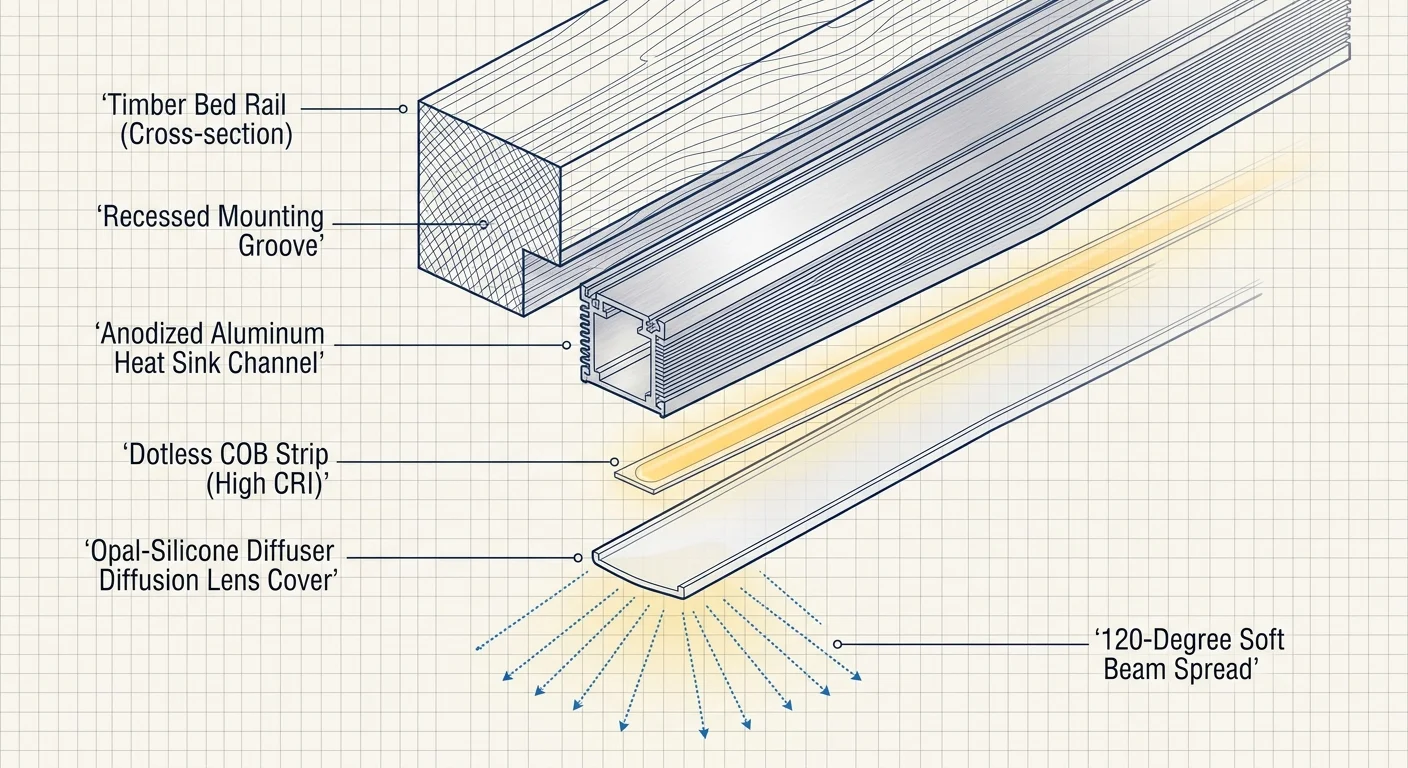
Diffused under-rail channels combine rigid structural aluminum housing, continuous linear light engines, and high-density polymer diffusers. Rather than projecting light outward from a single point, they emit continuous illumination along structural margins.
The core component of a modern low-glare installation is the Chip-on-Board (COB) smart LED strip. Traditional SMD strips place separate, visible LED chips every two or three inches along the ribbon.
Traditional diode spacing produces unmistakable “hotspot spotting” through plastic covers. In contrast, COB architecture packs 480 to 640 microscopic diode dies per meter directly beneath a uniform phosphor layer.
When you pair a COB strip with an extruded aluminum channel featuring a milky opal polycarbonate cover, individual light points disappear completely. The entire rail becomes a uniform, glowing surface emitter.
Mounting this linear assembly to the lower lip of a safety rail or the perimeter frame creates an indirect illumination path. Photons bounce off your wall or the underside of the bed frame before reaching your eyes.
Diffused under-rail channels deliver several clear photometric and architectural advantages for low-clearance spaces:
- Low Surface Luminance: By stretching 400 lumens across a six-foot channel instead of a two-inch disc, surface brightness drops from 3,500 nits down to an eye-safe 180 nits.
- True Indirect Bouncing: Angled 45-degree corner channels cast light upward against the ceiling plane or downward against the mattress, fully shielding your retinas from direct emitter lines.
- Integrated Thermal Management: The extruded 6063-T5 aluminum body pulls heat away from the diodes, preventing thermal degradation and extending smart controller lifespan.
- Clean Architectural Integration: Channel tracks fasten securely along structural steel or wood bed rails using countersunk screws or industrial magnetic backing tape.
Under-rail channels transform the structural perimeter of your bed frame into a broad, soft luminescence zone. The resulting wash eliminates harsh shadows while keeping direct glare out of your field of view.
Photometric and Physical Comparison: Pucks vs. Channels
Selecting the right fixture requires comparing verified physical attributes rather than vague aesthetic claims. In tight quarters, millimeter measurements and photometric values govern real-world usability.
The following table compares common low-clearance lighting setups measured at an 18-inch working distance to evaluate optical performance, glare potential, and deep-dimming capabilities.
| Lighting Architecture | Beam Angle & Dispersion | Surface Luminance (Nits at 100%) | Diode Spotting at 18 Inches | Usable Mattress Lux (18-In Distance) | Lowest Stable Dimming Level |
|---|---|---|---|---|---|
| Smart Micro-Puck (3-Inch Frosted Polycarbonate) | 60° to 90° Concentrated Cone | 3,200 Nits | Severe internal diode clustering visible through lens | 180 Lux (Center) / 12 Lux (Perimeter) | 8% to 10% (Drops abruptly to zero) |
| SMD 5050 Strip in Shallow Channel (60 LEDs/m) | 120° Wide Dispersion | 1,400 Nits | Noticeable dot pattern through standard frosted cover | 110 Lux (Uniform along linear axis) | 5% to 8% (Minor PWM steps) |
| COB Tunable White in 45° Corner Channel (512 LEDs/m) | 180° Continuous Indirect Wash | 190 Nits | Zero visible spotting; flawless solid line of light | 95 Lux (Even indirect distribution) | 1% (Continuous sub-lumen fade) |
| Edge-Lit Micro-Panel Surface Mount (6-Inch Disc) | 110° Diffuse Forward Field | 850 Nits | Smooth surface emission; moderate edge vignetting | 140 Lux (Broad circular field) | 5% (Firmware-dependent threshold) |
The quantitative data illustrates a stark contrast between architectures. The COB channel reduces peak surface brightness by over 94% compared to standard smart micro-pucks.
This dramatic reduction in nits prevents retinal blinding when you turn on your low ceiling smart lights in total darkness. Simultaneously, it maintains adequate lux across your bed for comfortable reading.
Worked Scenario: Lighting an 18-Inch Clearance Twin XL Loft
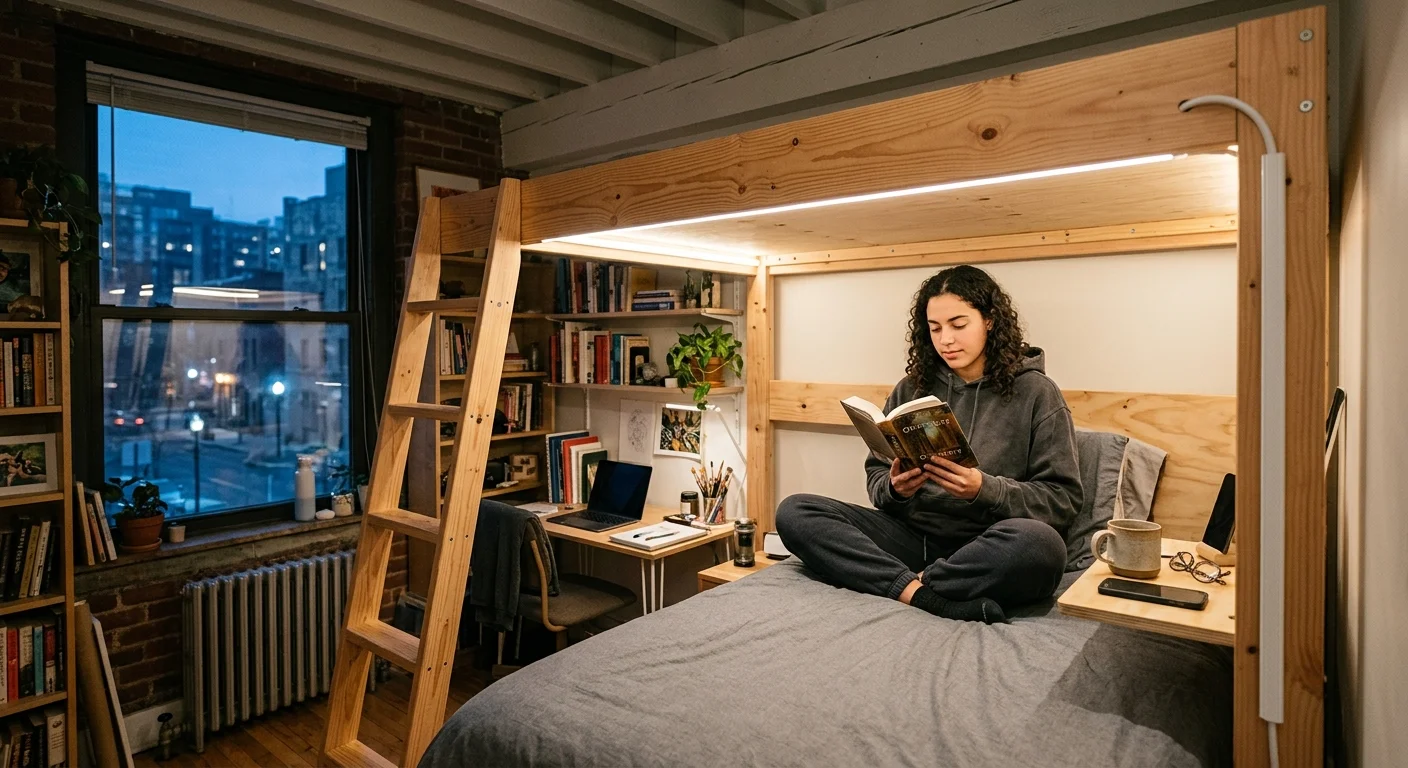
To understand how this hardware comes together, review this worked hardware installation for a studio apartment with an adult Twin XL loft bed. The distance from the mattress top to the drywall ceiling measures exactly 18 inches.
The sleeper requires sufficient illumination to read books without eyestrain, alongside automated, ultra-dim ambient lighting that allows safe exits at 3:00 AM without sleep disruption.
The structural layout utilizes a 75-inch safety rail along the outer edge of the frame. The component selection prioritizes precise low-end dimming and reliable smart ecosystem connectivity:
- LED Emitter: BTF-Lighting 24V Tunable White COB LED Strip (640 LEDs/meter, 2700K–6500K, CRI 92, 10 watts per meter). Cost: $34.00.
- Channel Housing: Muzata 45-degree V-Shape 16x16mm Aluminum Extrusion with milky white PC diffuser (Two 1-meter segments cut to 75 inches total). Cost: $26.00.
- Controller: Gledopto Zigbee Pro+ CCT Dual-White Dimmer Controller (PWM frequency 4 kHz). Cost: $29.00.
- Power Supply: Mean Well LRS-35-24 Enclosed 24V DC 1.5A Power Converter (36W Class 2 equivalent). Cost: $18.00.
- Cabling & Fasteners: 20 AWG 3-conductor silicone-insulated wire with black aluminum frame clips. Cost: $12.00.
The total hardware investment comes to $119.00. Installing this dedicated linear assembly requires approximately 75 minutes from unboxing to software integration.
Follow these progressive steps to complete the mechanical and electrical assembly safely:
- Cut Channels to Rail Length: Cut the two aluminum track pieces to match your bed rail length using a simple junior hacksaw with a fine-toothed metal blade.
- Deburr and Clean: Sand the cut edges with 220-grit sandpaper to remove sharp metal burrs that could slice through the silicone insulation of your LED tape.
- Mount the Channel Extrusion: Fasten the V-channel along the inner bottom edge of your side rail using the included countersunk hardware, directing the lens opening 45 degrees away from your eyes.
- Adhere the COB Ribbon: Wipe the interior aluminum channel floor with 70% isopropyl alcohol, let it dry, peel the adhesive backing, and press the COB strip firmly into place.
- Seat the Milky Diffuser: Align the opal polycarbonate cover with the channel grooves and click it into place from left to right along the entire 75-inch run.
- Wire to the Controller: Strip 1/4-inch of insulation from the 20 AWG lead wires, seat them into the spring-clamp terminals of your Zigbee controller, and connect the 24V power supply leads.
This completed setup generates a maximum of 750 lumens spread across 75 inches of rail. The resulting luminance sits at a comfortable 160 nits at full blast.
Dimmed to 1% inside your smart home dashboard, the strip emits a faint, uniform golden line generating barely 1.5 nits. That output provides effortless navigation without waking a sleeping partner.
Circadian Dimming Protocols and Ecosystem Integration
Hardware optics solve physical glare, but intelligent software controls your biological response to light. Lighting directly adjacent to your bed influences your circadian cycle and melatonin production.
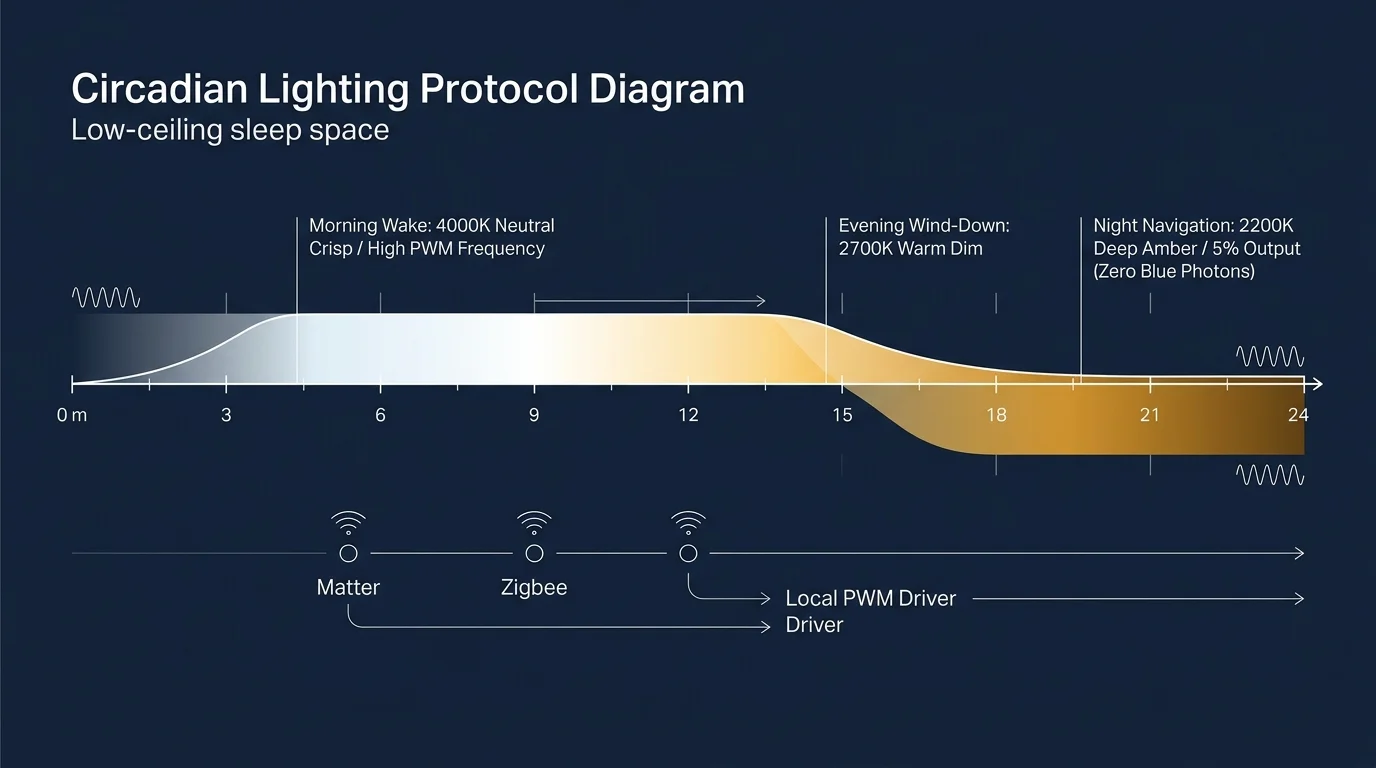
Adopting the Matter smart home standard or an established Zigbee mesh network allows you to link your low-voltage controller directly to platforms like Apple Home, Home Assistant, or Google Home.
To protect your natural circadian rhythm, automate color temperatures based on the position of the sun rather than leaving the strip at a static daylight setting. Strict temperature curves support healthy sleep routines.
Implement the following automated schedules within your preferred home automation hub:
- Morning Wake-Up Arc (06:45 AM): The strip powers on at a 1% brightness level at 2200K amber, gradually shifting to 4000K neutral white at 40% brightness over a 20-minute window.
- Focused Evening Reading (08:30 PM): A wireless button on the bedpost triggers 100% reading illumination set to 2700K warm white, casting 95 lux evenly across your book without harsh shadows.
- Wind-Down Phase (10:15 PM): Lighting drops down automatically to 10% brightness and shifts to an ultra-warm 2000K candlelit tone, signaling the brain to begin releasing natural melatonin.
- Midnight Path-Finder (11:30 PM – 06:00 AM): If an under-bed millimeter-wave motion sensor or smart floor pad detects movement, the channel activates at 1% warm amber for 90 seconds, illuminating the floor ladder without shining directly into your eyes.
Configuring these precise progressive shifts requires a controller that supports smooth, logarithmic dimming curves. Linear dimming feels abrupt at the bottom of the scale, causing unwanted sudden flashes when turning on.
Check the device specifications for transition times. Top-tier smart controllers allow you to set slow fade-in and fade-out durations up to five seconds, giving your pupils ample time to adjust naturally.
Low-Voltage Cable Routing, Heat Sinking, and Fire Safety
Low-clearance lofts place electrical hardware in direct proximity to wooden structures, cotton mattresses, pillows, and synthetic sheets. Fire safety and electrical neatness require strict adherence to low-voltage guidelines.
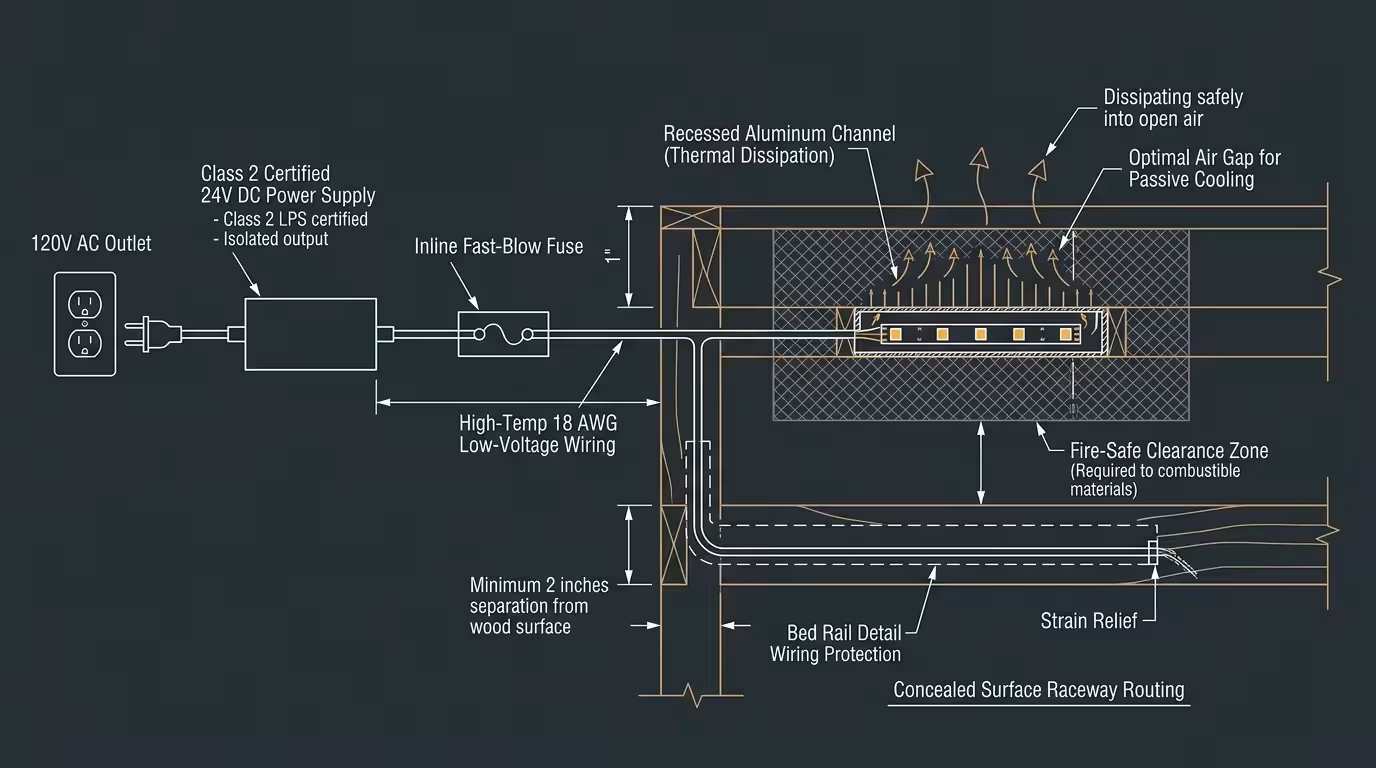
Never mount high-voltage 120V alternating current wiring on a bed frame. All components mounted directly to the rails should operate exclusively on safe 24V or 12V direct current.
Selecting 24V DC hardware over 12V hardware cuts operational amperage in half for an identical power draw. Lower amperage creates less heat across wire runs, significantly mitigating thermal wear on drivers.
Always power your lighting assembly with a certified Class 2 power supply. Class 2 units include internal fail-safes that automatically shut down power in the event of a dead short or electrical overload.
Apply these electrical safety protocols throughout your loft bed lighting build:
- Avoid Direct Combustible Contact: Never stick raw LED ribbon directly onto unfinished wood bed framing or directly against mattress fabric.
- Use Aluminum Extrusions for Heat Sinking: Mounting your strip inside an aluminum profile acts as a structural heat sink, keeping diode operating temperatures safely below 50 degrees Celsius.
- Secure Low-Voltage Leads: Fasten power feed wiring tightly along the loft bed legs using nylon zip ties or screw-down chassis clips to eliminate snag hazards when climbing up or down.
- Isolate the Power Brick: Anchor the power supply brick to the baseboard or wall near the floor outlet rather than keeping it under the mattress, ensuring adequate ventilation around the transformer casing.
For loft frameworks that require permanent in-wall conduit runs or dedicated wall switches, consult a licensed electrical contractor to ensure local building code compliance. Always verify that low-voltage connections remain mechanically secure and shielded from friction.
Frequently Asked Questions
Why are diffused channels better than puck lights for an 18-inch clearance bed?
Diffused channels spread light across a wide physical surface, reducing surface luminance to under 200 nits. Puck lights concentrate output into small lenses, creating intense glare hotspots that cause eye strain at close distances.
Can I install smart puck lights sideways to avoid direct eye glare?
Mounting puck lights sideways along vertical posts casts irregular, asymmetric shadows across the mattress. Diffused linear channels provide superior light distribution by washing the entire perimeter with low-contrast, indirect illumination.
What is the minimum clearance required between an LED strip and bed sheets?
Maintain at least two inches of air gap between bed linens and the channel diffuser. Fastening the strip inside an aluminum extrusion dissipates diode heat efficiently, keeping the housing well within safe residential operating temperatures.
What color temperature is best for loft bed reading before sleep?
Use a warm color temperature between 2200K and 2700K for late-night reading in tight quarters. Warm light contains minimal blue wavelength energy, preventing disruptive suppression of melatonin production before you sleep.
Disclaimer: This article is for informational purposes only. Smart home devices involve electrical connections and data privacy. Always follow manufacturer instructions for installation. For complex wiring or HVAC work, consult a licensed professional.

1 Comment